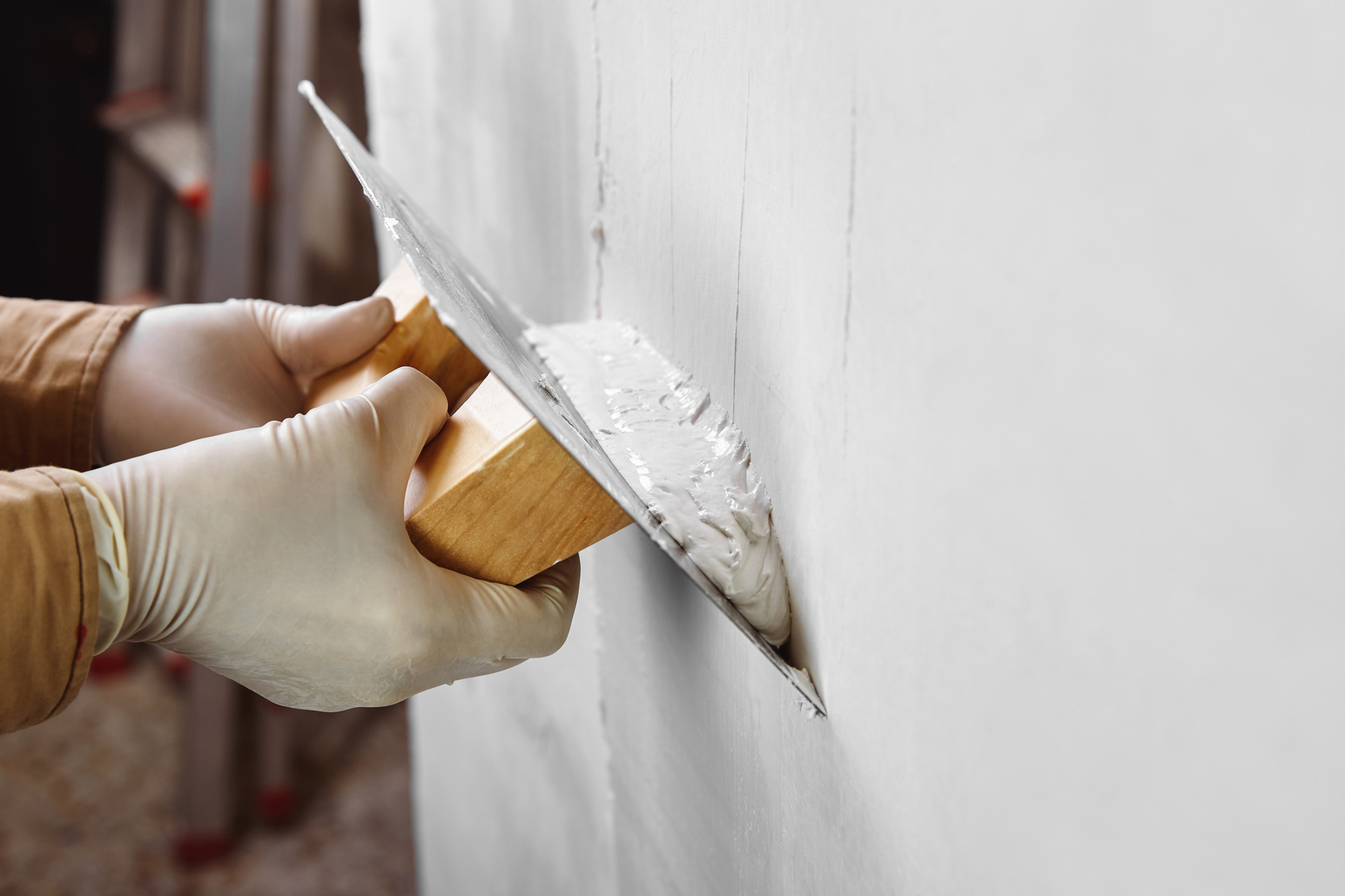
Plastering, Skimming & Dry Lining Bournemouth
Plastering and rendering, finished flat. Skimming, dry lining, traditional rendering and K Render for homes and commercial property across Bournemouth, Poole and Christchurch. Walls left straight, smooth and ready to decorate.
The site visit is free and so is the written itemised quote. Thomas Hannen prices every job himself.
Plastering
Plastering, Skimming, Dry Lining & Rendering in Bournemouth
A skim is a two to three millimetre finishing coat over a surface that is already sound. A re-plaster takes the old plaster off back to the brick or block and rebuilds the wall before the finish goes on. Which of those your wall needs is the biggest single difference between two plastering prices, and it is decided by tapping the wall for hollow patches rather than by looking at it.
Bournemouth Roofing & Building provide professional plastering services across Bournemouth, Poole, and Christchurch for homes and commercial properties. From smooth internal wall finishes to repairs, full room skimming, and external rendering our experienced team delivers high-quality, clean, and long-lasting results that improve the look and feel of any space.
The finish everyone sees, and the prep nobody does
A good plaster job is mostly what happens before the finish coat goes on: the wall prepared, the beads set true, and the backgrounds treated so the plaster grips.
We take on single rooms and whole houses, new builds and old properties, patch repairs after wiring or a new window, and full re-plasters where the original has blown. Ceilings and walls come out flat and straight, corners are beaded and sharp, and there is nothing left for the decorator to fill.
Outside, we render everything from a small patch around a new door opening to a complete elevation in silicone thin-coat. Same standard, different material.
Plenty of our work is over the border in Poole and along the coast, so if that is where you are, have a look at what we do for homeowners in Poole or for properties around Christchurch.
What we cover
Skimming, Dry Lining, Rendering & K Render
Inside and outside the same wall. Four finishes that cover almost every plastering and rendering job we get asked about.
Skimming
We provide professional skimming services for everything from single rooms to entire houses. Our expert finish leaves walls and ceilings smooth, level, and ready for painting or decorating.
Single rooms through to entire houses. A two-coat finish plaster over sound existing walls or new plasterboard, trowelled flat and polished up, ready for painting. Also ceiling repairs, patching after electrics and plumbing, and making good around new windows and door openings.
Dry Lining
We provide professional dry lining services for everything from single rooms to entire houses. Using quality materials and expert installation, we create smooth, durable walls and ceilings that are ready for plastering, skimming, or decorating.
Plasterboard fixed to timber or metal stud, or bonded onto solid walls on adhesive dabs. Joints taped and filled ready to decorate, or skimmed for a full plaster finish. Used for new stud walls, loft rooms, boxing in pipework and lining cold or uneven solid walls.
Rendering
We provide professional rendering services for properties of all sizes, from small repairs to complete property exteriors. Our expert workmanship delivers a clean, durable, and long-lasting finish that enhances the appearance of your property while helping to protect it from the elements.
Small repairs through to complete exteriors in traditional sand and cement, applied in coats with the mix matched to the background. Beads at every corner and reveal so the edges stay sharp. A clean, durable finish that protects the wall from the weather and takes masonry paint well.
K Render
We provide professional K Render services for a premium silicone based render for your property exterior. Our expert application ensures a modern, durable, and weather-resistant finish that improves the appearance of your property while offering long-lasting protection with minimal maintenance.
Silicone thin-coat render over a reinforced basecoat. The colour goes right through the topcoat, so there is nothing to paint afterwards and nothing to repaint later. Water repellent but still breathable, available in a range of colours and grain sizes, and low maintenance once it is on.
Internal finishes
Internal Plastering, Ceiling Repairs & Skimming in Bournemouth
Straight walls, sharp corners, no filler needed
Most of the internal work we do is skimming: a room that has been re-boarded, an old ceiling that has cracked, or walls that have been papered over so many times that the only sensible answer is to strip them and start again.
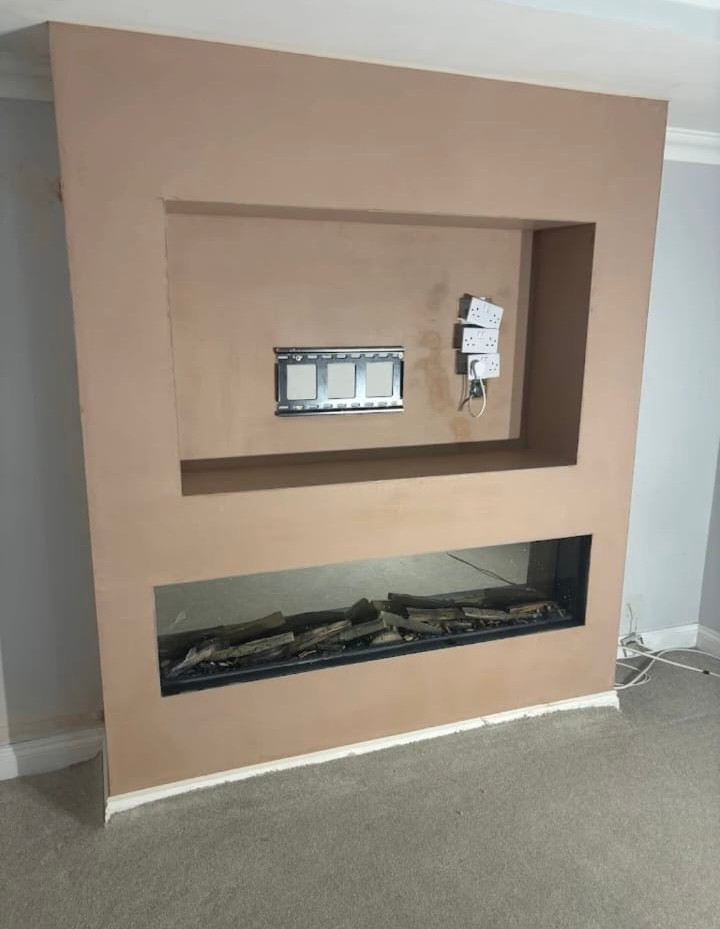
Feature walls, media walls, alcoves and fireplace openings are the ones where the prep shows. Getting an alcove square, a TV recess level and the edges beaded takes longer than the plastering itself, and it is the difference between a wall that looks built in and one that looks stuck on.
- Floors sheeted and furniture covered before anything is mixed
- Backgrounds treated so the plaster grips instead of blowing later
- Waste taken away and floors swept at the end of every day
Dry lining
Dry Lining & Plasterboarding in Bournemouth, Poole & Christchurch
Boarded, taped and filled, or boarded and skimmed
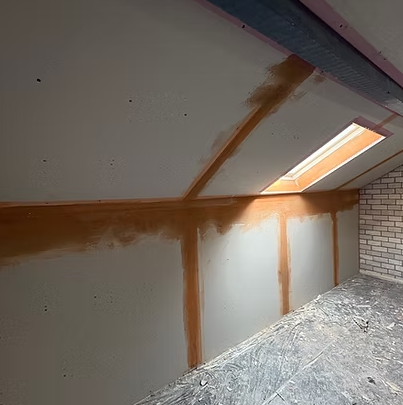
Dry lining is the quicker route to a finished wall. Boards go up on stud or on dabs, and from there you have two choices. Tape and fill leaves a decorator-ready surface with the joints and screw heads made good. A skim over the top gives you the solid, seamless plaster finish instead.
We use it most in loft conversions and new stud partitions, and on solid walls that are too uneven or too cold to plaster directly. Board thickness and type are chosen for the job: moisture resistant in bathrooms, fire rated where the building regulations call for it, and acoustic board where a wall backs onto a bedroom.
If the loft or wall is being lined anyway, it is usually the right moment to sort the insulation behind it.
Rendering
External Rendering: Sand & Cement and Silicone Thin-Coat
From bare blockwork to a finished wall
Render does two jobs. It keeps weather off the wall behind it, and it makes a mixed bag of blockwork, old brick and patched openings read as one clean elevation.
The work underneath is what decides how long it lasts. Beads set plumb at every corner and reveal, stop beads where the render finishes, a bell cast or drip at the bottom so water runs clear of the wall, and the right mix or basecoat for the background. Rush any of that and the cracks turn up in the first cold winter.
We render new extensions, garden and boundary walls, garages and full house elevations, in traditional sand and cement or silicone thin-coat. If the outside of the house is what brought you here, our page on external rendering is the fuller read: the systems, the crack and hollow-patch repairs, and the walls we would talk you out of rendering at all.
One regulation is worth knowing about before you re-render a whole elevation. Under the Building Regulations, renewing the finish on more than 50% of an external wall counts as renovating a thermal element, and Approved Document L then sets a target U-value of 0.30 W/(m²·K) for that wall, normally reached with an external insulation system finished in render. Whether it bites on your house depends on the wall and on what is technically and economically feasible, so we raise it at the survey and you confirm the position with building control. Planning is a separate question again, and the Planning Portal guidance on external walls sets out where it bites hardest, which is listed buildings and anything visible from the street in a conservation area.
If your house is up in the villages rather than in town, we render regularly for customers in Wimborne and around Ferndown and West Parley, and we are happy to come and measure up.
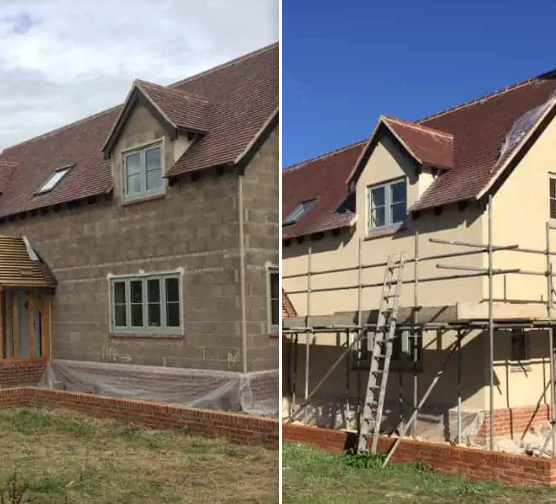
The same elevation before and after. Bare blockwork and open joints on the left, the finished cream render on the right, with the corners beaded and the base detailed so water runs off the wall rather than down it.
K Render
K Render & Silicone Thin-Coat Render in Dorset
Coloured through, so there is nothing to repaint
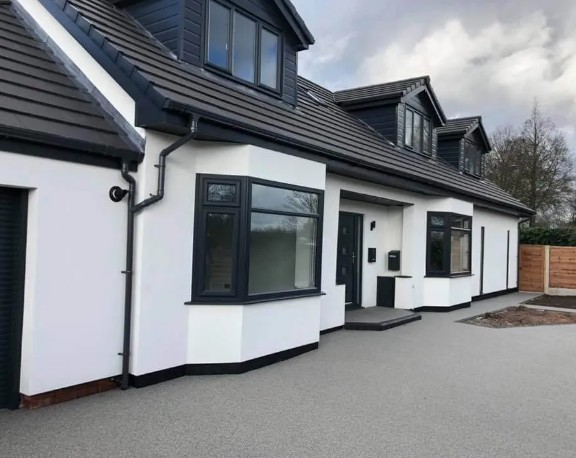
Silicone thin-coat render is built up in layers. A polymer basecoat goes onto the wall with a mesh set into it, which is what stops hairline cracks travelling. A primer follows, tinted to the topcoat colour, and then the coloured topcoat is applied and rubbed up to the grain size you have chosen.
Because the colour is in the material rather than painted on top, there is no maintenance cycle of repainting every few years. The finish sheds water but still lets the wall breathe, and it is far less prone to the green algae that traditional painted render collects on shaded elevations.
- Mesh-reinforced basecoat to control cracking
- Water repellent, breathable, and easy to wash down
- Range of colours and grain sizes, priced against traditional render on the same quote
What it costs
What Drives the Cost of Plastering and Rendering
Plastering is priced on preparation and access, not on the finish coat. The trowelling is the fast part. What decides the number is the state of the background, how much has to come off first, how many corners and reveals there are, and whether the room or the elevation can be worked in one go.
We quote after we have seen the wall, and we do not publish a rate per square metre, because a square metre of sound plasterboard and a square metre of blown Victorian lime plaster are not remotely the same job. These are the things that move the figure.
What moves the number
- The background. New plasterboard is the cheapest thing to skim. Sound old plaster is next. A wall that sounds hollow when it is tapped, or that has been painted over in something the plaster will not grip on, needs treating or taking off, and that is where two quotes separate.
- Skim or re-plaster. A skim is millimetres of finish. A re-plaster is a backing coat plus a finish coat, plus the removal and disposal of everything that came off first. It is a different job with a different price, and no amount of finish coat fixes a blown wall underneath.
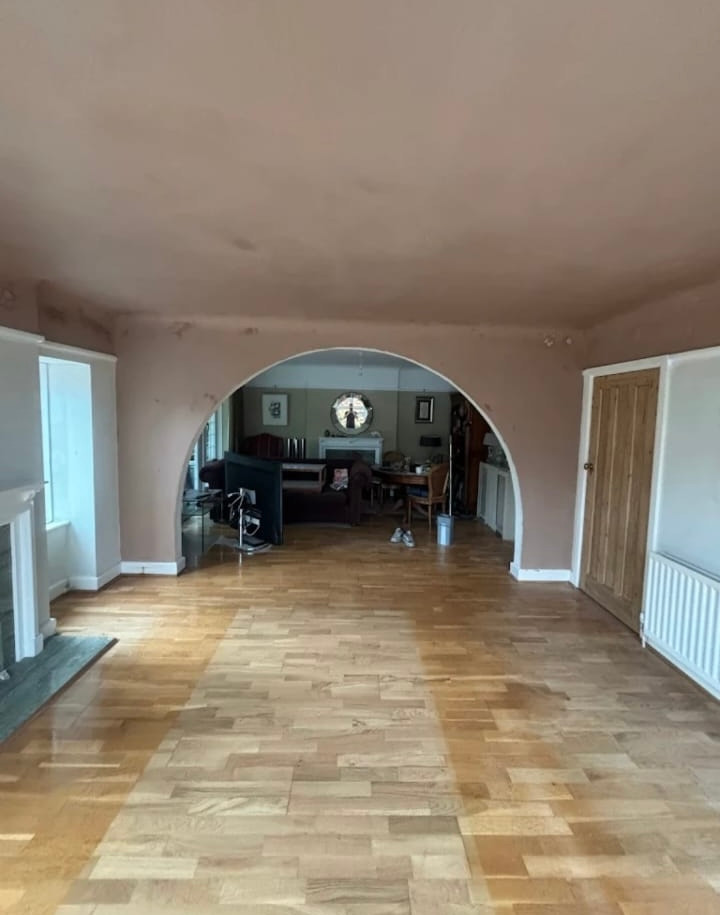
- Corners, reveals and openings. A plain rectangular room is quick. An alcove, a formed archway, a media wall recess, a bay window, a boxed-in soil pipe and every new window reveal all need beading, setting out and checking square, and that time is real.
- Ceilings. Ceilings take longer than walls for the same area, and an old lath-and-plaster ceiling that has to come down first is a different job again, with the mess and the disposal that go with it.
- Access and scaffold on rendering. A single-storey rear elevation off a tower and a two-storey gable needing a full scaffold are priced differently before a bag is mixed. As with roofing, how long the scaffold stands matters as much as its size.
- The render system. A silicone thin-coat system has more layers than sand and cement: a mesh-reinforced basecoat, a tinted primer, then the coloured topcoat. It normally costs more per square metre and it removes the repainting cycle. Both go on the same quote if you want to compare.
- What is already on the wall. Rendering over sound pebbledash is a dubbing-out job. Hacking failed pebbledash off and making the wall good first is a different price, and which one you have is settled by tapping the whole elevation before we quote, not halfway through.
- Whether Building Regulations come into it. Renewing the finish on more than 50% of an external wall counts as renovating a thermal element, and Approved Document L gives a target U-value of 0.30 W/(m²·K) for that wall. Where that applies, an external wall insulation build-up under the render changes the scope and the price considerably.
What we will ask you
Which rooms, and whether it is walls, ceilings or both. Whether the walls have been papered, artexed or painted, and whether anything sounds hollow. Whether wiring, plumbing or new windows are going in first, because plastering wants to follow those, not precede them. Whether the room can be cleared. For rendering: how many elevations, how many storeys, what is on the wall now, and where a scaffold could stand.
Why two plastering quotes differ
Usually because one is a skim and the other is a re-plaster, and only one of them has said so. After that it is the preparation: whether the background is being treated, whether beads are being fitted at every corner and reveal or only where they show, whether the old material is being taken away or left in your bin, and whether the price includes covering floors and furniture and sweeping up at the end of each day.
On render it is the build-up. Ask what goes on the wall before the topcoat, whether the basecoat is mesh-reinforced, whether beads are being used at the corners, reveals and stop ends, and whether there is a bell cast or drip at the bottom so water runs clear of the wall. Those details are invisible when the job is finished and they are the whole reason one render survives its first cold winter and another cracks.
| Render system | Sand and cement | Silicone thin-coat (K Render) |
|---|---|---|
| Build-up | Applied in coats, mix matched to the background | Mesh-reinforced basecoat, tinted primer, coloured topcoat |
| Colour | Painted after it has cured, in masonry paint | Coloured right through the topcoat, nothing to paint |
| Later upkeep | Repaint every few years to keep it looking right | Wash down. No repainting cycle |
| Small movement | Cracks more readily if the background moves | The mesh in the basecoat stops hairline cracks travelling |
| Drying and curing | Days between coats, two to four weeks before painting | Basecoat cures overnight or longer, topcoat touch dry within a day |
| Shaded elevations | Painted render collects green algae readily | Water repellent and breathable, far less prone to it |
| Cost per square metre | Lower to apply | Higher to apply, no repainting to budget for later |
Questions
Plastering & Rendering Bournemouth: Questions We Get Asked
How long before new plaster can be painted?
Wait until it has properly dried out. A skim over plasterboard is usually ready in four to seven days. A re-plastered solid wall, or anywhere the plaster has gone on thick, can take two to four weeks. Judge it by colour rather than by the calendar: the whole wall should be an even pale shade with no darker patches left in the corners or along the skirting. Then start with a mist coat, which is matt emulsion watered down roughly three parts paint to one part water. That soaks in and grips. Full-strength paint straight onto fresh plaster sits on the surface and peels off later.
What is the difference between a skim and a re-plaster?
A skim is a thin finishing coat, two or three millimetres, applied over a surface that is already sound: existing plaster in reasonable condition, or fresh plasterboard. A re-plaster means taking the old plaster off back to the brick or block and building the wall back up with a backing coat before the finish goes on. If your walls sound hollow when you tap them, are blown or cracked in patches, or are damp, a skim will not fix any of that and we will tell you so rather than covering it up.
Will you cover our floors and furniture?
Yes. Floors are sheeted, sockets and woodwork are masked, and anything staying in the room is moved to the middle and covered before a single bag is mixed. Plastering is wet work, so the more you can clear out beforehand the easier it is, but we do not expect you to empty the house. We take our waste away with us and leave the floors swept at the end of each day.
How does K Render compare on cost with traditional render?
A silicone thin-coat system such as K Render normally costs more per square metre than a traditional sand and cement render. There are more layers to it: the wall needs a basecoat with mesh reinforcement and a primer before the coloured topcoat goes on. Against that, the colour runs right through the topcoat so there is no painting now and no repainting every few years, and the thin-coat system copes better with small movement without cracking. We are happy to price both options on the same quote so you can compare them properly for your property.
Can you render over pebbledash?
Sometimes, but not always, and it depends entirely on what is under it. If the pebbledash is well stuck to the wall, sound all over and dry, it can be dubbed out and rendered over. If it is hollow, cracked, or coming away in patches, then hacking it off is the only sensible option and the wall underneath has to be made good first. We tap the whole elevation over before quoting so you know which one you are dealing with, rather than finding out halfway through the job.
How long does render take to dry?
Render cures rather than simply dries. A sand and cement render normally wants a few days between coats and around two to four weeks before it is painted, and it should be kept damp in hot weather so it does not go off too fast and crack. Silicone thin-coat systems go on in much thinner layers: the basecoat is usually left overnight or longer to cure before the topcoat, and the topcoat is touch dry within a day. Cold or wet weather slows everything down, and we will not apply render in frost or heavy rain.
Areas covered
Plastering & Rendering Across Bournemouth, Poole & Dorset
We serve these areas, and everywhere in between:
Plastering and rendering by location
Plastering and rendering in every town and village we cover
Each page is written from the ground, the housing stock and the planning position of that settlement, using Environment Agency, British Geological Survey, Valuation Office Agency and Census records. 84 pages covering 115 settlements.
Within 8 miles
8 to 14 miles
- Stone (also Sturminster Marshall)
- Furzehill
- Ashley Heath
- Beacon Hill
- Swanage
- Holt (also Chalbury Common, Gaunt's Common and more)
- Holton Heath
- Thorney Hill
- Three Legged Cross
- Lytchett Matravers
- Langton Matravers (also Worth Matravers, Harman's Cross)
- Barton on Sea
- Corfe Castle (also Studland)
- Sandford
- Ridge (also Stoborough)
- Ringwood
- New Milton
- Wareham
- Bashley
- Burley (also Burley Street)
- Verwood
- Hangersley (also Hightown)
- Ashley
- Milford on Sea
- Everton (also Hordle)
- Spetisbury (also Charlton Marshall)
- Alderholt
- Cranborne (also Whitmore)
14 to 20 miles
- Tarrant Monkton (also Pimperne)
- Hyde (also Frogham, North Gorley and more)
- Winterborne Kingston
- Lymington
- Brockenhurst
- Boldre (also Sandy Down, Tiptoe and more)
- Sandleheath
- Bere Regis
- Fordingbridge
- Blandford Forum
- Freshwater and Totland
- Walhampton and Portmore (also Pilley)
- Wool
- Norton
- Bryanston
- Yarmouth (also Bouldnor)
- Rockbourne (also Martin)
- Lyndhurst
- Sixpenny Handley
- West Lulworth (also Burngate)
- Breamore (also Woodgreen)
- Minstead
- Winterborne Stickland
- Winfrith Newburgh (also Briantspuddle)
- Milborne St Andrew (also Winterborne Whitechurch)
- Stourpaine (also Durweston, Ash)
- Tolpuddle
- East Boldre
- Cadnam and Bartley
- Lover
- Redlynch
- Downton
- Ashmore
- Woodlands
- Crossways
- Iwerne Minster (also Shroton)
- Owermoigne
Free quote
Free Plastering & Rendering Quotes in Bournemouth
Get a price for your plastering, with no obligation. Tell us the rooms or the elevation and we will come and measure up, then put a clear written quote in front of you.