Plastering and rendering in Barton on Sea
Render repairs on the weather side, blown plaster, ceilings, skimming and dry lining across Barton on Sea and BH25. Free visit, free written quote.
The site visit is free and so is the written itemised quote. Thomas Hannen prices every job himself.
In Barton on Sea the outside usually goes before the inside does. A mile from the sea, on the elevation taking the weather, render cracks, beads rust through the finish and damp arrives in the room behind. We look at the wall from both sides before we quote, because putting the inside right while the outside is still open is money wasted.
The calls fall into a few groups. Render crazed, hollow or stained down one elevation. A patch of plaster blown on an inside wall that backs onto that same elevation. A ceiling that is cracked or artexed and holding the room back. Or a flat where the hall and stairwell need making good and nobody is sure who arranges it.
We come out, sound the walls inside, look at the render outside, and give you a written itemised price. Barton on Sea is a short run for us, so getting a survey booked here is rarely the difficult part.
The work
Render fails at its edges long before the middle
Render repairs on the weather side. The single most common job in this village, with the coast barely a kilometre away and the exposed elevation facing south west. Sand and cement render on the postwar bungalows goes brittle, cracks, and then holds water behind itself instead of shedding it. We cut the failed area out rather than filling it, check whether the crack is movement or just the surface, and rebuild with a scratch coat and a mesh reinforced basecoat, then primer and topcoat. A silicone thin coat or monocouche system copes with repeated wetting far better than a rigid render does.
Render fails at its edges long before it fails in the middle. Corners, window reveals, the verge and the base of the wall are where we spend the time, and a bell cast bead at the bottom is what makes water drip clear instead of running down into the damp proof course. Rusting beads that have stained a corner are cut out and replaced, not painted over. When the render lets water through, the plaster on the inside is what tells you: it goes hollow, the paper lifts, and a tide line appears. The outside gets fixed first, the wall is allowed to dry, then the failed area is hacked off, backed in bonding or hardwall and skimmed. Replastering before the wall is dry gets you the same repair twice.
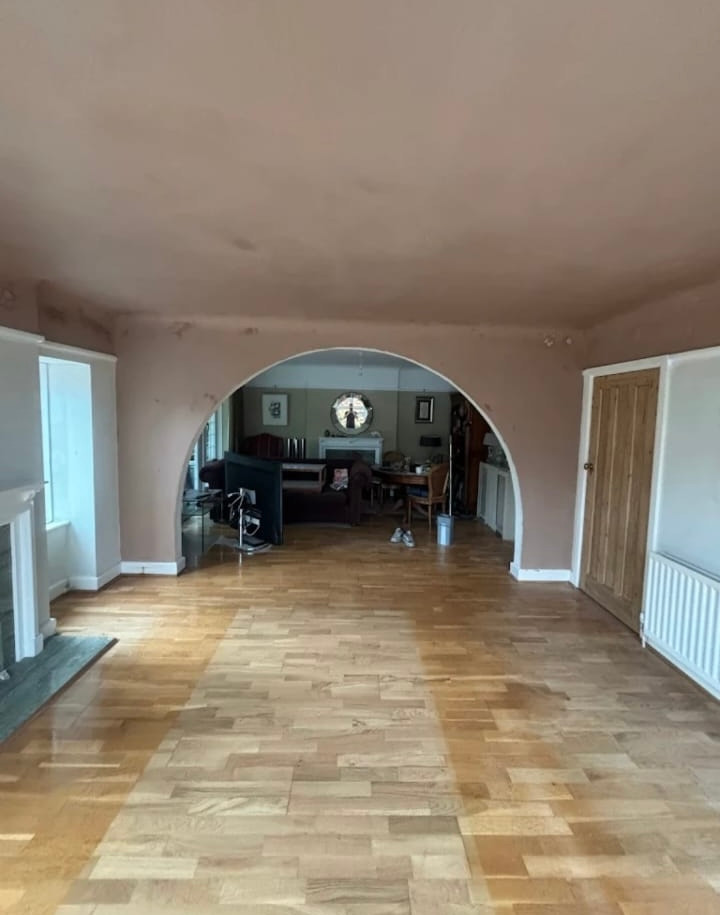
Flats, halls and stairwells. Flats are close to a fifth of the housing here and the work in them is different: everything comes up a communal stair, protection matters more, and the communal walls and ceilings are usually the freeholder's to instruct rather than yours. Inside your own front door it is ordinary work. Bungalows are over forty per cent of the village, so most ceilings sit straight under the loft and crack along the board joints. Sound artex is prepared, primed and skimmed flat, heavy or loose artex is overboarded and the new board skimmed, and nothing textured gets sanded because artex from before the 2000s can contain asbestos.
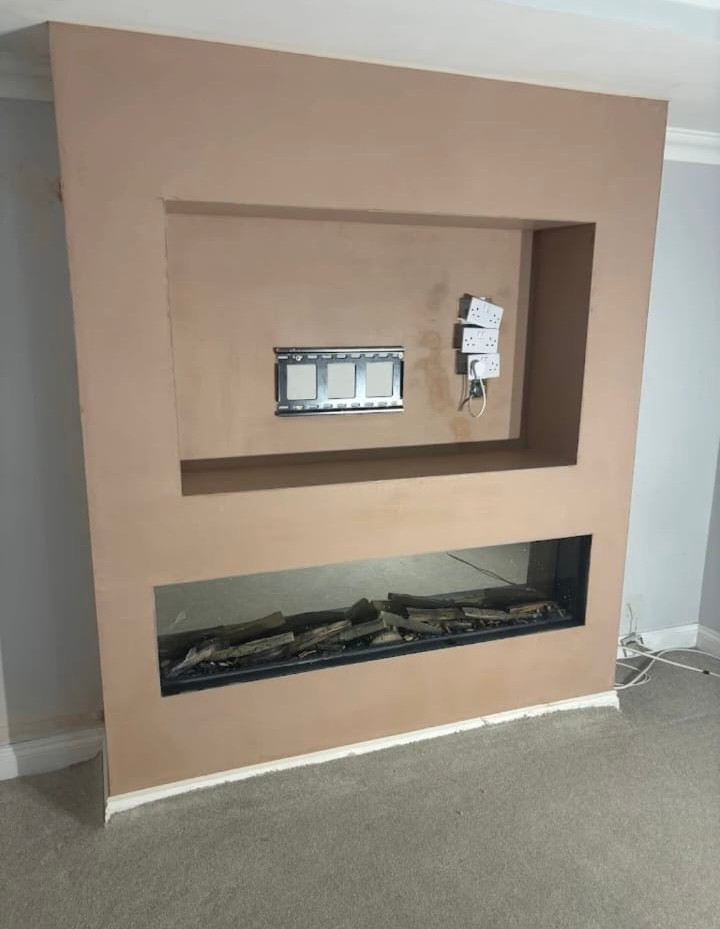
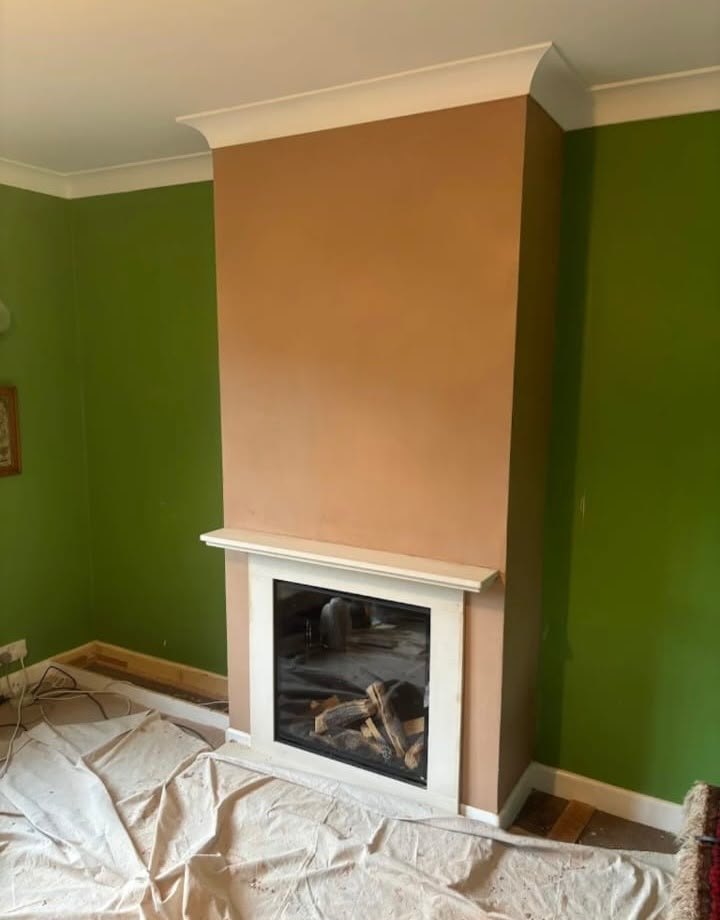
Extensions and conversions are plasterboard on dot and dab or on a stud, moisture resistant board behind a shower, angle bead on the corners and stop bead at the reveals. On a wall that has had damp through it we will often recommend dry lining on battens rather than wet plaster, so the new surface is not sitting on the wall that got wet. The rest is making good: chases after a rewire, reveals after new windows, the wall behind a removed fireplace.
How it runs
From your call to a written price
The site visit costs nothing, and we survey every wall and ceiling in the room rather than the patch you rang about. The quote is itemised: protection, whatever comes off, boarding, backing coat, finish coat, beads, making good and disposal on separate lines, and the old plaster and board leave with us. Everything inside is a repair. Outside, re-rendering a whole elevation counts as renovating a thermal element and the wall has to reach Approved Document L, while Planning Portal guidance on external walls covers when a change of finish needs an application. Barton on Sea has no conservation area and two listed entries, so for nearly every address the finish is your choice.
Cost
What decides the price
No rate per square metre, because the square metres are the easiest thing to measure and the least useful thing to know. What answers solid under a knuckle gets a skim, what drums comes off back to the background, and that split moves the price further than the size of the room. A clifftop flat where every bag comes up a communal stair, a bungalow with a side gate wide enough for a barrow, and a house that has been extended twice are three different jobs before anything is mixed. Ask any quote whether beads and mesh are in and who takes the waste away.
If it has come down
A ceiling sagging, or plaster blown off a wall
Ring rather than use the form. A ceiling pulling away from the joists, or plaster coming off a wall in sheets, goes to the front of the queue, because the next piece follows within days. If it is wet, find where the water is coming from before anyone replasters. We are close enough to Barton on Sea to get someone out the same day or the next.
Worth knowing
Salt air decides the render specification here
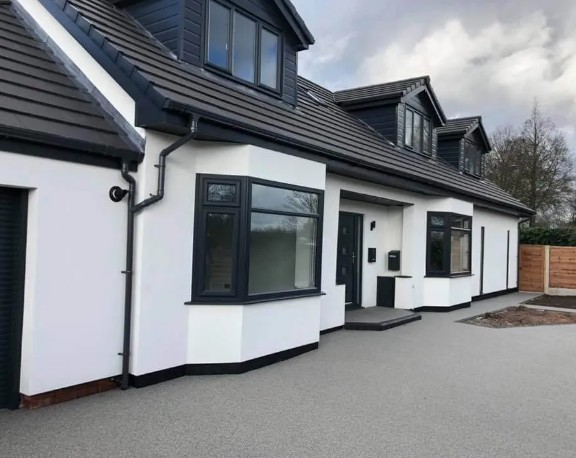
At a mile from the sea, the wall facing the weather here is not doing the same job as the one on the sheltered side of the same house. Salt-laden air keeps a surface damp between showers rather than letting it dry properly, and salt is hard on metal.
That is why the corners on a seaward elevation stain and blister first: ordinary galvanised beads corrode, the rust pushes the render off the edge, and a brown line bleeds through however many times the wall is painted. Stainless steel beads cost more per length and they are the difference between a corner that lasts and one you redo. Ask any quote which beads are in it.
The same logic runs through the rest of the specification on that elevation. A rigid sand and cement render is strong but it has almost no give, so it cracks, and every crack on a weather side is a way in for water that then cannot get back out. A mesh reinforced basecoat with a silicone topcoat moves a little, sheds water and stays breathable enough to dry.
It is worth spending the money on the elevation that takes the weather and being sensible on the sheltered sides, rather than spreading the same budget thinly over the whole house. If someone quotes you one specification for all four walls without asking which way the house faces, they have not looked at it properly.
Who you are dealing with
A local firm you can check
We cover Barton on Sea and BH25, out through New Milton to Milford on Sea, Everton and Highcliffe, and New Forest District Council is the planning and building control authority here. Bournemouth Roofing & Building Ltd, registered in England and Wales, company number 15471719, which you can look up in a minute. Thomas Hannen's business, and he is the one who comes out to price the job, not a salesman. A verified customer's 10 out of 10 on Checkatrade. The visit and the written quote are both free.
Questions
Barton on Sea questions we get asked
Why do the render beads rust through on this coast?
Because Barton on Sea is 1.2km from the water and salt gets into everything metal. Salt draws moisture, so the wall never dries fully between showers, and corrosion starts at a cut edge or a fixing head and works inwards. A steel bead behind a thin top coat swells as it rusts and pushes the render off in a straight line. Stainless or plastic beads and stainless fixings are the answer.
Why do black spots appear along our bungalow ceiling edge?
That perimeter is the coldest surface in the room, and in a bungalow it always will be. With 42.0% of Barton on Sea built single storey, every ceiling has a cold loft directly above it, and where insulation thins out at the eaves warm damp air condenses on the plaster. Replastering hides it for a season and it returns. Sort the insulation and the ventilation first, then decorate.
What do you look at before pricing a re-render here?
The edges first. Beads, verges, window and door reveals and the bottom two courses, because at 1.2km from the sea that is where failure begins. Then I tap across the elevation for hollow areas, check whether the render has been painted with something that traps moisture, and look at where the rainwater goods discharge. The south west face gets measured properly. Sheltered sides often need nothing at all.
What did the 1960s builders plaster onto in Barton?
Blockwork with a browning coat on it, in most cases. Over half the town, 53.4%, was built between 1945 and 1982, and the late fifties and early sixties alone account for 25.1%, so that construction is the local default. Ceilings are plasterboard fixed with nails, which lift over time and telegraph through the paint. We fix the boards back to the joists properly before anything is skimmed.
Is midwinter a bad time to render on the clifftop?
It is the hardest time. The exposed elevation faces south west into the weather, and at 1.2km from the sea a wall can be rewetted before a coat has cured. Silicone systems need a dry, frost free window to go off properly, and a rushed top coat in January shows up as patchy colour by spring. We watch the forecast and open only what we can finish.
Nearby, and next door
Plastering and rendering near Barton on Sea
Plastering and rendering nearby
Our other trades in Barton on Sea
Everything we do in New Milton Plastering and rendering, all areas Every area we cover
Free quote
Get a price for plastering in Barton on Sea
Tell us the address and which wall is giving trouble. We will come out, look at it inside and out, and put an itemised price in writing.