
Plastering in Milford on Sea
Render repairs at the corners and beads, skimming, ceilings and salt-damp walls across Milford on Sea and SO41, priced in writing.
The site visit is free and so is the written itemised quote. Thomas Hannen prices every job himself.
Last updated
Plaster this close to the water at Milford on Sea has a harder life than it does inland. Salt in old walls keeps a patch damp and blooming through fresh paint, and outside the corners and openings go first, because the steel beads behind the render have rusted and pushed it off. Both are repairable faults, and it is worth knowing that before somebody quotes you for a whole room or a whole elevation.
Walls in Milford on Sea give trouble through seaward render, damp on outside walls, and the ordinary run of cracked ceilings and flats to skim. Render that has cracked or blown on the seaward side of the house, often in a line down an external corner. Damp showing inside on an outside wall, with paint lifting and salts blooming through it. Or the ordinary work: a ceiling that has cracked or sagged, or a flat that wants skimming through before it is let or sold.
The survey is a knuckle on every wall and ceiling inside, and outside a look at the elevation from a tower, not the pavement, because corner damage does not read from the ground. You get a written price that separates the repair from the full strip out. The site visit and the quote are free and we are about ten and a half miles along the coast.
The work
Salt air gets to the bead buried in the corner
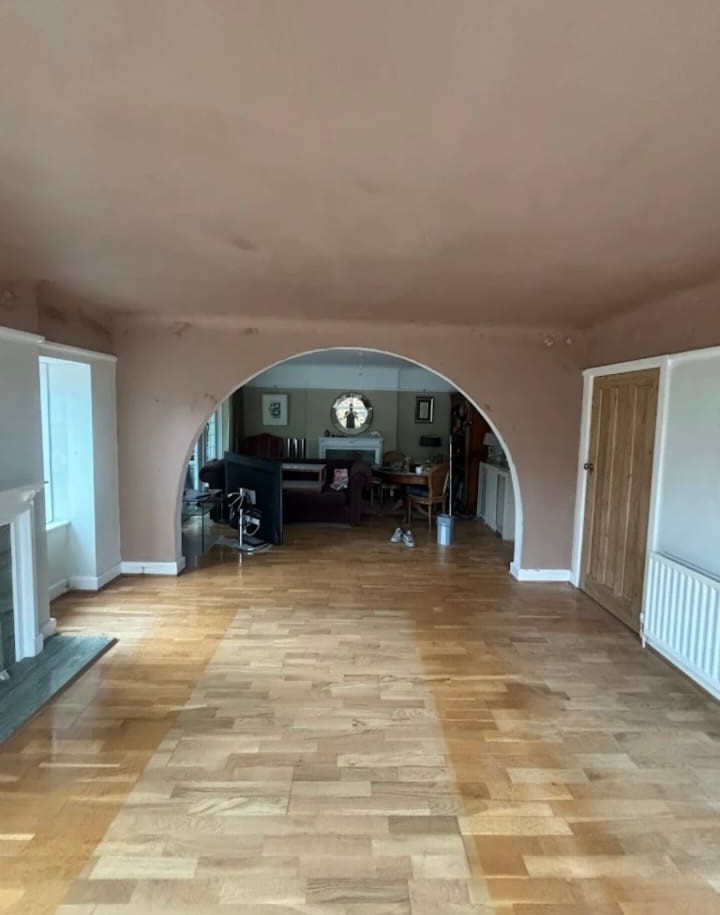
Salt gets to the bead buried in the corner. Galvanised angle bead and stop bead were standard for decades, and less than a kilometre from the water the coating gives up and the steel rusts.
Rust takes up more room than steel does, so it lifts the render off the corner in a strip, usually down an external angle or around a window reveal. The repair is to cut the render back beyond the damage, take the old bead out completely, never render over it, fit stainless mesh bead, and rebuild the corner in a basecoat with mesh before the topcoat.
The exposed side of nearly every house here faces south west, into wind-driven rain off the water. A rigid sand and cement render on that elevation cracks and holds water in the wall. Where it has to come off completely, a scratch coat, a mesh-reinforced basecoat, a primer and a silicone topcoat sheds water at the surface and still lets the wall dry. For the outside walls, see rendering in Milford on Sea.
A quarter of the homes in Milford on Sea are flats, so a good share of this work belongs to a freeholder or a management company, not to whoever can see the crack. We quote those itemised by elevation, with the scaffold and its standing time on its own line so it can be split fairly between leaseholders. Where leaseholders are being recharged for a major job, section 20 of the Landlord and Tenant Act 1985 sets out the consultation the landlord has to run before the work starts, and an itemised quote is what that process needs. Inside a block it is stairwell ceilings, hallway walls and making good after a leak from the flat above.
Salt earns its reputation on the inside face too. Old render and old masonry near the sea hold hygroscopic salts, and salts pull water out of the air long after the wall has dried, so the patch stays cold and blooms back through fresh paint. Find the water path first, then use a renovating backing coat that holds the salts back, or on a solid wall a breathable lime plaster. Sealing the wall up with a waterproof coating and hoping does not work.
Over half the town went up between the war and the early eighties: a block inner leaf, a float coat and a gypsum finish usually still stuck, so walls that knock solid take two passes of finish coat and walls that drum come off and take a new backing coat. About one house in nine predates 1919, solid wall construction where lime and a breathable render are the right repair, not a matter of taste, and twenty-eight entries in Milford on Sea are listed. Extensions and loft rooms at the other end are dry lining, taped, beaded at every corner and reveal, then skimmed.
How it runs
Plastering in a seaside house or flat
Thomas taps the walls and ceilings to find the blown plaster and prices the work himself. Separate lines cover protection, stripping old plaster, new plasterboard where it is needed, the backing coat, the skim, and disposal.
In a flat, parking, access and use of the lift are sorted with the managing agent before we arrive. Floors and stairs are sheeted, doorways sealed, and old plaster leaves in bags rather than sitting in a shared hallway. Should we uncover a damp wall, a rotten lath or a badly run cable, that part stops until you have seen it and have a price. Drying time is planned in, because a skim on a wet wall fails, and near the sea walls dry more slowly.
Across most of Milford, on an unlisted house, render colour and system are your choice, and renewing an elevation in similar material is maintenance; Planning Portal guidance on external walls shows where that stops. The Milford-on-Sea Conservation Area in the centre of Milford on Sea is where a change of finish deserves a word with New Forest District Council first, and a listed building needs consent for any change of plaster or render. Stripping a whole elevation is when Approved Document L asks whether the wall should be insulated while it is bare.
Cost
Blown plaster, salts and access in the price
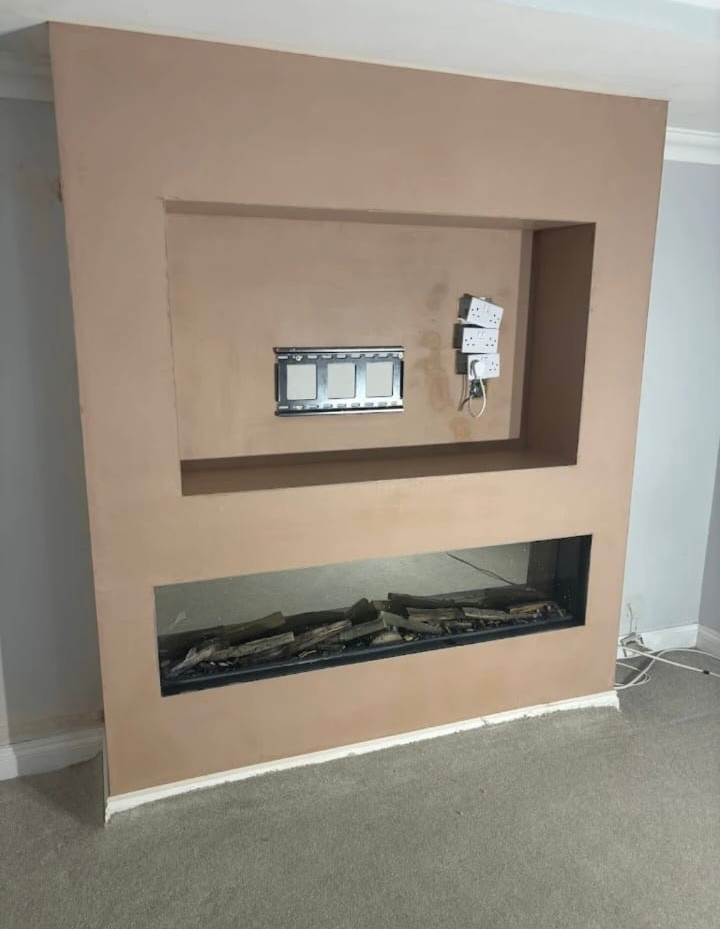
Plastering is not priced by the square metre, because the wall behind the finish is what decides it. Skim or replaster. A sound wall needs only a skim. Blown plaster comes off back to the masonry, and a backing coat goes on before the skim, which is far more work.
Salts from old damp. In older houses near the sea, salts left behind by past damp push through a new finish as a white bloom. They need dealing with, usually with a salt-resistant backing coat, or they come straight back.
Access. A bungalow on one of the roads behind the front, where a tower reaches every wall, is simple. A flat where the managing agent sets the hours, or a house near the cliff where scaffold must be braced against the wind, is not.
Ceilings. A cracked lath and plaster ceiling is often taken down and replaced with plasterboard, then skimmed, which means more waste and time.
Drying. Walls that have been wet have to dry out before plastering, and that has its own line.
Ask anyone quoting: a skim, or a full replaster? Are the salts being treated? How long before a mist coat?
If it has come down
Plaster falling, or a ceiling sagging
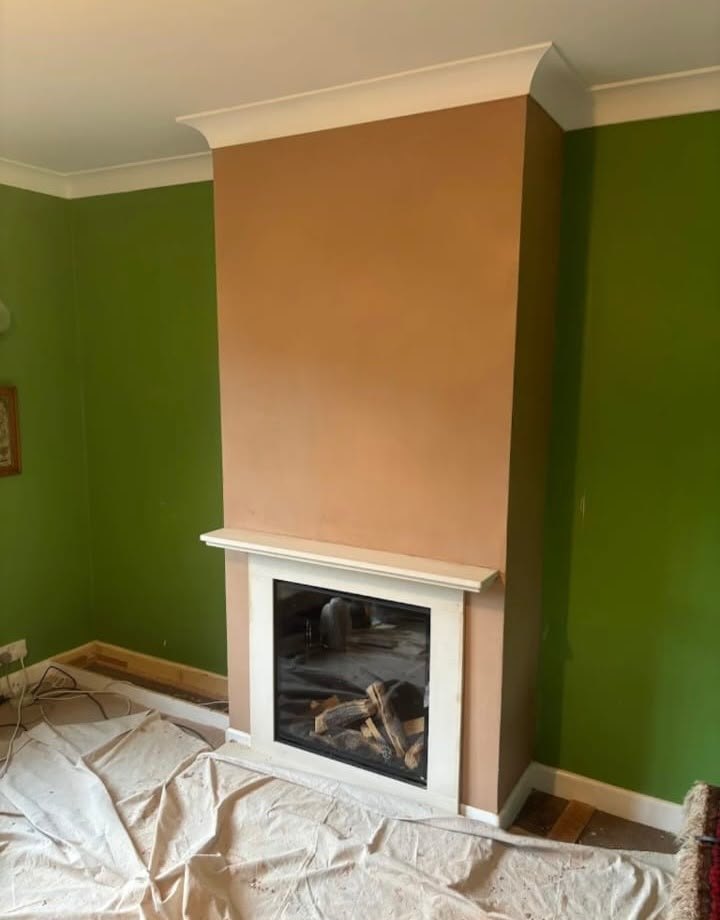
Pick up the phone rather than using the form. A ceiling that has cracked and dropped, or plaster coming away in sheets, needs seeing quickly. Keep everyone out of the room, and switch off lights on that circuit if water is near a fitting.
The first visit makes it safe and traces the water. After a blow, check external corners and window reveals from the ground for a lifted edge before rain gets behind the render. Plastering is booked Monday to Friday, 8am to 6pm. If you get no reply, a call back will follow as soon as we can.
Worth knowing
Salt gets at the steel beads in the corners first
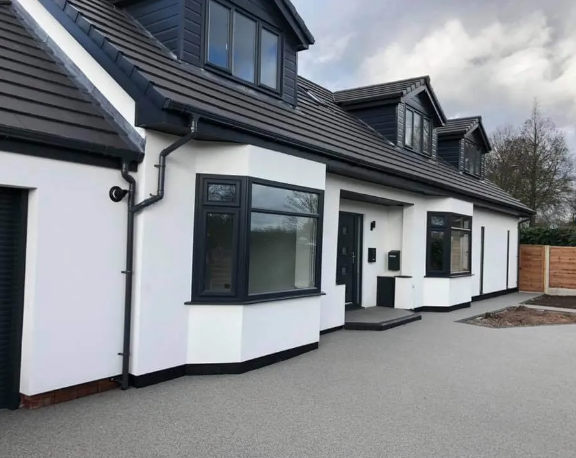
Milford on Sea sits close enough to the water that salt is on the walls every day of the year, and it changes the metal in a plastered or rendered corner more than the mix. Almost every rendered corner in the town has a steel angle bead buried a few millimetres under the surface.
Galvanising slows corrosion down but salt gets through it, and when that steel rusts it expands and pushes the render off in a strip along the corner. That is why so much render in Milford on Sea looks perfect across the flat and is failing down every external angle and around the window reveals.
First, on a Milford on Sea wall, the old bead has to come out, not be covered over, because covering rust simply moves the problem along a year, and what replaces it should be stainless or a mesh bead with no steel in it.
Second, the wall wants to be able to dry: a mesh-reinforced basecoat with a silicone topcoat keeps driven rain out at the surface while still letting moisture back through, where a waterproof masonry coating over a salt-laden wall traps it and pushes the damp inside instead. The seaward elevation also ages faster than the sheltered side of the same house, so it is worth walking round and looking at the corners every couple of years.
Who you are dealing with
The plasterers coming into your home
From Boscombe to Milford on Sea is 10.3 miles. We plaster across the village, Everton, Hordle and this stretch of the coast, where planning and building control sit with New Forest District Council. The firm is Bournemouth Roofing & Building Ltd, registered in England and Wales, company number 15471719. Before you book a visit in Milford on Sea, you can read our customers' Google reviews, word for word, on our reviews page.
Thomas Hannen owns it and comes into your house to look and price the work himself. A verified customer left us 10 out of 10 on Checkatrade. The site visit and the itemised written quote are free of charge.
Planning at a glance
Do you need planning permission in Milford on Sea?
Most repairs in Milford on Sea need no application at all. What decides whether a change to the outside of your house does is who the council is, whether a conservation area or a listing applies, and whether the place sits in a protected landscape.
| Question | In Milford on Sea |
|---|---|
| Who decides | New Forest District Council is the planning authority for Milford on Sea. The National Park boundary runs close by, and the Park's property map shows which side an address falls. |
| Conservation area | Yes: Milford-on-Sea Conservation Area. Check whether your street is inside the boundary before changing anything visible. |
| Listed buildings | Yes, there are listed buildings in and around Milford on Sea. If yours is one, work can need listed building consent. |
| Protected landscape | No National Park or National Landscape covers Milford on Sea. |
Questions
Questions about plastering in Milford on Sea
We are seven hundred metres from the sea. Does that change render?
Being seven hundred metres from the sea changes both the render specification and the maintenance. At under a kilometre from the water the walls in Milford on Sea take salt carried in on the wind, which keeps a surface damp between showers and eats any metal in it, beads, lintel ends and fixings alike.
So we use stainless beads and a silicone topcoat that sheds, not soaks. The seaward elevation then wants rinsing down every year or two, which is the part most people skip.
Ours is a flat in a block. Who signs off render?
The freeholder or the managing agent, not you. A quarter of the homes in Milford on Sea are flats, and in a block the external walls are held in common, so a leaseholder cannot instruct render on their own elevation. Ask the agent to request the quote. We can price the whole building or a single elevation of it, and they can then put that in front of the leaseholders properly.
Do we need consent for a cottage near the church?
Only where the cottage itself is listed, or attached to something that is, or where it sits in the Milford-on-Sea Conservation Area over the village centre, where a change of finish on the front is worth checking. Twenty eight listed entries sit in Milford on Sea, the Church of All Saints among them. Outside those, the housing is unconstrained. New Forest District Council is the planning authority here rather than the National Park. They will confirm the status of an address over the phone.
Why is only the south west wall breaking up?
Because that is the wall taking the weather off the water. The exposed elevation faces south west, so it collects the driven rain and the salt while the sheltered sides stay comparatively dry, and render on that face crazes and lifts years earlier. There is no sense in stripping four walls when one has failed. So we price elevations separately, and you do the face that has gone and leave the others until they need it.
Is winter a bad time for outside work here?
Winter is when the seaward elevation is hardest to work on, because render needs a dry background going on and a run of days without driven rain afterwards. This close to the water that window is short between November and March. Internal work carries on regardless. Where the render has opened and water is getting in, we can cut out and make the damage safe now, then do the full elevation in spring.
Nearby, and next door
Plastering near Milford on Sea
Nearby places we also cover for plastering, with straight-line distances from Milford on Sea, and the other trades we offer in Milford on Sea itself.
Plastering nearby
Our other trades in Milford on Sea
Plastering and rendering guides
Silicone, cement or lime: which render? Cracked render: which cracks matter Hollow-sounding wall: blown plaster or dot and dabEverything we do in Lymington Plastering, all areas Every area we cover
Free quote
Get your Milford on Sea walls and ceilings looked at properly
A free site visit, the corners and reveals checked from a tower rather than the pavement, and an itemised written quote.