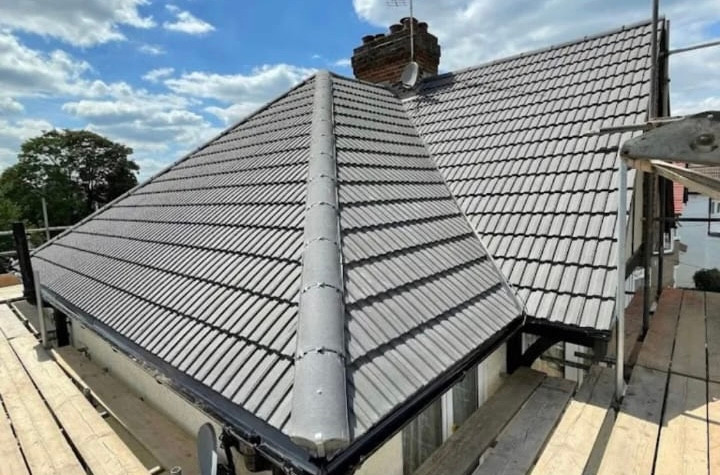
Roof cleaning and moss removal in Bournemouth
Moss scraped out of the laps by hand, the roof washed at low pressure, a moss treatment used to the label and the gutters cleared. Done by roofers, so whatever the moss was hiding is found and shown to you.
The site visit is free and so is the written itemised quote. Thomas Hannen prices every job himself.
Last updated
Roof cleaning in Bournemouth
Roof Cleaning and Moss Removal in Bournemouth, by Roofers
We clean a roof in Bournemouth by scraping the moss out of the laps by hand, washing the tiles down at low pressure and then treating them with a moss killer used to its label. We never blast a roof with a pressure washer. High pressure takes the face off concrete tiles and drives water up under the laps, which undoes the point of the job.
Bournemouth Roofing & Building Ltd is a roofing firm based in Boscombe. That matters on a roof clean, because a slipped tile, a cracked ridge or a blocked valley gets spotted and shown to you, not washed over. Thomas Hannen prices every job himself, and the site visit and written quote cost you nothing.
You might be here because moss drops into the gutter every time it rains, because the house is going on the market, or because somebody knocked and offered to clean and coat the roof that afternoon. Whichever it is, the quickest start is a photo of the roof from the garden and one of the gutter. Moss on a drive, patio or path is a different job, covered on our exterior cleaning page.
- Moss scraped out of the laps by hand before any water goes on
- Low pressure softwash, set by the covering and not by the machine
- A moss treatment used to its label, on a dry day
- Gutters and downpipes protected during the work, then cleared and run through
Why bother
Is Roof Cleaning Worth It?
Roof cleaning is worth it when moss is thick in the laps, lifting the tiles above it or dropping into the gutters, because that is when it holds water on the roof and blocks the rainwater run. A thin green film, or lichen on an old clay roof, is mostly cosmetic. If leaving it is the better call, we will tell you.
When moss is doing harm
Moss is a sponge. A tile that should dry out between showers stays wet under it, and in a cold snap that water freezes in the face of a concrete tile and opens it up a little more each winter. Thick moss in the laps lifts the tail of the tile above and holds water exactly where the lap is meant to shed it, so wind driven rain can track up on to the underlay.
The bigger nuisance is where it ends up. Every storm knocks clumps into the gutter, the valley and the top of the downpipe. Once those block, water overflows down the wall or backs up at the eaves, and you get damp inside long before the roof itself has given up.
When it can wait
A light green film, or the flat grey and yellow rosettes of lichen on an old clay roof, is doing very little on its own. Lichen grows slowly and holds far less water than moss. Scraping it off soft handmade clay or old slate can do more harm than leaving it, and we will say so.
Selling or buying a house
A buyer's survey may mention moss on the roof or in the gutters. That note is a prompt to look, not a verdict on the roof. What a buyer wants to know is whether the tiles, ridges and valleys under the moss are sound, so a clean that comes with a written note of anything we found is more use to a sale than a clean on its own.
The signs worth acting on are visible from the garden: moss proud in the laps, clumps in the gutter, green streaks under an overflow. Our post on roof checks you can do from the ground before winter goes through them without a ladder.
Method
What Is the Best Way to Remove Moss From a Roof?
The best way to remove moss from a roof is to scrape it out by hand, wash the roof down at low pressure, and finish with a moss treatment that kills what is left in the surface of the tile. Pressure washing is quicker but damages concrete tiles and forces water under the laps. Steam is gentler than a jet wash, but it still puts water on the roof.
Hand scraping
The bulk of the moss comes out first, by hand, with scrapers and stiff brushes drawn down the slope with the laps so nothing is levered against a tile edge. It is the slow part of the day and the part that matters. We work from the ridge down, so what comes off drops into a protected gutter and not back across clean tiles.
Pressure washing
A pressure washer is quick and looks impressive. On concrete tiles it strips the coloured surface and the sand face, leaving a rougher, more porous tile that greens up faster than before. It drives water under the laps, cracks brittle tiles and knocks mortar out of ridges and verges. We do not pressure wash roofs. It belongs on a concrete drive.
Softwash
Low pressure, roughly what comes out of a garden hose, with a cleaning solution doing the work that force would otherwise do. After the scrape the roof is washed down gently to lift what is left and rinse off the loose debris, and the tile surface stays where it is. With a moss treatment on top, the result lasts longer.
Steam cleaning
Some firms offer steam: hot water at a lower pressure than a jet wash. The heat kills growth on contact and it is kinder to a tile than a pressure washer. It still puts water on the roof, though, and it will not lift thick moss out of a lap by itself, so the scraping still has to be done. On soft old clay, fibre cement or slates hanging on tired nails, any water under pressure is a risk. If a quote offers steam, ask what pressure it runs at and whether the moss comes out by hand first.
If one quote is far cheaper than another, ask what pressure is going on the roof. Our guide to what a roofing quote should include covers the rest.
The covering
How the Method Changes With Concrete Tiles, Clay, Slate and the Rest
The covering decides the method before the moss does. Concrete tiles take a firm scrape and a softwash. Clay and old slate get a lighter hand and more reliance on the treatment. Fibre cement is handled with care, and felt or rubber flat roofs are brushed, never scraped.
Concrete Interlocking and Plain Tiles
Moss takes to concrete readily, because the surface is porous. It takes a firm scrape and a softwash well, but not pressure: the coloured surface wears thin with age and a lance finishes it off.
Clay Plain Tiles and Pantiles
Moss grips clay less, but an old handmade tile can have a soft face that flakes if worked hard, and pantile rolls pack with moss along the lap. So clay gets a lighter hand and more reliance on the treatment. The differences are in our post on concrete against clay roof tiles.
Natural Slate
Moss lives in the joints and along the tails, not on the smooth face. A slate whose nail has rusted through slides out the moment a scraper catches it. Slate is never walked on: it is worked from a roof ladder, the joints cleared lightly, and any slate that moves is noted and refixed properly.
Fibre Cement Slates
Thin, brittle and coated, so they crack under a knee and the coating comes off under a scraper. Older fibre cement slates, made before asbestos was taken out of the product, may contain it. Those are not scraped or washed at all. If we think that is what you have, we stop and tell you.
Flat Roofs, Felt and Rubber
Moss on a garage or extension roof usually means water is sitting where it should not. It is brushed off and rinsed, never scraped, because a scraper takes the chippings off felt and cuts a rubber membrane. The standing water is the real fault, and falls and coverings are on our flat roofing page.
Ridges, Verges and Valleys
Moss roots into cracked ridge bedding, and scraping it hard pulls the mortar out, so ridges and verges are worked gently. Valleys collect the most debris and are cleared first.
Treatment
What Does the Moss Treatment Do, and What Does the Label Say?
The moss treatment kills the root threads and spores left in the surface of the tile after the scrape and wash, and it carries on working for months as the rain washes the dead growth away. That is why a roof that is cleaned and treated stays clear noticeably longer than one that is only washed.
These are pesticide products and they are regulated. HSE runs the biocides regime the HSE administers for products that control algae and similar growth, and its COPR requirements page notes that control of moss falls under the plant protection rules instead. Either way, the product must be authorised for the use and it comes with a label.
Using a product in line with its label is a legal requirement, not a preference. The label sets which surfaces it may go on, the dilution, the protective kit, the weather it can be used in, and how far it must be kept from ponds, watercourses and drains. We use products authorised for the purpose and apply them to the label, which means no mixing it stronger to make it work faster.
So ask anyone treating your roof what the product is called, whether it is authorised for a roof, and what the label says about ponds and pets. A contractor who cannot tell you what they are spraying is not the right contractor.
Timing
When Is the Best Time of Year to Clean a Roof?
The best time to clean a roof is a settled, dry spell, and moss killer goes on when the roof is dry and the forecast stays dry for a while after. Late spring to early autumn gives the most of those days. Scraping can be done for much of the year, just not in frost, strong wind or rain.
Moss killer and the weather
A treatment washed off by a shower an hour later has been wasted. It wants a dry surface to go on and dry weather after, so it soaks into the tile and does its work before the rain comes. The label sets the conditions it may be used in, so the treatment day can move with the forecast. If it does, we tell you, and the scrape and wash can still go ahead.
Why a late summer or early autumn scrape makes sense
The moss in your laps ends up in the gutter with the first big storms. Having the roof scraped and the gutters cleared before the leaves drop means the rainwater run goes into winter clear. If your gutters also fill with pine needles, that timing matters twice. Our post on autumn gutter clearing and when to do it has more on the timing.
When nobody should be up there
No roof work goes ahead in frost, high wind or heavy rain. A wet, mossy roof is the most slippery surface on the house, and frozen tiles crack under a roof ladder. If the weather turns on the day, we stop and come back.
Gutters and downpipes
What Happens to the Gutters and Downpipes During a Roof Clean?
Yes, the gutters are part of a roof clean. Downpipes are plugged before the scraping starts, valleys are cleared first, and at the end every gutter is scooped out, flushed and run through so you know the water reaches the drain. Everything that comes off a roof goes into the gutter or over the edge, so the gutters are dealt with from the start.
Before. The top of each downpipe is plugged so moss cannot wash into the underground drain, where it is far harder to shift and can block a gully. On a long run we scoop out as we go so the gutter never spills over.
After. Every gutter is scooped out by hand and flushed, then water is run from the far end of each length to prove it reaches the outlet and leaves at the bottom of the downpipe. Hoppers and gullies are checked, and the debris is bagged and leaves with us.
If a joint drips, a bracket has pulled away or a run holds water, you are shown it and it goes on a separate price. Clearing the rainwater run on its own is on our gutter cleaning page, and replacing boards and gutters that are past it is on our fascias, soffits and guttering page.
Around the house
Does Moss Removal Make a Mess? Plants, Ponds and Run-Off
Moss removal makes some mess, and dealing with it is part of our job. Moss and grit come off the roof into the gutters and over the edge, so planting, ponds, conservatory roofs and paths are protected before we start and swept and rinsed before we leave. The washings are kept out of surface water drains.
- Planting. Beds under the eaves are wetted down first so they take up clean water, sheeted where they are delicate, and rinsed after.
- Ponds and water butts. Ponds are covered and kept clear of spray, and water butts disconnected. Tell us about fish, vegetable beds or anything else sensitive before the day.
- Conservatories and cars. Conservatory roofs and rooflights below the work are sheeted, and cars are best moved off the drive.
- Pets, children and paths. Kept off treated surfaces until dry, after which they are fine to walk on. Paths are swept and rinsed before we leave.
The run-off matters as much as the planting. Washings full of moss, grit and treatment should not go down a surface water drain, because those run to a stream or the sea and not to a treatment works. The pollution prevention guidance on GOV.UK is the reference, and it is why we look at where the downpipes and gullies go before we start. Near Poole Harbour, Christchurch Harbour or the Stour and Avon, it is a fair question to put to anyone quoting.
What turns up
What If Cleaning the Roof Shows Up Repair Work?
If cleaning shows up a repair, we stop, photograph it, show you and price it in writing before anything extra is touched. Moss hides things: tiles cracked for years and held in place by the moss, ridge bedding washed out, verge mortar missing, a worn valley, a lifted chimney flashing, slates slipping on rusted nails. A gentle clean does not cause any of that. It was there underneath.
A slipped tile can often be refixed while we are up there once you have agreed the price. A ridge that wants rebedding or a valley that wants relining is its own job on our roofing services side, done to BS 5534, the code of practice for slating and tiling. This is the difference a roofer makes to a roof clean: the person scraping the moss knows what a failing ridge looks like.
Sometimes a roof is past cleaning: tiles flaking apart, underlay perished, battens soft. Then we say so and quote for what it needs. We will not sell you a clean that makes a failing roof look better for a year.
Coatings
Is a Roof Coating Worth It After a Clean?
A roof coating after a clean is sometimes worth it for the look, on a roof of sound concrete tiles. It is not a repair, it wears and needs redoing, and it is not for clay or slate.
A roof coating is a paint or sealer sprayed on to concrete tiles after a clean, to bring back the colour and slow down how quickly water and growth get into the surface.
The case for. Faded, patchy concrete tiles come back to one even colour, and a smoother surface can slow the moss for a while. If the look matters to you, a sound concrete roof coated properly can be a reasonable thing to spend on.
The case against. A coating fixes nothing. A cracked tile or a loose ridge is still there, now painted over. Coatings wear, so a coated roof is committed to recoating. Put on badly, a coating can fill the gaps at the laps that let a tiled roof drain and dry. And sound tiles do not need it: BRE's testing of sixty year old roof tiles found the great majority still met the strength standard and all of them passed the water test. Coatings are not for clay, handmade tiles or slate, and because they change how a roof looks, a listed building or conservation area can need consent first. Planning Portal guidance on roofs is the place to start.
Where we land. On sound tiles a clean and a treatment is usually enough, and the money is better spent on the ridge, the valleys or the gutters. If you want a coating for the colour, we will tell you plainly whether your roof suits one and that it is cosmetic. We will not sell it as a repair. Be wary of anyone who knocks, calls the roof dangerous and offers to clean and coat it that afternoon; see what to do when someone knocks and says your roof is dangerous.
Access and safety
How Do You Get Up There Without Standing on the Tiles?
We work from a tower or scaffold at the eaves and from roof ladders hooked over the ridge, which spread the weight across the roof. Clay, slate and fibre cement are never walked on. Concrete tiles can take careful footing along the nail line, and anything fragile, such as an old plastic rooflight, is boarded over or kept clear of.
Roof cleaning is work at height every time, and the work at height hierarchy: avoid, prevent, mitigate sets the order of thinking: what can be done without going up, then the right platform to stop a fall, and only then kit that limits one.
A bungalow can often be done from a mobile tower and a roof ladder hooked over the ridge. A two storey house usually wants a tower or scaffold along the eaves as a working platform and edge protection. A steep or tall roof, or one over a conservatory, wants scaffold. HSE rules on roofwork are why that is a priced line on the quote and not something improvised on the day, and HSE's scaffolding guidance covers who puts it up and inspects it.
How it runs
What Happens on the Day of a Roof Clean?
Most roofs are a day's work. A large or steep one takes longer, and you will know which before we start. Protection goes down first, the moss comes off from the ridge down, the roof is washed and treated, and the gutters are cleared and proved before we leave.
- The visit. Thomas looks at the covering, the access and what sits below the eaves, then writes an itemised quote.
- Protection first. Downpipes plugged, planting, ponds and conservatory covered before a scraper goes on the roof.
- Clean and treat. Scraped from the ridge down, softwashed, gutters cleared and downpipes run through, then treated on a settled day.
- Anything extra. Photographed and priced before it is touched, and only done once you say yes.
- The finish. Paths swept and rinsed, waste taken away. One person to ring from start to finish.
What it costs
How Much Does Roof Cleaning Cost in Bournemouth?
There is no fixed price for roof cleaning, because access and the amount of moss that has to come off by hand decide most of the cost, not the size of the roof. A small, steep, heavily mossed roof with nowhere to stand a tower can cost more than a large open one, so there is no rate by the square metre here.
- Access. A tower and roof ladder, or scaffold along the eaves. Height, a conservatory underneath or a tight side passage all move this.
- The moss. A thin film washes off. Moss packed thick in every lap is hours of hand scraping.
- The covering. Slate, clay and fibre cement take longer than concrete, because they are worked more gently from ladders and boards.
- Pitch and shape. Valleys, hips, dormers and a steep pitch all slow the work.
- What is included. Protection, the treatment and the gutters. All three belong in a proper roof clean, and a quote that leaves them out is a different job.
When you compare two quotes, ask what pressure is going on the roof, what the treatment is and whether it goes on to the label, whether the downpipes are being proved, how the planting and drains are protected, and what happens if a cracked tile turns up. The cheaper one is often a pressure washer and nothing else.
The quickest way to a real figure is a photo of the roof and the gutter. Thomas then visits free and puts a written itemised quote in front of you. How that works is on how we price a job.
Before it gets worse
If Moss Is Already Blocking the Gutters
Moss is not an emergency, but a blocked gutter in a wet spell can become one. If water is pouring over the gutter or coming in at the eaves, ring us and do not wait on the form.
Scheduled work Mon to Fri, 8am to 6pm. Something urgent? Ring, and if we miss you we call back. Please do not go up a ladder with a hose or a pressure washer in the meantime. Take a photo of the roof and the gutter from the garden instead: it tells us most of what we need before the visit.
Bournemouth
Pine Trees, Protected Trees and Clay Roofs in Bournemouth
In Bournemouth the thing that most changes a roof clean is the trees. A roof in the shade of pines stays damp and greens up faster, and the needles pack valleys and gutters. So on a shaded roof the valleys and gutters come first, and how soon the moss returns depends on the trees more than on the clean.
The pines
BCP Council's appraisal of the Meyrick Park and Talbot Woods Conservation Area says the conifers there come from original planted Scots, Maritime and Corsican Pine, and that many garden pines were there before the houses were built among them. You cannot clean the shade away. If your roof sits under pines, plan on the gutters and valleys being cleared more often than the roof itself, and on a treatment doing more of the work.
You may not be allowed to cut the tree back
BCP Council's guidance on trees in conservation areas says a tree is protected if its stem is more than 7.5cm across, measured 1.5m above the ground, and that you must give the council six weeks' written notice before working on it. A tree under a Tree Preservation Order needs the council's consent first, and the Meyrick Park and Talbot Woods appraisal says there are few roads in that conservation area not covered by TPOs. If you want a tree lifted or thinned to let light on to the roof, lodge the notice well before booking the clean. We do not touch the tree; that is a job for a tree surgeon.
Clay plain tiles on the older houses
The appraisal also describes the Edwardian houses there as roofed in clay plain tiles. Old clay gets the lighter hand described above and more reliance on the treatment, and a coating is wrong for it. If your road is in one of the council's conservation areas, a change to how the roof looks can need consent, so check before agreeing to anything sprayed on.
If you live in a flat
Bournemouth has a great many blocks of flats. If you own one on a lease, the roof is usually the freeholder's or the management company's to look after, so raise moss or blocked gutters with your managing agent. Where the cost to any one flat goes over the limit in the consultation regulations, the landlord must consult leaseholders first under section 20 of the Landlord and Tenant Act 1985. We quote freeholders and agents the same way as anyone else: a free site visit and a written itemised quote. More on our landlords and letting agents page.
Questions
Roof Cleaning Questions and Answers
How much does roof cleaning cost in Bournemouth?
It depends on the roof, so there is no fixed price. Access, how much moss has to be scraped out by hand, the covering, the pitch and height, and whether the treatment and gutters are included decide it. Send a photo of the roof and gutter, and Thomas visits for free and gives you a written itemised quote.
How often does a roof need cleaning, and how long before the moss comes back?
It depends on the roof, not a calendar. A north facing roof under trees greens up far faster than an open south facing one, and the moss will come back in time because the spores are in the air. A treatment after a clean stretches the gap out. When moss is proud in the laps or dropping into the gutters, it is time again.
What time of year is best for roof cleaning and moss killer?
A settled, dry spell, which late spring to early autumn gives most of. Moss killer needs a dry roof and dry weather after, so the treatment day can move with the forecast. A scrape before autumn means the gutters go into winter clear. Nobody should be on a roof in frost, wind or rain.
Can I clean my roof myself?
You can clear a gutter you reach safely, but think hard before going on the roof. The real risk is the fall, so read the HSE guidance on ladders first. Never walk on slate, clay or fibre cement, never jet wash, and use only a moss killer authorised for the use, applied to its label.
Will pressure washing or steam cleaning damage my roof?
Pressure washing can, which is why we do not do it. It strips the surface off concrete tiles, drives water under the laps and knocks mortar out of ridges. Steam runs at lower pressure and is kinder, but it still puts water on the roof and does not shift thick moss by itself. We scrape by hand and softwash at low pressure.
Do you clear the gutters, and will it make a mess?
Yes. Downpipes are plugged before we start so moss cannot reach the underground drain, and afterwards every gutter is scooped out, flushed and run through. Planting, ponds and conservatory roofs are covered, the debris is bagged and leaves with us, and paths are swept and rinsed before we go.
Areas covered
Roof Cleaning Across Bournemouth and the Towns Around It
We clean roofs right across Bournemouth, from Westbourne and Talbot Woods to Winton, Kinson, Moordown, Boscombe, Pokesdown and Southbourne, and out into Poole, Christchurch and the towns beyond. The method is the same everywhere. What changes is the covering, the trees and the access.
The three nearest towns have their own pages: roof cleaning in Poole, roof cleaning in Christchurch and roof cleaning in Ringwood, each looking at the roofs you find in that town.
- Bournemouth
- Boscombe
- Southbourne
- Westbourne
- Kinson
- Moordown
- Poole
- Christchurch
- Broadstone
- West Moors
- Ferndown
- Highcliffe
- Corfe Mullen
- Wimborne
- Swanage
- New Milton
- Ringwood
- Wareham
- Verwood
- Blandford Forum
- Lymington
The nearest trades to this one: walls, render and driveways on our exterior cleaning page, blocked runs and downpipes on our gutter cleaning page, tiles, ridges, valleys and flashings on our roofing services page, and the boards and gutters at the eaves on our fascias, soffits and guttering page. Walls, render and drives in the two biggest towns are on exterior cleaning in Bournemouth and exterior cleaning in Poole.
Bournemouth Roofing & Building Ltd is registered in England and Wales, company number 15471719, and works from 80a Wolverton Road, Boscombe. Thomas Hannen prices every job himself, and the Checkatrade review on the profile is a verified 10 out of 10.
Free quote
Find Out What Is Under the Moss Before You Pay to Clean It
Send a photograph of the roof from the garden, and one of the gutter if moss is dropping into it. Thomas comes out, looks at the covering, the access and what sits below the eaves, and puts a written itemised price in front of you.