Exterior cleaning in Poole
Roof, render, balcony, gutter and paving cleaning across Poole town and BH15, for houses, landlords and blocks of flats alike.
The site visit is free and so is the written itemised quote. Thomas Hannen prices every job himself.
Last updated
Exterior cleaning in Poole town starts with whether the surface is actually yours. Around a third of the homes here are flats, and the outside of a flat belongs to the freeholder, not to you. We will tell you on the visit which parts you can instruct and which have to go through the managing agent.
Cleaning in Poole town tends to fall into three situations. A house off the High Street where the roof or the render has gone green and the owner wants it looking right. A leaseholder in a block who has looked out at a filthy balcony and a stained wall for two years and cannot get anyone to act. And a landlord or an agent with a date coming, an inspection, a viewing or a change of tenant.
The work itself is straightforward. What is not always straightforward here is who pays and who signs. We are 6.7 miles away in Boscombe, we come and look at the whole property, and you get a written price for each surface with a plain note of anything we think you cannot authorise on your own.
The work
Quayside blocks, High Street terraces and everything the gulls use
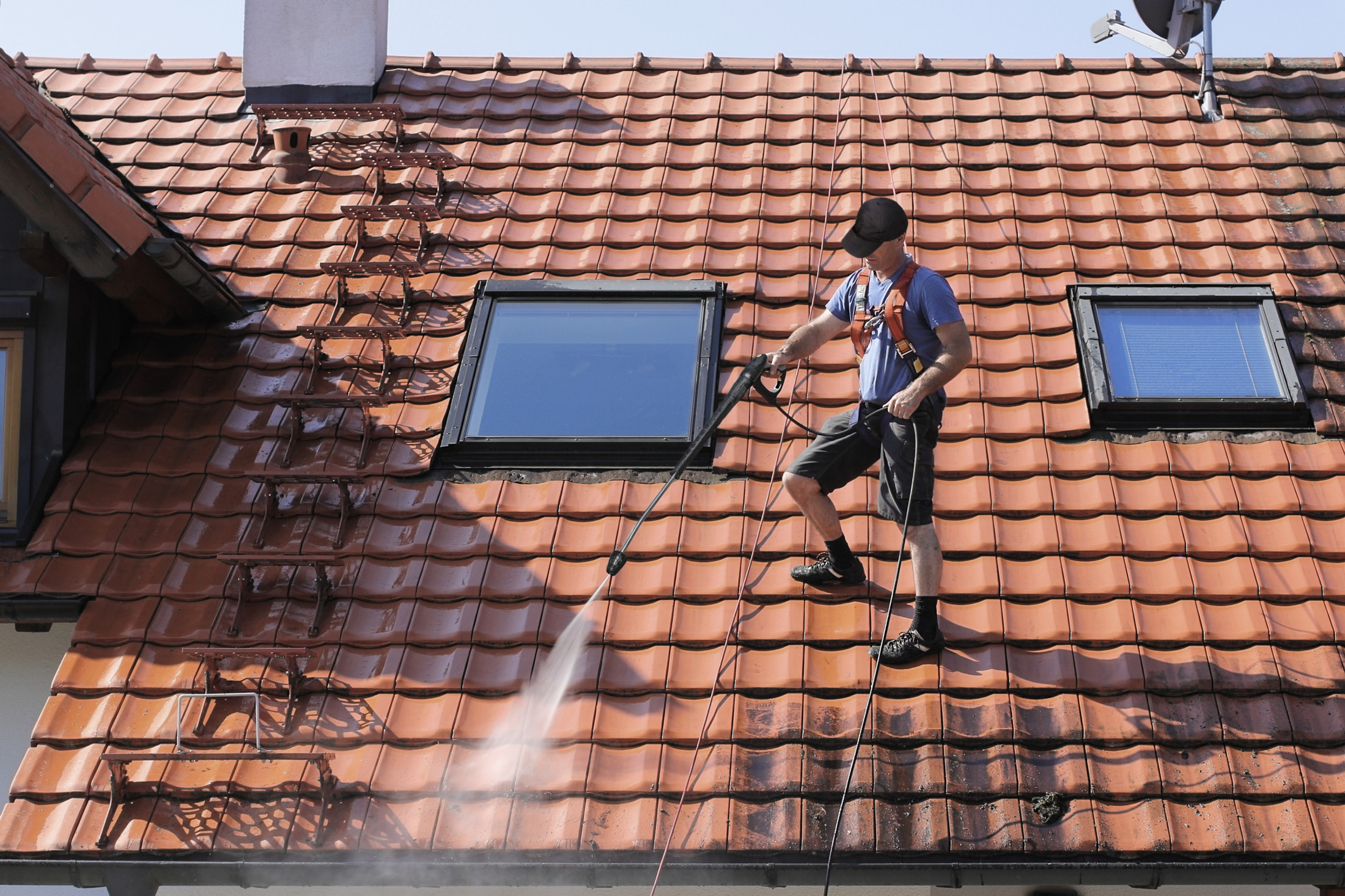
Roofs. The older streets around the town centre run to slate and clay tile, the inter-war housing to plain and interlocking tile, and there are a lot of flat roofs over extensions, bays and the walkways on the blocks.
On a pitched roof we scrape the moss out of the laps and off the ridge by hand, clear the valley, and treat the slope with a biocide so the spores left in the surface die back instead of regrowing. We do not pressure wash a roof. The force takes the face off a tile and lifts a slate off its nail, and a jet wash across a flat roof finds every lap in the felt.
Painted render is everywhere in Poole, on the blocks and on the pebbledash of the inter-war housing behind them. It cleans with a proper soft wash, low pressure through a wide nozzle and a treatment left to kill the algae and lichen in the surface rather than just push it off the front of it. The old red brickwork on the streets near the quay is a different job again, because the brick is soft and the mortar softer, so we test a panel out of sight and keep the lance well back so the face stays on it.
Gull fouling, and why it is not just unpleasant. Close to the water it is a big part of the job. Fouling sits on flat roofs, parapets, balconies, walkways and the cills below, and it blocks an outlet faster than leaves do because it sets hard. Left on a painted surface it eats into the coating. It is cleaned down, disinfected and the outlets proved clear afterwards, and we work it around residents rather than through them. Harbour air also leaves a film on glass balustrades and windows that will not wipe off, and hard mains water leaves spotting behind, so glass and frames get purified water. Balcony floors want low pressure and containment, because everything you wash off a fourth floor balcony lands on somebody else's.
On a terrace or a block, one blocked outlet or hopper backs up over several homes, so on those buildings the gutters in Poole want clearing before anyone washes the render beneath. A third of the homes here are flats, so a lot of the work is the ground around them: block paving on a driveway or a communal car park comes up under controlled pressure and then wants a re-sand, because the wash takes the jointing sand out with the black spot and the weed. Bin stores, undercrofts and the paths between blocks are steam and low pressure work, not brute force. On a patio we will give you a straight answer about whether a seal is worth the money or will simply lock the damp underneath it.
How it runs
Cleaning render, roofs and paving around Poole town
Thomas looks at each surface before he prices it, because render, brick, roof tiles and paving all need a different method. The quote is itemised: the method for each surface, protection for windows, plants and cars, access, and where the water and residue go. One visit and one quote cover the whole clean.
Render and painted walls are washed at low pressure with a biocide, used under the HSE biocide rules, left to work and then rinsed. Paving can take more pressure. Roof tiles are cleaned without a pressure washer, because it damages them. On a terrace near the High Street, where the front is on the pavement, we keep the footway clear and catch the run-off. On a block of flats the freeholder has to agree first, which is worth settling before we book a day. Cracked render or a loose tile spotted while cleaning is photographed, priced and left for you to decide.
Cleaning needs no permission. Painting brickwork that has never been painted, or coating render, changes how a building looks. The Town Centre Heritage Conservation Area covers the old town and quay, and BCP Council lists others across Poole, so ask the council whether your house sits in one before any paint or coating goes on. Their list is online.
Cost
How a clean is priced when every surface differs
Exterior cleaning is not priced per square metre. The same area can be quick or slow, depending on the surface and what is growing on it.
The surface. Render with green or black growth needs a biocide and time to work. Brick may only need a gentle wash. Paving needs a clean and then re-sanding. Getting the method wrong takes the finish off with the dirt.
Access. A top floor flat reached only through a communal door, a terrace off the High Street with no side access, and a harbourside block with a car park under it are all different. The work at height rules decide whether it is a pole, a tower or a scaffold.
Where the water goes. Run-off carrying cleaning product should not go into a surface water drain that runs to the harbour, as the pollution prevention guidance explains. On a pavement frontage it has to be collected, which adds time.
A treatment or a rinse. A rinse on its own looks good for a few months. A biocide treatment kills the growth at the root and lasts longer.
When you compare quotes, ask what method each surface gets, whether a treatment is included or just a rinse, and where the run off ends up.
If there is a date
A sale, a viewing or a letting inspection coming up
Exterior cleaning is rarely an emergency, but it often has a date on it: a sale, a viewing, a letting inspection, or a slippery path someone could fall on. Ring and tell us the date.
If you are in a block, speak to the managing agent at the same time, because their go-ahead can take longer than the clean itself. A green, slippery path or step can be treated first. Scheduled work runs Monday to Friday, 8am to 6pm. If the date is close, phone us; if we miss you, we call as soon as we can.
The one local thing
In a flat, the outside is not yours to clean
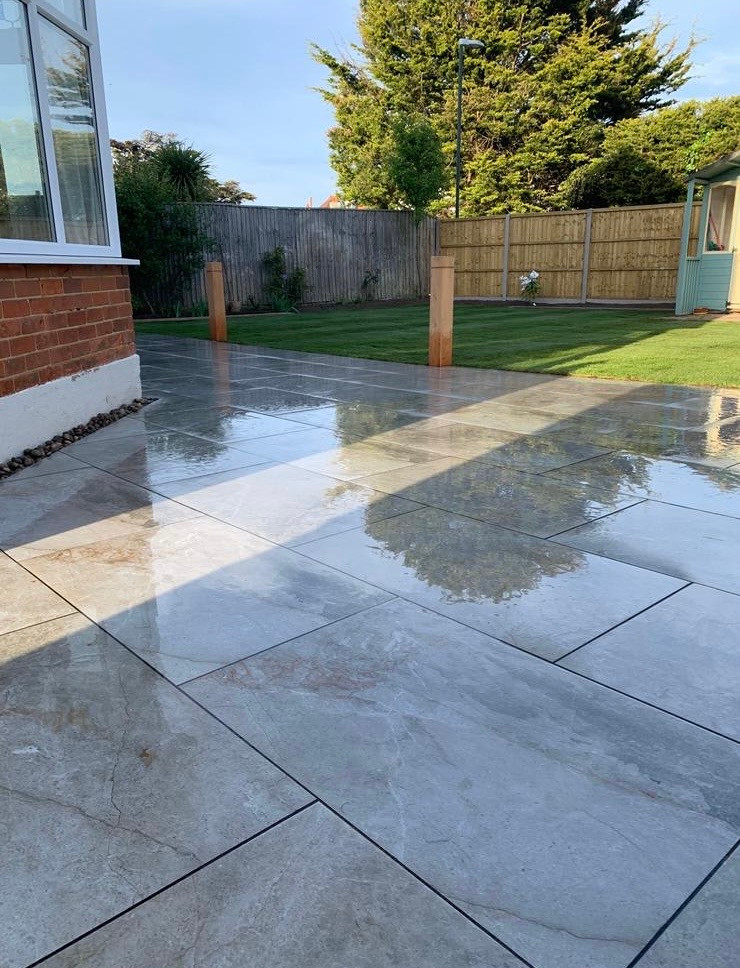
Around a third of the homes in Poole are flats or maisonettes, and in the town centre itself the proportion is far higher than that. If you are a leaseholder, the roof, the outside walls, the gutters, the walkways and usually the window frames are retained by the freeholder. They are maintained out of the service charge you already pay, and you cannot instruct a contractor to work on them however much they need doing.
This is easy to miss. A leaseholder can get a fair price for cleaning the render on their elevation and then find the managing agent will not let anyone on site. Check your lease, or ask the agent what is demised to you, before you spend an afternoon getting quotes.
There is also a rule that works in your favour. Where a landlord is carrying out works that will cost any one leaseholder more than £250, section 20 of the Landlord and Tenant Act 1985 requires them to consult the leaseholders first, and a proper external clean across a block will often pass that. That means you can ask to see the estimates, and you can put a contractor forward to be asked for one.
So the practical route for a leaseholder is not to book us, it is to get the block's clean onto the agent's list and ask that we are invited to price it. We are happy to quote to a freeholder, a management company or a residents association, and we will price the communal work and any individual balcony or patio separately so everybody can see what belongs to whom. If you own a house here, none of this applies and you can simply book it.
Who you are dealing with
A cleaning firm you can look up
Based in Boscombe, we are 6.7 miles from Poole town, and we cover houses and blocks around the High Street, Longfleet and Hamworthy, with Broadstone and Upton close by. BCP Council is the local authority.
Thomas Hannen owns the business, and he comes out to look at the surfaces and price the clean himself. Our company is Bournemouth Roofing & Building Ltd, registered in England and Wales as company number 15471719. We hold a 10 out of 10 from a verified customer on Checkatrade. The visit is free, and you get an itemised written quote at no cost. Before you book a visit in Poole, you can read our customers' Google reviews, word for word, on our reviews page.
Planning at a glance
Do you need planning permission in Poole?
Most repairs in Poole need no application at all. What decides whether a change to the outside of your house does is who the council is, whether a conservation area or a listing applies, and whether the place sits in a protected landscape.
| Question | In Poole |
|---|---|
| Who decides | BCP Council is the planning authority for Poole. BCP Council's heritage pages set out what it controls. |
| Conservation area | Yes: Town Centre Heritage Conservation Area, Poole Park Conservation Area and Heckford Park Conservation Area, among others. They cover parts of Poole, so check whether your street is inside one. |
| Listed buildings | Yes, there are listed buildings in and around Poole. If yours is one, work can need listed building consent. |
| Protected landscape | No National Park or National Landscape covers Poole. |
Questions
Questions about exterior cleaning in Poole
Do you work for freeholders and managing agents?
Yes, and in Poole town that is often the only way the work gets ordered. A third of the dwellings here are flats, 33.3% of them, so the resident is often a leaseholder who cannot instruct work on a roof or an elevation they do not own. We quote to the freeholder or the agent, break the surfaces out separately and give the consultation with leaseholders something solid to work from.
We are in the Town Centre Heritage area. Any restrictions?
Cleaning is not controlled, appearance is. The Town Centre Heritage conservation area covers much of the older street pattern in Poole, and what it bites on is change: a different render colour, a coating, a covering swapped for something that does not match. Washing a building back to what it already was sits on the upkeep side of that line. Painting it afterwards goes to the council first.
Can you clean up after the gulls?
Yes, as a job of its own. Gull mess sets hard on render and on flat roof coverings and it will not shift with a rinse once it has baked on. It is softened, lifted, then treated, because the staining underneath is biological and will darken again if it is only washed off. Nesting season limits when we can work close to a roost, not what we clean it with.
Our 1930s house has a black band low on the render. Why?
It is damp holding at the foot of the wall. Inter war houses make up 19.1% of Poole with the 1930s the largest single slice at 13.5%, and they sit on ground that is naturally wet here, with solid or very early cavity walls. Splash off a hard path and water tracking up the brickwork keep that bottom band dark. Cleaning takes it off, and it returns unless the ground is dealt with.
Where does the water go if the yard drains to the road?
Into the surface water system, which is exactly why we do not let it carry anything it should not. In Poole the yards and forecourts run to a gully rather than to soil, so the wash is swept toward a foul gully where one exists, and moss and grit are screened out on a mat and bagged. Nothing with product in it goes down an open road gully.
Nearby, and next door
Exterior cleaning near Poole
Nearby places we also cover for exterior cleaning, with straight-line distances from Poole, and the other trades we offer in Poole itself.
Exterior cleaning nearby
Our other trades in Poole
Exterior cleaning guides
Soft washing vs pressure washing: safe for a roof? How to clean a patio without damaging it Moss on a roof: does it need removing?Builders in Poole: all our building work Everything we do in Poole Exterior cleaning, all areas Every area we cover
Free quote
Get it priced surface by surface
Free site visit across BH15, houses and blocks. We will tell you plainly which parts you can instruct yourself and which need the freeholder.