Exterior cleaning in Parkstone
Render, brick, drives and patios cleaned the right way for each surface, from Ashley Cross up to Ashley Road.
The site visit is free and so is the written itemised quote. Thomas Hannen prices every job himself.
Last updated
Exterior cleaning in Parkstone changes method from street to street. Soft red brick and slate around Ashley Cross want a gentle hand, the painted render and pebbledash up towards Ashley Road want a biocide soft wash, and drives and patios want a controlled clean and fresh jointing. We look at each surface and price a method for each one in writing.
A Parkstone owner usually knows a clean is due from the render, the paving or a date to hit. The render on the shady side of the house has gone green and black and the paint underneath is starting to look tired. A block paved drive or a patio has turned slippery and weedy between the joints. Or a house is going on the market, or a tenant is moving out, and the outside needs to look cared for by a certain date.
Thomas comes out, walks round every elevation and the ground around it, and tells you which surfaces need what. Some want very little. Some should not be washed at all until something else is fixed. You get that in writing, surface by surface, and the visit costs nothing.
The work
From the villas at Ashley Cross to the semis up the hill
Render, painted walls and pebbledash. Much of Upper Parkstone, along and behind Ashley Road, is terraces and inter-war and post-war semis, a lot of it finished in painted render or pebbledash. Green algae, black spot and grey lichen settle on the north and east faces and under the eaves where the wall never dries.
That is soft wash work: a biocide applied at low pressure through a wide fan nozzle, left to kill the growth and its spores, then rinsed. A jet wash would push the top layer off and drive water into every hairline crack, and on old pebbledash it can lift the stones out of the dash coat. Where the paint is already failing we say so, because cleaning will not bring a flaking finish back and rendering in Parkstone is the other job to price.
Old brickwork. The Victorian and Edwardian houses in Lower Parkstone are mostly red brick, laid in a soft mortar that is often lime. The brick face is the weatherproof skin, and once it is blasted off the brick starts to crumble. So brick gets a low pressure wash and a treatment where there is growth, tried first on a panel out of sight. Any joints that are open or crumbling get pointed out to you, because washing them hard only makes them worse, and repointing comes before a clean in that case.
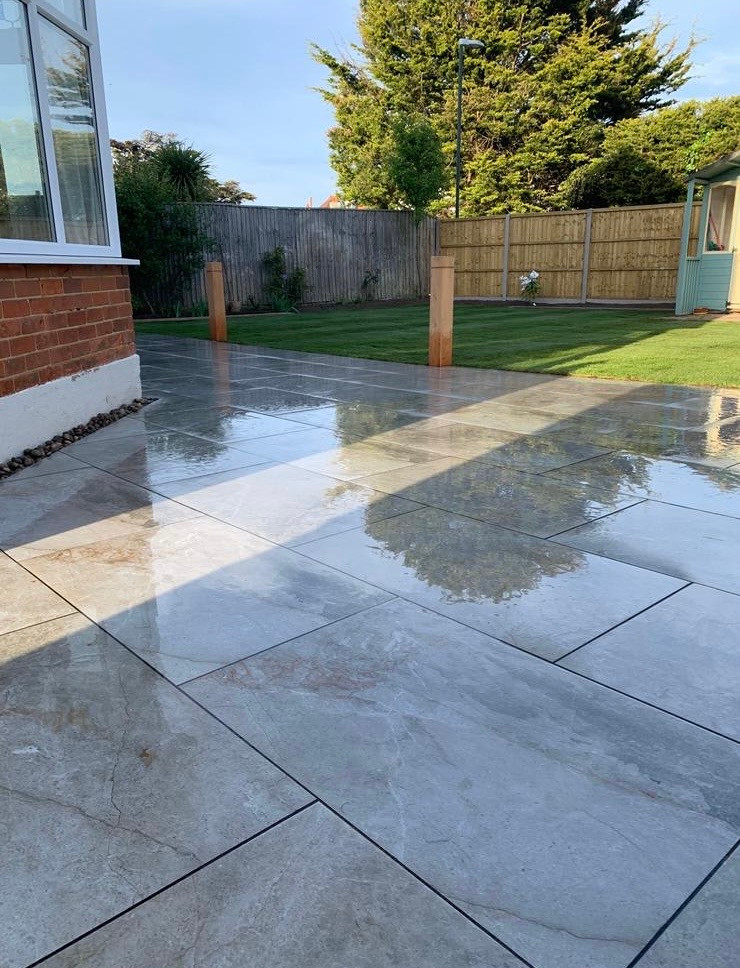
Drives, paths and patios. Towards Penn Hill the plots get bigger and so do the drives. Block paving is cleaned with a rotary surface cleaner at controlled pressure so the surface is not scoured, weed and moss come out of the joints, and then it is re-sanded, because the wash takes the jointing sand with it. Leave that out and the blocks start to move. A patio in sandstone or porcelain gets its own method, and we tell you plainly whether a seal is worth paying for or would just trap damp under the surface.
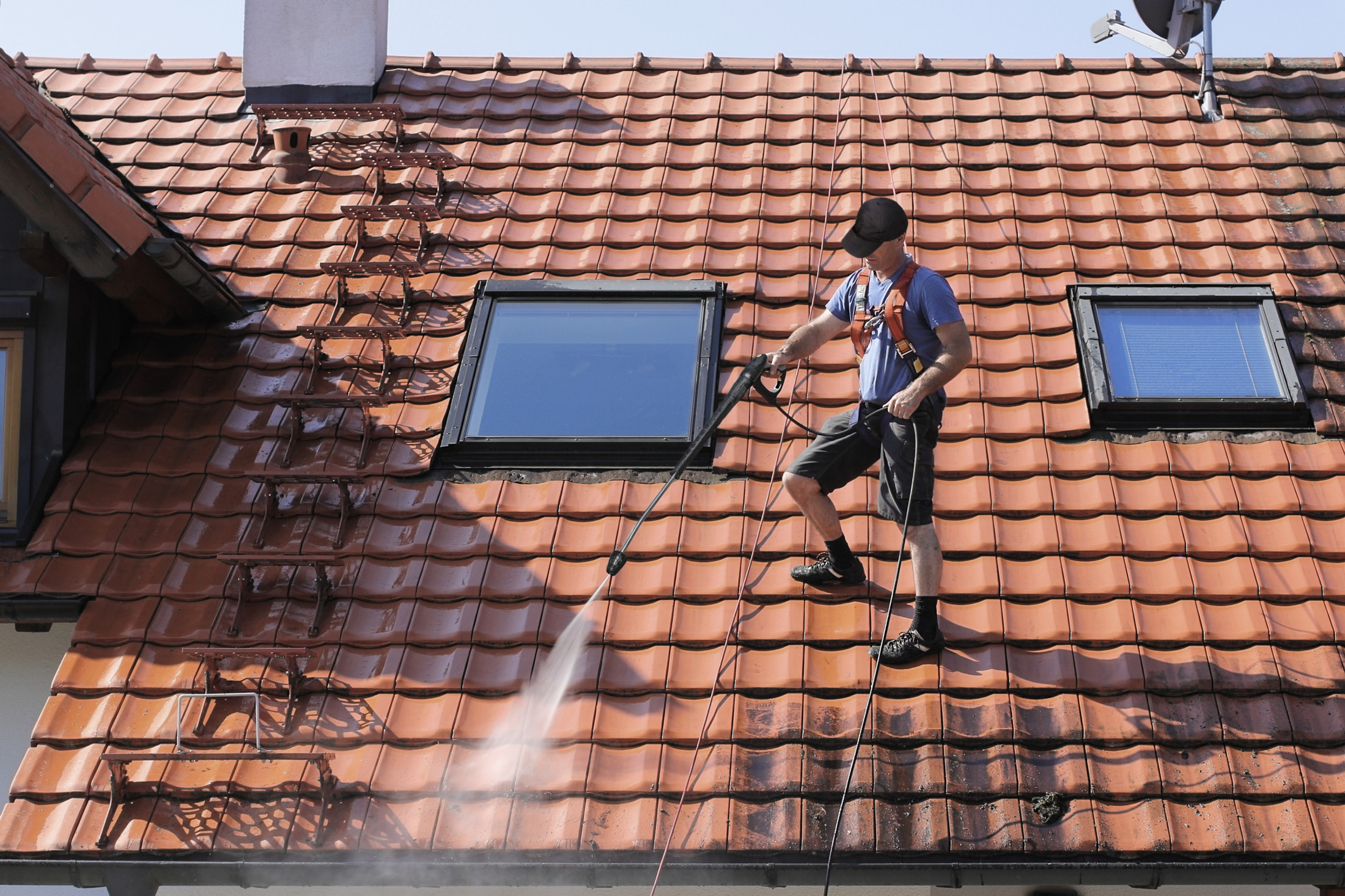
Roofs and gutters. Moss on a roof is scraped out of the laps and off the ridge by hand and the slope treated so it dies back, with the ridge and hips checked while we are up there. Slate and old clay tile are never pressure washed. The roof cleaning page covers that in full. Moss off a roof ends up in the gutter, so clearing the valleys, outlets and downpipes belongs as part of the same visit, which is set out on the gutter cleaning in Parkstone page.
Protecting the garden and the harbour. Planting under the walls is soaked with plain water first and sheeted where the treatment could drift onto it, and every biocide is used at the dilution on its label, under the rules the HSE administers. Parkstone runs downhill to the harbour, and a road gully carries surface water, not sewage, so nothing with product in it is washed into one. That follows the pollution prevention guidance, and on a sloping drive it means catching the run off at the bottom instead of letting it find the road.
How long it takes. A semi with render front and back and a drive is usually a day. A larger detached house with a patio and paths can run to two. Heavy, long established growth sometimes needs a second visit so the biocide can finish working, rather than more pressure.
When we would talk you out of it. If the render is cracked and the growth is following the cracks, a clean on its own buys a few months. If the drive has sunk, cleaning shows the dips off more clearly. In both cases we tell you before you pay for a clean.
How it runs
From your call to a written price
One person to ring from the first visit to the last. The quote is itemised, not a figure on the back of a card: the method for each surface, protection, access, and where the water and residue go on separate lines, so you can compare it properly against anyone else's.
Nothing is left open or unusable overnight. The site is swept at the end of each day rather than the end of the job, and what comes out leaves with us. If something turns up once we start that nobody could have seen, you get a photograph and a price before we carry on.
Cleaning is maintenance and needs nobody's permission. Painting brick that has never been painted, a masonry coating or a new render colour is different, because it changes how the house looks. Ashley Cross is a conservation area and the council keeps the list, so ask the council before anything new goes on a front elevation there.
Cost
What decides the price of a clean
No rate per square metre, because the same square metre can be twenty minutes or two, depending what is growing on it.
Getting to it. A Victorian villa near the station with a shallow front garden, an Upper Parkstone terrace that fronts the pavement, and a detached house off Penn Hill Avenue with a long block paved drive are three different set ups. Ground level off a lance is one thing, a second storey or a roof slope is another. Reach poles do a lot of it, some of it wants a tower, and the work at height rules decide which.
The surface decides the method. Render, painted masonry, old brick, block paving and a tiled roof all want different pressure, and some want no pressure at all. Getting that wrong takes the surface off with the dirt, which is the expensive kind of clean.
How bad it has actually got. A light film comes off quickly. Years of organic growth needs treating, and often needs a second visit rather than more pressure.
Comparing quotes? Ask what method is being used on each surface, whether any treatment is included or just a rinse, whether a second visit is part of it, and where the run off is going. What is left off a quote matters as much as what is on it.
If there is a date
A viewing, a visit or a deadline
Ring rather than use the form. This is not emergency work, but it is often work with a date on it: a property going on the market, a letting inspection, a visit, or scaffolding coming down.
Tell us the date when you ring and we will tell you honestly whether it can be done properly by then, rather than book it and rush it. In Parkstone that is often a steep front path or steps that have turned green and slippery, and those can be treated on their own ahead of the rest. Scheduled work runs Monday to Friday, 8am to 6pm. For anything urgent, ring rather than use the form, and if we cannot pick up we ring you back as soon as we can.
Worth knowing
Around Ashley Cross, clean it and leave it looking the same
Ashley Cross, the old centre of Lower Parkstone around the station, Commercial Road and Church Road, is a conservation area, and a few buildings close by, the Church of St Peter among them, are listed. Inside a conservation area the council is interested in how buildings look from the street.
Washing a wall back to what it already was sits on the upkeep side of that line. What catches people out is what they add afterwards: a masonry paint on red brick to hide the staining, a clear sealer that darkens the brick, or a render colour nobody else in the row has.
So on a house inside the boundary, keep the clean a clean. We use a low pressure and a treatment on the brick, test it first on a panel you cannot see from the road, and we do not recommend coatings for brick that has always been bare, because they trap moisture and change the look. If you are not sure whether your address is inside the boundary, we check it with you at the visit, and on a listed building we talk to the council before any product touches the face. Shops with flats above them along Commercial Road are the other thing to watch: the upper floors often belong to someone else, and whoever owns the freehold signs off the work on the front.
Who you are dealing with
A local firm you can check
We cover the whole of Parkstone, from Ashley Road and Heatherlands on the higher ground down through Ashley Cross to Penn Hill and Whitecliff, across BH12 and BH14, with BCP Council as the local authority. Our Boscombe base is 4.6 miles away.
You are dealing with Bournemouth Roofing & Building, the trading name of Bournemouth Roofing & Building Ltd, registered in England and Wales, company number 15471719, which you can look up in a minute. Thomas Hannen's business, and he is the one who comes out to price the job, not a salesman. A verified customer's 10 out of 10 on Checkatrade. The visit and the written quote are both free. Before you book a visit in Parkstone, you can read our customers' Google reviews, word for word, on our reviews page.
Planning at a glance
Do you need planning permission in Parkstone?
Most repairs in Parkstone need no application at all. What decides whether a change to the outside of your house does is who the council is, whether a conservation area or a listing applies, and whether the place sits in a protected landscape.
| Question | In Parkstone |
|---|---|
| Who decides | BCP Council is the planning authority for Parkstone. BCP Council's heritage pages set out what it controls. |
| Conservation area | Yes: Ashley Cross Conservation Area. Check whether your street is inside the boundary before changing anything visible. |
| Listed buildings | Yes, there are listed buildings in and around Parkstone. If yours is one, work can need listed building consent. |
| Protected landscape | No National Park or National Landscape covers Parkstone. |
Questions
Questions about exterior cleaning in Parkstone
Will a pressure washer damage my render?
Yes, a pressure washer can damage render. High pressure opens hairline cracks, drives water behind the finish and strips paint. Render and pebbledash get a low pressure soft wash with a biocide that does the work instead.
How long does a clean stay looking good?
A rinse on its own looks fine for a season. A proper biocide treatment kills the growth at the root, so it regrowth is far slower, though a shaded north wall will always green over sooner than a sunny one.
Do I need to be home?
Not for the whole day: we need an outside tap or a clear route for our own water, access round the sides, and cars moved off the drive. We talk it through at the visit.
Can you clean the drive and re-sand it in the same visit?
Yes. Block paving is cleaned, left to dry, then brushed full of kiln dried sand. On a big drive the sanding may be the next day, because wet joints will not take it.
I live near Ashley Cross. Can I paint my brickwork after the clean?
Ask the council first: painting brick that has never been painted changes how the house looks, and inside the Ashley Cross conservation area that is what they control. Cleaning alone needs no permission.
Nearby, and next door
Exterior cleaning near Parkstone
Nearby places we also cover for exterior cleaning, with straight-line distances from Parkstone, and the other trades we offer in Parkstone itself.
Exterior cleaning nearby
Our other trades in Parkstone
Exterior cleaning guides
Soft washing vs pressure washing: safe for a roof? How to clean a patio without damaging it Moss on a roof: does it need removing?Everything we do in Parkstone Exterior cleaning, all areas Every area we cover
Free quote
Get your Parkstone house and drive looked at
A free visit, every surface looked at, and a written price with the method for each one on its own line.