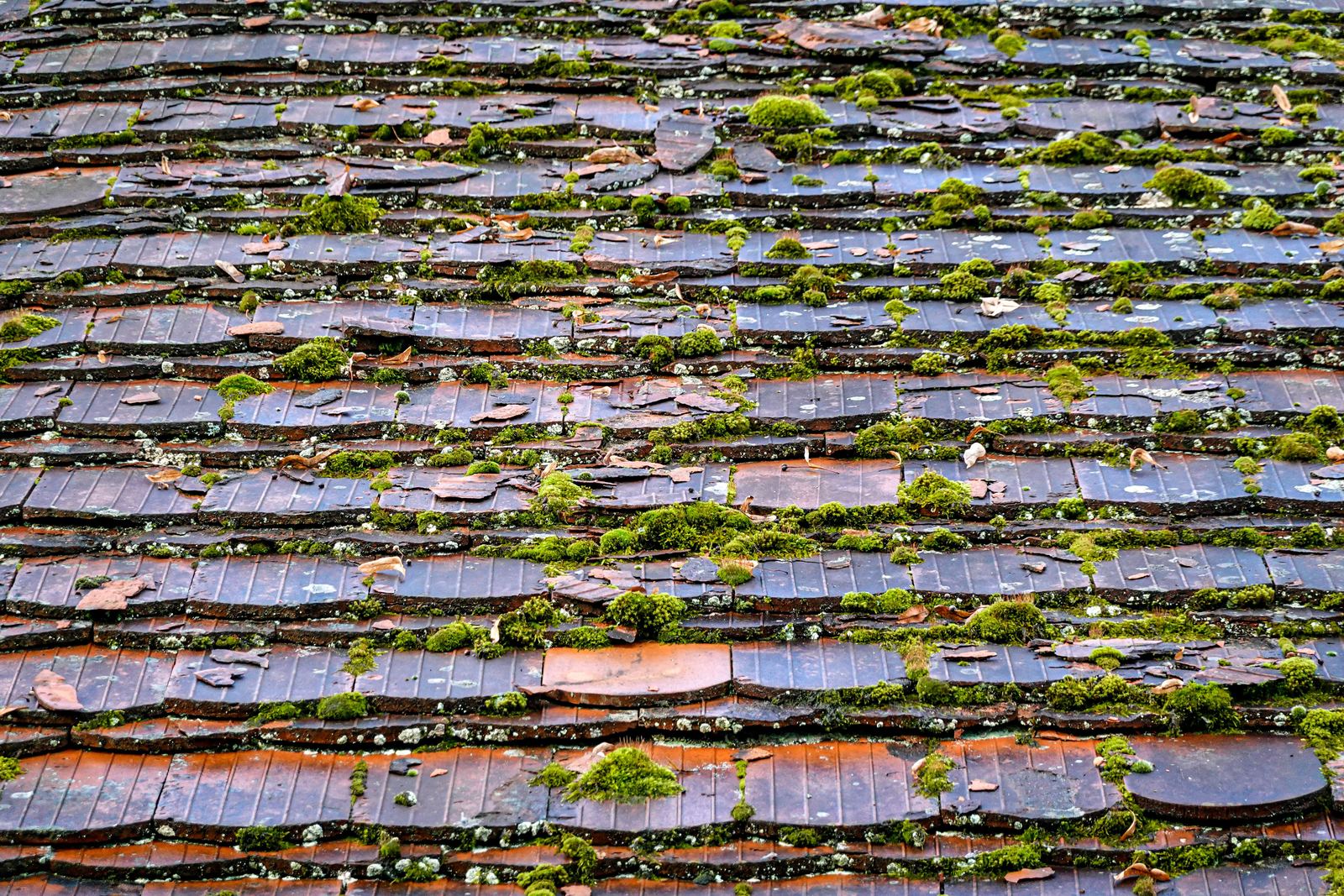
Moss on a roof: does it need removing, and how to do it safely
On most pitched roofs the honest answer is no. Here is how to tell when it does, and what to use when it has to come off.
Moss on a roof usually does not need removing. Marley, which makes concrete and clay roof tiles, says low to moderate moss is a natural part of a pitched roof ageing and normally does not harm tiles or slates, and advises leaving it unless the roof is leaking or the gutters are blocked. Thick, water-holding growth is the exception.
The short version
- A thin green film or scattered cushions of moss on a sound roof needs nothing doing. Leave it, and stay off the roof.
- Act when moss is blocking the gutters or outlets, when the roof is leaking, or when growth is thick enough to stop water running off the tiles.
- Hand scraping and a treatment that kills the moss in place are the two methods the tile maker describes. It does not recommend jet washing.
- A product sold to kill moss must be authorised as a plant protection product. Look for a MAPP number on the label and check it on the HSE database before you buy.
- The HSE lists slates and tiles among the surfaces likely to be fragile. If the job means walking on the roof, it needs proper access, not a ladder.
The tile maker’s view
Moss on its own does not damage a sound tiled roof
The clearest statement on this comes from Marley, which makes roof tiles. Its technical guidance says that low to moderate moss or lichen growth on a roof is a natural part of the ageing process on many pitched roofs, and that under normal circumstances it is not harmful to roof tiles or slates.
Unless the roof is leaking or the gutters and outlets are blocked, its advice is to leave the moss where it is and not to go onto the roof to remove it.
The reason it gives matters more than the advice. Removing moss can cause further damage to the tiles and the roof, either from feet on the tiles or from some of the methods used. A roof that was doing its job with moss on it can be leaking after somebody has walked across it.
The same page draws the line where moss does start to matter. A heavy build-up inhibits the flow of water off the tiles, so the covering stays wetter for longer, which raises the chance of leaks and can speed up the deterioration of the tiles. In extreme cases Marley says some tiles may need replacing rather than cleaning. So the question is not whether there is moss on your roof. It is how much, and whether water still runs off.
Moss grows where a roof stays damp: under trees, on shaded slopes, on north-facing elevations and on shallow pitches, which shed water more slowly than steep ones. If one slope is green and the other is clean, that is shade and pitch at work, not a sign the green side is failing.
Where it does cost you
Where moss does cost you: the gutters, and tiles that stay wet
When moss causes trouble, it is water in the wrong place rather than the moss itself, by one of two routes.
Moss in the gutters
Cushions of moss come away from the tiles in dry weather and in wind, roll down the slope and settle in the gutter, usually at the outlet, which is exactly where they do most harm. A gutter blocked at the outlet fills and spills over, often down the wall. Clearing the gutters at the eaves deals with that without anybody setting foot on the slope. If water already comes over the top in heavy rain, a gutter that overflows in heavy rain helps you tell a blockage from an undersized gutter, and autumn gutter clearing covers when a clear does the most good.
Tiles that stay wet
Thick moss holds water against the tile like a sponge. Marley’s guidance is that a heavy build-up means the roof covering stays wetter for longer, which raises the chance of leaks and can accelerate the deterioration of the tiles. On an older, porous or already flaking tile, staying wet through cold nights is the likely route to that deterioration. As with frost damage to brickwork after the thaw, it does not show on the day.
So thick, spongy moss on an older roof, or moss that is lifting the edges of tiles, is worth dealing with. A thin green coat on a newer roof is not.
If it has to come off
Scraping, treating, soft washing and jet washing compared
Marley describes two methods, scraping by hand and a treatment that kills the growth, and says jet washing is not recommended. Soft washing is the third method you will be offered. They are compared below on what matters to a homeowner.
| Method | How it works | Main risk to the roof | Result |
|---|---|---|---|
| Hand scraping | Moss lifted off the tiles with hand tools | Cracked or dislodged tiles under foot or under the tool | Immediate. Roots left behind regrow |
| Kill treatment | An authorised product sprayed on and left. The moss dies and weathers away | Low to the tiles. The runoff can harm plants, animals and drains | Slow. The roof clears over the following months |
| Soft washing | A chemical at low pressure, left to dwell, then rinsed | Low to the tiles. Same runoff questions as any chemical | Faster than a kill treatment alone |
| Jet washing | Water at high pressure | Can damage the tile surface, and spraying up the slope can lift tiles | Looks clean at once. Not recommended by the tile maker |
In practice the two sensible methods are often combined. The thick moss is scraped off by hand, carefully, and the roof is then treated so what is left dies back rather than regrowing from the roots. Marley warns that scraping must be done with caution to avoid damaging tiles and slates, and that a treatment can be harmful to plants and animals, so the gutters and outlets need protecting while it is applied.
On jet washing, the manufacturer is direct: high powered jet washes are not recommended because they can damage the surface of the slate or tile and reduce its expected life considerably. Spraying up the slope from the ground can also lift tiles. We have covered the two washing methods side by side in soft washing or pressure washing, so we will not repeat it here. The short version is that if a quote for roof cleaning involves a pressure washer on the tiles, say no.
When to do it
Treat moss in a settled, dry spell, not just before rain, which carries the product off the tiles and into the gutters and drains. The label gives the conditions for each product, so follow it. Spring and early autumn usually suit, but the forecast decides it, not the month. Scraping belongs in dry weather too: nobody should be on a wet or frosty roof.
Clear the gutters after the roof, not before. A treated roof sheds dead moss for months as it weathers away, and most of it ends up in the gutter. Do the roof, let it shed, then clear the gutters before the wet part of winter.
Moss killers and the law
Which rules a moss killer falls under, and how to check one
Products that kill moss are regulated, and the regime depends on what the label says the product does. People call all of them “biocides”, but the HSE splits them in two, and it administers both.
- A product that claims to kill moss is a plant protection product. The HSE states that the control of moss is regulated under the GB and EU Plant Protection Products Regulations, so claims against moss cannot be accepted under the older biocides law, and any product making them must be authorised as a plant protection product.
- A product that claims to remove lichen, mould or mildew from tiles is a surface biocide. On the same page, the HSE says surface biocides applied to masonry, brickwork and tiles need approval from it under the Control of Pesticides Regulations before they can be advertised, sold, supplied, stored or used, until a decision is made on approving the active substance under the GB or EU biocides rules.
The practical test is the label. An authorised plant protection product carries a MAPP number, and the HSE’s advice is that the easiest way to check whether a product is authorised is to search its database by MAPP number. If there is no record, the product is no longer authorised, and it is illegal to use or store it. A tub at the back of the shed may fall into that category, so check it before you use it.
Three more points from the HSE’s guidance on using these products at home change what you should do:
- Products sold for amateur use can be used without training. Professional products must only be used by somebody trained to use them, so do not buy a trade product online and apply it yourself.
- Do not buy one from the internet or abroad until you have checked it is legal to use in the UK.
- Never pour any of it, diluted or not, down a drain, sink or toilet. You could face prosecution.
The HSE also says using household chemicals as a home-made remedy is not without risk and is not always legal. If a cleaner turns up with an unlabelled container, ask what is in it and what it is authorised as.
Before anyone goes up
Getting onto the roof is the dangerous part
Whatever the method, the hazard is the access. The HSE’s guidance on roof work says almost one in five deaths in construction work involve roof work, and that some are specialist roofers but many are just repairing and cleaning roofs. For sloping roofs it requires scaffolding to stop people or materials falling, with edge protection fitted at the eaves, and allows properly secured ladders and proper roof ladders only for work that takes minutes.
Tiles are the second problem. The HSE’s page on fragile surfaces lists slates and tiles among the materials likely to be fragile, says every roof should be treated as fragile until a competent person has confirmed it is not, and notes that people doing small, short-term maintenance and cleaning jobs are over-represented in the injury statistics. Moss makes it worse: wet moss on a slope is about as slippery as a roof gets.
Do not walk on the roof. If you cannot reach the moss from a ladder at the eaves, the job needs proper access, not a bolder attempt. Tiles crack under a boot even when nobody falls, and a hairline crack is invisible from the ground until it leaks. If somebody knocks offering to clean your roof from a ladder against the gutter, read someone knocked and said your roof is dangerous first.
Doing it yourself
When you do not need anyone at all
Most homeowners with moss on the roof need nobody.
- Moss on a sound roof, no leak, gutters running. Leave it. That is the manufacturer’s advice, and paying somebody to walk on the tiles buys you risk, not protection.
- Checking whether it matters. Look from the ground and from upstairs windows, with binoculars if you have them. You are looking for thick, lifting cushions, slipped or cracked tiles, and water spilling from the gutters in rain. Our roof checks from the ground list the rest.
- Moss in the gutters of a single-storey roof or a low extension. Scooping it out from a level, secured ladder is a short job many people do themselves. The HSE suggests that if a task would mean staying up a leaning ladder for more than 30 minutes at a time, other equipment is the better choice. Stay on the ladder and off the roof.
- Less shade. Marley recommends trimming back overhanging branches. More light and air on the roof means less moss next year. If the tree is protected by a tree preservation order, stands in a conservation area or belongs to a neighbour, check with the council or the owner before you cut.
You do need somebody when moss is lifting tiles, when tiles are cracked or slipped, when water is getting in, or when the gutters you cannot safely reach keep blocking. At that point the moss is a symptom you are looking past, and the repair matters more than the clean.
Next steps
What to do next
Work through these in order. Most people stop at the first or second.
- Look from the ground. If the moss is thin, nothing is lifting and the gutters run clear, leave it.
- If the gutters are blocked, get them cleared at the eaves. That fixes the actual problem.
- If growth is thick, lifting tiles or holding water, plan to have it scraped by hand and treated in dry weather, with the gutters protected and cleared afterwards.
- If you buy a product, check its MAPP number on the HSE database first, and never pour it down a drain.
- If anybody quotes for a jet wash on your tiles, decline.
If you would rather somebody looked before you decide anything, that is part of our exterior cleaning and roofing work across Bournemouth, Poole and Christchurch. Thomas Hannen comes out to look at the roof and the gutters himself, and you get a free written itemised quote. If the right answer is to leave the moss and clear the gutters, the quote will say that.
Questions
Common questions
Is moss bad for a roof?
Low to moderate moss usually is not. Marley, which makes concrete and clay tiles, says it is a natural part of a pitched roof ageing and is normally not harmful to tiles or slates. Heavy growth is different: it stops water running off, keeps the tiles wet for longer and can block the gutters.
What is the best way to remove moss from a roof?
Scraping by hand with care, followed by an authorised treatment that kills what is left, applied in dry weather with the gutters protected. Marley does not recommend jet washing because it can damage the surface of the tile and shorten its life. Clear the gutters afterwards, once the dead moss has shed.
Can I clean my roof with a pressure washer?
It is not recommended. The tile maker says high powered jet washes can damage the surface of the slate or tile and reduce its expected life considerably, and spraying up the slope from the ground can lift and damage tiles.
Is bleach or a home-made mix safe to use on roof moss?
The HSE says using household chemicals as a home-made remedy is not without risk and is not always legal. A product sold to kill moss must be authorised as a plant protection product with a MAPP number, which you can check on the HSE database.
What time of year should you put moss killer on a roof?
In a settled, dry spell, usually spring or early autumn, so the product is not washed off before it works. Follow the conditions on the product label, and leave clearing the gutters until the dead moss has shed.
Read next
Related advice
The guides below pick up where this one leaves off, and the exterior cleaning page covers the work itself and the places we cover, if you would rather have the job looked at.
Who wrote this
Thomas Hannen
Thomas owns Bournemouth Roofing & Building and prices every job himself instead of sending somebody else. The company is Bournemouth Roofing & Building Ltd, number 15471719, registered in England and Wales. If you want to talk something through before you commit to anything, the site visit and the written itemised quote are both free.
Free quote
Not sure whether your roof moss matters?
Thomas comes out, looks at the roof and the gutters, and puts what he found in a written, itemised quote. If the moss can stay where it is, that is what the quote will say.