Soft washing or pressure washing: what is safe for your roof?
Before you choose a method, check whether the roof needs cleaning at all. On most pitched roofs it does not.
Soft washing is the safer of the two on a roof, but the safer answer is usually neither. If a pitched roof is not leaking and the gutters are clear, the tile maker’s own advice is to leave low to moderate moss where it is. Every trip onto a tiled roof breaks tiles.
The short version
- Marley, which makes concrete and clay tiles, says low to moderate moss and lichen is part of a roof ageing and is not harmful to tiles or slates. Unless the roof leaks or the gutters are blocked, its advice is to leave it alone.
- The same manufacturer says high powered jet washes are not recommended on tiles and slates because they damage the surface and shorten the life of the covering.
- Soft washing is not chemical-free. It is the method that works by chemistry, which is why you should ask what the product is and what it is authorised as.
- Any product sold with a claim against moss needs plant protection product authorisation, and the HSE says a moss claim cannot be accepted under the pesticides regime instead.
- Pressure washing is the right tool on block paving and concrete, provided the jointing sand it strips out is replaced afterwards.
Start here
Most moss on a pitched roof is better left alone
If the only thing wrong with your roof is that it has gone green, the tile maker’s own advice is to leave it. Marley makes concrete and clay roof tiles and has every reason to want roofs looking new.
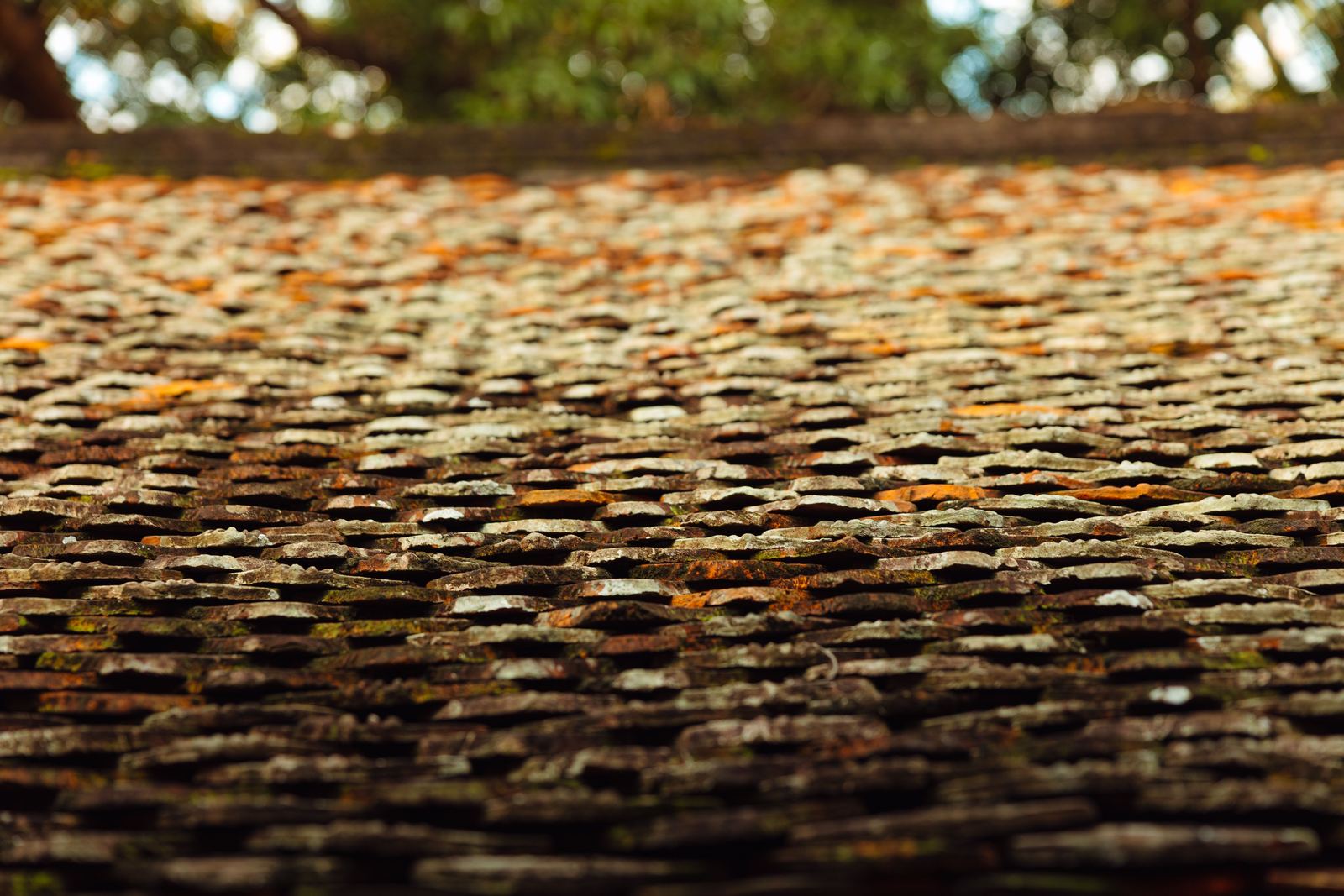
Its published position is that low to moderate moss or lichen growth on a roof is a natural part of the ageing process on many pitched roofs, and that under normal circumstances this is not harmful to roof tiles or slates.
The instruction that follows is blunter. Unless the roof is leaking or the gutters and outlets are blocked, the best advice is to leave the moss and lichen where it is and not to access the roof to remove it. Read that second half again: the advice is not just to skip the clean, it is to stay off the roof.
The arithmetic is simple. Cleaning adds nothing to the life of a roof, because the covering is not failing from moss. Getting up there subtracts from it, because tiles crack under a boot and a hairline crack you cannot see from the ground is a leak in three winters. The person selling the clean carries none of that risk.
Two conditions change the answer and both are about water rather than appearance. If moss is washing down and blocking the gutters, the gutters are the problem, and that is a job at the eaves rather than on the slope: see autumn gutter clearing and why a gutter overflows in heavy rain. If the roof is leaking, the leak needs diagnosing, and moss is rarely the cause. We do exterior cleaning, and we are telling you that on most pitched roofs it is not worth buying.
The two methods
Soft washing is the chemical method, not the chemical-free one
Soft washing is a chemical applied at low pressure, left to dwell, then rinsed. The pressure only puts the product on and takes it off again, the chemistry does the work, and the result develops over weeks as the growth dies back. Pressure washing is the opposite: no chemistry, mechanical removal by water at high pressure, which is why the result is instant.
That gives you the correction. Soft washing is routinely sold as the gentle, chemical-free option and it is the exact reverse: it is the method that relies entirely on a chemical being sprayed onto your roof, into your gutters and onto your garden. Not a reason to rule it out, but a reason to ask what is in the container.
The HSE states that the control of moss is regulated under the GB and EU Plant Protection Products Regulations, and that claims against moss cannot be accepted under the Control of Pesticides Regulations. Any product making claims against moss needs authorisation as a plant protection product, while algaecides and biocidal surface treatments sit under a different regime.
So there is a question worth putting to any cleaner before they unroll a hose. What is the product, and what is it authorised as? Somebody who works with these materials daily will have the label to hand. Somebody who cannot name it is telling you something useful.
Ask a second question if you were thinking of buying something yourself. The biocides regime separates amateur products from professional ones. The public should only use products intended for the general public, and professional-only products carry conditions about information, instruction and training for whoever applies them. Then ask where it all goes, because discharging anything but clean rainwater to a surface water drain is a pollution offence, and it is your drain.
Side by side
The two methods compared, dimension by dimension
Soft washing and pressure washing are compared here on a pitched tiled or slated roof, with one row for a driveway because that is where the answer flips.
| Dimension | Soft washing | Pressure or jet washing |
|---|---|---|
| Mechanism | Chemical at low pressure, dwell time, rinse | Mechanical removal by water at high pressure |
| Regulatory position on the chemical | A moss claim needs plant protection product authorisation. Algaecides sit under the biocides regime. Professional-only products carry training conditions | None, unless a chemical is used alongside it |
| Manufacturer position on tiles | Not addressed in the published guidance | Not recommended: it can damage the surface of the slate or tile and reduce its expected life considerably |
| Risk to mortar bedding | Low | High. A bedded ridge or verge is pointing, and pressure takes pointing out |
| Driving water under the covering | Low | High. Water forced up under the laps lands on the underlay |
| Granule loss on concrete tiles | Low | Real, and it is what the reduced life refers to |
| On a driveway | Works on organic growth, slower, no sand loss | The right tool on block paving, but it strips the jointing sand |
| Working at height | Both governed by the work at height rules. Access, not method, is the hazard on a roof | |
| Speed and visible result | Slower. The result develops over weeks | Immediate. That is why people buy it |
One row you will not find here is a pressure threshold. A figure in pounds per square inch circulates on cleaning pages as the point above which damage becomes irreversible, with no methodology or source behind it anywhere, so we are not going to repeat it. The manufacturer’s statement is attributable, and it is stronger.
On a roof
Water at pressure takes more off a roof than moss
The clearest statement on this comes from the firm that makes the tiles. Marley’s position is that the use of high powered jet washes is not recommended as it can damage the surface of the slate or tile, thus reducing its expected life considerably. That is a manufacturer describing damage to its own product from a service it does not sell. Three things happen while the lance is on the roof, and only one is visible from the ground.
- The surface of the tile goes. A concrete tile is finished with a granular surface layer. Pressure takes it off, and the tile underneath is rougher, more porous and better at holding the next crop of moss. The roof looks cleaner for a season and colonises faster afterwards.
- The mortar goes. Bedding at the ridge, the hips and the verge is a wet trade repair, and a lance removes it faster than a chisel would. A ridge sound in the morning needs re-bedding by the afternoon. See dry ridge against a mortar bedded ridge.
- The water goes the wrong way. A tiled roof sheds water by overlap and pitch, and every lap is designed for water running down it, not fired up under it. Push water up the slope and it lands on the underlay, which on an older roof is brittle felt with tears at the eaves already, and the underlay is what fails on an old tiled roof.
So a pressure wash on a pitched roof gives an immediate cosmetic improvement and three mechanisms of harm, none of which shows up until the following winter, by which point the connection to the clean is impossible to prove. Where growth genuinely has to come off, Marley’s alternative is that moss can be scraped off with hand tools, with caution to avoid damaging the tiles and slates.
One more case we would talk you out of, and it deserves naming on its own. Pressure washing a mortar bedded ridge, verge or valley removes the mortar, and you have bought a re-bed that was not needed before the clean. It did not find a problem. It made one.
The real hazard
The access is the hazard, not the algae
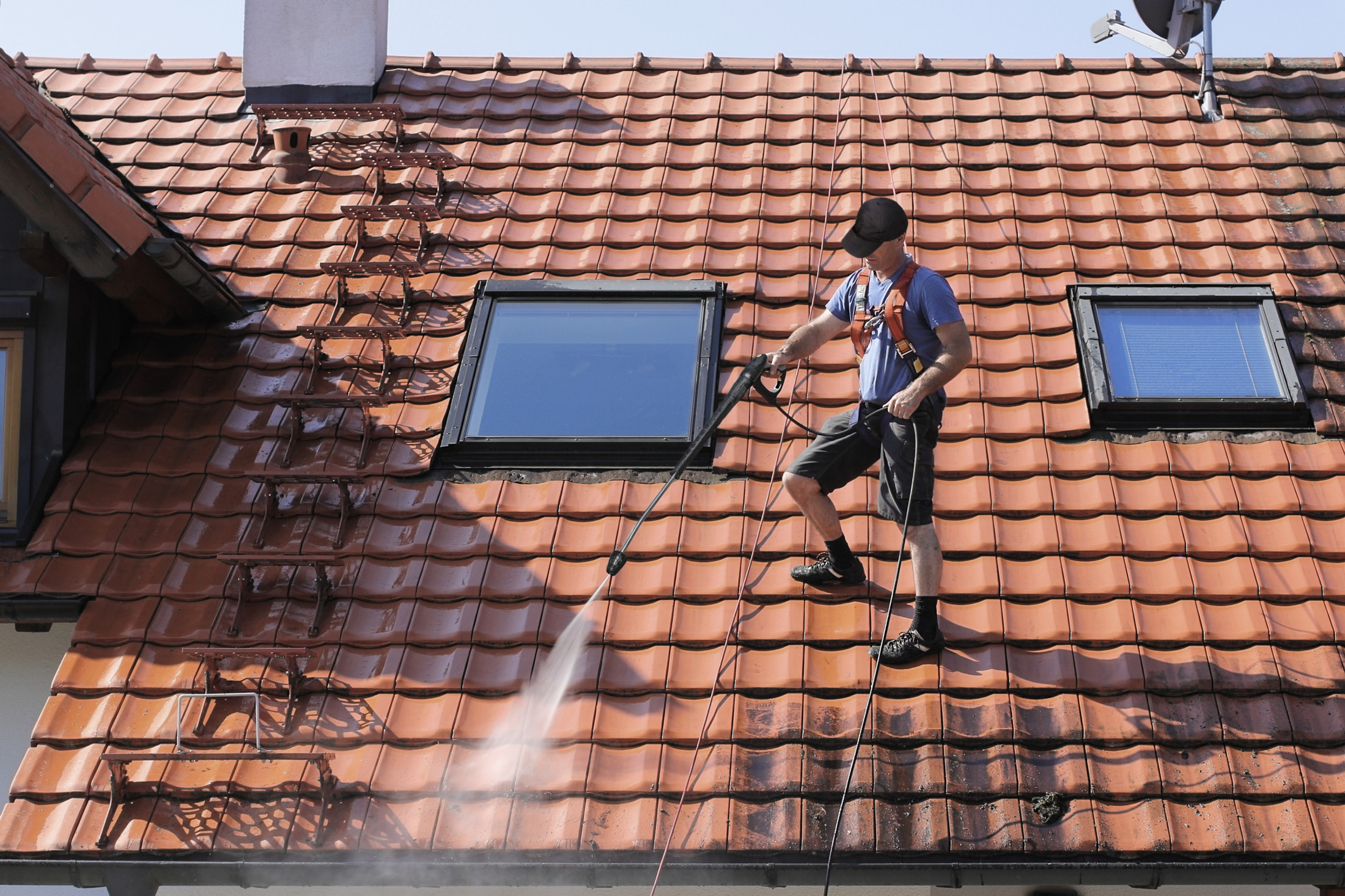
Whatever method is proposed, the dangerous part of a roof clean is getting onto the roof. The HSE’s guidance on roof work treats falls from and through roofs as one of the biggest causes of death and serious injury in construction, and a pitched roof with wet tiles and a hose on it is not a mild version of that.
The work at height rules run on a hierarchy: avoid the work where the job can be done another way, prevent a fall where it cannot, and only then limit the consequences of one. A cosmetic roof clean sits at the top of that hierarchy, because it can be avoided entirely and the manufacturer says it usually should be.
It is also what separates a proper quote from a cheap one. Tower, scaffold or platform is a real cost and it shows on the price, so if one quote for a two storey roof looks light against another, the difference is usually the access, and the person absorbing it is the one on your tiles. Our note on checking a roof from the ground covers what you can see with binoculars.
Before anybody goes up. If a caller offers to clean your roof off a ladder leaned against the gutter, say no. A ladder is access to a roof edge, not a working platform on a slope, and a plastic gutter is not a fixing point. Doorstep callers are covered in somebody knocked and said your roof is dangerous.
Where it earns its place
On block paving and concrete, pressure washing is right
Pressure washing is the correct tool on block paving, concrete, flags and modern hard surfaces, and there is no need to be precious about it. Those surfaces are dense and laid flat, there is no lap for water to be driven under, and nothing beneath them a jet will reach.
One condition comes with it, and it is the item most often left off a driveway quote. Pressure washing block paving strips the sand out of the joints, and that sand is not decoration: it locks the blocks together and stops them rocking and spreading. It has to be swept back in with fresh kiln dried sand once the surface has dried, and a driveway left unsanded moves within a year. If it is not on the quote, ask why.
Two things not to point a lance at, even on the ground: old soft brick and lime pointing, which erode under it, and rendered walls, where water at pressure gets behind the render at a crack and does its damage out of sight. And if the paving is sunken or spreading at the edges, cleaning it is cosmetic work over a laying problem. Sorting the base is our driveway and patio work, and the surfaces themselves are compared in resin bound against block paving and tarmac.
Next steps
What to do next
Before paying for any roof clean, ask whether the roof is leaking and whether the gutters run clear, because for a sound roof the manufacturer's advice is to leave the moss alone. The first three steps cost nothing and the first settles most cases.
- Ask whether the roof is leaking and whether the gutters run clear. If both answers are no, the manufacturer’s advice is to leave the moss alone and you can stop here.
- If the gutters are blocked, treat that as a gutter job at the eaves rather than a roof job on the slope. Cheaper, safer, and it fixes what was actually wrong.
- If the roof is leaking, get the leak diagnosed before anybody cleans anything.
- If you still want a roof cleaned, ask what product will be used and what it is authorised as, how the access will be provided, and where the runoff goes.
- On a driveway, ask whether the joints will be re-sanded afterwards.
If you want the roof looked at before you spend anything, that is what our roofing work is for, and a free written itemised quote comes out of the visit. Thomas Hannen prices the job himself, and if the moss is doing nothing and the gutters need clearing, that is what the quote will say.
Questions
Common questions
Should I have the moss cleaned off my roof?
Usually not, Marley, which makes concrete and clay tiles, says low to moderate moss or lichen growth is a natural part of a roof ageing and is not harmful to tiles or slates. Unless the roof is leaking or the gutters are blocked, its advice is to leave it and not access the roof.
Is jet washing bad for roof tiles?
The manufacturer says the use of high powered jet washes is not recommended, because it can damage the surface of the slate or tile and reduce its expected life considerably. It also strips mortar bedding and can drive water up under the laps and onto the underlay.
Is soft washing chemical-free?
No, it is the opposite. Soft washing works by chemistry rather than by pressure, so the product matters. Ask what it is and what it is authorised as: the HSE says any product making claims against moss needs plant protection product authorisation.
Can I clean a driveway with a pressure washer?
Yes. Block paving, concrete and modern hard surfaces are the right place for it. Accept that the jointing sand comes out and must be swept back in with fresh kiln dried sand once the surface has dried, or the blocks will start to move.
Does cleaning a roof make it last longer?
There is no published evidence that it does. The covering is not failing because of moss, so the clean adds nothing, while the access needed to do it cracks tiles and stresses old battens. On a pitched roof the cleaning can cost more life than it adds.
Read next
Related advice
The guides below pick up where this one leaves off, and the exterior cleaning page covers the work itself and the places we cover, if you would rather have the job looked at.
Who wrote this
Thomas Hannen
Thomas owns Bournemouth Roofing & Building and prices every job himself instead of sending somebody else. The company is Bournemouth Roofing & Building Ltd, number 15471719, registered in England and Wales. If you want to talk something through before you commit to anything, the site visit and the written itemised quote are both free.
Free quote
Been quoted for a roof clean you are not sure about?
Thomas comes out, looks at the roof and the gutters properly and puts in writing what he found. If the answer is that the moss can stay where it is, that is what he will tell you.