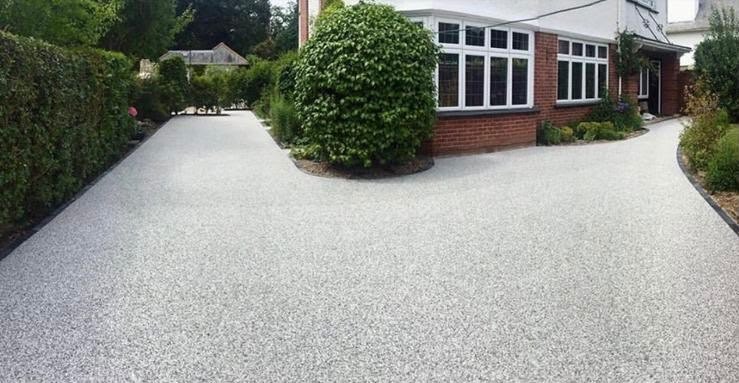
Resin bound driveways in Bournemouth
Resin bound drives, paths and patios across Bournemouth, Poole and Christchurch, laid on a base built to drain. Levels, edges and the dropped kerb worked out before anything is dug.
The site visit is free and so is the written itemised quote. Thomas Hannen is the person you deal with from the first call.
Last updated
Resin driveways
A resin drive is only as good as what is under it
Resin bound driveways are clean, dried stone mixed with a UV-stable resin and trowelled smooth over a firm, porous base. Laid that way the drive lets rain soak through, so for a house’s front garden you do not usually need planning permission for the drive itself. The dropped kerb is separate. The site visit and the written quote are free.
Three things usually start it. An old tarmac or concrete drive that has cracked, sunk or holds a puddle by the door. A gravel drive that throws stones onto the pavement and ruts where the car sits. Or a front garden you want to turn into parking, which brings the kerb and the council into it.
We look at what is there now, tell you whether it can stay as a base or has to come out, and check the levels at the door and the pavement. The written quote shows the groundwork, edging, drainage and resin as separate lines.
The work
What goes into a resin drive that lasts
Resin bound and resin bonded are different products
Resin bound means the stone and the resin are mixed together and trowelled out as one layer. The finish is smooth and even, with tiny gaps between the stones that let water through. Resin bonded is the opposite way round: a coat of resin is rolled onto an existing surface and loose stone is scattered into it. It looks like fixed gravel, but it is sealed, so water runs off the top, and over the years the loose stones work free.
For a drive we lay bound. It is the one that drains, and that decides the planning position.
Laying over the drive you have
An overlay goes straight onto an existing tarmac or concrete drive and saves the dig out and the muck away. The old surface has to be up to it: no moving cracks, no sunken patches, no ponding in hollows, and room in the levels, because the new layer has to finish below the damp proof course and still meet the pavement.
We would talk you out of an overlay on cracked concrete, whose cracks and joints come through the resin, on sunken block paving, or where the threshold would end up near the damp course. And resin over sealed tarmac is not permeable as a whole, because the water runs off the tarmac underneath.
A new drive from the ground up
When the old surface is past it, it comes out. We excavate to the depth the ground and the traffic need, lay a geotextile membrane, then build the sub-base from open-graded stone such as Type 3 or 4/20, compacted in layers. That stone has voids for water to sit in while it soaks away, which ordinary Type 1 hardcore does not. On top goes a porous asphalt layer, and the resin goes on that. The government guidance on permeable front gardens explains this build-up well if you want to read it before we visit.
If a big tree stands near the drive, check whether it has a tree preservation order or sits in one of BCP Council’s conservation areas before anything is dug, because cutting roots can need permission.
Edges, thresholds, manholes and falls
Resin needs a fixed edge restraint to finish against: an aluminium or steel edge strip, or a block border or kerb, set before the resin goes down. Manhole covers are swapped for recessed trays filled with the same resin. The drive falls away from the house, and where it falls towards the road a channel drain goes across the entrance.
The resin and the stone
Ask for UV-stable resin, sometimes called aliphatic. The cheaper aromatic resin goes yellow in sunlight, which is fine under a carport and a mistake on a south facing drive. The stone is dried aggregate in a chosen blend, such as marble, granite, quartz or flint, and it is laid thicker where cars turn. Most driveway systems go down at 18mm or 24mm depending on the stone size, and a footpath blend is not a driveway blend.
Each batch is weighed, mixed in a forced action mixer and trowelled by hand. It needs a dry day and a dry base, so if rain is forecast we move the day. The laying is usually a day on a normal drive; the dig out and base take longer. You walk on it first and drive on it later, to the manufacturer's curing times, which run longer in cold weather.
Paths, patios and the garden
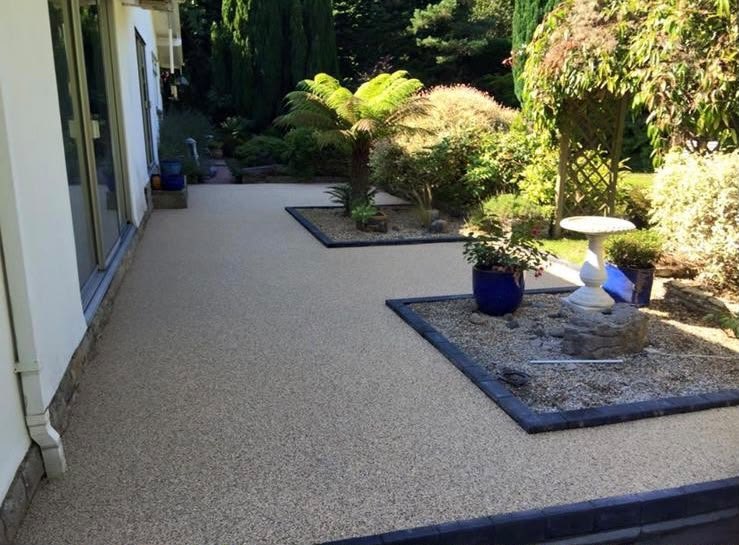
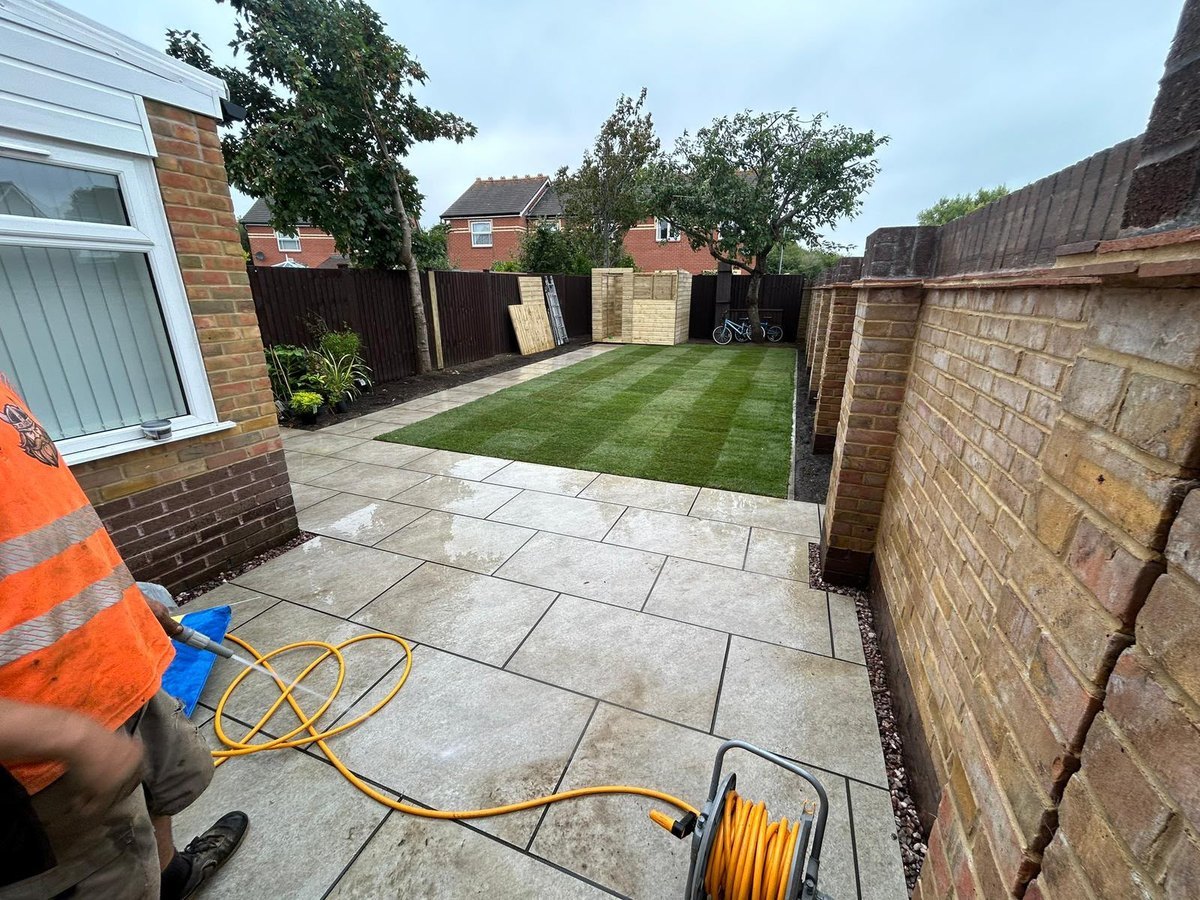
The same surface works for a front path, a back patio or around the garden beds, and ties a path neatly into a new drive. For slabs and porcelain, see our patios page.
Before you choose
Is resin the right surface for your drive?
Resin suits a drive where you want a smooth, even finish that drains and needs little weeding. It has downsides, and you should know them now.
Resin does not enjoy tight turning, and if your drive needs it we tell you before you commit. Turning on full lock with the car standing still scuffs the same spot. A patch repair nearly always shows against the weathered drive around it, and oil staining wants cleaning off quickly. Every one of these gets worse on a poor base.
Block paving is easier to lift and relay when something underneath needs fixing, and a permeable block can drain too. Tarmac is hard wearing and suits long or busy drives, but standard tarmac is sealed. Resin sits between them: smoother than block, and permeable on the right base. We lay all three and will tell you which suits your drive.
How we work
What happens from the first visit to the last sweep
One person, Thomas Hannen, deals with you from the first call to the finished drive. He comes out to measure, checks the levels at the door and the pavement, and lifts a corner or digs a small test hole where he needs to see what the old drive is sitting on.
- A free site visit and a free written quote, with the dig out, sub-base, edging, drainage and resin priced as separate lines
- Dates agreed with you, and the laying day moves if rain is forecast
- Your car parked off the drive from the dig until the resin has cured, so it helps to warn the neighbours
- The old surface and the spoil taken away by skip or grab lorry
- Nothing left open as a trip hazard at night, and the site swept at the end of every day
- If we find something extra once the old drive is up, such as a soft spot or a broken drain, we stop, photograph it and price it, and it only goes ahead when you agree
When it is finished we walk it with you and leave written care notes for the resin used.
Price
What decides the price of a resin driveway
A price per square metre is not something we publish, because the resin is often the smaller part of the bill. What changes the price most is what happens underneath.
- The area, and the shape: curves and cut-outs take longer than a plain rectangle
- Overlay or dig out, and how deep the new sub-base has to go
- Taking the old surface away, and how much of it there is
- The length of edging, and what it is made of
- Drainage: a channel drain at the entrance, a soakaway, or neither
- The stone blend, and how deep it is laid for cars
- Access for the mixer, the barrows and the lorry, and whether there is a side gate or only the front
- Manhole covers, steps and awkward falls
- A dropped kerb, which goes through the council separately
If you have another quote, ask the installer these questions and compare the answers with ours:
- Is it resin bound or resin bonded?
- Is the resin UV-stable?
- What sub-base goes in, and how deep?
- Is the old surface being removed, or laid over?
- What depth of resin goes down where the car turns?
- Who deals with the dropped kerb and the drainage?
Before it gets worse
A drive that is cracking, sinking or holding water
A drive rarely needs anyone today, but its faults grow. A crack lets water into the base, the base softens, and a crack becomes a dip. A puddle by the door that never drains means the fall is wrong. Loose stones on a bonded drive mean the coat has worn through.
Take a photo of the worst spot with a coin or a shoe in it for scale, and another after rain showing where the water sits. Send them with the enquiry and we can tell you on the visit whether it is a repair, an overlay or a dig out. Scheduled work runs Mon to Fri, 8am to 6pm. Something urgent? Ring 07435 839745, and if we miss you we call back.
In Bournemouth
The dropped kerb goes through BCP Council, so check it first
If the drive is new parking, you cannot drive over the pavement until the kerb is dropped. In Bournemouth the kerb is quoted and usually built by BCP Council, or by a contractor the council licenses to work on the highway, not by us.
The council will usually want planning permission for the kerb if the house is on a classified road such as an A-road, if the property is a flat, a maisonette or listed, or if the parking area is a surface that does not let water drain. That last one is where resin bound on a porous base helps you.
The council also sets a minimum space, at least 5.5 metres by 2.6 metres where the car faces the road. It will not drop a kerb too close to a street light, a sign, a street tree or a junction, and it may refuse one if the drive cannot be made level with the back of the pavement. The drive must not spill water onto the road. So check the kerb before the drive is designed, and set the levels to meet it. The national rules are on the Planning Portal dropped kerbs page, and the local ones on BCP Council's dropped kerbs page.
Who you are dealing with
A Boscombe firm, and who you speak to
Bournemouth Roofing & Building Ltd is a limited company, company number 15471719, registered in England and Wales and run by Thomas Hannen from 80a Wolverton Road, Boscombe, BH7 6HX. We lay drives across Bournemouth, from Boscombe and Southbourne to Westbourne, Winton and Kinson, and on into Poole and Christchurch.
Our verified Checkatrade review is a 10 out of 10 from a customer who had a resin driveway, patio and decking area laid. The site visit is free and so is the written, itemised quote.
Questions
Resin driveway questions
How much does a resin bound driveway cost?
A fair figure is not possible without seeing the drive, because the resin is only part of the price. The biggest swings come from whether the old surface can stay as a base or has to be dug out, how deep the new sub-base needs to be, how much edging and drainage the drive needs, and how easy it is to get the mixer and the waste in and out. The visit and the itemised written quote are free.
What are the downsides of a resin driveway?
It is only as good as the base under it, so a cheap base means cracks later. It has to be laid in dry weather, so dates can move. Tight turning on full lock can scuff the surface where the tyres twist. A patch repair usually shows. Resin that is not UV-stable yellows in the sun. And a bonded finish, which is a different product, sheds loose stones and does not drain.
How long does a resin driveway last?
It depends on four things: the base, whether the resin is UV-stable, whether the layer is deep enough for cars, and whether it was laid in the right weather. Get those right, keep it swept, and it lasts well. Get the base wrong and it cracks. Ask any installer which resin system they use and for the manufacturer's data sheet.
Can you pour resin over gravel?
No. Loose gravel moves under a car, and resin bound needs a base that does not move, or it cracks. The gravel comes out and a bound base goes in, usually compacted open-graded stone with porous asphalt on top.
Can you pressure wash a resin driveway?
Gently, now and then. A regular sweep and a hose with a stiff brush does most of the work. If you use a pressure washer, keep it on a low setting with a wide fan and hold it well back from the surface. A narrow, high pressure jet held close can loosen stones at the edges and around any damage.
Do I need planning permission for a resin bound driveway?
For the front garden of a house, not usually. You do not need permission for a new or replacement drive of any size if the surface lets water through or drains to a lawn or border. Resin bound laid on a porous base does that. Over five square metres of sealed surface that runs off to the road does need permission, which is where a bonded finish on old tarmac can catch you out. Flats and maisonettes do not have these rights at all, so a forecourt for a block needs checking with the council first.
Next steps
Other surfaces, and where to go from here
- Driveways and patios: every surface we lay, side by side
- Driveways in Bournemouth: the town's housing and what it means for a drive
- Resin driveways in Poole: the same work across the Poole side
- Block paving: for a drive you can lift and relay
- Tarmac driveways: hard wearing, for longer and busier drives
- Patios: porcelain, stone and slab patios
Free quote
Send us a photo of the drive you have now
Tell us roughly how big it is, whether you need a dropped kerb, and a photo after rain if it holds water. We will come out, check the base and the levels, and put an itemised written quote in front of you.