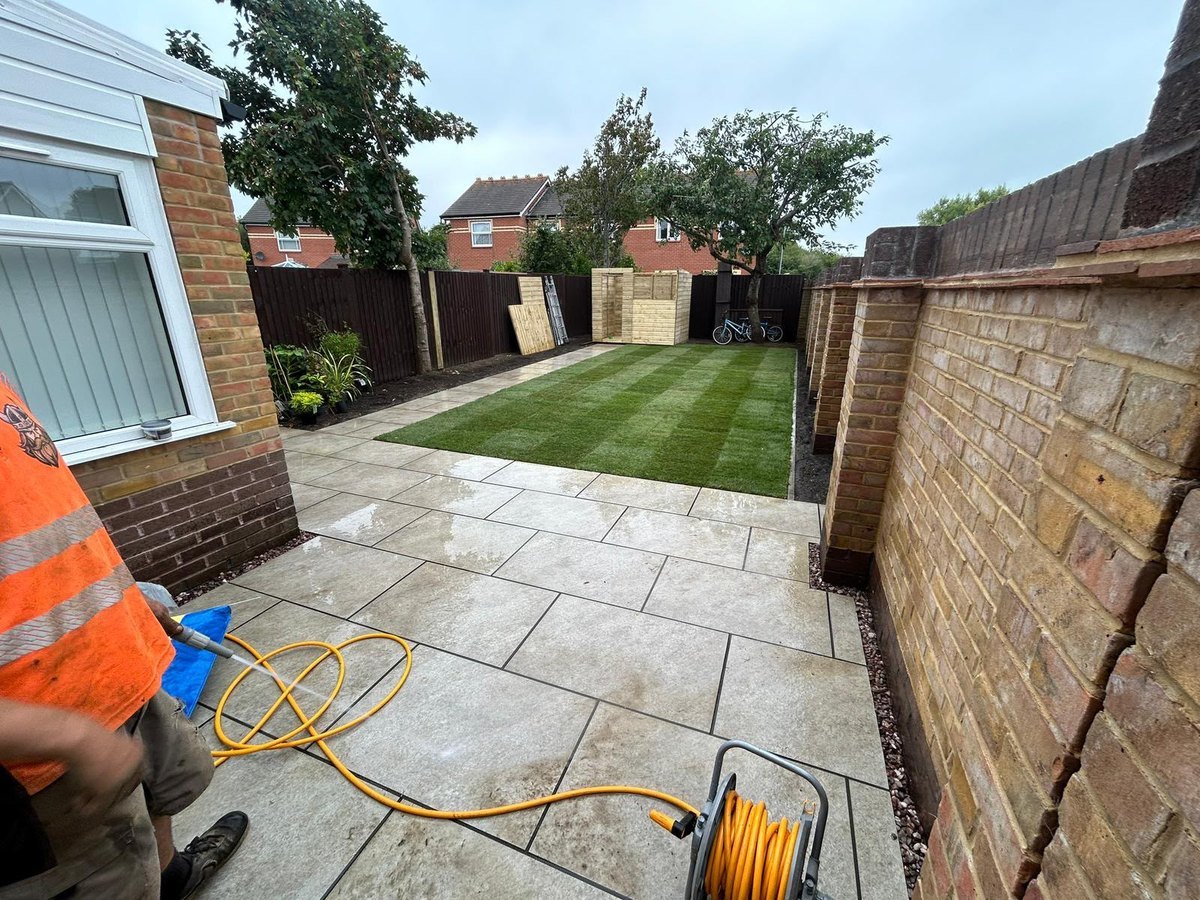
Patio Laying & Paving Repairs Bournemouth
Porcelain, sandstone, limestone and granite on a full mortar bed over a base built up in compacted layers. The dig and the falls decide whether it is still level in ten years, so that is where the survey starts.
Back gardens
Patios, Terraces and Paving Repairs Around Bournemouth and Poole
What you are really buying when you buy a patio is the ground underneath it. The paving goes down last and gets chosen first, and almost every surface that rocks, ponds or drops away failed in the few inches nobody photographs.
Bournemouth Roofing & Building lay, re-lay and repair garden paving across Bournemouth, Poole and Christchurch, and inland through Wimborne, Wareham, Ringwood and Blandford. Thomas Hannen prices every job himself, and the site visit and the written itemised quote cost you nothing.
People ring us about one of four things. A slab that tips when you put a foot on the corner of it. A puddle sitting against the back wall two days after rain. A shaded seating area gone green and genuinely unsafe by November. Or a garden with nowhere flat to put a table. Only one of those is a new patio. The others are a lift and relay of one bay, a drainage detail, or a wash and a fresh joint. The front of the house is a different scheme with its own run-off rules, and that sits on our driveways in Bournemouth page.
- Porcelain, Indian sandstone, limestone, granite and concrete paving, calibrated or riven
- Every slab on a full wet mortar bed with a primed back, never bedded on five dabs
- Falls set away from the building and the finished level kept below the damp proof course
The site visit is free and so is the written itemised quote. Thomas Hannen prices every job himself.
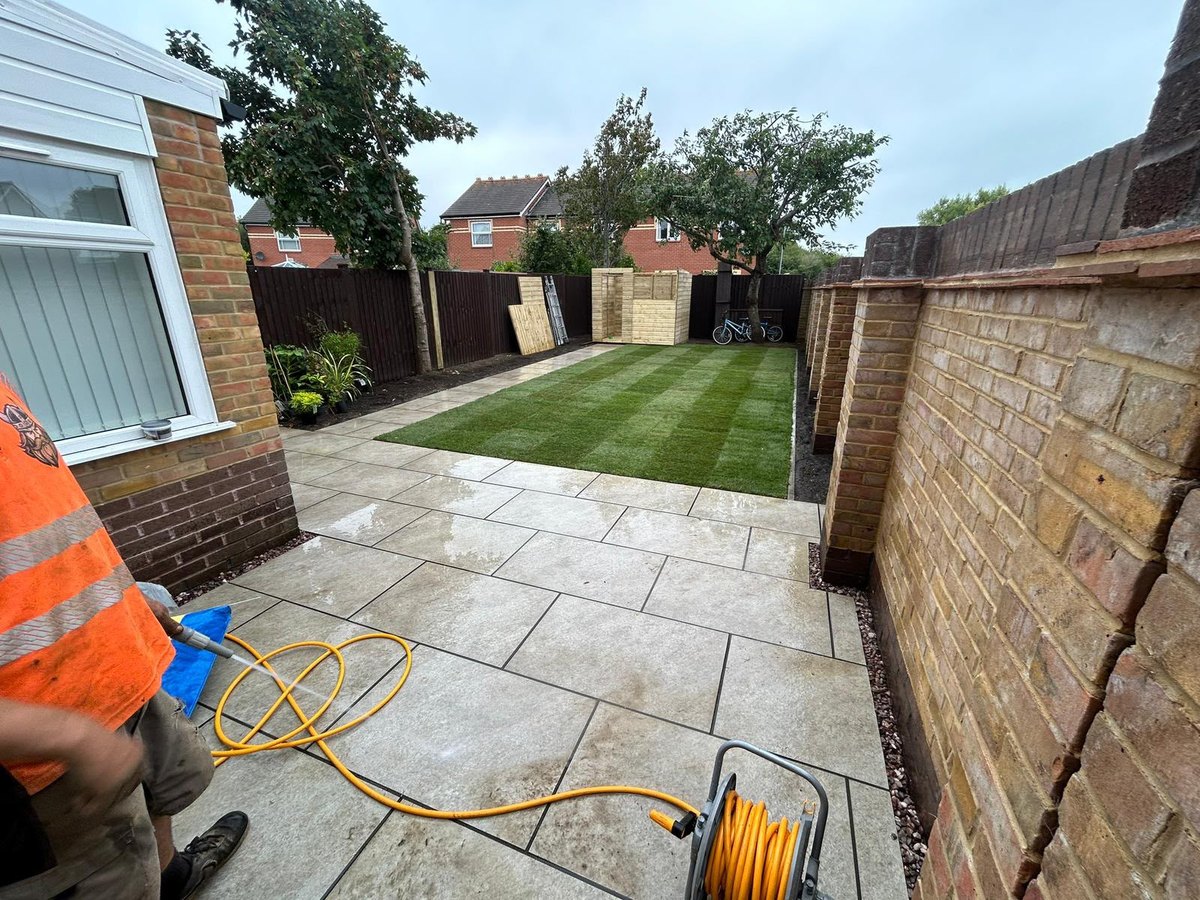
What the job covers
The Dig, the Sub Base, the Bedding and the Edge
From half a dozen rocking slabs in an afternoon to a terrace cut into a slope.
Taking the Old Surface Out, and Where It Goes
Pressed flags bedded on sand, a raft of 1960s concrete, a raised bed, a stump and its roots, or made ground with rubble through it. It is dug out to a formation that will not move, and it is the part nobody budgets for. Spoil is priced by the load. We are on the public waste carrier register, and the duty of care on waste is why it is worth asking anyone quoting you where the muck ends up.
MOT Type 1 Brought Up in Compacted Layers
A geotextile separator goes over soft ground so the stone does not sink into it, then the sub base goes in thin lifts, whacked at each one and carried past the line of the paving rather than stopping at it. Tip the whole depth in and run a plate over the top and you compact the surface while the bottom half stays loose, which is what a patio that settles unevenly is made of.
A Full Wet Bed, Not Five Dabs
Every slab goes down on a continuous bed of mortar with a slurry primer painted on the back, so nothing is hollow underneath. Dabs are quicker and they leave voids that hold water, and the frost lifts the corner out. On porcelain the primer counts twice over, because a dense body gives the mortar almost nothing to grip.
Edgings, Retaining Courses, Steps and Jointing
An open edge is held with a kerb haunched in concrete, and any edge holding soil back gets a footing and a land drain behind it, capped with a coping that throws water clear. An unhaunched edging is the commonest reason a patio spreads and drops along its border. Steps come off a footing with equal risers you can walk in the dark. Joints are brushed in wet with a two part compound and tooled off before it goes hard.
Reading the paving
What a Rocking Slab, a Standing Puddle or a Green Patch Is Telling You
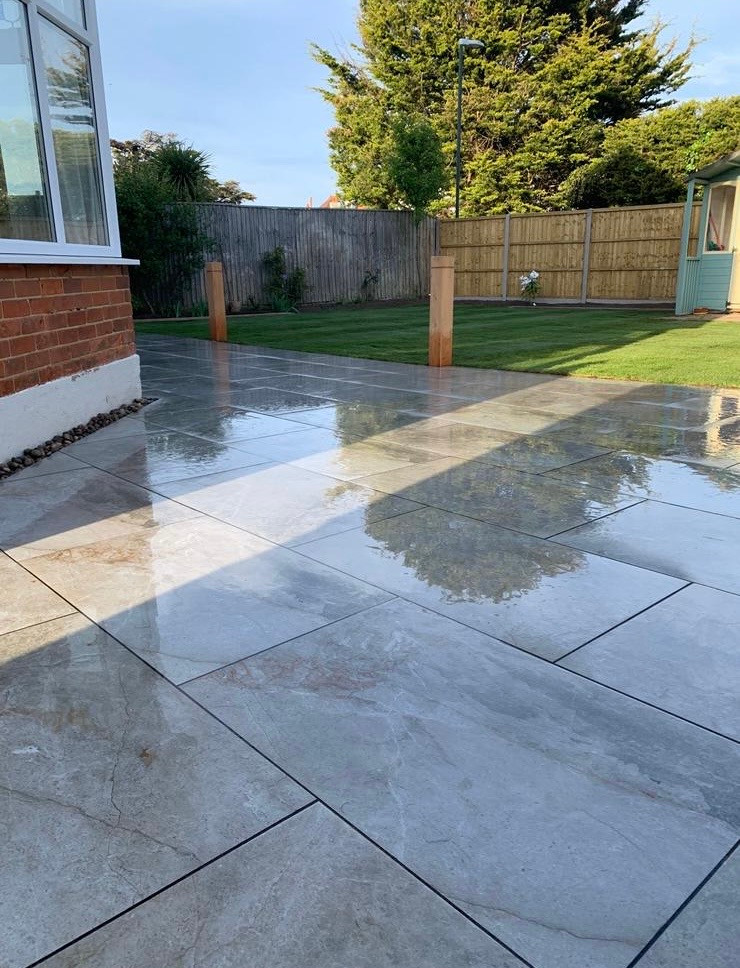
Walk a patio in the rain and you learn more in five minutes than a dry survey gives you.
A slab that tips has a void beneath it, built in the day it was bedded or washed out since. One or two in a sound patio is a lift and relay. A whole bay moving together is the base, and relaying slabs over it buys a season.
Water standing in the same place every time is a fall problem, and against the house it is urgent rather than untidy. A white bloom on new sandstone or limestone is usually efflorescence, salts carried out of the bedding and left on the face as the stone dries. It weathers off over a couple of seasons.
Green or black film on a north facing terrace is algae on paving that never gets long enough in the sun to dry. Where what is under it is sound and level, that is a cleaning job rather than a paving one, and it sits on our exterior cleaning page.
The paving
Porcelain, Sandstone, Limestone, Granite and Travertine
There is no best slab, only the one that suits the aspect, the age of the house and how much upkeep you will do. Aspect is the part people leave out, and it decides whether a patio is a pleasure or a chore by its third autumn.
Porcelain
Twenty millimetre external grade porcelain is what most people ask for now, and on a shaded terrace it is usually right. It takes up almost no water, so frost has nothing to work on and algae little to hold, and a textured face keeps its grip in the wet. It is calibrated to one thickness, so the joints stay honest. It wants a wet blade and a slurry primer, and both are labour rather than material.
Indian sandstone
Warm, easy to work, and the finish that sits most comfortably against older brick and stone here. Riven sandstone is split rather than sawn, so thickness varies across the pack and the mortar bed does the levelling. It is porous: it darkens where water lands repeatedly and greens on an elevation that never sees the sun.
Limestone
Quieter and more uniform than sandstone, and it suits a house where the paving should recede rather than be the feature. It marks with iron, so a rusting table foot or a bag of fixings left out overnight stains it. It weathers softer than the pallet suggests, so ask for a sample.
Granite
The hardest of the natural stones and the least likely to move once down. A flamed finish holds grip in the wet as well as anything, which makes it sensible for steps and the strip outside a back door. It is unforgiving to cut, so curves cost more in time on granite than on anything else.
Travertine and concrete paving
Travertine is beautiful in the dry and the one we most often talk people out of. It is full of open pores and holds water long after the rest of the garden has dried, so on a shaded terrace it stays damp and grows a film. Pressed concrete paving is the other end of the range: consistent, quick to lay, and a good one outlasts a poor natural stone.
Calibrated or riven, and why it moves the price
Calibrated means every slab is sawn to one thickness, so the bed under it is a constant depth and the surface comes up flat with far less adjustment. Riven stone varies through the pack, and that variation is taken out slab by slab in the mortar. The stone can cost the same and the laying does not.
Fault finding
Six Things People See on a Patio, and What Each One Actually Needs
| What you see | What it usually is | What it damages | What puts it right |
|---|---|---|---|
| One slab tipping when you stand on it | A void under it, from dabs or a washed out bed | The slab, which cracks under a point load | Lift it, clean off, re-bed on a full bed |
| A whole area sunk below the rest | A sub base that was never properly compacted | The falls, and the joints around the dip | Take it up, rebuild the base in layers, relay |
| A puddle sitting against the house wall | No fall, or a fall running back at the house | The brickwork at the base of the wall | Relay that bay to a fall, drain the threshold |
| Joints washed out and full of moss | Loose sand, or a compound put in dry | The bed, once water gets between the slabs | Rake out, brush a compound in wet, tool off |
| A white bloom on new stone | Efflorescence, salts drying out of the bed | Nothing structural, appearance only | Leave it to weather, then wash down |
| A slippery green film on the shaded side | Algae on paving that never dries fully | Underfoot safety, more than the paving | A soft wash and a treatment, then sweeping |
That matters when you compare quotes. Two of those are half a day and two are a rebuild with a skip outside, so anybody pricing all six as a new patio is selling the most expensive answer to the cheapest problem.
Water
Falls Away From the House, and Where the Water Actually Goes
A patio sheds every drop that lands on it, and it is usually built against the one wall you least want wet. That is why the falls and the outfall get set out before the paving is chosen. The surface runs away from the building along its full length, not just the first course by the door. Around one in eighty moves water without being noticeable underfoot, and it has to be consistent: a flat spot holds a puddle just as reliably as a badly laid patio.
The finished level matters as much as the fall. Paving stops at least two brick courses below the damp proof course, and the reasoning is in Approved Document C on site preparation and resistance to moisture. Build the level up against a wall and you bridge the damp course, and the damp arrives inside at skirting height on a house whose brickwork looks perfect from the garden. Plenty of older properties towards Wareham, Cranborne and the Avon valley have no damp course at all. There the level comes off the floor inside, and a gravel margin keeps splashback off a soft brick or cob wall.
Where a back door already sits low, the answer is never to raise the paving to meet it. It is a channel drain across the threshold running to a gully, or a step down onto the terrace, or both, decided at the survey with a level on the brickwork.
Then the water has to reach somewhere. An existing gully or a positive outfall into a surface water drain is the simplest route where one exists. Where it does not, a soakaway sited clear of the foundations does the job, and Approved Document H on drainage and waste disposal sets out the order you are expected to try them in. On the clay north of the conurbation a soakaway can fail its percolation test, and a positive outfall is then the only honest answer. The other route is to stop the water becoming runoff at all: a permeable build up over open graded stone lets rain through the joints into the ground below, and the BSI guide to modular permeable pavements covers how those are built. On a plot that already takes water in heavy rain, check the flood risk for the area first.
Permission
When a Patio Needs Consent, and When It Needs None
Paving laid at ground level in a back garden is normally permitted development, because the permitted development rights for a dwellinghouse cover hard surfacing within the curtilage. The government's guidance on when permission is required is the plain English version.
Three things change that. Raising the surface into a platform more than 300mm above the surrounding ground takes it outside permitted development, which is where a level access terrace on a slope trips up. A retaining wall over a metre high alongside a road is caught by the rules on fences, gates and garden walls. And a retaining structure holding a real depth of ground is building control work in its own right, judged against Approved Document A on structure.
Then there is the address. A listed building brings its grounds with it, so garden work can need consent where the house is untouched. Dorset Council publish their listed building guidance, BCP publish the conservation area list, and inside the National Park the interactive property map shows what applies. Boundaries do not follow the streets you would expect, so we check an address first.
Front gardens run on a different rule, about surface water reaching the road. That belongs with the guidance on paving your front garden and our driveways page, not here.
What it costs
How a Patio Quote Is Put Together
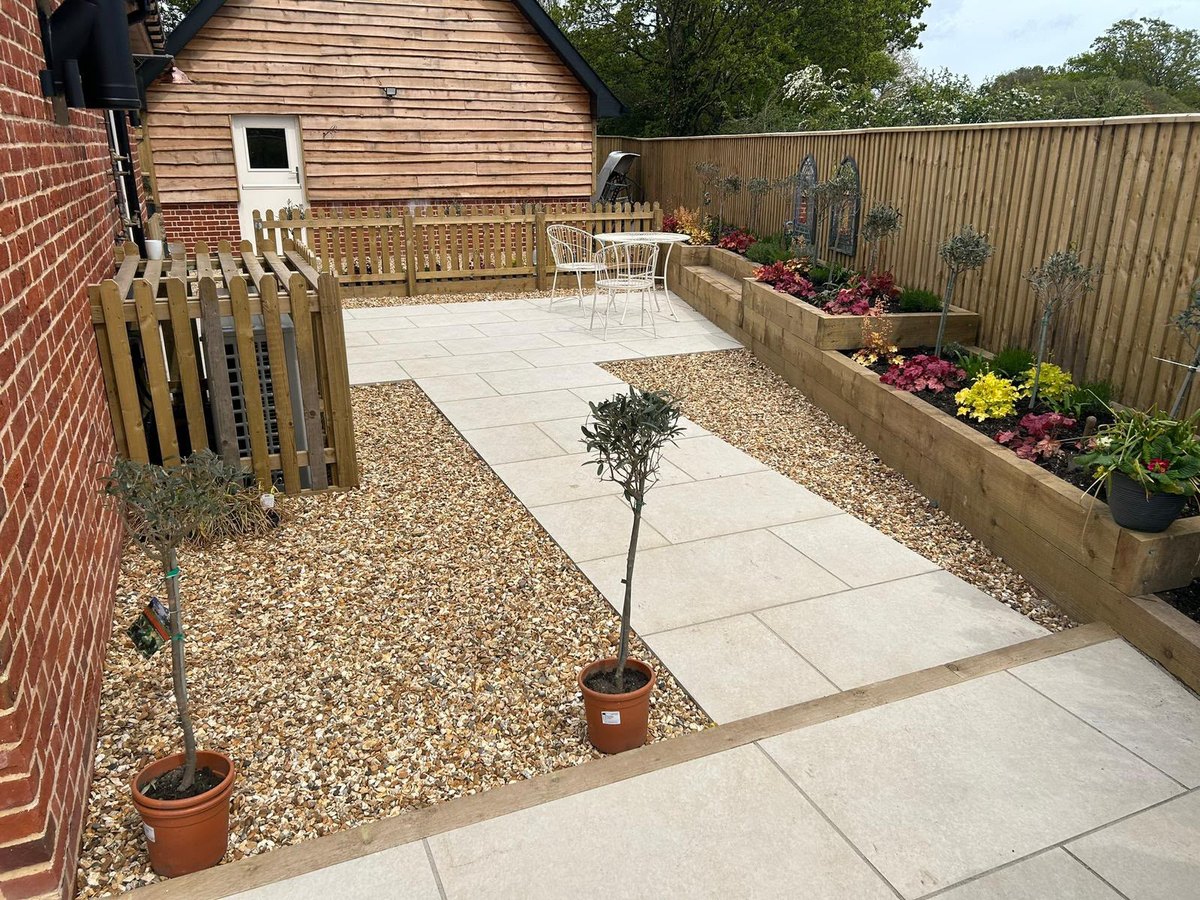
A patio is priced on what has to come out, how it gets in and out of the garden, and what has to be held up. The slabs are the part you choose, and they are rarely the biggest line on the page.
We do not publish a rate by the square metre, because a flat lawn with a gate wide enough for a machine and a terraced garden where every slab is carried through the kitchen are not the same metre.
What the survey is measuring
- What is coming out, and how deep. A concrete raft, flags on sand, a raised bed, a stump or made ground are all different digs, and the depth to a firm formation is the number nobody gives you over the phone.
- How the garden is reached. A gate a machine fits through, a side alley a barrow fits down and a route through the house are three different jobs before a slab is cut.
- What the levels ask for. A flat plot wants a base and a fall. A garden that climbs wants a terrace: a footing, a haunched retaining course, a coping and steps.
- Where the water is allowed to go. An existing gully, a channel drain at a low threshold, a soakaway clear of the footings or a permeable build up are four different costs, and the ground decides which are available.
- The paving and the setting out. Calibrated or riven, the size of the units, and how many cuts a curve or a border puts into the layout.
- Protection and clearing up. The route in is sheeted, the site is swept at the end of each day, and the waste leaves with us.
What we will ask you before we come out
How big the area is and what is on it now. Whether the garden is level or climbing. How you get to the back. Whether the back door sits high or low against the ground outside.
Reading two patio quotes side by side
Ask what depth is being excavated and where the spoil goes. Ask whether the sub base is compacted in layers, whether the slabs sit on a full bed or on dabs, which drain, gully or soakaway the water ends up in, and whether the edges are haunched. Two prices for one garden are usually two different jobs, and the cheaper one dug less.
Questions
Patio Questions We Get Asked Most
How deep does the ground have to come out under a new patio?
The spade decides that, not the tape. You dig until you reach ground that will not move, then build back up in compacted stone, so a garden with a foot of soft made ground in it takes far more out than one hitting firm gravel. That is why the dig sits on its own line and why nobody can settle it over the phone.
Is a full mortar bed really worth it over five dabs?
Yes, and it is the difference between paving that lasts and paving that rocks in its second winter. Dabs leave voids under every slab. The voids hold water, the water freezes, the corners come up, and a heavy planter on an unsupported area cracks the slab. A full wet bed with a primed back costs more in labour and removes the failure.
Which paving stays safest underfoot on a north-facing terrace?
A textured porcelain or a flamed granite. Both are dense, so algae have little to get into, and both keep their grip when wet. Riven sandstone suits an older house but it is porous and it greens on a wall that never sees the sun. Travertine is the one we would talk you out of on a shaded terrace: it holds water and stays damp.
How long before a patio is ready to walk on and put furniture on?
Give the bedding and the jointing a couple of days before anything heavy goes on, longer in cold or damp weather, because both are still gaining strength. Light foot traffic is fine sooner. We tell you on the day, and a route through the garden stays open while we work.
Why does my patio hold a puddle against the back wall?
Because the fall runs the wrong way, or there is no fall at all. Paving should drop away from the building along its whole length, not just at the door, and a surface laid flat ponds wherever the base has settled since. Water standing against a wall soaks the brickwork at the point it is most likely to bridge inside. The fix is a lift and relay of that bay.
Areas covered
Paving Work Across Bournemouth, Poole & Dorset
New patios, terraces, steps and paving repairs in these towns and everywhere between:
Bournemouth Roofing & Building Ltd is registered in England and Wales, company number 15471719, and the Checkatrade review on the profile is a verified 10 out of 10. Drives, block paving, resin and tarmac sit on our driveways and patios page. A garden or retaining wall that needs rebuilding is on our bricklaying and repointing page, and mortar joints alone on our repointing page.
Patios by location
Patios in every town and village we cover
Each page is written around the gardens that are actually there: how far the ground climbs, what the soil does with water, how you get a barrow to the back, what the houses are built of at the point the paving meets them, and what the planning position does to a raised terrace. 84 pages covering 115 settlements, grouped here by the part of the coverage they sit in.
Bournemouth, Poole and Christchurch
Wimborne, Ferndown and the east Dorset heaths
- Wimborne Minster
- Corfe Mullen
- Ferndown
- West Moors
- Verwood
- Three Legged Cross
- Furzehill
- Holt (also Chalbury Common, Gaunt's Common and more)
- Woodlands
- Ashley Heath
- Stone (also Sturminster Marshall)
- Alderholt
- Cranborne (also Whitmore)
Purbeck, Wareham and the Frome valley
- Swanage
- Corfe Castle (also Studland)
- Langton Matravers (also Worth Matravers, Harman's Cross)
- Wareham
- Ridge (also Stoborough)
- Sandford
- Holton Heath
- Lytchett Matravers
- Wool
- West Lulworth (also Burngate)
- Winfrith Newburgh (also Briantspuddle)
- Owermoigne
- Crossways
- Bere Regis
Blandford, the Winterbornes and Cranborne Chase
- Blandford Forum
- Bryanston
- Stourpaine (also Durweston, Ash)
- Spetisbury (also Charlton Marshall)
- Tarrant Monkton (also Pimperne)
- Iwerne Minster (also Shroton)
- Winterborne Kingston
- Winterborne Stickland
- Milborne St Andrew (also Winterborne Whitechurch)
- Tolpuddle
- Sixpenny Handley
- Ashmore
Ringwood, Fordingbridge and the Avon valley
- Ringwood
- Hangersley (also Hightown)
- Burley (also Burley Street)
- Bransgore
- Sopley
- Thorney Hill
- Fordingbridge
- Sandleheath
- Rockbourne (also Martin)
- Breamore (also Woodgreen)
- Hyde (also Frogham, North Gorley and more)
- Downton
- Redlynch
- Lover
The New Forest and the Solent shore
- New Milton
- Barton on Sea
- Bashley
- Ashley
- Milford on Sea
- Everton (also Hordle)
- Lymington
- Walhampton and Portmore (also Pilley)
- Boldre (also Sandy Down, Tiptoe and more)
- East Boldre
- Brockenhurst
- Lyndhurst
- Minstead
- Cadnam and Bartley
West Wight, across the Solent
- Yarmouth (also Bouldnor)
- Freshwater and Totland
- Norton
Free quote
Have the Levels Taken Before You Choose the Slab
Send one photograph from the back door looking down the garden and one of the worst area close up. We will come out, put a level on the brickwork, work out what has to be dug and where the water can go, and put a written itemised price in front of you.