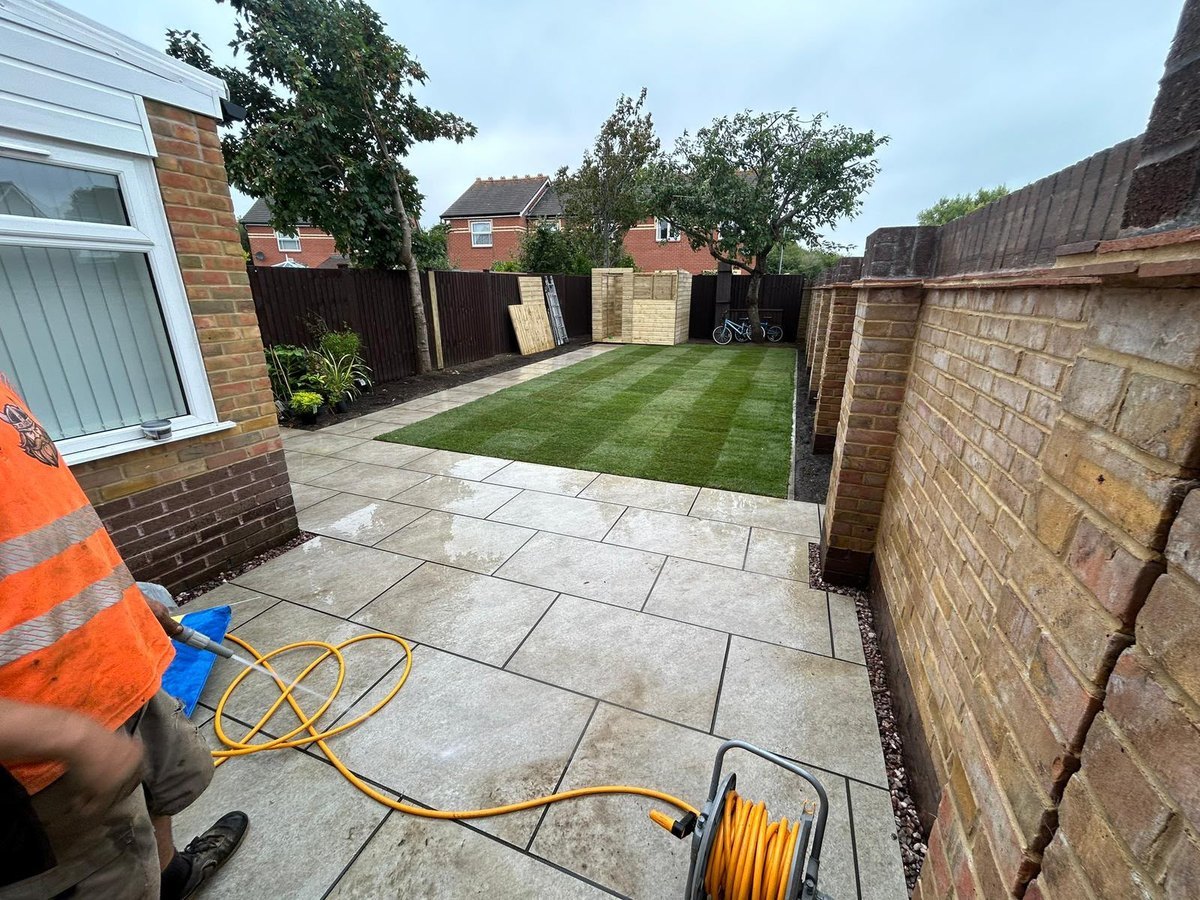
Patios at Matchams, away from the back door
On a plot this size the best place to sit is rarely against the house, so siting the terrace and getting the stone to it are half the job.
The site visit is free and so is the written itemised quote. Thomas Hannen prices every job himself.
Last updated
The houses out at Matchams sit on big plots on the heath, and the best spot to sit in a garden that size is very often not next to the back door. A patio built out in the garden, away from the house, is a different job from one against a wall, and it is worth knowing how before you plan one.
The questions worth settling first here are where a seating area should actually go, and how we intend to get a machine and several tonnes of stone to it without wrecking the lawn on the way.
Both are answered on site. We walk the Matchams plot, look at the sun through the day, work out a route for the machinery and check what the ground does where you want to sit. Then it goes into a written itemised quote with the dig, the base, the edgings, the paving and the jointing on their own lines. The visit and the quote are free.
The work
Seating areas out in a large garden
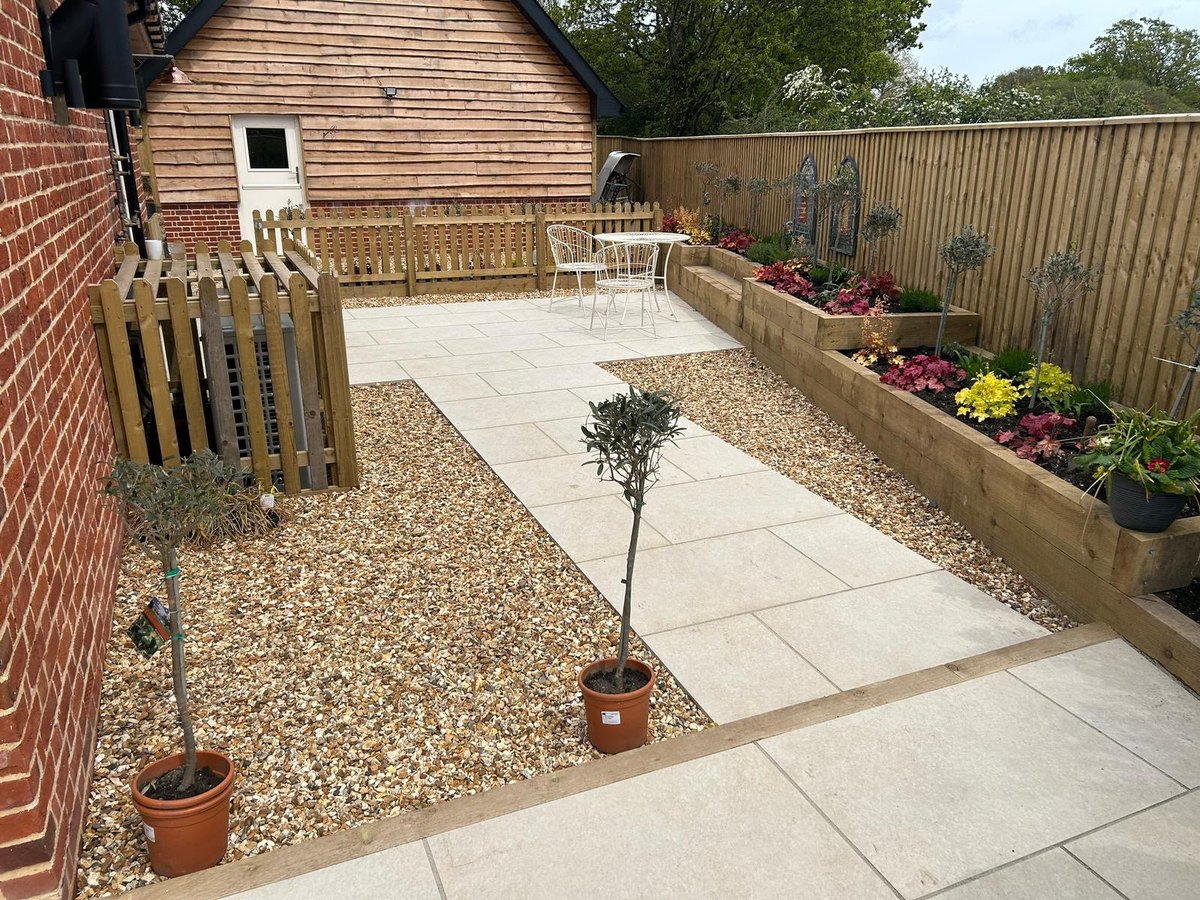
Siting it comes first. A terrace against the house gets the morning and loses the evening, or the other way round. On a Matchams plot with room to choose, a detached seating area can be put where the sun actually is at the time you use the garden, and sheltered from the prevailing south westerly rather than exposed to it. That decision is free and it is the one people most often get wrong.
What changes when it is not against the house. No damp proof course to work to and no threshold to match, so the levels are yours. In exchange, everything has to be held together by its own edges, and it needs a fall and somewhere for the water to go just the same, or you get an island with a wet ring around it.
Access and the route in. Long Matchams gardens mean a long haul. We track boards across grass so the machine and the barrows are not running on soft turf, keep the stone drop as close to the work as the drive allows, and reinstate the route at the end. Spoil goes out the same way, into a grab lorry or a skip, and it leaves with us.
The dig and the base. Turf and topsoil off, down to a formation that will compact, geotextile membrane over it, then MOT Type 1 in compacted layers. Out on the heath at Matchams the ground underneath is generally sandy and free draining, which helps the base but does nothing to spread the load.
Edgings and retaining. A free standing terrace lives or dies on its perimeter. Every edging is haunched in concrete, and where the paving sits proud of the lawn a retaining course with a land drain behind it keeps the base from washing out at the sides.
Full bed laying and paving. Slabs on a full wet mortar bed with a slurry primer on the back of porcelain and dense stone. Porcelain takes almost no water and stays clean under trees. Sandstone is warm and easy to cut but porous. Limestone marks with iron. Granite is the hardest wearing. Calibrated slabs lay faster than hand cut stone.
Drainage. A detached terrace usually drains to the surrounding ground, which on Matchams soil works well. Where it does not, a channel drain takes the runoff to a gully or a soakaway, judged against Approved Document H, and a permeable build with open joints over a free draining base is often neater still.
Steps, jointing and repairs. Steps off a footing with a coping front, joints brushed in with a two part compound and tooled off. We also do the smaller jobs: re-bedding slabs that have lifted or sunk, cutting out cracked ones, re-pointing washed out joints and clearing algae and efflorescence.
How it runs
Building a terrace in a bigger garden
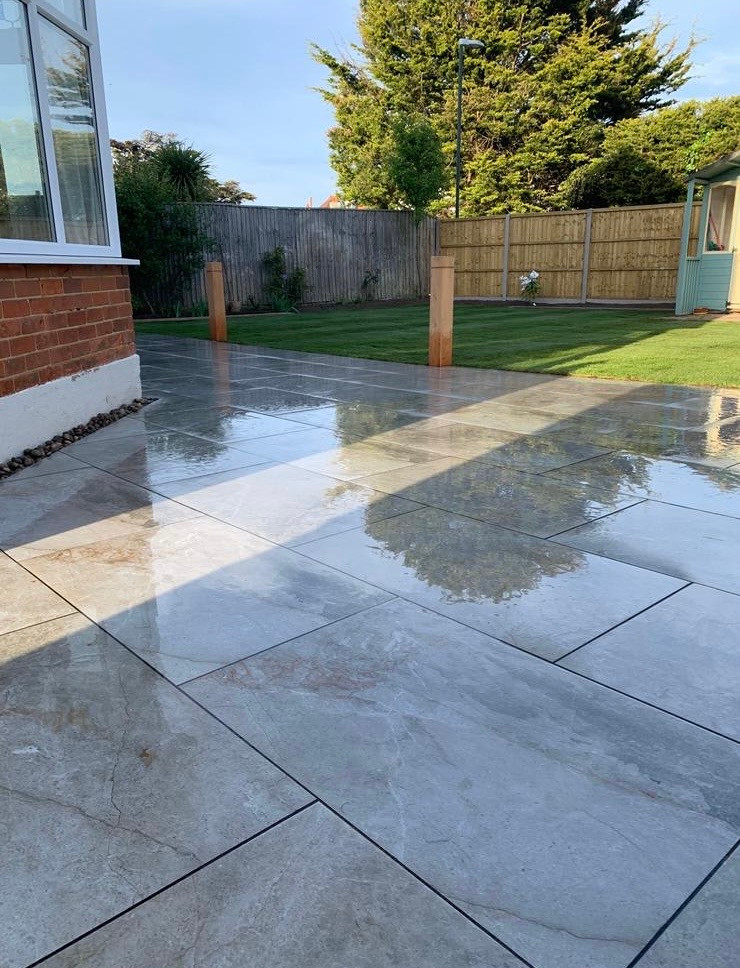
Thomas walks your Matchams garden with you, finds the damp proof course, works out the falls and where the water will go, and prices it himself. The quote separates the dig and spoil removal, the sub-base, falls and drainage, edgings and steps, the slabs, and the jointing. One quote covers the lot.
In a larger Matchams garden the question is often how far everything travels from the gate. A small digger and a tracked barrow can cross a lawn once boards go down, and otherwise it is wheelbarrow runs. We protect the grass, sweep paths daily and take spoil and offcuts away. If the dig finds old concrete, roots or a drain in the way, it is shown to you with a cost before the digger goes further.
Matchams is Dorset Council territory, with no conservation area and nothing listed, so a terrace at ground level is permitted development wherever it goes. What does need watching is anything raised or built alongside. A raised platform needs planning permission, and a summer house or garden room built alongside has its own rules on size and siting, which the Green Belt can tighten. when permission is required sets out where those lines fall. The patio itself, and the stone, are your choice.
Cost
Distance from the gate, levels and the stone
Most of the money in a patio goes into the ground and the carrying, not the paving. How far it all travels. A patio at the back door with a drive alongside is quick to supply. One at the far end of a long lawn, or where the only way in is round the side, means every slab and every barrow of spoil is carried. That is days, not hours.
What comes out. Turf, topsoil, old concrete and roots are dug out and taken away by the load.
Against the house. Paving next to a wall has to finish below the damp proof course and run away from the house, so there may need to be a step down from the door or a slot drain along it.
Where the rain goes. A big terrace sheds a lot of water. It needs to run to a border, a soakaway or a drain, never back at the house.
The stone. Porcelain wants a slurry primer on the back of every slab, sandstone comes in uneven thicknesses, and granite and concrete each bed and joint in their own way.
Ask any rival quote how deep they dig, what goes in as a base, whether slabs sit on a full mortar bed or on spots, how the falls are set, whether edges and steps are in, and what fills the joints.
If it has become a hazard
A lifted slab, a dropped step or green algae
One corner of a slab standing proud, a step that has sunk, or a shaded Matchams terrace gone green and slippery over winter: each of these can put someone on the ground. If that is a real risk, ring rather than use the form.
We re-bed the loose slabs first, then find out whether the base under the others has given way. On algae we use a treatment that kills it at the root, because a jet-wash alone just brings it back greener. Patio work is booked Monday to Friday, 8am to 6pm. Should your call go unanswered, we get back to you as soon as we can.
Worth knowing
Getting several tonnes of stone down a long garden
On a small plot the materials come off the lorry and land within a few metres of the work. On the plots out in Matchams they do not, and that single fact accounts for a surprising share of what a patio costs.
A pallet of paving is roughly a tonne. A base for a decent sized terrace is several more. All of it has to travel from the hardstanding to the spot you have chosen, and the spoil has to make the same trip in reverse.
Doing that badly leaves a garden looking worse than the patio looks good: rutted turf, a stone drop that kills the grass under it, and a barrow line you can still see the following summer. So we board the route rather than run on grass, keep the stone on boards or sheeting rather than straight on the lawn, and put the ground back at the end.
It is worth asking about when you compare quotes, because it is rarely written down. Ask where the materials land, how they reach the work, and who reinstates the route. On a long garden that is a real cost and it belongs on the page.
Who you are dealing with
Who you are letting into the garden
Thomas Hannen runs the business and prices your patio himself after walking the garden. We are five and a half miles off in Boscombe. Around Matchams we cover the Hurn Road side of the heath, St Leonards and out towards Ashley Heath, broadly BH24, where Dorset Council decides planning.
Bournemouth Roofing & Building Ltd is registered in England and Wales, company number 15471719, and trades under that name. One customer's verified score on Checkatrade is 10 out of 10. There is no charge to come out or for the written, itemised quote. On a plot this size the drive is usually long, and a driveway at Matchams can be priced on the same visit if it needs work. Before you book a visit in Matchams, you can read our customers' Google reviews, word for word, on our reviews page.
Planning at a glance
Do you need planning permission in Matchams?
Most repairs in Matchams need no application at all. What decides whether a change to the outside of your house does is who the council is, whether a conservation area or a listing applies, and whether the place sits in a protected landscape.
| Question | In Matchams |
|---|---|
| Who decides | Dorset Council is the planning authority for Matchams. Dorset Council's heritage pages set out what it controls. |
| Conservation area | None covers Matchams, so a like-for-like repair is ordinary maintenance. |
| Listed buildings | Nothing in Matchams is on the statutory list, so listed building consent does not come into it. |
| Protected landscape | No National Park or National Landscape covers Matchams. |
Questions
Questions about patios in Matchams
Should the patio go against the house or out in the garden?
Whichever gets the sun when you actually sit outside. Out in the garden you gain the choice of aspect and shelter and lose the step straight out of the kitchen. Plenty of people in Matchams end up with a small one at the door and a larger one further out.
Does a detached terrace still need drainage?
It needs a fall, yes, or water sits on it. Out in Matchams it will usually run off into the surrounding ground quite happily. Where it will not, a channel and a soakaway, or a permeable build, deal with it.
Will the machinery damage my lawn?
It will if nobody plans for it. We track boards across the route so the weight is spread, keep the stone off the grass, and reinstate the line at the end. It is worth asking anybody quoting how they intend to do that.
How much extra does a long garden add to the price?
Enough that it should be its own line. It is haulage time, in both directions, rather than anything to do with the paving. That is why we itemise it instead of folding it into a rate.
Can you build a patio around an existing tree?
Often, with care: we hand dig near the roots and use a shallow or permeable build so water and air still reach the soil. What we will not do is cut structural roots to get a level base, because that tends to cost you the tree.
Nearby, and next door
Patios near Matchams
Nearby places we also cover for patios, with straight-line distances from Matchams, and the other trades we offer in Matchams itself.
Patios nearby
Our other trades in Matchams
Patios guides
Driveway planning permission and where water goes Frost damage to brickwork: why it shows later Resin bound, block paving or tarmac comparedEverything we do in West Moors Patios, all areas Every area we cover
Free quote
Get the best spot in your garden worked out first
Thomas walks the plot, works out the sun, the shelter and the route in, and prices the build in writing. The visit and the quote are free.