Roof, Wall & Driveway Cleaning Bournemouth
Moss and algae off your roof, walls and drive, across Bournemouth, Poole and Christchurch. Soft washing where the surface is delicate, pressure washing where it is not, and a biocide treatment that keeps working after we have gone.
The site visit is free and so is the written itemised quote. Thomas Hannen prices every job himself.
Exterior cleaning
Exterior Cleaning & Treatments in Bournemouth, Poole & Christchurch
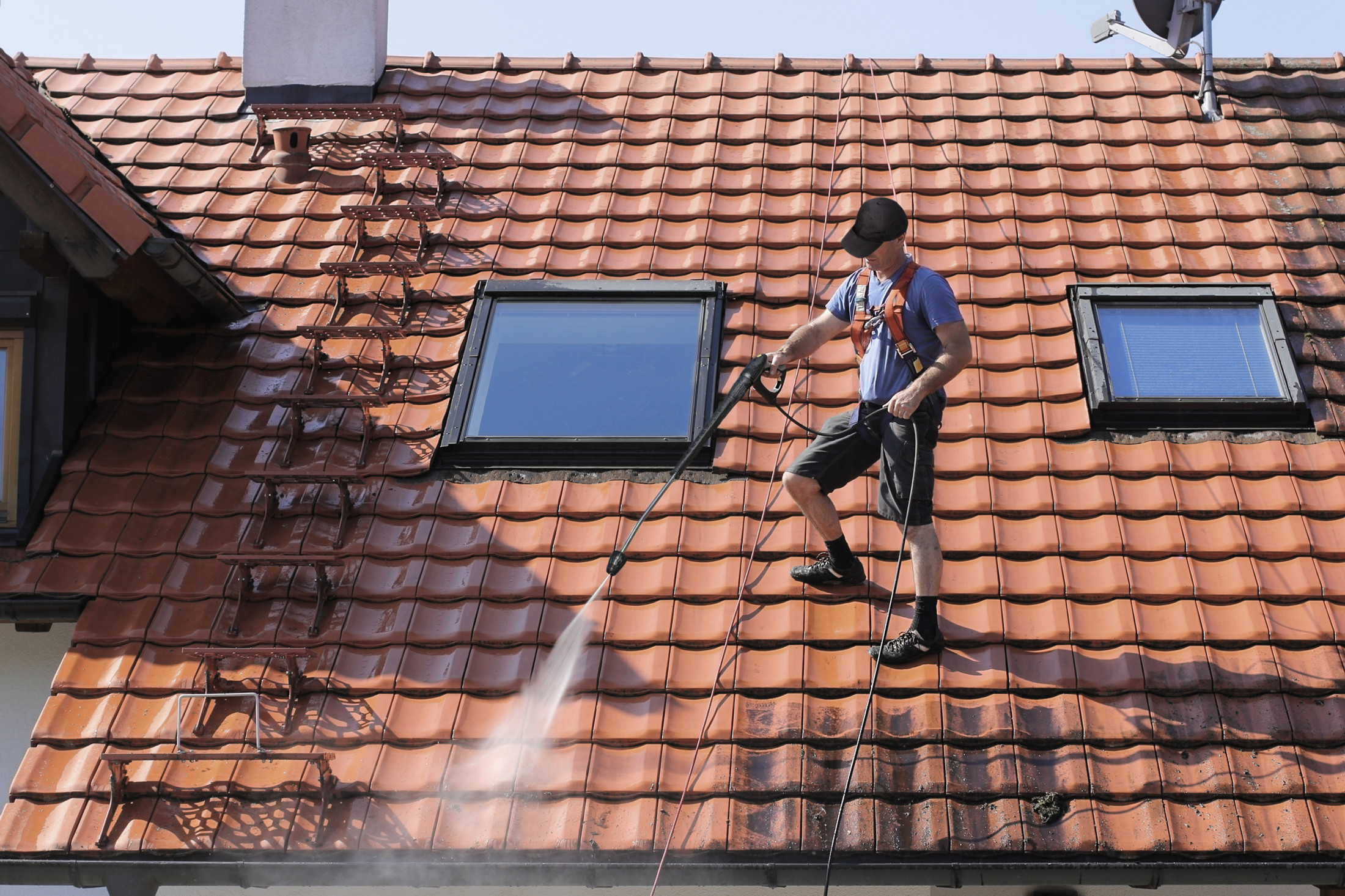
We do not pressure wash roofs, and nor should anybody else. High pressure strips the surface off concrete tiles and drives water up under the laps. A roof is cleaned by scraping the moss out of the laps by hand, soft washing at low pressure, then treating what is left with a biocide so the regrowth is slower. Pressure washing belongs on hard flat surfaces that can genuinely take it.
Cleaning that does not cost you the surface underneath
Anyone can point a lance at a roof. The skill is knowing which surfaces take pressure, which ones need treating instead, and where the water is going to end up.
We clean roofs, render, brickwork, patios, paths and driveways, and we treat them afterwards so the growth takes longer to come back. Because we are roofers as well, we spot the cracked tile or the flashing that has lifted while we are up there, and we tell you about it rather than washing over it.
Domestic and commercial, one-off cleans or maintenance visits. Everything is quoted in writing after we have seen the job.
Where the house sits makes a real difference to how quickly it greens up. Properties on the edge of the New Forest get a constant fall of leaf litter, which is why we do so much roof cleaning in Ringwood, and the pine trees around Verwood drop needles into the tile laps and gutters all year round rather than just in autumn.
What we clean
Roof Cleaning, Wall Cleaning and Driveway Cleaning
Three surfaces, three methods. We match the method to the surface rather than using the same machine on everything.
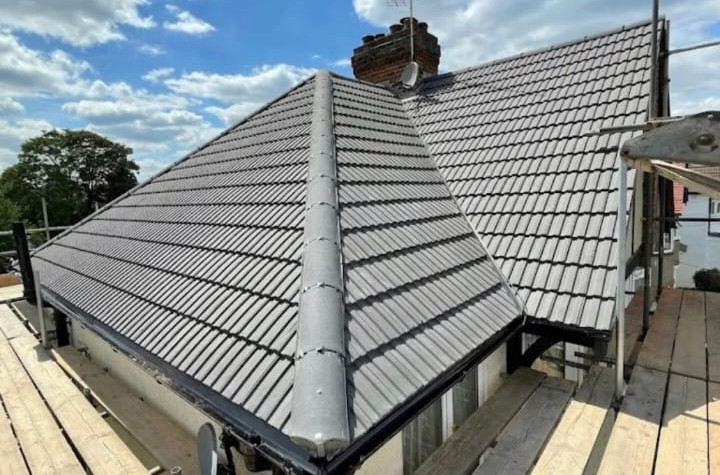
Roof Cleaning & Treatment
Moss scraped out of the tile laps by hand, then the roof soft washed at low pressure so the tiles are not damaged. Gutters, valleys and outlets are cleared of everything that comes down with it. A biocide treatment is then applied to kill what is left in the surface, which is the part that slows the regrowth.
Wall Cleaning & Treatment
Render, pebbledash, painted masonry and brickwork cleaned of green algae, black spotting and general road grime. Soft washing lifts the growth without stripping paint or blowing out mortar joints. Treated afterwards, and if we find open joints or failed render while we are there, we can quote to put that right too.
Driveway Cleaning & Treatment
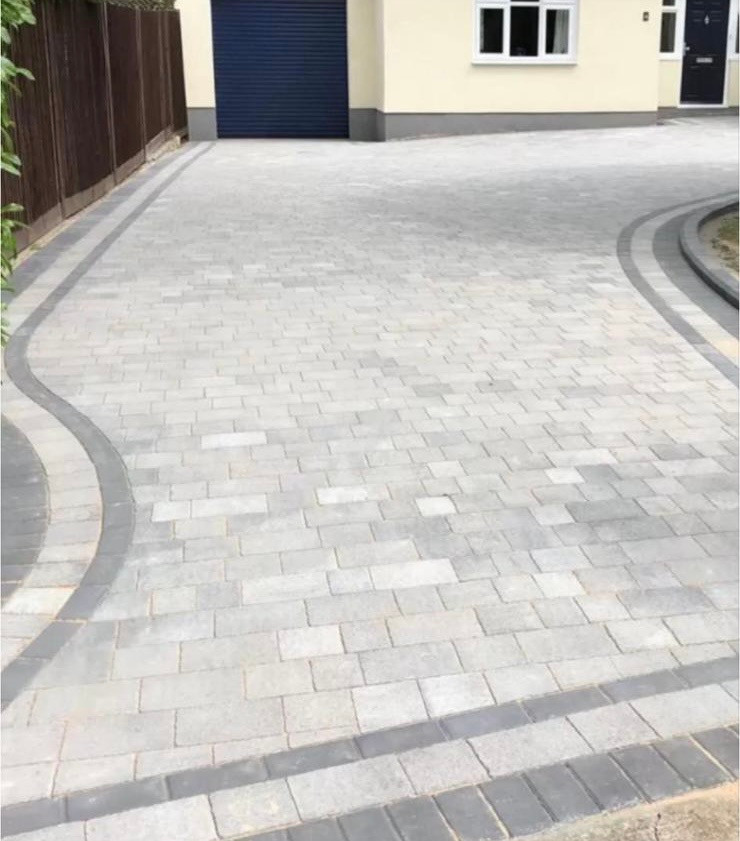
Block paving, concrete, tarmac, slabs and porcelain washed back towards their original colour, with weeds and moss taken out of the joints. Block paving is re-sanded afterwards so the blocks lock together again, and we can seal it if you want the finish to last longer.
Method
Soft Washing vs Pressure Washing for Roofs, Render and Driveways
Soft washing and pressure washing are not the same job
Both have their place. Using the wrong one is how people end up with a stripped roof, blown mortar joints or a patio full of lance marks.
Soft washing
Low pressure, roughly what comes out of a garden hose, with a cleaning solution doing the work instead of force. It is what roofs, render, painted walls and older brickwork need, because the surface stays exactly where it is and only the growth comes off. It looks slower on the day. It leaves the tiles, the paint and the pointing intact, and the result holds for longer because the treatment kills the growth at the root rather than just blowing the top off it.
Pressure washing
High pressure water, used on hard flat surfaces that can genuinely take it: concrete driveways, paving slabs, block paving, steps and some tarmac. It shifts ingrained dirt and lichen quickly and gets right into the joints. On a roof, on render, or on soft old brick it does more harm than good, so that is not where we use it. Pressure and nozzle are set for the surface, not left on maximum.
Why it matters
Roof Moss Removal, Algae Treatment and Gutter Clearance
Moss is not just an appearance problem. Green on a roof or a wall looks scruffy, but the damage it does is mostly to do with water that cannot get away.
It holds water against the surface
Moss behaves like a sponge. Instead of a tile drying out between showers, it stays wet, and in winter that trapped water freezes, expands and breaks up the face of the tile or the mortar it is sitting on.
It blocks the route water should take
Moss knocked off the roof by wind and rain ends up in the gutters, valleys and outlets. Once those block, water backs up under the tiles or runs down the wall, and you get damp inside long before the roof itself has failed.
It makes paths and patios slippery
The green film on paving is the same sort of growth as the one on the roof, and it is genuinely dangerous underfoot in wet weather. It comes off the same way, and treating it afterwards is what keeps it off through the winter.
Driveways & patios
Driveway & Patio Cleaning in Bournemouth and Poole
Cleaned, re-sanded, and left to drain properly
Block paving does not just get dirty. The kiln-dried sand in the joints washes out over the years, weeds take hold, and the blocks start to move under the car. Cleaning it is only half the job.
We wash the surface back, clear the joints out, and then re-sand block paving so it locks together again. Concrete, slabs and porcelain are washed to suit the material, and tarmac is treated more gently because the binder at the surface can be lifted by too much pressure. Drains and gullies are checked and cleared before we leave, so the slurry we have created does not end up blocking them.
If the drive turns out to be past cleaning, we will tell you that as well, and we can quote to replace it.
One thing that gets overlooked on a driveway clean is where the dirty water ends up. Washings full of silt, moss and cleaning solution should not go down a surface water drain, because those run to a watercourse rather than to treatment. The pollution prevention guidance on GOV.UK is the reference for that, and it is the reason we check and protect gullies before we start rather than clearing them out afterwards.
Salt and sea air keep block paving and render dirtier for longer near the water, so a lot of this work is for homeowners in Poole and along the coast towards Christchurch.
How the day runs
How a Roof, Wall or Driveway Clean Works
Prepared, cleaned, treated, tidied up
Most jobs are done in a day. Larger roofs and full driveways take longer, and we will tell you which yours is before we start.
Look at the job
We come and see the surface, the access, how bad the growth is and what is planted nearby, then quote in writing.
Protect and prepare
Planting wetted down or sheeted, drains and gullies checked, and the right method chosen for each surface.
Clean
Moss scraped and soft washed, or pressure washed where the surface takes it. Gutters cleared of what comes down.
Treat and tidy
Biocide applied where it is wanted, everything rinsed off, and the site left clean. The treatment carries on working afterwards.
What it costs
What Drives the Cost of Roof, Wall and Driveway Cleaning
Exterior cleaning is priced on access, and on how much growth has to come off by hand before anything is washed. Area matters less than people expect. A small, steep, heavily mossed roof with nowhere to stand a tower costs more than a large open one you can reach easily.
Most jobs are a day. Larger roofs and full driveways take longer, and we will tell you which yours is before we start. These are the things behind the figure.
What moves the number
- Access. A bungalow reached off a tower, a two-storey semi, and a roof with nowhere safe to stand on one side are three different prices for the same square metres. This is work at height, and the HSE rules on work at height are why a safe working position is priced in rather than improvised.
- How much moss is actually up there. A light green film is a wash and a treatment. Moss sitting proud in the laps has to be scraped out by hand first, and that is the slow part of a roof clean, not the washing.
- What the surface is. Concrete tile, clay, natural slate, render, pebbledash, painted masonry, block paving, porcelain and tarmac each want a different method and a different amount of care. Using one machine on all of them is quicker, and it is how surfaces get wrecked.
- Protection and preparation. Planting wetted down or sheeted, gullies and drains protected, windows and doors checked. It is unglamorous, it takes time, and leaving it out is how a clean turns into a claim.
- Gutter clearance. On a roof clean this is part of the job rather than an extra, because cleaning a roof brings a great deal of debris down into the gutters. As a stand-alone visit it is priced on its own.
- Whether a treatment goes on afterwards. A scrape and a wash is cheaper than a scrape, a wash and a biocide. The treatment is what changes how long the result lasts, which usually makes it the better value of the two.
- Re-sanding and sealing on block paving. Cleaning washes the kiln-dried sand out of the joints, so re-sanding is part of doing the job properly rather than an upsell. Sealing is genuinely optional and priced separately.
- How often it needs doing. A shaded, tree-covered roof on the forest edge wants looking at more often than an open south-facing one. Keeping on top of it is cheaper than letting it go, and that is a maintenance conversation rather than a one-off price.
| Method | Soft washing | Pressure washing |
|---|---|---|
| Pressure used | Roughly what comes out of a garden hose | High pressure, with the nozzle set for the surface |
| What does the work | A cleaning solution, then a biocide treatment | Force and water volume |
| Right for | Roofs, render, painted masonry, older and softer brickwork | Concrete drives, paving slabs, block paving, steps, some tarmac |
| Wrong for | Nothing. It is simply slower on hard surfaces | Roofs, render, soft old brick, lime pointing |
| Cost of using it in the wrong place | Time only | The surface off the tiles, blown mortar joints, water driven under the laps, lance marks across a patio |
| How long the result holds | Longer, because the treatment kills growth at the root and keeps working | Shorter on porous surfaces, because only the top is taken off |
| How it looks on the day | Slower and less dramatic | Instant, which is exactly why it gets used where it should not be |
What we will ask you
Which surfaces, and roughly how big. How many storeys, and whether there is space around the building for a tower. Which way the roof faces, and whether trees overhang it. How long since it was last done, and whether it has ever been pressure washed. Whether there is a pond, a vegetable bed, fish or anything else sensitive nearby. A photograph from the garden usually answers half of that.
Why two cleaning quotes differ
Most often because one is soft washing and the other is pressure washing, and the cheaper of the two is the one that will cost you a roof. After that it is whether a biocide treatment is included, whether the gutters are being cleared, whether block paving is being re-sanded, and whether the planting and the drains are being protected before anyone starts.
Ask what pressure is going on your roof, and ask what the treatment is. We use biocides approved for the purpose and apply them to the label, which is a legal requirement under the biocides regime the HSE administers rather than a preference. A contractor who cannot tell you what they are spraying is not the right contractor.
Questions
Exterior cleaning questions we get asked
Will pressure washing damage my roof tiles?
It can, which is exactly why we do not blast roofs. High pressure strips the surface layer off concrete tiles, drives water up under the laps where it is not supposed to go, and can shift or crack older or brittle tiles. A roof is cleaned by scraping the bulk of the moss out of the laps by hand and then soft washing at low pressure, letting the treatment do the work instead of force. Hard, flat surfaces such as concrete driveways and paving slabs are a different matter and do take pressure washing well, with the pressure and nozzle matched to the surface.
How often should a roof be cleaned?
It depends on the roof rather than on a fixed schedule. A north-facing roof shaded by trees will green up several times faster than an open south-facing one. As a rough guide, most roofs around here want looking at every few years, and a biocide treatment after a clean stretches that interval out. The practical test is to stand in the garden once a year and look up: if moss is building up in the tile laps, sitting proud along the ridge, or dropping into the gutters, it is time.
Do you clean the gutters at the same time?
Yes, and on a roof clean it is part of the job rather than an extra. Cleaning a roof brings a lot of moss and debris down into the gutters, so we clear and flush them afterwards and check that the outlets and downpipes actually run. If we find a cracked joint, a bracket that has pulled away or a length that has dropped out of level, we will tell you and quote for the repair separately.
Is the treatment safe for plants and pets?
We use biocides approved for this purpose and apply them according to the label, which is a legal requirement rather than a preference. In practice that means planting near the wall is wetted down or sheeted before we start, we keep spray away from ponds and open water, and we ask that pets and children stay off treated surfaces until they are dry. Once dry, treated paths and patios are fine to walk on. Tell us about ponds, vegetable beds, fish or anything else sensitive before the day so we can plan around it.
How long before the moss comes back?
It will come back eventually. The spores are in the air everywhere and Dorset is damp, so nothing stops it permanently. What changes is how fast. A roof that is only scraped and washed will green up again fairly quickly. One that is cleaned and then treated stays clear noticeably longer, because the biocide carries on working in the surface for months after we have packed up and the rain gradually washes the dead growth away. We will not put a number of years on it, because shade, overhanging trees and which way the roof faces make more difference than anything we do on the day.
Where we work
Roof, Wall and Driveway Cleaning Across Dorset
We serve these areas for roof cleaning, wall cleaning and driveway cleaning, and we will tell you honestly if a surface is better treated than washed.
Exterior cleaning by location
Exterior cleaning in every town and village we cover
Each page is written from the ground, the housing stock and the planning position of that settlement, using Environment Agency, British Geological Survey, Valuation Office Agency and Census records. 84 pages covering 115 settlements.
Within 8 miles
8 to 14 miles
- Stone (also Sturminster Marshall)
- Furzehill
- Ashley Heath
- Beacon Hill
- Swanage
- Holt (also Chalbury Common, Gaunt's Common and more)
- Holton Heath
- Thorney Hill
- Three Legged Cross
- Lytchett Matravers
- Langton Matravers (also Worth Matravers, Harman's Cross)
- Barton on Sea
- Corfe Castle (also Studland)
- Sandford
- Ridge (also Stoborough)
- Ringwood
- New Milton
- Wareham
- Bashley
- Burley (also Burley Street)
- Verwood
- Hangersley (also Hightown)
- Ashley
- Milford on Sea
- Everton (also Hordle)
- Spetisbury (also Charlton Marshall)
- Alderholt
- Cranborne (also Whitmore)
14 to 20 miles
- Tarrant Monkton (also Pimperne)
- Hyde (also Frogham, North Gorley and more)
- Winterborne Kingston
- Lymington
- Brockenhurst
- Boldre (also Sandy Down, Tiptoe and more)
- Sandleheath
- Bere Regis
- Fordingbridge
- Blandford Forum
- Freshwater and Totland
- Walhampton and Portmore (also Pilley)
- Wool
- Norton
- Bryanston
- Yarmouth (also Bouldnor)
- Rockbourne (also Martin)
- Lyndhurst
- Sixpenny Handley
- West Lulworth (also Burngate)
- Breamore (also Woodgreen)
- Minstead
- Winterborne Stickland
- Winfrith Newburgh (also Briantspuddle)
- Milborne St Andrew (also Winterborne Whitechurch)
- Stourpaine (also Durweston, Ash)
- Tolpuddle
- East Boldre
- Cadnam and Bartley
- Lover
- Redlynch
- Downton
- Ashmore
- Woodlands
- Crossways
- Iwerne Minster (also Shroton)
- Owermoigne

Free quote
Get a price for your clean. No obligation
Send a photo of the roof, wall or drive and we will come and look at it, then put a clear written quote in front of you.