Exterior cleaning in Wareham
Roof moss, streaky render, blocked gutters and slippery paving, each cleaned the way that surface will stand. Free site visit, free itemised quote.
The site visit is free and so is the written itemised quote. Thomas Hannen prices every job himself.
If a Wareham roof or wall has gone green, the answer is a soft wash and a biocide, not a jet wash. The growth is living, so it has to be killed rather than blasted off, and on the old town roofs pressure does more harm in an afternoon than the moss has done in ten years.
Three things bring people here to the phone. A slope of tile that has turned dark and started shedding moss into the gutter. A front elevation on one of the town streets that has gone streaky and grey while the house next door looks fine. And a back path or patio that goes slippery every autumn and stays that way until March.
We survey the whole property before quoting any of it, because on most Wareham houses the surfaces want different treatment from each other. Old clay tile, Purbeck stone slate, painted brickwork and sand and cement render all get chemistry and a gentle rinse. Concrete flags, tarmac and block paving will take a machine and are quicker for it. You get one itemised written price covering the lot, with each surface on its own line so you can drop any of it without redoing the whole quote.
The work
Roofs that never see the sun, and old town brick
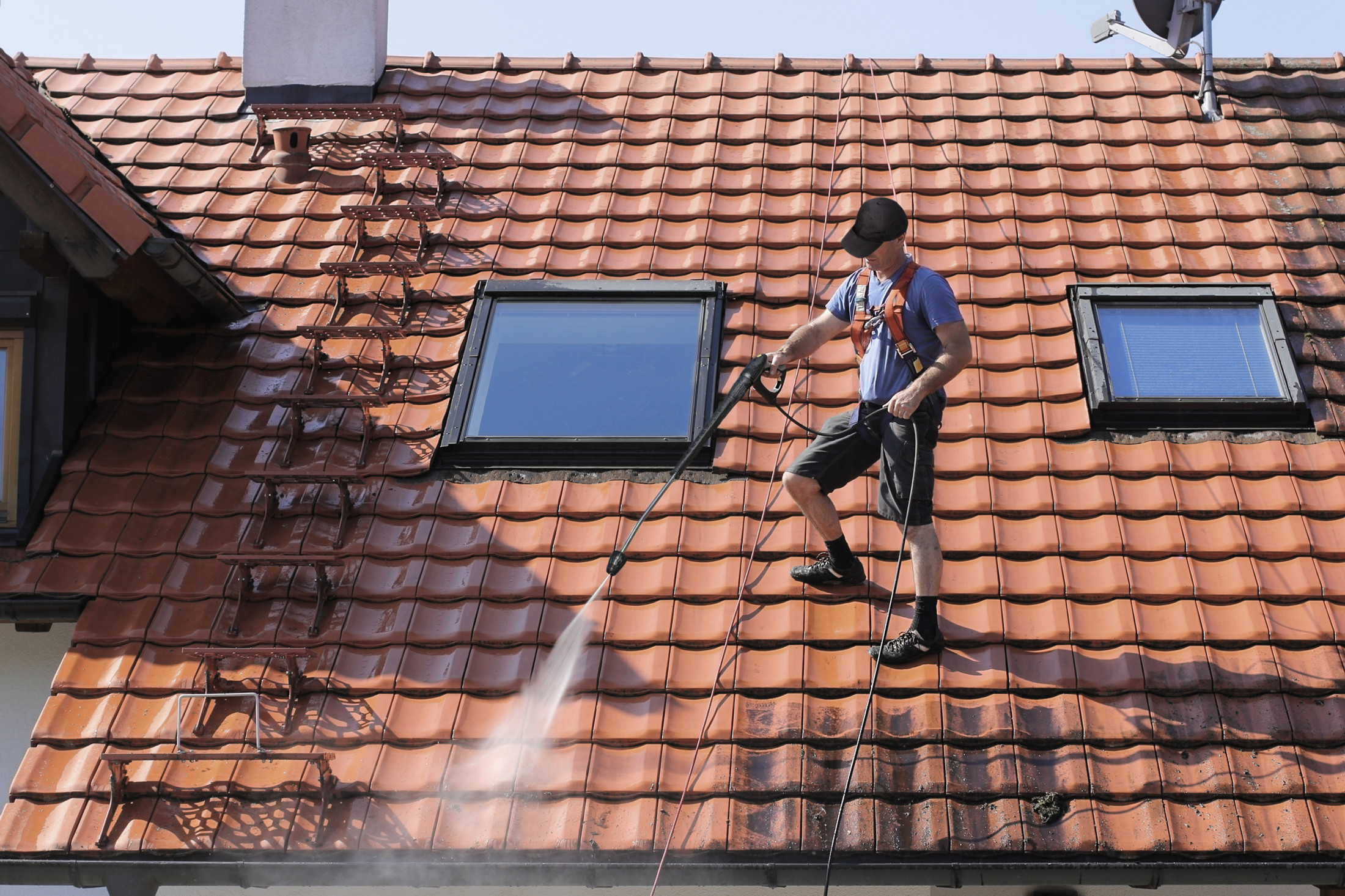
The old streets, and the estates. Inside the walls the roofs run in continuous terraced slopes, plain clay tile and pantile mostly, with Purbeck stone slate on the oldest of them, and one slope often covers three or four houses, which is why a terrace can look half cleaned from the pavement. Moss beds into the laps, holds water and lifts the tail of the tile, and on stone slate it gets under the peg and does real damage. That work is scraped by hand off ladders and towers from the front and the back yard. Nobody should be putting a lance on stone slate. Just over half the town was built between 1945 and 1982, peaking in the late 1960s and early 1970s, and those roofs are concrete interlocking tile: porous, so it holds moss better than anything else here, but tough enough for a straightforward scrape, wash and treatment.
The slope that never dries. The aspect here is north west, and a slope that gets no direct sun stays damp most of the year, so moss and algae establish far faster than on the open side of the same roof. That is usually the elevation people ring about, and the one to treat rather than scrub, because growth is back within a season if the spores are only rinsed off.
Painted brick and render fronts sit straight on the pavement here, so half of that job is protecting people and parked cars while it is done. Low pressure nozzle, the treatment left to dwell, then a soft rinse. Force would strip paint off a rendered front in visible bands and pull the mortar out of a soft old brick joint, and on a house joined to two others the damage would be somebody else's as well as yours. In the terraces the gutter runs the length of the row and the downpipes are shared, so a blockage at one outlet floods somebody else's wall, while out on the estates it is a long low run over a garage or a conservatory. Either way clearing is by hand and by vacuum, each downpipe is flushed, and valley gutters are checked because they silt up quietly and overflow inward.
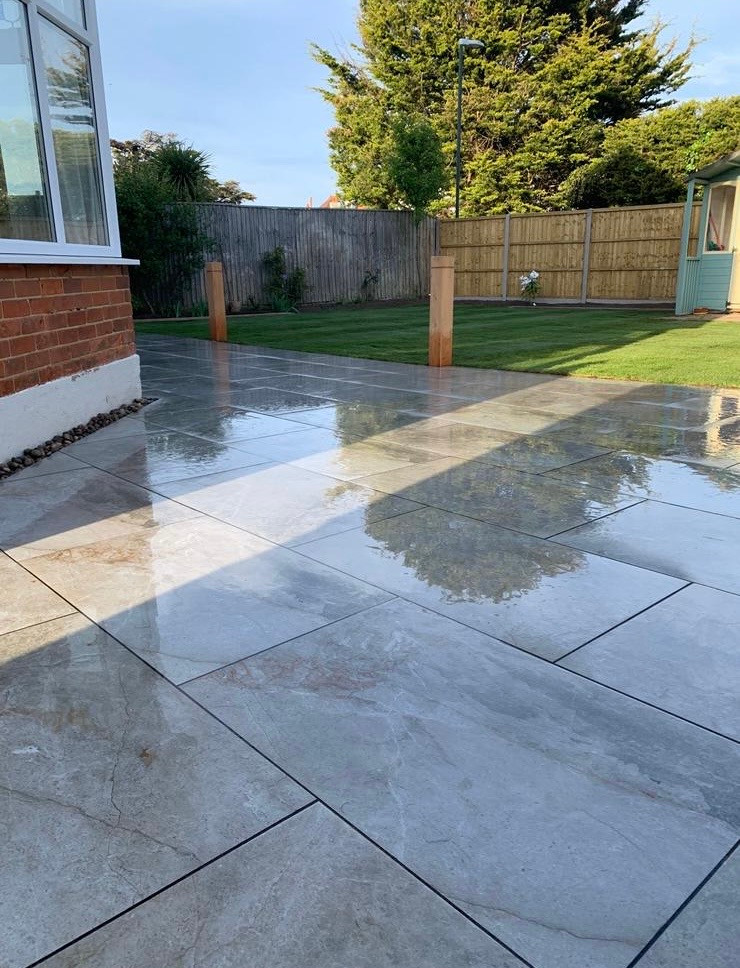
Block paving on the estate drives, brick paviours and old flags in the town, and slabbed back yards behind the terraces. Block paving is washed with a rotary head at a controlled setting and re-sanded with kiln dried sand, which is not optional: joints left empty let the blocks rock. Old flags and stone get less pressure, and black spot lichen on them will not shift in a single visit. Beds are sheeted, every gully covered, and the discharge point agreed first. Products go on at the rate printed on the label and only on surfaces they are approved for, which is what the biocides regime the HSE administers requires, and pollution prevention guidance is why nothing runs to a ditch or a watercourse. Wareham sits between two rivers, in flood zones 2 and 3 with the Piddle a little over 150 metres away, and that matters more here than in most places we work.
How it runs
From your call to a written price
Same team throughout, one person to ring, and an itemised quote: the method for each surface, protection, access and where the water and residue go, each on its own line. Cleaning a surface is maintenance and there is nothing to apply for. The exception worth knowing about is the old town. There are 196 listed entries in and around Wareham, concentrated in the streets inside the walls rather than out on the estates, and abrasive cleaning of a listed building can need listed building consent because it takes fabric off the building. On anything listed we check with Dorset Council before a machine comes out of the van, and the answer is usually a poultice or a very soft wash.
Cost
What decides the price of a clean
No rate per square metre, because the same square metre can be twenty minutes or two. Access decides most of it: a town terrace where every hose and machine goes down a shared passage or through the house, a seventies semi with a drive you can park the van on, and a bungalow whose eaves you can reach off a pole are three different days. Poles do a lot, some of it wants a tower, and work at height rules decide which. Ask each quote what method goes on each surface, whether a second visit is included, and where the run off ends up.
If there is a date
A viewing, a visit or a deadline
Ring rather than use the form. Not emergency work, but usually work with a date on it: a sale, a letting inspection, or scaffolding coming down. Wareham is about twenty minutes from us, so a date is usually workable if you ring as soon as you have one rather than the week before. The phone is answered 24 hours for emergencies; scheduled work runs Monday to Friday, 8am to 6pm.
Worth knowing
One slope green, the other clean, and what to do about it
Look along almost any Wareham street and you will see roofs that are dark on one pitch and near enough clean on the other. That is not neglect and it is not a fault in the tiles. It is aspect. A slope that faces roughly north gets no direct sun for months at a time, so after rain it stays wet into the following day, and moss, algae and lichen need very little else.
The slope opposite dries within hours and never lets growth establish. The same happens on walls: the shaded gable greens up while the sunny front stays clean, and the paving under a north wall is the paving people slip on.
Two practical things follow. First, you can often buy half a job. If only the shaded pitch has gone, we will scrape, wash and treat that slope and leave the other one alone, and the quote shows it as its own line so you can see what you are saving. Second, timing changes the result. A shaded surface treated in late spring or summer gets weeks of drying to work in, and the regrowth is slower and patchier when it does come.
The same treatment put on in November sits on a wet surface, gets rinsed off by the next front coming in, and you are looking at green again by the following autumn. If you want a rough rule for Wareham, book the shaded elevations for the warm half of the year and save the hard paving and the gutters for the cold half, when the trees have finished dropping.
Who you are dealing with
A local firm you can check
We cover Wareham and the BH20 villages, out to Sandford, Stoborough, Ridge and Holton Heath, and Dorset Council is the planning and building control authority for this address. Bournemouth Roofing & Building Ltd, registered in England and Wales, company number 15471719, which you can look up in a minute. Thomas Hannen's business, and he is the one who comes out to price the job, not a salesman. A verified customer's 10 out of 10 on Checkatrade. The visit and the written quote are both free.
Questions
Wareham questions we get asked
Why does the back of the house stay green all year?
Because no sun ever reaches it. The local aspect in Wareham is north west, so that pitch and that wall stay damp from one week to the next and algae establish far faster than on the open side. The wash gets the growth off, the biocide is what keeps it off, and even then the shaded elevation will come back before the sunny one does. We weight the quote towards that side for exactly that reason.
The street is listed. What does that change for cleaning?
Wareham has 196 listed entries, so a good number of jobs here are on one or next door to one. Washing a listed wall needs no consent in itself, but the method has to suit the fabric, and on old brick and render in West Street that means low pressure and hand work rather than a lance. Nothing gets sealed or painted without you checking with Dorset Council. We say plainly if a surface should be left alone.
Is the river a problem when a whole frontage is washed?
It is a consideration. Wareham sits in flood zone two and three with the Piddle close by, so on a low lying frontage the wash water runs rather than soaks away. We collect it off sheeting instead of letting it find the nearest gully, and the moss solids are bagged and go with us. On a wide frontage we work in sections so there is never more water on the ground than we can catch.
Our roof runs on across next door. Can just ours be cleaned?
That is the normal job in Wareham, where 29.5% of the stock is terraced. The covering stops at your rafter but the gutter and often the valley do not, so we clear the shared run to the next outlet in both directions or the debris comes straight back to you. Where a neighbour will not have it done we work to the party line and tell you what is sitting on the other side of it.
How do you reach the back with no side access?
Through the house with boards and sheeting down, or over the roof from the front on a pole system, depending on what is back there. Plenty of Wareham terraces have no side alley at all and a yard you can only get to through the kitchen. We look at it on the free site visit and say which way it has to be done, because that decides whether it is a one man job or two.
Nearby, and next door
Exterior cleaning near Wareham
Exterior cleaning nearby
Our other trades in Wareham
Everything we do in Wareham Exterior cleaning, all areas Every area we cover
Free quote
Get a price for exterior cleaning in Wareham
Tell us the address and which surfaces have gone. We come out, look at all of them and put an itemised price in writing. No charge for either.