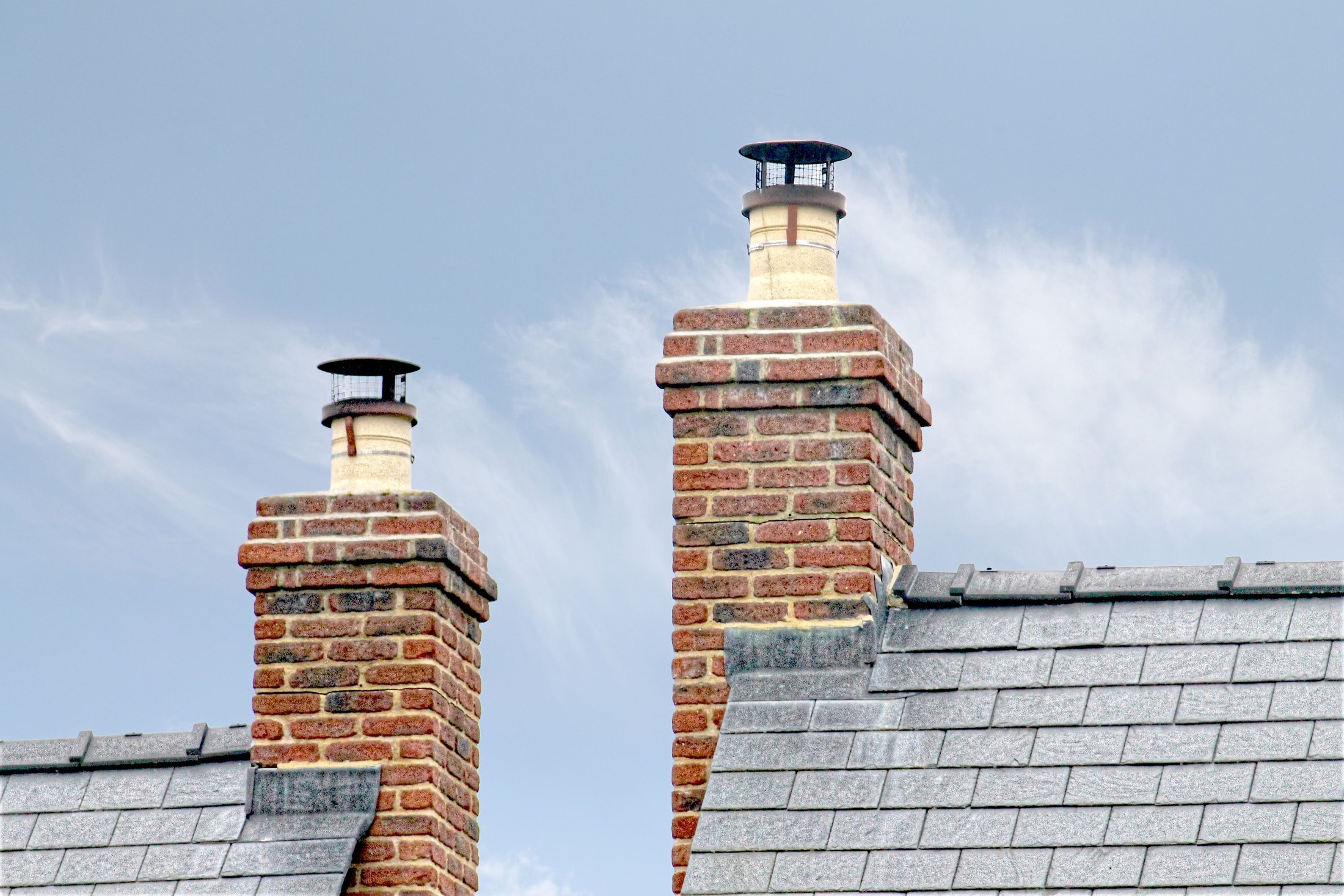
Roofing in Wareham
Repairs, leadwork, flat roofs and full re-covering across Wareham and the BH20 villages. We look first, photograph what is there, and price it in writing.
The site visit is free and so is the written itemised quote. Thomas Hannen prices every job himself.
Wareham is two roofing towns in one postcode. Inside the old walls the roofs are natural slate and plain clay tile on buildings where what comes off has to be what goes back on, and on the estates around them they are concrete interlocking tile from around 1970, where the tile is sound and the mortar and the nails have finished.
Three things bring people here to the phone. A ridge tile has cracked its bedding and there is mortar down the back of the gutter. A stain has come through an upstairs ceiling and nobody can say where it started. Or a homebuyer report says the roof covering is nearing the end of its serviceable life and you would like that translated.
We get on the covering, put our head into the roof space where there is a hatch, and photograph what is up there so you see what we saw. Then you are told which of three you have: a repair that will hold, edge work that buys the roof a decade, or a covering that has finished. A little over ten miles from us, and the site visit and the written itemised quote are both free.
The work
Half the town has its ridge bedded in sand and cement
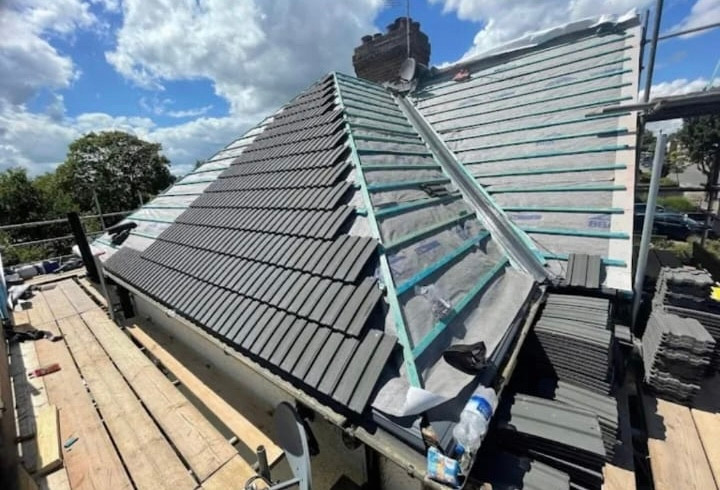
Ridge and verge on the estate roofs. The commonest job in the town by a distance. Half the houses here went up between the war and the early eighties, and every one of those roofs has its ridge and gable verge bedded in sand and cement. The bedding cracks along the joint, water gets behind it, and it comes away in pieces while the tiles either side are sound. We strip it and convert to a dry fix system, dry ridge and dry verge screwed onto a ventilated roll, the mechanical fixing BS 5534 expects, which vents the roof space along the ridge at the same time.
Slate and plain tile in the old streets. A different failure. What finishes a pre-war slate roof is the nail rather than the slate: the heads corrode, slates creep down a course, and you get slips along one line instead of damage in a patch. Those roofs sit on battens with no sarking and often no underlay, so the repair means lifting the courses above rather than sliding something in from beneath. Plain clay tile goes the same way and the pegs give out first. Out towards Corfe you meet Purbeck stone slate, heavy and laid in diminishing courses, which wants the rafters looked at before anyone re-lays it. Thatch we leave alone, and look at the tiled range and the chimney beside it.
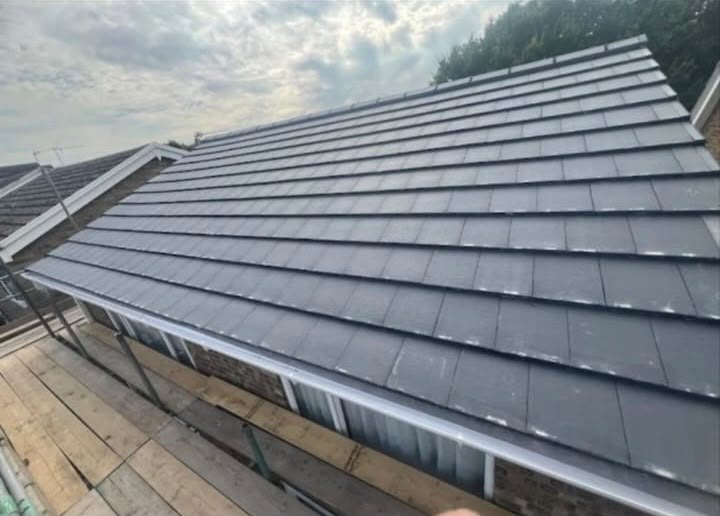
Concrete tile covers most of the town, nearly all of it interlocking and laid to a shallow pitch, which copes with everything until one tile lifts and the course below starts taking water sideways. Slipped, cracked and missing tile work, storm damage, a hip tile you can rock by hand, and a leak traced back to where water genuinely enters rather than patched where the stain shows. On the seventies roofs the tell is at the eaves, where the old bitumen underlay has torn where it laps into the gutter, the one place it has to be sound. When the fixings, battens and underlay have gone together the covering comes off, soft rafter feet are cut out, and it goes back on breathable membrane and treated battens with a matched tile and stainless nails and clips.
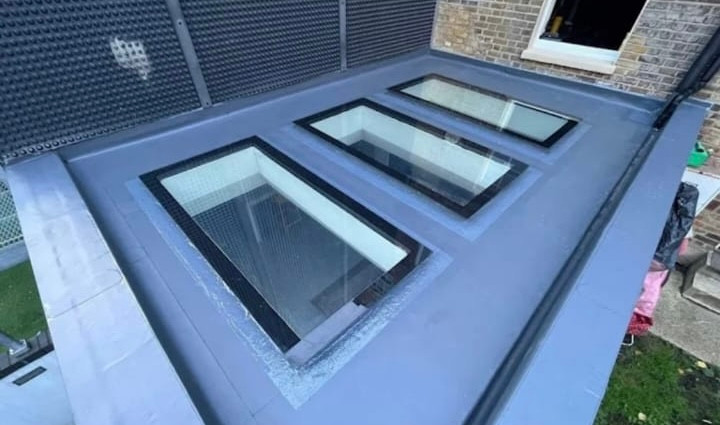
Chimney flashings, soakers, valleys and the abutments where an extension meets the original roof go in code rated lead cut so it can move without splitting, and on a terrace the stack usually sits on the party wall and is shared. Flat roofs over garages, back additions, dormers and the flats above the shops in felt, GRP fibreglass or EPDM rubber, deck first and then the falls, upstands and outlet. A good share of the leaks we attend are a gutter running over or a downpipe discharging into nothing, and in the older parts a parapet gutter can run behind three houses before it finds an outlet, so clearing the moss and debris out of it is what stops the next ceiling. With the roof open, insulation and eaves ventilation cost a fraction to sort, and Approved Document L sets the standard a renovated roof is expected to reach.
How it runs
From your call to a written price
Same team throughout, one person to ring, and an itemised quote: scaffold, strip out, battens and membrane, the covering and each junction on separate lines. Wareham has close to two hundred listed entries and almost all of them are in the streets inside the old walls, so the address decides the paperwork. On an unlisted house a like for like re-covering, a repair, new rainwater goods and a rooflight sitting no more than 150mm above the roof plane all stay inside ordinary householder permitted development, within the limits Planning Portal guidance sets out. On a listed building the roof needs listed building consent whatever it is covered in. Dorset Council for both.
Cost
What decides the price of a roof
No rate per square metre: on a roof that is the least useful number there is. In the old streets there is often nowhere to put a lorry and a platform may need to stand over a public footway, so we settle that on the free site visit rather than on the first morning. On the estates there is usually a drive and a side gate. It is work at height, and the work at height rules are why the platform is a priced line rather than an optional extra. Ask any other quote whether the scaffold is in and whether battens and membrane are renewed or covered over.
If it is leaking now
Water coming in today
Ring rather than use the form. Anything letting water in goes to the front of the queue, and the first visit makes it safe and watertight while you decide. Before we get there, move what is under the stain and look along the ridge and the gutters from the ground. Do not go up a ladder. The phone is answered 24 hours for emergencies; scheduled work runs Monday to Friday, 8am to 6pm.
Worth knowing
On a terrace, the roof is not only yours
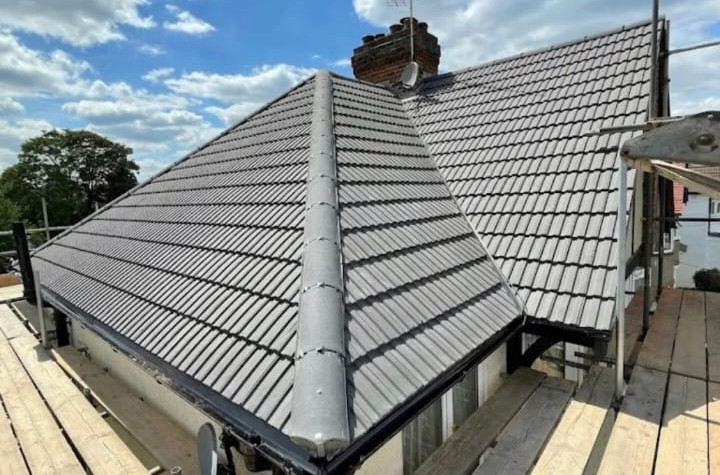
Close to three in ten homes in Wareham are terraced, more than any other kind of house here, and that changes the practical half of a roof job more than the covering does. A terrace is one long roof over several families. The chimney stack above your bedroom usually sits on the party wall and is shared, and a parapet gutter can run behind three houses before it reaches a downpipe, so a blockage two doors along shows up on your ceiling.
The first questions here are therefore who owns the stack and where the platform stands, and both are settled on the site visit. Cutting into or rebuilding a party wall or a shared stack brings the Party Wall etc. Act 1996 into it, which means written notice to the neighbour and time in the programme rather than a problem. We ask in writing to stand over their ground as well, because this goes better when the houses either side know what is coming.
Who you are dealing with
A local firm you can check
A little over ten miles from us, covering Wareham town and the walled centre, Northport, Stoborough and the BH20 addresses out towards Ridge and Sandford, with Dorset Council for planning and building control. Bournemouth Roofing & Building Ltd, registered in England and Wales, company number 15471719, which you can look up in a minute. Thomas Hannen's business, and he is the one who comes out to price the job, not a salesman. A verified customer's 10 out of 10 on Checkatrade. The visit and the written quote are both free.
Questions
Wareham questions we get asked
There are listed houses all along West Street. Am I affected?
Only if your own building is on the list, or attached to one. Wareham Town has 196 listed entries, among them 12 West Street and St Michaels House at number 22, which is a great many for a town of this size. There is no conservation area of its own here, though, so most houses are governed by ordinary planning rules and a like for like re-covering is simply maintenance.
Does being in the flood zone change the roof job?
Not the covering, but it changes where things stand and where water goes. Parts of Wareham sit in flood zones 2 and 3 with the Lower Piddle running about 150 metres away, so we will not leave a skip or a tile stack where it can end up in standing water, and the new rainwater goods are set to take the discharge away from the building rather than pond beside it.
Can you re-cover just my half of the terrace?
We can, and the join is the part that needs thinking about. Terraces are close to a third of the stock in Wareham at 29.5 per cent, and the party wall line is where a partial job leaks if it is done carelessly. New covering has to lap correctly against the old, the ridge has to be closed off properly at the break, and any shared valley or gutter gets dealt with while the access is up.
What is actually listed on the written quote?
Each element separately: strip and disposal, any timber replacement found once the covering is off, underlay and battens, tiles or slates by type and number, ridge and verge, flashings, rainwater goods, scaffold and access. Thomas Hannen measures and prices it himself after the visit, so the figures come off the roof rather than from an estimate given over the phone. VAT is charged on top and shown as its own line.
Wareham is a fair way out. Do you cover it?
It is about ten miles from where we are based and it is on the regular run, so yes. A leak that is actively coming in gets a temporary cover first, normally a sheet dressed over the failed area and weighted down, so the inside stops getting worse while the proper repair is planned. The survey and the written itemised quote follow, and neither of those is charged for.
Nearby, and next door
Roofing near Wareham
Roofing nearby
Our other trades in Wareham
Roofing guides
Concrete vs clay roof tiles: which is right? Planning, building regs or listed building consent Storm damage to a roof: the first 24 hoursEverything we do in Wareham Roofing, all areas Every area we cover
Free quote
Get your Wareham roof looked at properly
Send the address and what you have noticed. We come out, get on the roof, and you get an itemised written price.