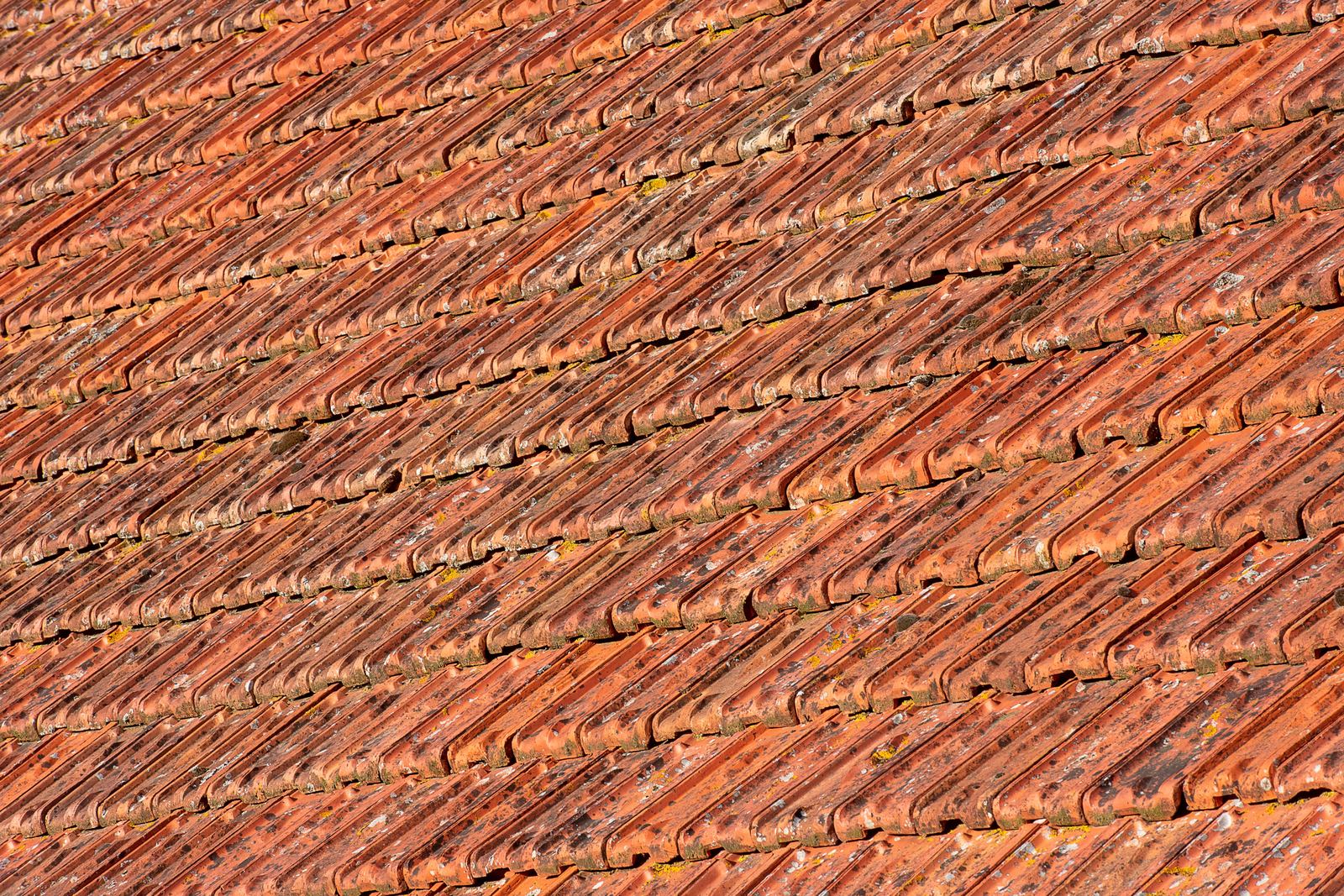
Concrete vs clay roof tiles: which is right for your roof?
Before you choose between them, find out whether you need new tiles at all. On a lot of roofs, you do not.
Concrete suits an interlocking-tiled roof and a pitch below 30 degrees. Clay suits a period house where the look matters. But if your concrete tiles are 50 or 60 years old, they are usually still sound, and it is the underlay and the fixings underneath that have failed. Get them inspected before accepting a quote.
The short version
- The idea that concrete tiles wear out at 30 to 40 years is not supported by testing. BRE put roof tiles that had been up for about sixty years through the current product standards and found they could keep going for several decades more.
- What wears out on an old tiled roof is the underlay, the battens, the nails and the mortar bedding. All four sit underneath the tiles, and all four can be renewed with the same tiles going back on.
- Concrete is not automatically heavier than clay. A clay plain tile roof at 64 kg per square metre is about 28% heavier than a concrete interlocking roof at 50 kg per square metre. Format drives weight, not material.
- Never accept a single minimum pitch figure for a tile. The published minimum depends on the headlap and on whether the surface is smooth or granular, and one common concrete tile has four different minimums for that reason.
- Anyone quoting new tiles on a sixty year old concrete roof without inspecting the existing tiles is quoting the easy job rather than the right one. Ask which of the two has actually failed.
The 30 year myth
Concrete tiles do not wear out at 30 to 40 years
Concrete roof tiles do not have a 30 to 40 year lifespan. That figure gets repeated on roofing blogs and merchant pages with nothing behind it, and it is the single most common reason a homeowner is talked into a re-roof they did not need. The published testing points somewhere very different.
The Building Research Establishment took roof tiles that had been on buildings for about sixty years and put them through the current product standards, BS EN 1304:2013 for clay and BS EN 491:2011 for concrete. Its finding, in its own words, was that even after 60 years of wind, rain, snow and hail, the tiles could keep going for several decades more. The same piece sets out the general position: clay and concrete roof tiles have a good track record, most carry a 30 year manufacturer’s warranty, and 60 years is a reasonable working life for either.
Two details from that testing are worth carrying with you. The standards require a minimum flexural strength of 600 N for clay tiles and 550 N for concrete tiles, which is a bending test and a measure of what the tile takes before it snaps. And the water impermeability test, which a tile passes only if no water drips from its underside inside 24 hours, was passed by the aged tiles. Concrete is porous, which is true and is why moss takes to it more readily. Porous is not the same as failed.
One caveat on the source. That BRE work was published in February 2014 and has not been superseded, so treat it as a dated tested finding rather than recent research. The tiles it tested were already around sixty years old at that point, which puts them on roofs laid in the middle of the last century.
Marley is worth reading alongside it, because Marley makes both clay and concrete tiles and so has no reason to talk one of them down. It puts the life expectancy of its roof tiles at around 60 years, while its roofing systems carry a 15 year system warranty. Look at the gap between those two numbers, because it is the gap that gets misread. A warranty is a commercial promise with a term on it. A service life is how long the thing actually lasts. Nobody puts a 60 year warranty on a tile, and that does not mean the tile stops working in year 31.
What actually fails
The parts that wear out are underneath the tiles
Durability on a pitched roof is governed by the underlay, the battens, the nails and the mortar bedding, not by the tile. Every one of those four has a shorter working life than the tile sitting on top of it, and every one of them can be renewed without buying a single new tile.
- The underlay. Roofs laid before the late 1990s are almost always on bitumen felt. It sags into hammocks between the rafters, goes brittle with heat and age, and tears first at the eaves where the sun and the wind get at it. Once it has torn, wind driven rain that gets past the tiles has nowhere to go but the ceiling. This is the single commonest reason an old tiled roof starts leaking, and the tiles are usually fine.
- The battens. Older roofs frequently have battens that would not be accepted today: too thin, too knotty, not graded, and split around the nails. You cannot judge them from the ground and you cannot judge them from the loft either, because you are looking at the wrong face.
- The nails. Plain galvanised nails corrode, and when the head goes the tile is only held by gravity and its own overlap. On an exposed elevation that is how a roof starts shedding tiles in a gale without anything else being wrong with it.
- The mortar. Mortar bedding at the ridge, the hips and the verge is pointing, and like all pointing it has a life. It cracks, it lets go in sections, and it takes the ridge tiles with it.
So the job on a sound sixty year old concrete tiled roof is usually a strip and re-lay: the tiles come off and are stacked, the felt and battens are taken out, new breathable underlay and graded battens go on, and the same tiles go back down with new fixings plus a percentage of new tiles for breakages. You will lose some in handling. A contractor who tells you there will be no breakages has not done many.
The fixings are where the current rules bite. BS 5534, the code of practice for slating and tiling, has since 2014 required every single lap tile to be mechanically fixed, and it requires ridge and hip tiles to be mechanically fixed as well, including where they are bedded in mortar. That is a common misunderstanding worth clearing up before anyone quotes you: mortar bedding was not banned, it just stopped being a fixing on its own. We have set out what that means for your ridge in dry ridge against a mortar bedded ridge. If your roof has been losing tiles rather than leaking, the cause is more often the fixing pattern than the tile, and why roof tiles blow off goes through how the wind actually gets under them.
All of which gives you one question to put to whoever has quoted you. Has the existing tile been inspected, and is it the tile or the underlay that has failed? A quote that says “supply and fit new roof tiles” and never mentions what is happening to the underlay and the battens is not telling you enough to compare it with anything. Our guide to what a roofing quote should include lists the lines that ought to be on it.
The weight claim
Concrete is not automatically heavier than clay
You will read that concrete tiles weigh around 40% more than clay, and that concrete therefore needs a roof structure with a high level of reinforcement. For the two coverings homeowners most often choose between, that is backwards. Marley, which makes both, puts it plainly: many people believe that concrete roof tiles weigh more than clay roof tiles; however, this is not necessarily the case.
Here are the published figures for the finished roof. Every one of them carries the condition it applies at, because without the headlap or the gauge the number means nothing.
| Covering | Weight of tiling | Condition it applies at |
|---|---|---|
| Concrete interlocking, Marley Modern | 50 kg/m² (0.49 kN/m²) | at 75 mm headlap |
| Concrete interlocking, Marley Modern | 54 kg/m² (0.53 kN/m²) | at 100 mm headlap |
| Clay plain tile, Marley Acme single camber | 64 kg/m² (0.63 kN/m²) | at 100 mm gauge, roof |
| Concrete plain tile, Marley | 73.8 kg/m² (0.72 kN/m²) | at 100 mm gauge, roof |
Read the first and third rows together. A clay plain tile roof at 64 kg per square metre is about 28% heavier than a concrete interlocking roof at 50 kg per square metre. The clay one is the heavy roof. And where you do compare like with like, concrete plain against clay plain, the difference is about 15%, not 40%.
Weight is set by the format of the tile, not by what it is made of. An interlocking single lap tile is large and there are roughly ten of them to the square metre. A plain tile is small and double lapped, so there are 60 to the square metre and most of the roof is two thicknesses of tile deep. That is where the kilograms come from. It is also where the labour comes from: an interlocking roof needs about 2.9 to 3.1 linear metres of batten per square metre, and a plain tiled roof needs 10.0.
Notice too that the same Marley Modern tile is 50 kg per square metre at a 75 mm headlap and 54 at 100 mm. Identical product, 8% apart. So the useful question is not whether concrete is heavier than clay. It is what the covering on your roof weighs now, what the proposed one weighs, and at what headlap or gauge in each case.
If the answer is that the new covering is heavier, the roof structure has to take it, and that is a question to settle before the tiles are ordered rather than after the old ones are in a skip. Changing to a materially different covering can also matter for permissions on some houses, which we cover in do I need planning permission to replace a roof, and it matters more again in a conservation area re-roof, where the appearance of the covering is the point of the control.
Side by side
Concrete and clay compared, dimension by dimension
Every row here carries the condition that changes it, because almost none of these figures is a single number. A comparison that gives you one weight and one minimum pitch per material is a comparison you cannot use.
| Dimension | Concrete | Clay | The condition |
|---|---|---|---|
| Product standard | BS EN 490 | BS EN 1304 | BRE tested aged tiles to BS EN 491:2011 and BS EN 1304:2013 |
| Minimum flexural strength in test | 550 N | 600 N | A bending test. Clay is the stronger of the two on this measure |
| Manufacturer warranty | 30 years typical on the tile | 30 years typical on the tile | Marley’s roofing systems carry a 15 year system warranty. A warranty term is not a service life |
| Reasonable service life | 60 years, and BRE found tested tiles could keep going for several decades more | 60 years, same finding | Governed by underlay, battens, nails and mortar, not by the tile |
| Minimum pitch, interlocking | 17.5° smooth at 100 mm headlap, 22.5° smooth at 75 mm, 25° granular at 100 mm, 30° granular at 75 mm | Not the usual clay format for a domestic re-roof | Depends on headlap and on surface finish. Four numbers, one tile |
| Minimum pitch, plain tile | 35° | 30° for Marley’s Acme single camber | Read the data sheet for the actual tile. There is no universal plain tile figure |
| Weight of tiling | Interlocking 50 to 54 kg/m², plain 73.8 kg/m² | Plain 64 kg/m² | At the stated headlap or gauge. Format decides this, not material |
| Tiles per square metre | Interlocking 9.9 to 10.7, plain 60 | Plain 60 at 100 mm gauge | Drives labour and battens: 2.9 to 3.1 linear metres of batten per m² for interlocking against 10.0 for plain |
| Surface with age | A granular finish weathers and softens in colour. Early efflorescence, a white bloom, is possible and temporary | Fired colour through the body, so it does not fade | This is the honest difference between them, and it is cosmetic |
| Relative cost of the tile | Lower | Higher, with handmade clay highest. Machine made clay plain tiles sit closer to similar concrete products | Tile cost is only one line on a re-roof. Scaffold, underlay, battens and labour do not change with the material |
The row that decides most jobs is not durability and it is not weight. It is pitch.
The constraint that decides it
Pitch usually settles the argument for you
Minimum pitch is a property of the individual tile and the way it is laid, not a property of the material. Take one common concrete interlocking tile. Marley publishes four separate minimum pitches for the Modern tile: 17.5 degrees for the smooth finish at a 100 mm headlap, 22.5 degrees for the smooth at 75 mm, 25 degrees for the granular at 100 mm and 30 degrees for the granular at 75 mm. One tile, four answers, and the difference between the best and worst case is more than twelve degrees.
Plain tiles sit at the other end. Marley’s concrete plain tile has a published minimum of 35 degrees. Its Acme single camber clay plain tile has a published minimum of 30 degrees. Those are the tiles’ own numbers, taken off their own data sheets, and they are not interchangeable with each other or with anything else.
The practical consequence: on a shallow post-war roof at 22 degrees, no plain tile of either material is an option, and the comparison in this article collapses before it starts. An interlocking concrete tile will go on it. A plain tile will not, however much you prefer the look, because water on a shallow plain tiled roof runs sideways under the laps instead of down the roof.
Measure the pitch before you get into materials. A photograph of the gable end taken square on will do it, or a spirit level against a rafter in the loft. Then ask for the published minimum pitch of the specific tile at the headlap proposed, not a general figure for “clay tiles”.
If the pitch rules out the plain tile look and you wanted it for appearance, a slate is the other route down to a lower pitch, and we compare the two kinds in natural slate against fibre cement slate.
The verdict
Which one is right for your roof
Four answers, and two of them are “neither”. The two neither cases cover more houses than the first two do.
Concrete is right when
The house is post-war with an interlocking tiled roof, the pitch is below the plain tile threshold, and you are replacing like for like. On that roof concrete is not a compromise, it is the correct covering, and the alternative is not a clay plain tile because the pitch will not have one. It is also the right answer where a matching replacement matters on a semi or a terrace and the neighbours are all in the same tile.
Clay is right when
The house is a period property, it is listed, it sits in a conservation area, or it is already in clay plain tiles and you want it to look the same in twenty years. Colour is the honest reason for clay and it is a good one: the colour is fired through the body of the tile, so it does not fade, and a clay roof at forty years old still looks like a clay roof. Say that is why you are choosing it. Do not let anyone dress it up as durability, because the testing does not separate the two materials on that.
Neither, and this is the common one
The tiles are sound and the underlay has failed. On a roof of 50 to 70 years old that is the normal finding, not the lucky one. The tiles come off, the felt and battens are renewed, and the same tiles go back on with new fixings and a percentage for breakages. You get a roof with the working life of a new one and you keep the tiles that already match the rest of the street.
Anyone quoting new tiles on a sixty year old concrete roof without inspecting the existing tiles is quoting the easy job rather than the right one. Stripping and re-laying is more careful work than tipping the lot in a skip and opening new pallets, and the difference shows in the quote. That is not a reason to accept the wrong job. Ask directly: what condition are my tiles in, and what did you find when you looked at them.
Also neither: the pitch is below the tile’s minimum
The roof is below minimum pitch and somebody has offered clay plain tiles. The answer is no. If the tile’s published minimum is 35 degrees then 35 degrees is 35 degrees, and a 28 degree roof does not become acceptable because the tile is expensive or because the installer is confident. Water gets under the side laps, the roof leaks in driving rain, and the tile maker will point at the data sheet.
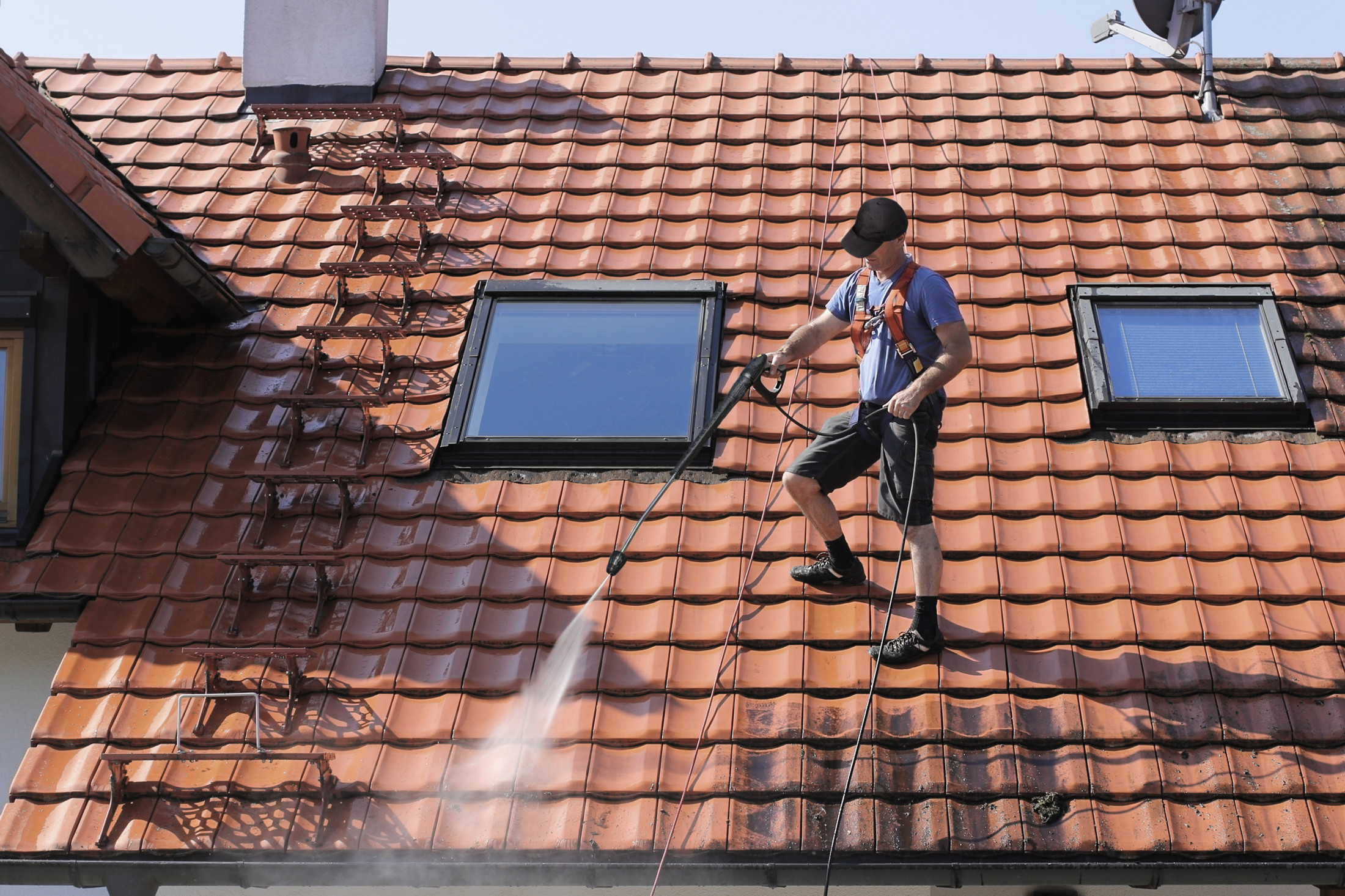
Before you sign anything. Nobody should be walking on a sixty year old tiled roof to inspect it, and nobody needs to. Aged concrete tiles crack underfoot and old battens are exactly the thing that gives way. A proper inspection is done off a ladder at the eaves, from the loft underneath, and with a camera or a scope for the parts you cannot reach. If somebody has just walked up your roof to tell you it needs replacing, they may have made that true.
Next steps
What to do next
In this order, and the first four cost nothing.
- Find out what you already have. Interlocking or plain, concrete or clay, and roughly what year the roof went on. A photograph of the gable end and one of a tile taken off the ground will usually settle it.
- Measure the pitch. It rules options in and out before anything else does.
- Ask whoever quoted you which has failed, the tiles or the underlay, and how they established it. If the answer is vague, that is your answer.
- If you are being offered a new covering, ask for its published weight and minimum pitch at the headlap or gauge actually proposed, and compare it with what is up there now.
- Get a second quote written to the same scope, so you are comparing a strip and re-lay with a strip and re-lay rather than with a full replacement. The roofing quote checklist gives you the lines to ask for.
- Only then choose the material, and choose it on pitch first, appearance second and the cost of the tile last.
If you want the roof looked at properly before you commit to anything, that is what our roofing work covers, and a free written itemised quote comes out of it either way. Thomas Hannen comes out and prices the job himself. If what he finds is that the tiles are fine and the roof needs its underlay and its ridge sorting rather than a re-roof, that is what the quote will say, and it will be the cheaper of the two jobs.
Questions
Questions we get asked about this
Do concrete roof tiles really only last 30 to 40 years?
No. BRE put roof tiles that had been on buildings for about sixty years through the current product standards and concluded they could keep going for several decades more. Most tiles carry a 30 year manufacturer's warranty, but a warranty term is a commercial promise rather than a service life.
Are clay tiles lighter than concrete tiles?
Not necessarily. A clay plain tile roof at 64 kg per square metre is about 28% heavier than a concrete interlocking roof at 50 kg per square metre. Weight is driven by the format of the tile, plain or interlocking, rather than by the material.
My roof is sixty years old and I have been quoted for new tiles. Is that right?
It might not be. At 50 to 70 years the usual finding is that the tiles are sound and the underlay has failed. Ask whether the existing tiles were inspected, and whether a strip and re-lay using the same tiles was priced as an option.
Can I put clay plain tiles on a low pitched roof?
Not below the tile's published minimum pitch. Marley's concrete plain tile is 35 degrees and its Acme single camber clay plain tile is 30 degrees, so a shallow post-war roof at 22 degrees rules out plain tiles of either material.
Does a mortar bedded ridge still comply with the standard?
Yes, provided the ridge tiles are also mechanically fixed. BS 5534 requires ridge and hip tiles to be mechanically fixed even where they are bedded in mortar, so mortar bedding was never banned. It simply stopped counting as a fixing on its own.
Who wrote this
Thomas Hannen
Thomas owns Bournemouth Roofing & Building and prices every job himself rather than sending somebody else. The company is Bournemouth Roofing & Building Ltd, number 15471719, registered in England and Wales. If you want to talk something through before you commit to anything, the site visit and the written itemised quote are both free.
Free quote
Not sure whether it is the tiles or the underlay?
Thomas comes out, looks at the roof properly and puts in writing what he found. If it is a strip and re-lay rather than a re-roof, that is what he will price.