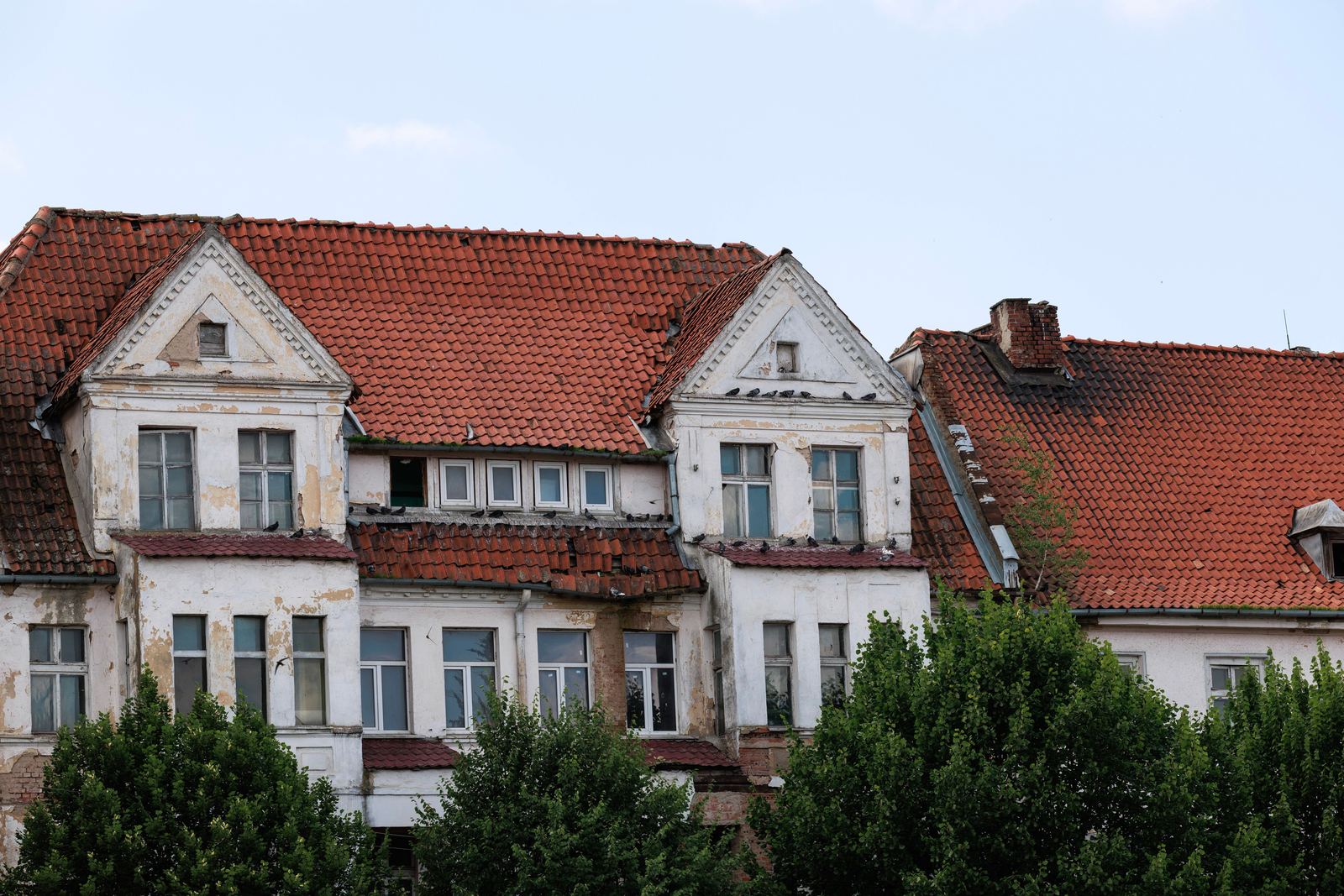
Wind-lifted tiles and ridge: what wind actually does to a roof
The force that takes tiles off a roof points upwards, and it is strongest at the edges. Once you know that, your own roof starts making sense.
Wind does not push tiles off a roof. It lifts them. Airflow over the ridge and around the edges creates suction, and that suction is strongest at the eaves, the verge, the corners and the ridge. That is why damage starts at the edges, and why one lost tile usually becomes several.
The short version
- The force on a tile in a gale is upward suction, not sideways pressure.
- Uplift concentrates round the perimeter and along the ridge. The middle of a slope is the calmest part of the roof, which is why you rarely see a gap there.
- Ridge and hip tiles bedded in mortar and nothing else are not fixed to the current standard. BS 5534 stopped relying on mortar to resist uplift in 2014, and they now have to be mechanically fixed as well.
- That does not make an older mortar-bedded ridge illegal and it does not mean it will fail. It does mean it is the first thing to check before winter and the first thing to expect to lose in a gale.
- Inspect it from the ground, with binoculars, on a still day. Nobody assesses wind damage from the roof.
The physics
Wind lifts tiles, it does not push them off
Picture a gale hitting the front of your house and you will picture the wind shoving tiles off the back. That is not what happens. Air arriving at a building has to get over it, and to get over it, it has to speed up and change direction at every sharp edge: the eaves, the gable, the ridge. Where air accelerates around an edge it loses pressure, and low pressure above a tile is a lifting force underneath it.
So the tile is not being pushed. It is being sucked. The strongest suction sits just past each edge the air has had to bend around, which is why the sheltered slope sheds as many tiles as the slope facing the weather. People find that backwards every time, and it is the most useful thing to understand about a roof in a storm.
There is a second half to it. A tiled roof is not sealed. Air gets in at the eaves and through the gaps between tiles, and it raises the pressure in the space beneath the covering. What acts on a tile is the difference between the pressure under it and the pressure over it, so suction above and extra pressure below add together.
Pitch matters too. On a steep roof the slope facing the wind is pressed into the building and only the sheltered slope lifts. On a shallow roof, and most post-war interlocking tiled roofs are shallow, the wind skims over both slopes and both are under suction. A low pitch is not the easy case.
The wind that does the damage gusts rather than blows steadily. A tile that is not mechanically held is flexed up and dropped back several times a second, and that chatter works a corroded nail loose and cracks a mortar bed.
Where it happens
The edges take the load, not the middle of the slope
Uplift is not spread evenly over a roof. It piles up in a band round the perimeter and along the ridge, and it peaks at the corners, where two edges meet and the air bends round both.
The middle of a slope carries a fraction of what the verge carries, which is why storm damage is nearly always a gap at an edge. Look at any roof in your street that has lost tiles and check where the gap is. Once you have seen it on one roof you will see it on all of them.
| Part of the roof | Uplift | What is holding it | What you would see from the ground |
|---|---|---|---|
| Ridge and hip | Highest, along the whole length | Mortar bedding on older roofs, a mechanical fixing or a dry ridge system on newer ones | A ridge tile rocked out of line, a run of ridge missing, mortar in the gutter or on the drive |
| Verge, the sloping gable edge | Very high, and highest at the top and bottom corners | Mortar bedding on an undercloak, or a dry verge unit clipped to the batten | Cracked mortar along the gable, a verge cap gone, an end tile tipped up |
| Eaves course, the bottom row | High, and the row the wind gets under first | Nails or clips, plus the tile above holding its head down | A tile out of line at gutter level, chipped tails, tile fragments in the gutter |
| Corners of the roof | The highest of all, because two edges meet | Whatever the verge and eaves detail uses, doing two jobs at once | Where the first gap usually appears, and where a specification adequate everywhere else falls short |
| Middle of a slope | Lowest on the roof | Nails or clips, and the overlap of the tiles around it | Damage here is usually something else: a corroded nail, or an impact from something that flew into it |
The cascade is what turns a small loss into a bill. A tile that has lifted and dropped back out of position no longer covers the head of the tile below it and no longer holds the tail of the one above. The wind now has an edge to get under that it did not have five minutes earlier, and it works along the course. That is why ridge tiles come off in runs, not one at a time, and why a roof that lost two tiles in November loses eight in January. Closing the first gap is worth more than the size of the repair suggests, and what to do in the first 24 hours after storm damage sets out the order.
The ridge
Why the ridge is the piece most likely to go
If your house was re-roofed before about 2015 and the ridge tiles are bedded in mortar with no mechanical fixing visible, that ridge is not fixed to the standard that applies to new work today. That is the sentence to take away from this article, and it needs handling carefully, because it does not mean what people assume it means.
Here is the change. BS 5534, the British Standard code of practice for slating and tiling, was revised in 2014, and the revision withdrew reliance on the tensile strength of mortar bedding as a means of resisting wind uplift. Mortar had been doing that job on British roofs for a century, but its bond strength cannot be calculated or checked on a finished roof and it degrades, so the standard stopped counting it. Ridge and hip tiles now have to be mechanically fixed, whether or not they are also bedded in mortar. BSI later published BS 8612, the specification for dry fixed ridge, hip and verge systems, which gave the mechanical alternative a performance standard of its own.
What follows from that: mortar bedding was never banned. A mortar bedded ridge is still a proper detail today, provided the tiles are screwed or clipped down as well and the mortar is doing what mortar is good at, which is filling the gap and shedding water. A great many British roofs, laid entirely correctly at the time, are bedded to a rule that has since been withdrawn. And the ridge is the part of the roof where the highest uplift and the oldest fixing method most often meet.
What does not follow: that an older mortar bedded ridge is illegal. Building Regulations are not retrospective and nobody has to change a ridge because a standard moved. Nor that it will fail, because plenty are sound and will stay sound. Nor that you need the whole roof done, which is what you will sometimes be told by whoever spotted it. Re-bedding and mechanically fixing a ridge line is its own job.
What it does mean is that the ridge is the first thing to check before winter and the first thing to expect to lose in a gale. If you want the compliance side properly, including where a repair sits differently from a re-roof, we have gone through it in dry ridge against a mortar bedded ridge.
The specification
A fixing pattern is a calculation, not a habit
The number of nails and clips on a roof is supposed to be worked out, not inherited. BS 5534 sets out how.
The fixing specification comes from the wind loading at that address, which depends on the exposure of the site, the height of the building, the distance to the coast and the surrounding terrain, combined with the pitch, the batten gauge and the size and weight of the tile. A heavier tile resists uplift better than a light one, and an exposed plot needs more fixings than a sheltered one four miles inland.
Two things follow before you accept a quote. The calculation produces a heavier fixing pattern round the perimeter than in the middle of the roof, so a quote saying every tile is clipped and nailed at the verge and the eaves and every third one in the middle is not a corner being cut, it is the standard being followed. And the same tile on the same roof needs a different pattern on an exposed coastal plot from the one it needs in a sheltered valley, so a roofer who fixes every roof the same way is not calculating anything.
So ask for it. Anyone working to the standard will have the fixing specification to hand, because they needed it to price the work. Our checklist of what a roofing quote should include has the other lines to look for, and if you are being sold new tiles rather than new fixings, the tile is usually the part that has not failed, which we cover in concrete against clay roof tiles.
From the ground
What you can see, and the wind speed that ends the inspection
Every check in this article is done standing on grass. Roof work accounts for almost one in five deaths in construction work, and those are people who do it for a living with equipment you do not own.
Before you go outside to look. HSE is explicit about this: do not consider going on any roof in poor weather conditions such as rain, ice, frost or strong winds (particularly gusting) or if slippery conditions exist on the roof. The same page notes that winds in excess of 23mph will affect a person’s balance. That is a fresh breeze, not a gale. If it feels like it has died down enough to have a look, it very often has not, and a firm offering to go up there while the wind is still running is telling you something about how it works rather than about how urgent your roof is.
What you are looking for, with binoculars from the garden or an upstairs window, is movement more than absence. A missing tile is obvious. A ridge tile rocked half an inch out of line, a hairline crack along the mortar joint at the gable, a line of daylight under a verge, a tile at the eaves sitting a shade higher than its neighbours: those are the ones that go next, and they are all visible from the lawn. Mortar crumbs on the drive are the same warning arriving by a different route. The before-winter checks from the ground are the fuller version of this list.
For a sense of scale, the Met Office impact descriptions are the most useful public yardstick, because they are written as what you can see rather than in miles per hour. Medium impact includes “some structural damage, such as slates dislodged from roofs”. High impact includes “widespread structural damage e.g. roofs blown off, mobile homes overturned, power lines brought down”. Those two bracket the whole subject of this article: at the first, sound roofs shed material at the edges and the ridge, and at the second, structural failure is a live possibility. The colours and what each one means for a roof are in what a named storm actually means.
The morning after, photograph the debris where it landed, before you tidy it. A ridge section on the lawn with a scatter of mortar tells a different story from a tile against the fence, and both say more about what happened than the gap in the roof does. Why that matters is set out in what evidence to gather for a roof damage claim.
Next steps
What to do about it
Check the ridge, hips, verges and eaves with binoculars on a still day, then photograph what you find. The first three cost nothing.
- On a still, dry day, stand back far enough to see the whole roof and work along the edges with binoculars: ridge, both hips, both verges, the eaves course, then the corners. Leave the middle of the slopes until last.
- Look at the ridge specifically. A continuous mortar joint and nothing else, no screw heads, no capping unit, no visible clip, means a bedded ridge with no mechanical fixing, and that belongs at the top of your list.
- Photograph what you find, dated, from the ground and from an upstairs window. Do it now, because a photograph taken before the damage is the most valuable evidence anyone can hold.
- Get anything that has already moved dealt with before the weather turns. A rocked ridge tile is a small job in October and a run of missing ridge in January.
- If you are being quoted for work, ask what the fixing specification is, what wind loading it was calculated for, and which parts of the roof get the heavier pattern. The answers tell you whether the person in front of you is working to the standard or to habit.
If you would rather someone looked at it properly, that is what our roofing work covers, and a free written itemised quote comes out of it. Thomas Hannen comes out and prices the job himself, and if what he finds is a ridge line that needs re-bedding and fixing rather than a roof that needs replacing, that is what the quote will say.
Questions
Common questions
Why do tiles blow off the sheltered side of the roof?
Because the force on a tile is suction, not pressure. Air has to speed up and bend to get over the ridge, and where it does that it loses pressure, which lifts the tiles below it. The slope facing away from the weather is often the one under the strongest suction.
Are my mortar bedded ridge tiles still allowed?
A mortar bedded ridge is still a proper detail, but since the 2014 revision of BS 5534 the ridge and hip tiles have to be mechanically fixed as well, because the standard no longer relies on the mortar to resist uplift. An older ridge bedded in mortar alone is not illegal and does not have to be changed, but it is the part of the roof most likely to move in a gale.
Why is the damage always at the edge of the roof?
Uplift concentrates in a band around the perimeter and along the ridge, and it peaks at the corners where two edges meet. The middle of a slope carries a fraction of the load the verge carries, which is why gaps appear at the verge, the eaves and the ridge and almost never in the middle.
Can I go up and look after a storm?
No, HSE says not to consider going on any roof in poor weather, including strong or gusting winds, and notes that winds over 23mph will affect a person's balance. Everything worth seeing is visible from the garden with binoculars or from an upstairs window.
One tile has gone. Does that matter?
More than it looks. A tile out of position stops covering the head of the tile below and stops holding the tail of the one above, so the wind gains an edge to get under. That is why losses spread along a course, and why the first gap is worth closing quickly.
Read next
Related advice
The guides below pick up where this one leaves off, and the roofing page covers the work itself and the places we cover, if you would rather have the job looked at.
Who wrote this
Thomas Hannen
Thomas owns Bournemouth Roofing & Building and prices every job himself instead of sending somebody else. The company is Bournemouth Roofing & Building Ltd, number 15471719, registered in England and Wales. If you want to talk something through before you commit to anything, the site visit and the written itemised quote are both free.

Free quote
Worried about the ridge before winter?
Thomas comes out, looks at the ridge, the verges and the eaves properly and puts in writing what he found. If it is a ridge line and not a whole roof, that is what he will price.