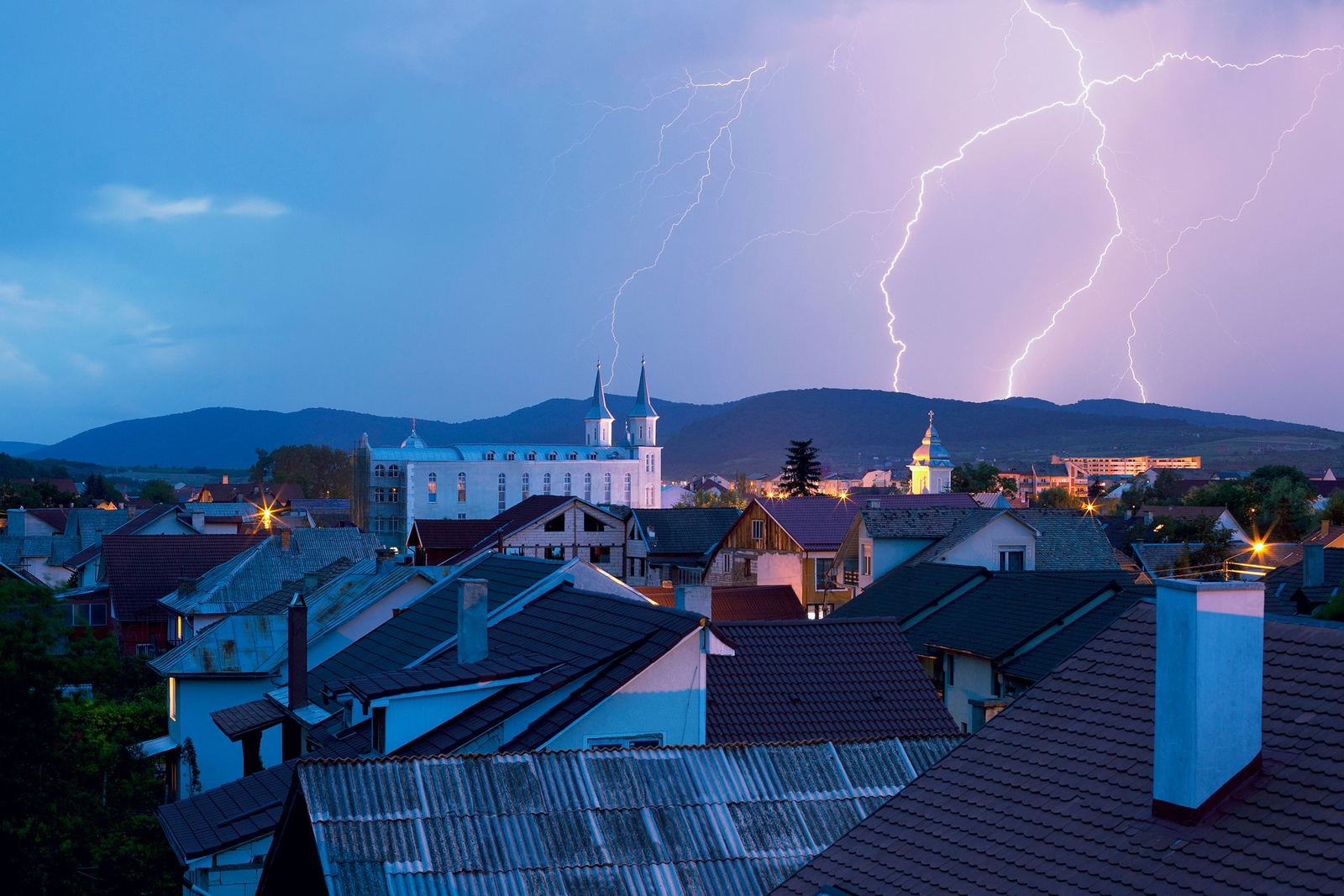
What a named storm actually means, and what the warning colours mean
The name tells you less than you think. The colour of the warning tells you more, as long as you know what it is really measuring.
A storm gets a name when the Met Office expects it to cause enough disruption to justify an amber or a red warning. The colour is the part that matters for your roof: amber is the level at which the Met Office itself expects slates to be dislodged. The catch is that colour reflects likelihood as well as impact, so a yellow warning can still carry serious impacts at lower confidence.
The short version
- Storms are named jointly by the Met Office, Met Éireann and the Dutch service KNMI, and the naming year runs from early September to late August.
- A named storm is not a different kind of weather. It is a forecast of disruption, which is why the warning colour tells you more than the name does.
- At amber, the Met Office’s own impact wording includes slates dislodged from roofs. At red it includes roofs blown off.
- Read the individual warning rather than the colour alone. Colour combines how likely the weather is with how bad it would be, so yellow is not simply a mild version of amber.
- Whatever the colour, nobody should be on a roof during it or straight after it while the wind is still up.
How it works
Who names a storm, and on what basis
Storms affecting the UK are named jointly by three national weather services: the Met Office, Met Éireann in Ireland and KNMI in the Netherlands. One storm therefore carries one name across all three countries, which is the whole point of the arrangement. Before it existed the same weather system could pick up three different names and nobody was certain they were talking about the same thing.
The threshold is stated plainly in the Met Office’s own storm naming criteria: a storm is named when it has the potential to cause disruption or damage which could result in an amber or red warning. That is worth reading twice, because it means the name is a consequence of the warning, not the other way round. The forecasters decide the weather is bad enough to warrant an amber warning, and the name follows.
Names run alphabetically through a list published before each season. The naming year starts in early September and runs to late August, which is why storms in January are usually well down the alphabet. Wind is the most common trigger, but rain and snow are considered too, so a named storm is not always a wind event.
The practical consequence for a homeowner is small but useful. If a storm has a name, somebody has already decided it is likely to cause damage somewhere. That is a reasonable prompt to bring the bins in and check nothing is loose. It is not, by itself, a reason to expect damage to your particular house.
The warning colours
What each colour means for a roof
This is the translation nobody publishes. The Met Office severe weather guidance describes impacts in general terms across everything from transport to power supplies. What follows takes its published impact wording and says what it means for the thing above your head.
| Warning | Met Office impact wording | What it means for your roof | What to do |
|---|---|---|---|
| Yellow | A range of situations, from low-level disruption upwards. The advice is to read the individual warning | Tiles that are already loose or slipped are the ones at risk. A sound roof normally rides it out | Bring in bins, trampolines and ladders. Nothing on the roof |
| Amber | Increased likelihood of impacts. Includes “some structural damage, such as slates dislodged from roofs” | Sound roofs start losing material, and they lose it at the edges: verge, eaves and ridge | Stay off it. Stay off it afterwards too, until the wind has genuinely dropped |
| Red | “Dangerous weather is expected.” Includes “widespread structural damage e.g. roofs blown off, mobile homes overturned, power lines brought down” | Structural failure is a live possibility rather than a remote one | Stay indoors. Do not go outside to look at the roof |
Notice that the Met Office puts slates coming off roofs in the amber band itself. That is not a worst case buried in a footnote, it is the described impact of an ordinary amber warning, and it is the single most useful fact on this page.
The bit people get wrong
Colour is likelihood as well as impact
The common assumption is that yellow, amber and red are a simple scale of how bad the weather will be. They are not. The colour combines two things: how likely the impacts are, and how bad they would be if they happened.
That has a consequence that catches people out. A yellow warning can carry severe impacts at lower confidence. If forecasters think there is a real but uncertain chance of damaging gusts in your area, that can be issued as yellow, and the damage it describes may be the same damage an amber warning would describe. The Met Office says explicitly that you should read the individual warning rather than rely on the colour.
So the useful habit is to open the warning and read the impact text, which names what is expected and where. It takes about fifteen seconds and it is more informative than the colour of the triangle.
A different system entirely
Flood alerts are not Met Office warnings
People routinely conflate the two, and they come from different organisations with different meanings. Met Office warnings are about weather. Flood warnings come from the Environment Agency and are about water that has already arrived or is about to.
| Level | What it means |
|---|---|
| Flood alert | Flooding is possible, so you should prepare now |
| Flood warning | Flooding is expected, so you should act now |
| Severe flood warning | Flooding could cause danger to life. You must act now |
The wording is worth taking literally. The difference between an alert and a warning is the difference between possible and expected, and the difference between a warning and a severe warning is danger to life. You can sign up for flood warnings for your own address free of charge, which is a better use of five minutes than most storm preparation.
What the name is worth later
A named storm helps a claim, but it does not settle it
If you end up claiming, the storm having a name is helpful evidence and not much more. The Financial Ombudsman Service, which decides these disputes when an insurer and a customer cannot agree, says that the Met Office naming a storm serves as a good indication that the conditions were genuinely stormy. It then goes on to say it will still check the weather records to establish whether it was a storm, how intense it was, and where the storm sat in relation to the property itself.
That last point is the one that surprises people. Wind speed is assessed for your location, not for the region or for the country. Seventy miles an hour on an exposed stretch of coast may have been forty-five four miles inland, and a claim can turn on the second figure rather than the first.
It is also worth knowing that the insurance industry has its own reference thresholds, published by the Association of British Insurers: gusts of at least 55mph, torrential rain of at least 25mm an hour, snow to a depth of at least 30cm in 24 hours, or hail intense enough to damage hard surfaces or break glass. Those are an industry reference point rather than a rule, and your policy does not have to use them. Read your own policy’s definition of storm before you assume 55mph is the test.
We can quote for the repair and put in writing what we found and what caused it. We do not handle claims, we do not deal with your insurer for you and we are not loss assessors. If you want to understand what an insurer is actually looking for, we have set that out separately in what evidence to gather for a roof insurance claim.
Before, during and after
Nobody goes on the roof, whatever the colour
Whatever the warning says. The Health and Safety Executive’s position is that you should not consider going on any roof in poor weather conditions such as rain, ice, frost or strong winds, particularly gusting winds, or if the roof is slippery. The same guidance notes that winds in excess of 23mph will affect a person’s balance. That is a fresh breeze, not a gale, and it is far below the threshold at which most people would say the weather had turned.
Put those two numbers next to each other and something useful falls out. The insurance industry’s reference point for a storm is a 55mph gust. The regulator’s threshold for wind affecting your balance is 23mph. There is a wide band of weather in between that is not a storm as far as your policy is concerned, and is already too windy for anyone to be working up there.
That applies to us as much as to you. If the wind is still up and somebody offers to climb up and look today, that tells you something about how their business works rather than something about how urgent your roof is.
Before the weather arrives, everything useful happens at ground level: bins, trampolines, garden furniture and ladders put away, and a look along the ridge line from the lawn. We have set out the whole list in roof checks to do before winter, from the ground.
Next steps
What to do with all this
In order, and none of it involves a ladder.
- When a warning is issued, open it and read the impact text rather than stopping at the colour. It names what is expected and where.
- Sign up for Environment Agency flood warnings for your address if you are anywhere near a watercourse or the coast. It is free and it is specific to you.
- Clear the ground: bins, furniture, trampolines, ladders, anything that can be picked up and put through a window or a roof.
- Take a few dated photographs of your roof from the garden now, while the weather is fine. They are the single most valuable piece of evidence you can have if you ever claim, and almost nobody has them.
- After it passes, look from the ground and from an upstairs window. If material has come down, photograph where it landed before you tidy up.
- If something has actually gone, work through what to do in the first 24 hours before you ring anybody.
If you want the roof looked at properly once the weather has cleared, that is what we do. Thomas comes out, goes over it, and puts in writing what he found and what it would take to put right. If the answer is that it is fine and it can wait, that is what the report says.
Questions
Questions we get asked about this
Who decides to name a storm?
Storms affecting the UK are named jointly by the Met Office, Met Éireann in Ireland and KNMI in the Netherlands, so that one weather system carries one name across all three countries.
Does a named storm mean my roof will be damaged?
No. It means forecasters expect enough disruption somewhere to justify an amber or red warning. Whether your particular roof is at risk depends far more on its condition, and on how exposed your house is, than on whether the storm has a name.
Is a yellow warning safe to ignore?
No. Colour reflects how likely the impacts are as well as how bad they would be, so a yellow warning can describe serious impacts at lower confidence. The Met Office advises reading the individual warning rather than relying on the colour.
Should I get on the roof to check after a storm?
No. The Health and Safety Executive advises against going on any roof in poor weather, and notes that winds over 23mph affect a person's balance. Look from the ground and from upstairs windows instead.
Who wrote this
Thomas Hannen
Thomas owns Bournemouth Roofing & Building and prices every job himself rather than sending somebody else. The company is Bournemouth Roofing & Building Ltd, number 15471719, registered in England and Wales. If you want to talk something through before you commit to anything, the site visit and the written itemised quote are both free.

Free quote
Want the roof looked at once the weather clears?
Thomas comes out himself, goes over the roof properly and puts in writing what he found. If it can wait, he will tell you that.