
Driveways and patios in Poole
Front parking, worn out drives and patios laid to the right level, priced in writing after a free visit.
The site visit is free and so is the written itemised quote. Thomas Hannen prices every job himself.
We lay drives, front parking bays and patios across Poole. In a town this tightly built the first question is rarely which surface you like. It is what you are allowed to do at the front, how the work gets in, and where the rainwater is going to go once the ground is sealed.
Most people ring about one of three things. Somewhere to park at a house that has never had it, which means a front garden, a footway crossing and a conversation with the council. A drive that went down with the house and has finally broken up, cracked along the wheel tracks with the edges spilling into the borders. Or a back garden that floods at one end, where the patio has sunk and now sits wet against the wall.
We come out, open the surface, look at what is underneath and take levels off the house before anything is priced. Then you get one written price with the dig, the base, the edgings, the surface and the drainage on their own lines. If the sensible answer is a repair, we will say so and price that instead.
The work
Front gardens, 1930s drives and shared parking courts
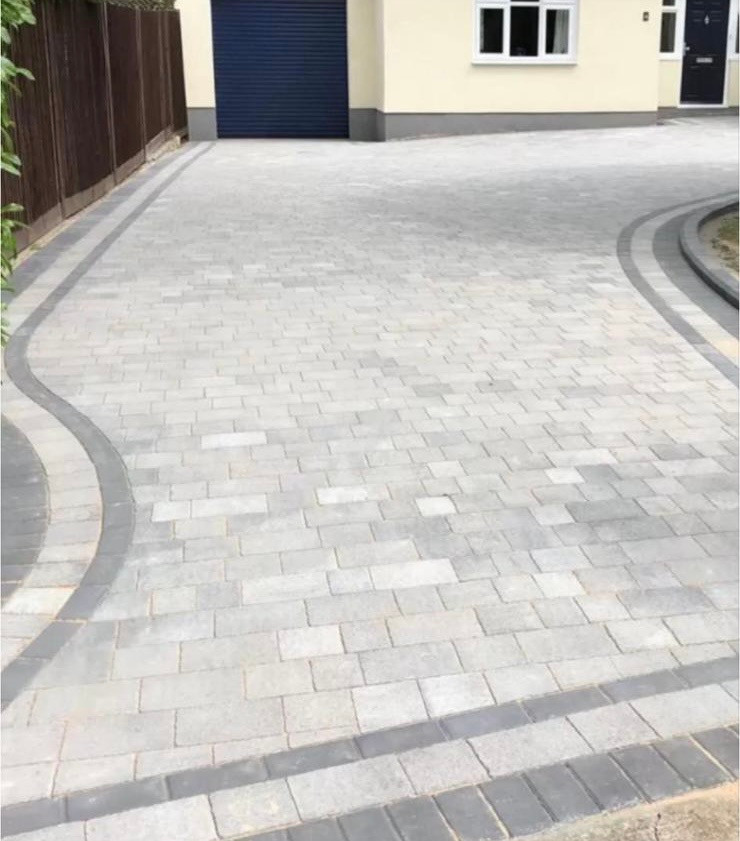
Turning a front garden into parking. On the older streets the house sits close to the pavement and there is nothing at the back, so the front garden is the only parking there will ever be. The paving is the quick part. Forming the crossing sets the date, because it is a highway application, the kerb and the footway are rebuilt to their specification, and the service covers in the path have to be dealt with properly. Behind it the bay wants a haunched kerb line and an edge restraint, or block paving creeps sideways under a turning wheel, with a planted border left along the wall so the rain has somewhere to soak away on your land.
Inter-war and 1930s drives. A lot of Poole was built between the wars, and the original drives were two concrete strips or a thin skim of tarmac laid straight onto the ground. They fail in the same order every time: a crack down each wheel track, rutting where the car swings in off the road, and the surface breaking up at the garage threshold where water has stood. If the concrete underneath is still flat and solid, resin bound over the top is a two day job with no dig and almost no muck away. If it rocks under your foot it comes out, the formation is re-cut and the sub-base rebuilt on a geotextile membrane in compacted layers. This is wet ground, so a soakaway wants a percolation test before anyone draws one.
Shared forecourts and parking courts. A third of the homes in the town are flats, and a lot of them share a tarmac apron, a bin store slab and a run of communal parking that nobody has touched since it was laid. That work is worth doing in one go: the whole area to one fall, a channel drain across the entrance instead of a puddle, and bays marked out so the same cars stop blocking the gate. Where leaseholders are being charged for it, the freeholder has to consult under section 20 of the Landlord and Tenant Act 1985 once one leaseholder's share passes the statutory limit, so we write the quote in a form that can go straight out with that notice.
At the back, porcelain on a full mortar bed, natural stone flags, or block paving you can lift and relay later. Whatever goes down finishes below the damp proof course and falls away from the house, and a low back door threshold gets a channel drain and an outfall rather than another lift of build up against the wall. Small courtyards get the level changes and steps set out first, because that is where a garden either works or annoys you daily. On their own we also do the repairs: a sunken bay, a lifted flag, weed through open joints, pointing washed out of a stone terrace, or a gully that has stopped taking water.
How it runs
From your call to a written price
Same team throughout, one person to ring, and an itemised quote: excavation, muck away, sub base, edgings, surface and drainage on separate lines.
Bournemouth, Christchurch and Poole is the planning authority, and a good part of the old town centre sits in the Town Centre Heritage conservation area, where the council keeps the list. Everywhere else, paving a front garden is permitted development while the water stays on your own ground, and it is more than five square metres of sealed surface draining out to the road that needs planning permission. The crossing over the footway is a separate highway application, it takes the longest, and we start it the day you give us the go ahead.
Cost
What decides the price of a driveway
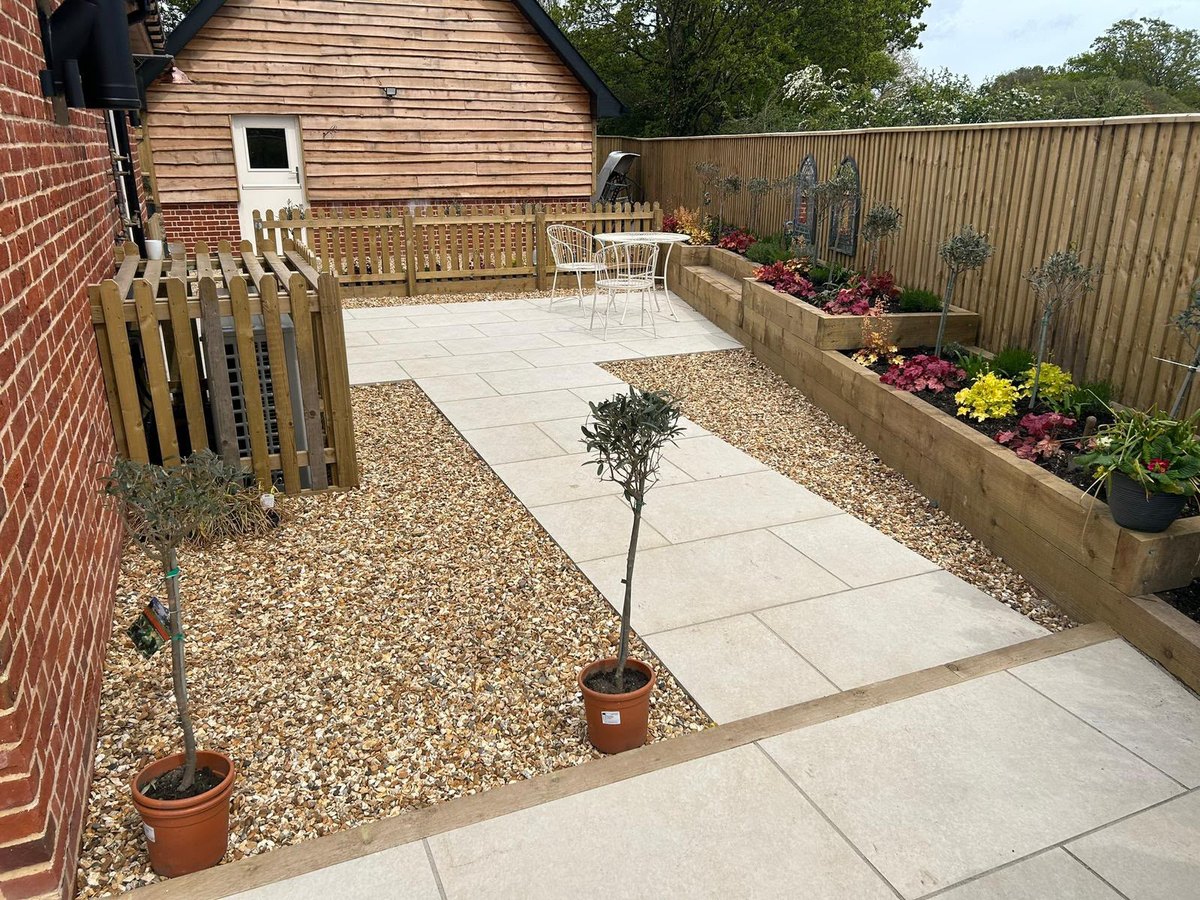
In the older streets the crossing sets both the price and the date, because rebuilding kerb and footway is a highway job before it is a paving one. A terrace fronting the pavement, a semi with a narrow side alley and a block of flats with a shared entrance are three different jobs before a machine turns a wheel. The ground under the town is wet, so how the surface water is dealt with is designed rather than assumed. Comparing quotes, ask the dig depth, the sub base, the drainage, and who takes the spoil away.
If it is urgent
A trip hazard, or a drive that floods
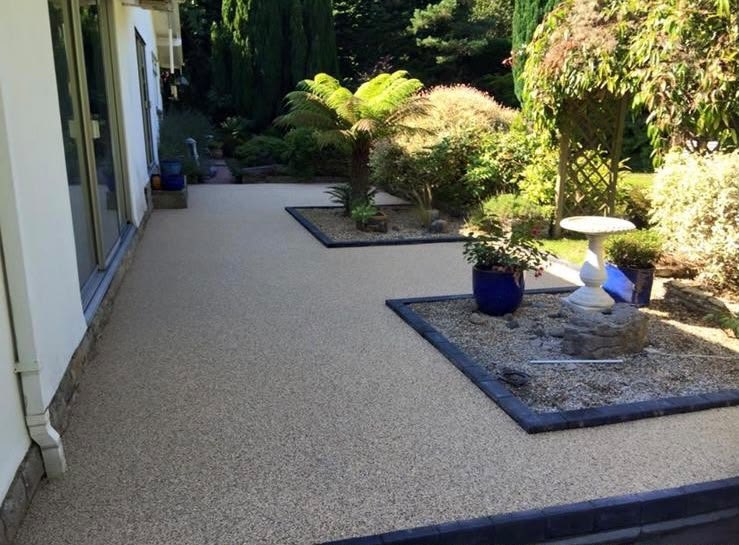
Ring rather than use the form. A lifted slab, a sunken bay by a doorway or a gully that has stopped taking water will not wait. On a street where the water has nowhere to go but the drive, ring while it is still standing, because a photograph of where the puddle sits tells us more than a dry survey ever will. Outside Monday to Friday, 8am to 6pm, by arrangement.
The one local thing
Paving in and around the town centre conservation area
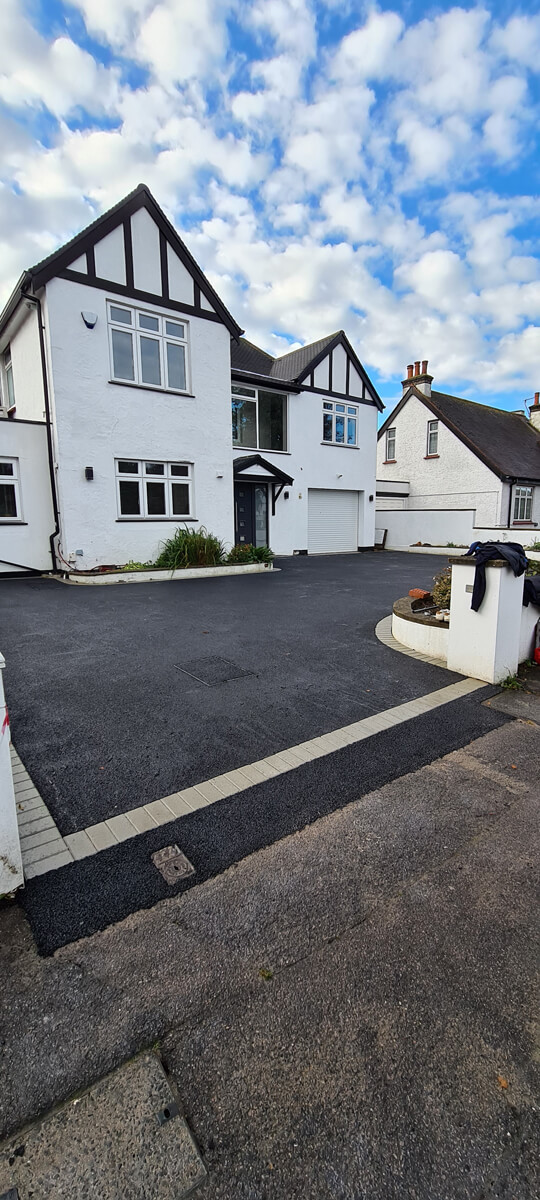
The old town centre is a conservation area, which does not stop you building a drive or a patio, but it does mean appearance is controlled in a way it is not two streets away. The council keeps the list, so it takes a minute to find out whether your address is inside it.
The parts that catch people out are rarely the paving. They are the front boundary: taking down a wall, railings or piers to make an opening is not automatically something you can just do in a conservation area, and neither is cutting a tree, which needs written notice to the council before anyone touches it. Ask before the wall comes out, not after.
What it changes for us is the specification. In and near the older streets we keep the historic wall wherever it can be kept and form the opening with rebuilt piers rather than a gap, we match the kerb and the sett work at the crossing to what is already in the street, and we choose a permeable block in a muted colour rather than the brightest range in the brochure.
Photographs of the existing frontage, a simple plan and a note of the materials are usually all that is needed to support an application, and we put that together as part of the quote rather than leaving you to it. It is worth saying that none of this makes the job slower to build. It makes it slower to start, which is why we get the paperwork moving first and book the dig around it.
Who you are dealing with
A local firm you can check
We cover Poole town, the harbour side streets and out through Parkstone, Hamworthy, Broadstone and Upton, six miles from us and daily ground. Bournemouth Roofing & Building Ltd, registered in England and Wales, company number 15471719, which you can look up in a minute. Thomas Hannen's business, and he is the one who comes out to price the job, not a salesman. A verified customer's 10 out of 10 on Checkatrade. The visit and the written quote are both free.
Questions
Poole questions we get asked
Our street is in the Town Centre Heritage area. Consent needed?
Appearance is controlled there, so putting back an existing surface like for like is maintenance, while switching the material or the colour of a frontage is what gets looked at, and BCP Council make that call. Five entries are listed nearby, the Church Of St Peter among them. Away from those streets the ordinary rule takes over: a front parking space has to deal with its own water rather than tipping it onto the pavement.
Will a new parking bay make the flooding at the front worse?
It can, and it is a fair question here, because the ground through Poole is naturally wet and the harbour is under three kilometres away. Sealing a front garden with nowhere for the water to go sends the lot onto the road. So it is either a permeable surface over a stone reservoir, or a sealed one falling to a drain that actually goes somewhere. A test pit tells us which of the two this ground will take.
Can you work with no side access to the back?
Yes, and on the terraced streets it is the normal way we work. Everything goes through the house on boards and sheeting, or over a wall by conveyor where a neighbour agrees, and the machine is a micro digger narrow enough for a standard gate gap. It is slower, and the quote shows that as its own line rather than hiding it. Nothing gets carried through a hall until the floor is covered.
Our thirties semi has the original crazy paving. Keep it?
Keep it if it is sound, because it belongs to the house. The 1930s is the single biggest period in the local stock at 13.5%, and the original path and step detail in front of those houses is half of what the frontage looks like. Where it has settled we lift it, rebuild the base and relay the same material. Where it is cracked through and throwing water at the wall, it comes out and gets built again properly.
Where does the muck go on a street with no drive?
Into a grab lorry, or a covered skip with a permit from the council where it has to stand on the highway, and that is arranged before the first morning rather than on it. On the narrow streets near the town centre we book the collection to arrive as the dig finishes, so nothing sits out on the road overnight. The muck away appears as its own item on the written quote.
Nearby, and next door
Driveways and patios near Poole
Driveways and patios nearby
Our other trades in Poole
Everything we do in Poole Driveways and patios, all areas Every area we cover
Free quote
Want a proper price for the drive or the patio?
Tell us what the ground does after heavy rain and we will come and look. Free visit, free itemised written quote, no salesman.