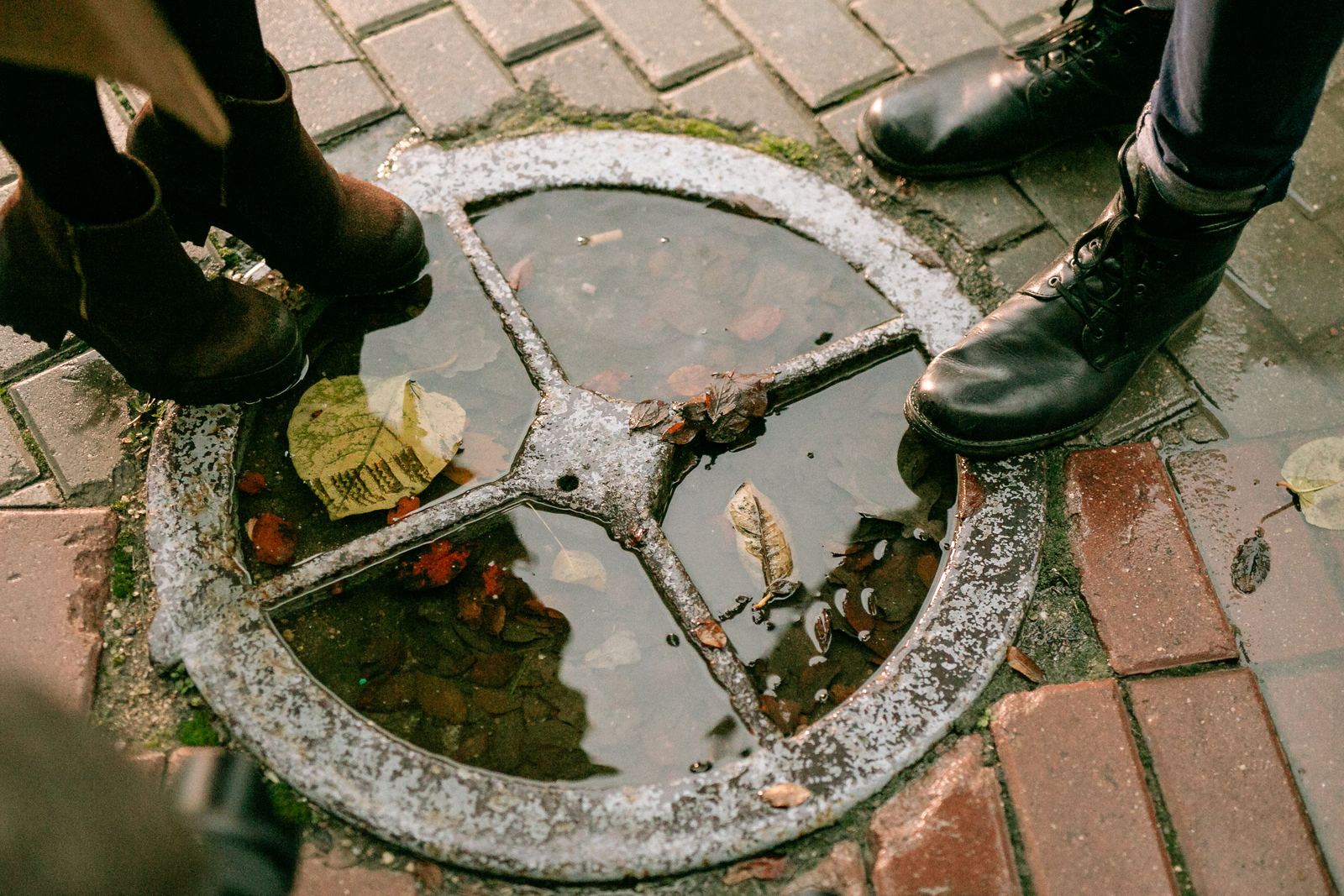
A sunken or ponding driveway: base failure or drainage?
The surface almost never fails on its own. It fails because of what is underneath it, or because of where the water goes.
A paved surface almost never fails on its own. It fails because of what is underneath it, or because of where the water goes. So read the pattern. Ruts in the wheel tracks point at the sub-base, a dropped edge points at the edging, and flat ponding with no dip at all points at the falls being wrong from the day it was laid.
The short version
- Sinking is a base problem. Ponding on a drive that has not moved is a falls problem, and much the smaller job.
- On block paving the edge restraint is structural, not decorative, and an edge never haunched in concrete is the commonest single fault on a domestic drive.
- Watch it during heavy rain, not after it. Water gone within the hour is a fall. Water still there the next day means the drive has nowhere to send it.
- A localised dish or a rutted wheel track can very often be lifted and relaid with the same blocks, for a fraction of the cost of a new drive.
- A drive falling towards the house is a defect on its own, and a common cause of damp at the foot of a wall.
The build-up
A driveway is a structure, and the surface is the least of it
What you can see is the thinnest part of the job. Under a block paved drive there should be a compacted sub-base of crushed stone carrying the load, a thin laying course of grit or sharp sand, the blocks, and an edge course haunched in concrete holding the lot in.
The blocks do not carry the car. The stone under them does, and only if it was deep enough and compacted in layers, not tipped in and rolled once. The government’s guidance on permeable surfacing of front gardens describes about 150mm of sub-base over a geotextile, compacted before the surfacing goes on. Soft ground or a van on the drive nightly pushes that up.
The joints matter more than they look. Kiln dried sand swept between the blocks locks them together, so a wheel load on one is shared by its neighbours. That sand is a consumable, and a pressure washer strips it faster than anything, which is one reason how a drive gets cleaned matters. Once it has gone, each block is on its own, it starts to rock, and water runs down the open joint into the laying course.
Read the pattern
What the shape of the failure tells you
Stand at the top of the drive and look along it before you look down at it. The shape of the failure separates a construction fault from a drainage one, and that is the difference between a morning’s work and a new drive.
| What you can see | What it usually is | What it takes |
|---|---|---|
| Ruts in the wheel tracks, the rest sound | Sub-base too thin or under-compacted for the loading. Construction, not drainage. | Lift the strips, rebuild the base, relay the same blocks. |
| A dish or hollow in one area | A soft spot: a backfilled trench, a filled-in service run, or the line of a wall taken out. | Localised. Lift, dig out the soft material, rebuild, relay. |
| Sinking along one edge | No edge restraint, or the edging has moved. The blocks creep sideways and the surface drops behind them. | Rebuild the edge on a concrete haunch first. Nothing holds until it is done. |
| Ponding across the whole area, no sinking | The falls were wrong the day it was laid. | Relay the low ground to a fall, or intercept it with a channel. The base is fine. |
| Ponding new on a drive that used to drain | Something changed: levels raised at the edge, a blocked gully, a saturated soakaway, an extension shedding onto it. | Find the change. Often no paving work at all. |
| Blocks rocking underfoot, open joints, no sand | Jointing sand loss. The blocks have stopped acting together. | Sweep in fresh kiln dried sand. The cheapest job here, and it stops the rest. |
| The surface has risen rather than dropped | Heave: tree roots under the base, or frost on a base that stays saturated. | Roots are a tree question first. Heave every winter means the base holds water. |
| A defined hole, often near a manhole or a drain run | Material washed out from under the paving by a broken drain. | Stop. A drainage investigation, not a paving job. |
The edge is the one to press on. The perimeter stops the whole field of blocks creeping outwards under braking and steering, so an edging bedded on sand instead of haunched in concrete is a structural fault, and it shows first as joints opening near it. Heave is water and cold doing the work, the mechanism that also shows in masonry after a hard winter and a thaw.
A hole is not a dip. If a defined hole has opened rather than a dish, particularly near a manhole or a soil pipe run, treat it as a possible void and keep vehicles off it until somebody has looked down it.
The tests
What to check, and most of it needs rain
Watch it in heavy rain, not afterwards
Put a coat on and stand in it. Note where the water stands, which way the sheet travels, and whether it leaves the drive at all. Then time it. Gone within an hour of the rain stopping is a fall problem: the drive is slow, not blocked. Still sitting the next day means it has nowhere to go, and that points at a gully or an outfall, not the paving.
Check the gully actually flows
Tip a bucket into every channel drain and gully. One that backs up or holds water is silted, or the run below it is blocked, and a linear channel laid but never connected to anything is more common than it sounds. See where the downpipes finish too, because one discharging onto the paving loads the drive with the whole roof, which is why a gutter that only overflows in a downpour is worth sorting first.
Is the standing water over a service run?
Look for a straight line rather than a round dish, a manhole cover, a stop tap, or a band of blocks that do not quite match. Water, gas, electricity and telecoms all come in under the front garden, and a trench backfilled with its own spoil settles for years.
Which way does it fall?
Lay a long straightedge across the drive with a spirit level on it and work from the house outwards. The government guidance is blunt about the right answer: the driveway should be sloped away from the house wherever possible, towards the road. Then measure the standing water with a ruler. A deep dip over a short length is base failure. A shallow film over a long stretch is a fall.
The percolation pit, and it is free
If the question is whether the ground will take water at all, the same guidance carries a test anyone can run with a spade. Dig a pit 300mm by 300mm by 300mm beside the drive, fill it with water and time how long it takes to empty. As a rule of thumb a pipe will be required if it takes more than 11 hours, which is the threshold in the permeable surfacing guidance. That is a design test on a new drive, where the rules on permeable and impermeable surfaces are covered properly. On an existing one it answers something simpler: whether the soakaway that drive relies on was ever going to work. Where the ground is clay it was not, and the water needs a positive outfall instead of a hole full of stone.
Where the water goes
Away from the house, and not onto next door
If the drive falls towards the house, that is a defect regardless of everything else here, and correcting it is usually the highest-value thing you can do. Every downpour delivers water to the base of the wall, and it is one of the most fixable causes of damp at the bottom of a wall in the country.
Where a drive was laid over the old one rather than dug out, the level has come up too, and it may now be bridging the damp proof course.
The second rule is about the neighbour. The same guidance says it in four words: do not direct water towards a neighbour’s property. That is guidance on one side and civil liability on the other. Falling a drive so it sheds onto adjoining land, or fitting a channel that discharges through a boundary, turns a paving job into a dispute with the people you live next to. If the only fall available is that way, the water has to be collected and taken away, not simply pointed.
Where it should go is set out in Approved Document H, which works down an order of preference: into the ground where the ground will take it, then to a watercourse, and only then to a sewer. That order is why the percolation test matters, and why so many drives start ponding after a decade. The soakaway was undersized, or sat in ground that never percolated, and it has silted up. Permeable construction sidesteps that by taking water into a stone reservoir under the surface, which is what BS 7533-103, the guide to modular permeable pavements, is built around. It needs a clean open stone rather than a compacted one, so a permeable drive is not an impermeable one with a different block on top, and that is why guidance on paving a front garden treats the two differently.
The verdict
Lift and relay, or start again
Lift and relay is the answer that costs us work, and it is true. A localised dish, or a rutted wheel track, on block paving can very often be lifted and relaid using the blocks already there. They come up with a pair of extractors, the laying course and base are put right underneath, the same blocks go back down and the joints are re-sanded.
It is a fraction of the cost of a new drive, and that ability is the main practical advantage block paving has over a resin bound or tarmac surface, which have to be cut out and made good. If you have been quoted for a full replacement of a drive with one bad patch, ask why the rest has to come up.
The honest other half. A drive laid on no meaningful sub-base will keep failing wherever it is patched. Fix the dip by the gate and the next appears by the garage, then a wheel track, then the edge. Repeated patching is the expensive route to the same place. The test is what comes out when the first area is lifted: clean crushed stone at a sensible depth means the drive is worth repairing, while soil, rubble or an inch of sand straight onto subsoil means you are buying the same failure again.
Next
What to do next, in order
- Photograph the standing water while it is standing, with something in shot for scale, and date it. Nobody can price a puddle they have not seen.
- Tip a bucket into every gully and channel and watch where it goes.
- Straightedge and spirit level from the house outwards. If it falls towards the wall, that goes to the top of the list.
- Dig the 300mm test pit, fill it and time it, if you suspect the ground will not take water.
- Check whether the standing water lines up with a service run or a mismatched patch of blocks.
- Sweep kiln dried sand into any open joints. It costs almost nothing and it stops the next stage.
Then ask any contractor two questions before accepting a quote for driveway and patio work: which of the patterns above is this, and how do you know. A quote to relay one area, rebuilding the sub-base and reusing the existing blocks, is a different proposition from a quote for a new driveway. Where the water has been soaking a wall too, part of the repair may be brickwork and repointing.
Thomas looks at the levels, the falls and where the water is going before he says anything about blocks, and he will tell you when the answer is a bag of sand and a rodded gully. You can ask for a written itemised quote or send him the photographs first.
Questions
Common questions
Why does my driveway puddle in only one spot?
A round dish in one area is almost always a soft spot underneath: a backfilled service trench, a filled-in drain run, or ground that was never compacted before the base went on. Standing water in a straight line, not a round pool is a strong hint that a pipe or a cable runs under it. Either way it is a localised repair, not a new drive.
Can sunken block paving be lifted and relaid with the same blocks?
Usually, yes, and that is the main practical advantage block paving has. The blocks are pulled out with extractors, the laying course and sub-base are rebuilt underneath, and the same blocks go back down with fresh kiln dried sand in the joints. It only fails as an approach where there is no real sub-base under the drive at all, in which case patched areas keep failing one after another.
Does a puddle on a driveway always mean the drainage has failed?
No, broad shallow ponding across a drive that has not sunk anywhere usually means the falls were wrong when it was laid, which is a levels problem, not a drainage one. The test is time. Water gone within an hour of the rain stopping is a fall. Water still there the next day means it has nowhere to go.
How do I know whether a soakaway will work in my garden?
Dig a pit 300mm by 300mm by 300mm, fill it with water and time how long it takes to empty. Government guidance on permeable surfacing gives a rule of thumb that a pipe will be required if it takes more than 11 hours. On clay ground it will take far longer than that, so the water needs a positive outfall instead of a soakaway.
Do I need planning permission to repair a sunken driveway?
Repairing or relaying an existing drive in the same surface is maintenance. The permission question arises when the surface is replaced, because more than five square metres of traditional impermeable surfacing that does not drain to a permeable area needs permission, while a permeable surface, or one draining to a lawn or border, does not.
Read next
Related advice
The guides below pick up where this one leaves off, and the driveways and patios page covers the work itself and the places we cover, if you would rather have the job looked at.
- Permeable or impermeable driveway: planning permission
- Resin bound, block paving or tarmac
- Damp at the bottom of a wall
- The gutter overflows in heavy rain but not in light rain
Driveways and patios, and where we cover All advice articles
Who wrote this
Thomas Hannen
Thomas owns Bournemouth Roofing & Building and prices every job himself instead of sending somebody else. The company is Bournemouth Roofing & Building Ltd, number 15471719, registered in England and Wales. If you want to talk something through before you commit to anything, the site visit and the written itemised quote are both free.
Free quote
Drive sunk, or holding water every time it rains?
Thomas comes out, checks the levels, the falls and where the water is actually going, and puts in writing what he found. If it is a relay of one area and not a new drive, that is what the quote will say.