Roof repairs in Bournemouth
Slipped tiles, leaks, loose ridges, tired lead and split flat roofs, repaired across Bournemouth. We find where the water really gets in and fix that part.
The site visit is free and so is the written itemised quote. Thomas Hannen prices every job himself.
Last updated
Roof repairs
Find the fault, then fix the fault
Yes, we repair roofs across Bournemouth, from one slipped tile to a failed valley or a split flat roof. We find where the water actually gets in, which is often higher up the slope than the stain, and repair that part. We will not sell you a new roof you do not need. The site visit is free, and so is the written, itemised quote.
If water is coming in now, ring 07435 839745 and tell us which room it is under. The form is for planned work.
A tile on the lawn after a windy night. A brown ring on the bedroom ceiling that grows when it rains. Mortar crumbs in the gutter and a ridge tile out of line. A drip by the back door under the flat roof of the extension.
Each has a cause you can put a finger on. We go up, get into the loft, photograph what we find and write down what it needs.
The repairs
What we repair, and how each one is done
Bournemouth has every covering, from concrete interlocking tiles on post-war semis to clay plain tiles and Welsh slate on Victorian villas, and each is repaired in its own way.
Slipped, cracked and missing tiles or slates
A slipped slate usually means its nail has rusted through. We slide in a new one and hold it with a tingle, a strip of lead or copper nailed to the batten and turned up under the slate's bottom edge, or a clip on a tile. Concrete interlocking, clay plain tile and natural slate do not mix, so on an older roof a reclaimed match is sometimes the only one that disappears. A handful of tiles is an hour or two once we are safely up. If slates are slipping all over a slope, that is nail fatigue, and the slope wants stripping and re-nailing, not a tingle for every slate.
Ridge, hip and verge
The mortar bedding under ridge and hip tiles cracks with age, then the wind lifts the tile. We re-set them in fresh mortar with a mechanical fixing, or on a dry fix system with no mortar at all, because BS 5534 expects them to be mechanically fixed. Verges lose their mortar at the gable end the same way, and a clip-on dry verge is the tidy fix. A run of ridge is about a day. Ornamental ridge tiles on a period roof are kept and re-fixed.
Lead flashing, soakers and abutments
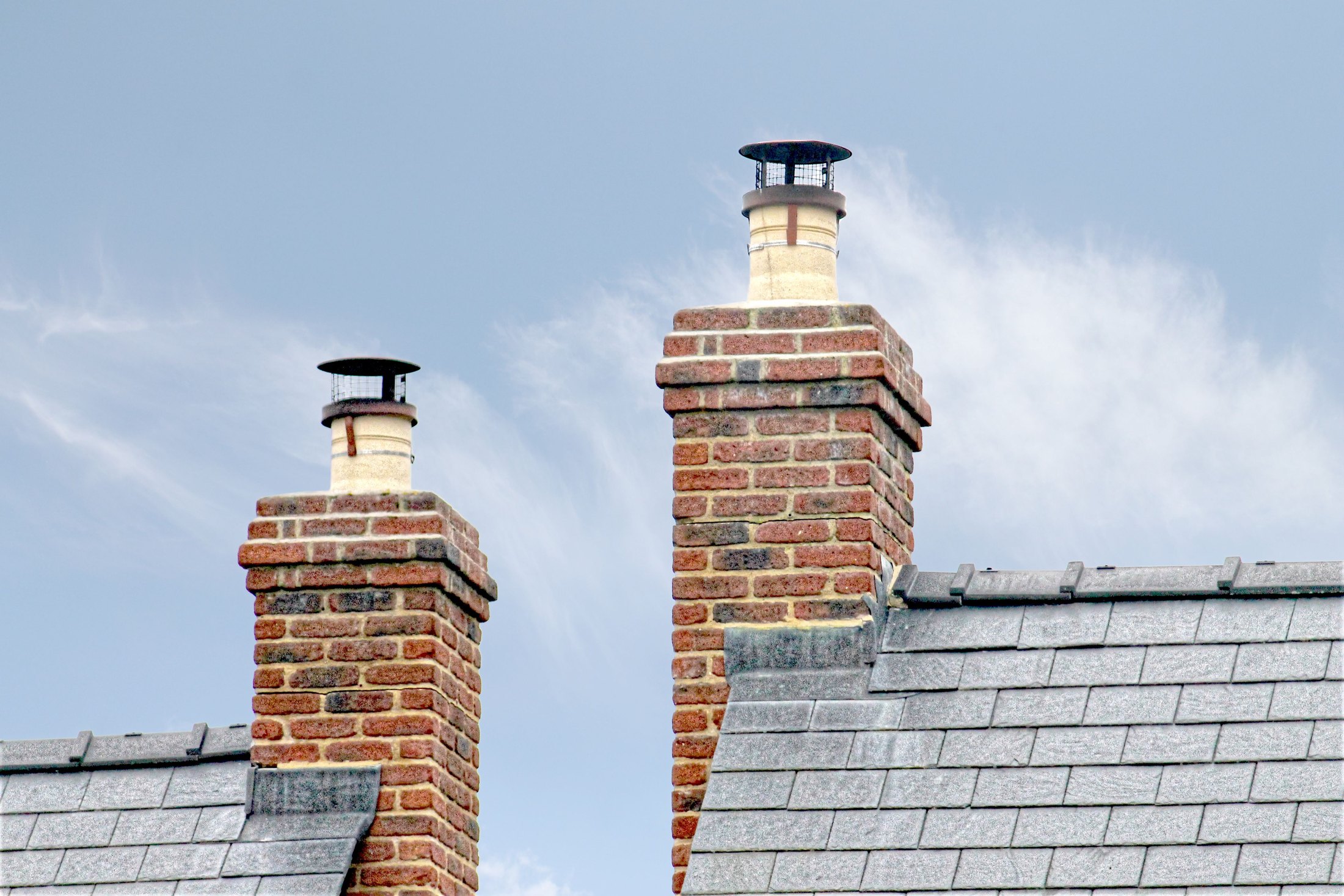
Where a roof meets a wall or a chimney, stepped flashing works loose from the joints, old cement fillets crack and the soakers under the tiles split. We re-dress or replace it in rolled lead, cut in lengths short enough to move with the heat without tearing. A chimney flashing set is usually a day. If the stack itself has loose flaunching or open joints, that is chimney repairs, and new lead alone will not stop it.
Valleys
A valley drains two slopes at once, so a small split lets in a lot of water. Relaying one means lifting the tiles either side for new lead or a GRP valley trough, so allow a day or two. We will not smear mastic over a split lead valley. It lasts a season at best.
Underlay, membrane and battens
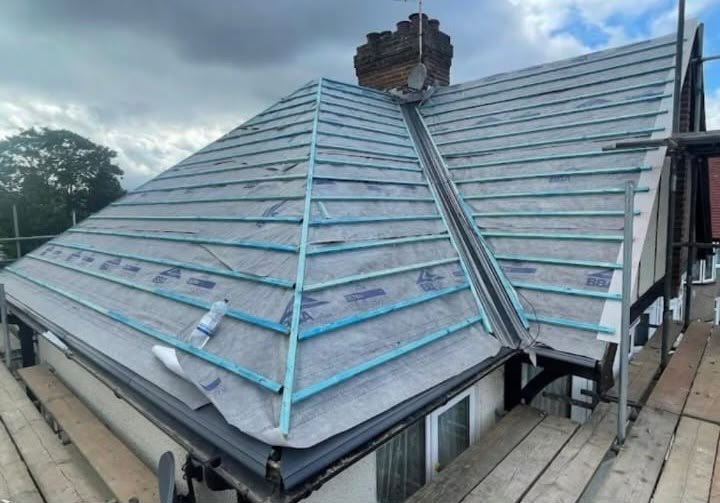
Older roofs have bitumen felt under the tiles. A local tear at the eaves can be cut out, new membrane let in and a rotten batten or two replaced. If the felt crumbles as soon as it is touched right across the slope, a patch only moves the leak along.
Flat roofs over extensions, garages, dormers and bays
Felt, GRP fibreglass and EPDM rubber fail in the same places: splits and blisters, the upstand where the roof meets the wall, and the outlet where the water leaves. A small split can be patched in a few hours if the deck underneath is dry and firm. A soft deck will not hold a patch, and we will tell you so. More on flat roofing.
Gutters, downpipes, fascias and soffits
Not every leak is the roof. A gutter full of moss, a valley choked with leaves and debris, a downpipe with a failed joint or a rotten fascia can all put water where it should not go. Sometimes clearing it out is the whole repair. See gutter repairs and fascias, soffits and guttering.
Tracing a leak
Why the stain is rarely under the hole
Water gets through a gap, runs down the felt or along a rafter, and drips wherever it meets something. So the stain can be a metre or more downhill from the cause, and a patch above it misses the fault.
We work from the top down: the chimney and the back gutter behind it, the valleys, the abutments, any roof window, then the ridge. Then the loft, in daylight, looking for light where there should be none, damp timber and tide marks on the felt. Condensation in a loft with blocked eaves and poor ventilation can pass for a leak, so can rain driven into a wall, and we check for both.
Everything we find is photographed, and you see it before any work is agreed. Our guide to what a brown stain on a ceiling means covers the signs.
Repair or replace
When repairs stop paying off
A leak usually needs a repair, not a new covering, and the quote says which. A fault in one place usually only needs one. These are the signs that the roof as a whole has had its time:
- slates slipping all over a slope because the nails have rusted through
- felt that tears or crumbles wherever it is touched
- tiles flaking, softening or cracking right across the roof, not in one spot
- the same slope patched again and again, with the leak moving each time
Where it is close, the quote prices the repair and the re-cover side by side. Re-roofing is on our roofing services page.
Planning Portal guidance on roofs says work that does not materially change how a house roof looks will usually not need planning permission, so a like-for-like repair needs no application. Changing the material may, and flats and listed buildings have their own rules. Renewing a large part of a roof can also bring in building control and insulation under Approved Document L.
How we work
How a repair runs, from your call to a clean drive
One person to ring throughout: Thomas Hannen, who owns the company. Thomas Hannen prices every job himself, and the quote you get is the one he wrote.
- A free site visit, and photographs of the fault before anything is agreed.
- A free written quote with every item on its own line: access, each repair, materials and waste.
- Scaffold when we say it is needed, and we explain why. A low roof may only need a roof ladder or a tower. A tall or steep one needs edge protection under the HSE rules on roofwork.
- Nothing left open overnight. If a repair runs on, the roof is covered and weathertight before we go.
- The site swept at the end of each day, and the old tiles, lead and mortar leave with us.
- If we find something extra once the roof is open, work on that part stops. We photograph it, price it, and it goes ahead only when you say yes.
The price
What decides the price of a roof repair
Two roofs with the same fault can be very different jobs, so no price is published here. These are what move it:
- Access. A bungalow with a clear side path is quick to reach. Three storeys, a conservatory underneath or a block of flats with no rear access means scaffold, often the biggest line.
- The covering. Concrete interlocking tiles are easy to buy. Clay plain tile, natural slate and discontinued concrete profiles take sourcing, sometimes from a reclamation yard.
- How far it has spread. One broken tile over sound felt is small. The same tile over rotten battens, a soft rafter end or a swollen flat roof deck is not.
- The detail. Chimneys, valleys and abutments take longer than open roof, and lead is priced by the length and thickness the job needs.
A quote well below the others is often a smaller job in the same words, such as sealant where new lead is needed. So ask any quote you are comparing: is access included? What exactly is being replaced, and with what? Are the ridge tiles mechanically fixed? What happens if more damage turns up? Is the waste taken away? Can I see photos of the fault? More on how we price a job and what a roofing quote should include.
Choosing a roofer
How to spot a dodgy roofer before you pay one
A sound roofer is easy to check before you pay a penny, and five quick checks tell you most of what you need. They work for anyone, us included:
- A company you can look up. Ours is company number 15471719 at Companies House.
- An itemised quote in writing before work starts. Citizens Advice says the same, and warns against large deposits.
- Photographs of the fault. If nobody can show you what is wrong, you cannot know it needed doing.
- No pressure to sign on the doorstep, and no insistence on cash.
- Nobody knocking after a storm to say your roof is dangerous. Read what to do if someone knocks first.
Whoever you choose, the law already says the work must be done with reasonable care and skill.
If it is urgent
Water coming in? Do this first
Put a bucket under the drip and move anything valuable. Keep clear of any wet light fitting and turn that circuit off at the consumer unit if you can do it safely. If a ceiling is bulging, pierce it once at the lowest point over the bucket so it drains there. Photograph the damage for your insurer. Then ring 07435 839745.
The first visit is about stopping the water: tiles refixed, lead dressed back, or the slope sheeted until the permanent repair is priced. In a top floor flat, tell your managing agent too. Scheduled work Mon to Fri, 8am to 6pm. Something urgent? Ring, and if we miss you we call back. More on the first hours is on our emergency roof repairs page.
Worth knowing in Bournemouth
Slate and clay roofs in the conservation areas
If your house is in one of Bournemouth's Victorian or Edwardian conservation areas, match the slate or clay tile that is already there. BCP Council's appraisal for Churchill Gardens, in north Boscombe, records that many natural slate roofs on streets like Churchill Road, Walpole Road and Borthwick Road were replaced with concrete interlocking tiles. It calls that harmful to the area, and notes the concrete adds weight and bulk.
The appraisal for Meyrick Park and Talbot Woods describes villas along Wimborne Road and Bodorgan Road with roofs of clay plain tiles or natural slate. It notes that late Victorian builders increasingly used Welsh slate with ornamental terracotta ridge tiles, on steep pitches. On those roofs we source matching slate or plain tile, keep the ornamental ridges and plan access for the pitch, which takes longer and shows on the quote. If a slope needs recovering, stay with the original material and check with the council before changing it. The council keeps the list of conservation areas, which also includes Boscombe Manor, Boscombe Spa, East Cliff and Westbourne.
Who you are dealing with
A Boscombe company you can check
Bournemouth Roofing & Building Ltd, registered in England and Wales, company number 15471719. The owner is Thomas Hannen, and the business is at 80a Wolverton Road, Boscombe BH7 6HX. A verified customer gave the work 10 out of 10 on Checkatrade.
We repair roofs across Bournemouth, including Boscombe, Southbourne, Winton, Charminster, Westbourne, Moordown and Kinson, then out to Poole and Christchurch.
About half the homes in central Bournemouth are flats, where the freeholder or managing agent usually instructs roof work, and larger shared jobs go through section 20 consultation. See our page for landlords and agents.
Questions
Roof repair questions
How much does a roof repair cost in Bournemouth?
It depends on access, what the roof is covered in, and how far the damage has spread under the tiles. Two slipped tiles on a bungalow and a split valley on a three storey villa are different jobs, so we do not publish a figure. The visit and the itemised written quote are free.
Should I repair my roof or replace it?
Repair it if the fault is in one place. Think about a new covering when the same slope keeps needing patches or the felt underneath has perished. Where it is close, we price both and you choose.
Do you need scaffolding to replace a few tiles?
Not always. On a bungalow or low eaves, a roof ladder or a tower is often enough for short, low risk work. Two or three storeys, or a steep slope near an open edge, needs scaffold with edge protection.
What is the best time of year for roof repairs?
Any time the roof is dry enough to work on safely. Lead and flat roof coverings go down best in dry, mild spells, but a leak should not wait for spring: every wet week soaks the battens and the ceiling a little more.
Is storm damage to a roof covered by my insurance?
Check your policy. Buildings cover often includes sudden storm damage and often excludes wear and tear. We photograph the damage and put what we found in writing, so you have something to send your insurer.
Where we repair roofs
Roof repairs by area
Each page below is written for the roofs in that place: what they are covered with, what tends to fail on them, and which council to check with before anything visible changes.
Bournemouth, Christchurch and Poole
Dorset
- Alderholt
- Ashley Heath
- Ashmore
- Beacon Hill
- Bere Regis
- Blandford Forum
- Bryanston
- Corfe Castle
- Corfe Mullen
- Cranborne
- Crossways
- Ferndown
- Furzehill
- Holt
- Holton Heath
- Iwerne Minster
- Langton Matravers
- Longham
- Lytchett Matravers
- Matchams
- Milborne St Andrew
- Owermoigne
- Post Green
- Ridge
- Sandford
- Sixpenny Handley
- Spetisbury
- Stone
- Stourpaine
- Swanage
- Tarrant Monkton
- Three Legged Cross
- Tolpuddle
- Upton
- Verwood
- Wareham
- West Lulworth
- West Moors
- West Parley
- Wimborne Minster
- Winfrith Newburgh
- Winterborne Kingston
- Winterborne Stickland
- Wool
The New Forest
Related pages
More on roofs, and where we work
Free quote
Tell us what you have noticed
Send the address and what is wrong, with a photo from the ground if you have one. We will come out, get in the loft, find the cause and put an itemised repair in writing.