Roof repairs in Poole
Slipped clay tiles and slates in the Old Town, cracked ridges and bay leadwork on Longfleet terraces, and split felt over extensions and stairwells, repaired across Poole.
The site visit is free and so is the written itemised quote. Thomas Hannen prices every job himself.
Last updated
Roof repairs
Find where it gets in, fix that point
Yes, we repair roofs across Poole town, from a slipped plain tile on an Old Town house to a leaking bay on a Longfleet terrace or a split in the felt over a stairwell. We trace where the water enters, repair that spot, and put the price in writing after a free site visit.
If water is coming through a ceiling now, ring 07435 839745 and say which floor and which room it is dripping into. There is more on emergency roof repairs here.
A clay tile has slid down the front slope of a house off the High Street. The bay roof on an Edwardian terrace drips onto the bedroom sill whenever it rains hard. A top floor flat has a brown tide mark by the outside wall, and nobody in the block is sure whose job it is.
We look from the street, go up where it is safe, and check the loft from inside. You get photographs and a written quote for that fault alone. Our main roof repairs page explains how each repair is done.
The repairs
Clay, slate, concrete and felt: where Poole roofs let water in
Poole town has Georgian and Victorian in the old town, Edwardian and inter-war terraces and semis further out, and a lot of post-war and later flats. Each leaks at its own weak points.
Plain clay tiles in the Old Town. On the two and three storey brick buildings around the Quay and the High Street, a plain tile hangs on its nibs, nailed every few courses or pegged. When the nail rusts or the peg rots, the tile slides and opens the double lap. We replace it with a reclaimed clay plain tile matched for size, colour and camber, held with a tile hook or tingle where it cannot be nailed. A concrete plain tile sits flat and shows from the street. Many of these fronts stand at the back of the pavement, so a tower or scaffold goes up under the HSE rules on roofwork before anyone steps onto the slope.
Natural slate on the same streets. Slate outlasts its nails. The nail corrodes and the slate drops out of line. One or two slipped slates get a tingle, a strip of lead or copper hooked under the bottom edge. A slope already dotted with tingles, with more moving, wants its slates off, sorted and re-nailed.
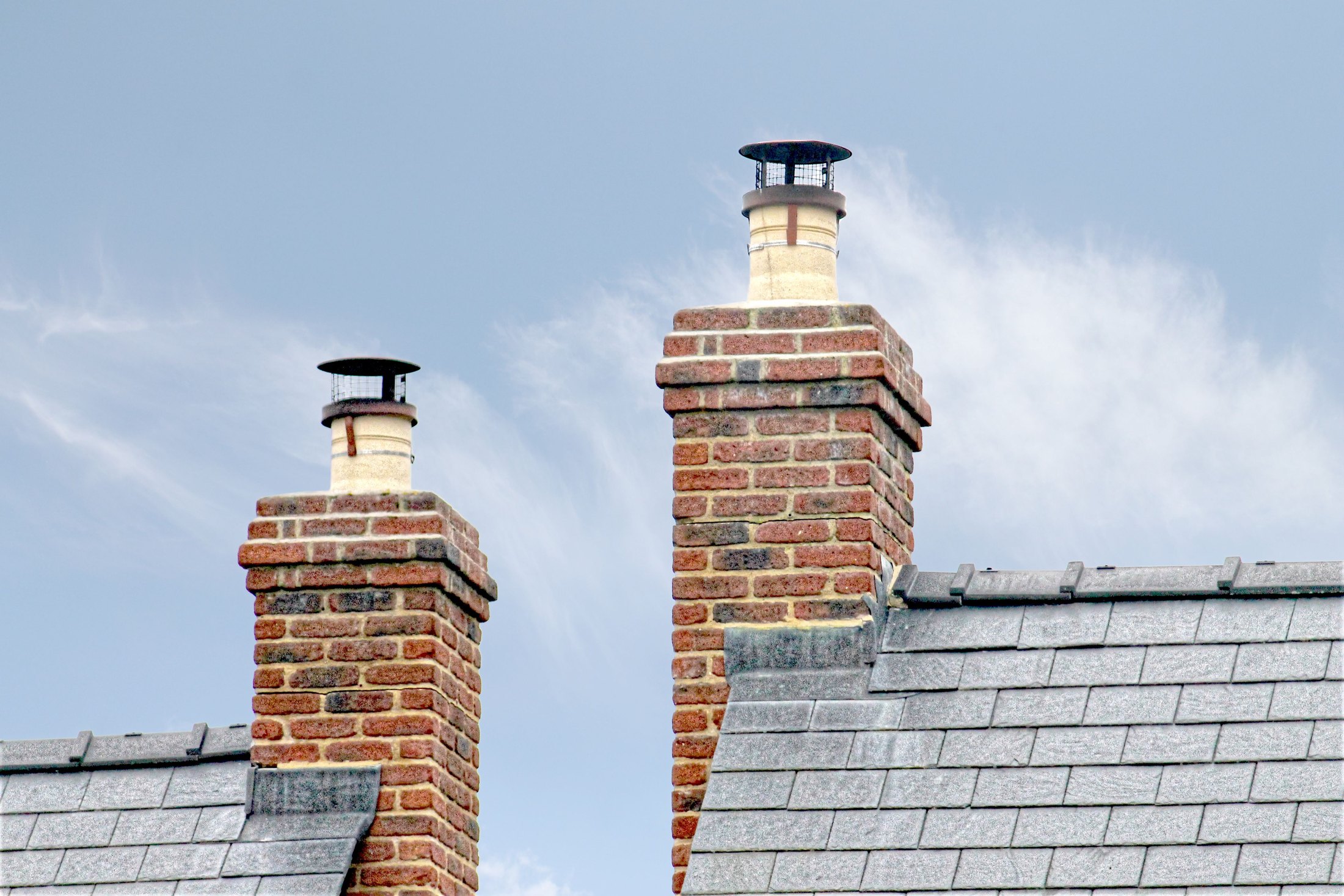
Gable stacks, dormers and parapets. Gable chimney stacks and period dormers are lead jobs. Step flashings pull out of the brick joints, soakers split, and dormer cheek lead cracks along old folds. We re-form them in code lead, and a lime-pointed stack is repointed in lime above it. See chimney repairs for the stack itself. Behind a parapet sits a box gutter lined in lead or felt, draining to one outlet. When silt blocks the outlet, water rises over the lining and under the tiles. Sometimes clearing it is the whole repair; a split lining is relined.
Edwardian terraces in Heckford Park. In Longfleet, on Garland Road, Kingston Road, St Margaret's Road and Tatnam Road, the terraces are two storey with bays and gabled roofs. The council's appraisal for the Heckford Park Conservation Area records that most of the original roofing there has already been replaced with concrete tiles. Water gets in at three places. Where the bay roof meets the main slope, concrete tile is cut round a lead valley, and the cut edge and the lead leak. Ridge and verge mortar cracks and drops out. And the brick chimneys and pots, which the appraisal names as part of the area's character, leak at the flashing and flaunching, so the repair is new lead on the stack you have, not taking it down. The decorative bargeboards sit under the verge tiles, so a verge is repaired without levering against them, and soft timber is fascias, soffits and guttering work.
Inter-war hips and bays. About a fifth of homes here are inter-war: hipped semis and terraces in concrete interlocking tile or clay plain tile. Hip mortar cracks and a hip tile works loose near the eaves. We rebed with a mechanical fixing in every tile, or fit a dry fix hip to BS 8612. The small flat or lead roof over a bay leaks at the upstand against the wall, straight into the front bedroom. Under the tiles is torn bitumen felt or, on some, no underlay at all, which leaves little margin and shifts the repair or replace decision.
Post-war tile and flat roofs. The largest share of Poole's homes went up after 1945, mostly in concrete interlocking tile. On a dry ridge a screw backs out or a union clip breaks and the ridge tile lifts in wind, which is a refix with new fixings. Flat roofs over extensions, garages, dormers and block stairwells blister, split and lose their upstand. Over a sound deck that is a patch; where the deck gives underfoot, a patch or overlay seals the wet in, and it needs a new deck in felt, GRP or EPDM. More on flat roofing in Poole.
After a storm. Tiles on the lawn or a verge lifted by a gale get a temporary sheet or refix, then a permanent repair fixed with nails or clips as BS 5534 expects. You get dated photographs for your insurer.
When patching stops. Tiles cracking across whole slopes, felt that crumbles when touched and soft battens mean a re-cover, which belongs with our roofers in Poole. You can read how we price a job before we come.
How it runs
From your call to a written price
One person to ring from the first visit to the last. The quote is itemised, not a figure on the back of a card: access, where the fault is and what is being opened up to reach it, each tile, slate, ridge or flashing being renewed and what with, making good, and disposal on separate lines, so you can compare it properly against anyone else's.
Nothing is left open or unusable overnight. The site is swept at the end of each day rather than the end of the job, and what comes out leaves with us. If something turns up once we start that nobody could have seen, you get a photograph and a price before we carry on.
BCP Council is the planning authority in Poole, and the Old Town and the Quay sit inside the Town Centre Heritage Conservation Area, with Poole Park and Heckford Park conservation areas close by. Before a repair changes a roof material, check whether your street is in one: the council keeps the list. Many Old Town buildings are listed, and on those even a like for like repair should be checked against the council's listed building records first.
Cost
What decides the price of a roof repair
No rate per square metre, because a slipped tile over a porch and the same tile above a three storey gable are one repair and two very different jobs.
Getting to it. In Poole that might be a three storey Old Town front on the pavement edge, a bay roof on a Heckford Park terrace reached from the front path, or the stairwell roof on a post-war block of flats. A tile over a porch or a bungalow eaves can often be reached from a ladder and a roof ladder. A ridge, a chimney or a valley on a two storey house usually wants a tower or a scaffold, so a small repair can still need a proper platform. The work at height rules decide that, which is why access is its own line on the quote and not hidden inside the repair.
Finding the cause, not the stain. Water runs along the battens and the underlay before it drips, so the mark on the ceiling is rarely under the fault. Tracing it back to a cracked tile, a lifted flashing, a perished valley or a ridge joint that has opened is part of the job, and a repair priced before anyone has looked is a guess.
What the repair uncovers. Lifting a few tiles shows the battens and the underlay around them. If they are sound the repair stays small. If the felt has perished or the battens have rotted, you get a photograph and a separate written price before anything more is done. Where patching stops being worth it is a conversation you have with the facts in front of you.
Comparing quotes? Ask what fault they actually found and where, whether access is included, what is being replaced and with what (a matched tile, new or reclaimed slate, which code of lead), whether the ridge and verge are being bedded in mortar or mechanically fixed, and what happens if more is found once the roof is open. Two quotes for the same job are usually two different jobs.
If it is leaking now
Water coming through a ceiling
Ring rather than use the form. Put a bowl under the drip, keep anything electrical away from the wet patch, and if a ceiling is bulging keep everyone out from under it. The first visit is about finding where the water gets in and making the roof weathertight, and the permanent repair is priced in writing once the fault can be seen properly. When you ring about a Poole roof, say whether it is a house or a flat and which floor the water is coming through. Scheduled work runs Monday to Friday, 8am to 6pm. For anything urgent, ring rather than use the form, and if we cannot pick up we ring you back as soon as we can.
Worth knowing
The leak is over a flat: who can order the repair
A third of homes in Poole town are flats or maisonettes. Under most leases the roof and outside walls stay with the freeholder, so a leaseholder or tenant with a stain on the top floor ceiling generally cannot book the repair themselves. Today, report it in writing to the managing agent or freeholder, with photos and the date it started. Tenants report to their landlord. Above a shop in the Old Town, the landlord of the whole building instructs the roof, not the flat upstairs.
A small repair, such as a slipped tile or a split in the felt over a stairwell, usually goes straight through the agent. Consultation under section 20 of the Landlord and Tenant Act 1985 only applies where one leaseholder's share of the work passes the legal threshold. Where a leak cannot wait for that, the law lets the freeholder ask the tribunal to dispense with consultation for urgent work.
When the agent or freeholder asks us out, we make the roof weathertight and price the make-safe and the permanent repair on separate lines, so the first can be signed off on its own and the second can go through their process.
Who you are dealing with
A local firm you can check
We cover Poole town from the Old Town and the Quay to Baiter, Longfleet and Heckford Park, and on to Hamworthy, Oakdale and Parkstone, 6.7 miles from our base in Boscombe, with BCP Council as the planning authority. You are dealing with Bournemouth Roofing & Building, the trading name of Bournemouth Roofing & Building Ltd, registered in England and Wales, company number 15471719, which you can look up in a minute. Thomas Hannen's business, and he is the one who comes out to price the job, not a salesman. A verified customer's 10 out of 10 on Checkatrade. The visit and the written quote are both free.
Nearby, and next door
Roof repairs near Poole
Nearby places we also cover for roof repairs, with straight-line distances from Poole, and the other trades we offer in Poole itself.
Roof repairs nearby
Our other trades in Poole
Builders in Poole: all our building work Everything we do in Poole Roof repairs, all areas Every area we cover
Questions
Questions about roof repairs in Poole
Water is coming into my top floor flat and the agent has not replied. What can I do today?
Catch the water, keep electrics clear of it, and send the agent or freeholder a written report with photos and the date it started. We can come out once they ask, and price the make-safe separately so it can be signed off by itself.
Our Heckford Park terrace has concrete tiles. Can you repair it, or must it go back to clay?
Yes, we repair the concrete tile roof you have: matched tiles, ridge and verge, and new lead at the bay. The council's appraisal favours clay tiles or slate where a roof is reinstated. That question matters when the whole roof is re-covered, and BCP Council is the one to ask before the material changes.
Is it worth repairing a chimney we no longer use?
If the stack is sound, usually yes. A leaking flashing or cracked flaunching is a smaller job than taking a stack down and making good the roof and the gable. The Heckford Park appraisal counts the chimneys as part of the area's character, so in a conservation area removing one may need the council's view.
How do I tell a genuine roofer from a doorstep one after a storm?
Look the company up at Companies House (ours is company number 15471719), ask to see the fault in photographs, and get an itemised quote in writing before any work starts. Do not hand cash to someone who knocked on the door after a gale.
Can one slipped tile really let water in?
Yes. One slipped tile breaks the lap or side lock and sends rain onto the felt beneath. Where that felt is old or missing, the water goes on to the battens and the ceiling. Caught early, it is a small repair.
Free quote
Tell us where the water is showing
Send the postcode, whether it is a house or a flat, and what you have seen. We look properly and put the repair in writing.