Roofing Services Bournemouth
Roofing that keeps the weather out. New roofs, roof repairs, flat roofing and leadwork for homes and commercial property across Bournemouth, Poole and Christchurch. Free quotes, and a clear written price before anyone starts.
The site visit is free and so is the written itemised quote. Thomas Hannen prices every job himself.
Last updated
Roofing
Does your roof need a repair or a new roof?
Most roofs with a problem do not need replacing. A slipped tile, a lifted flashing or a ridge that has lost its bedding is a repair measured in hours. A full re-roof is the right answer when the battens, the felt and the fixings have reached the end together, and a straightforward pitched re-roof then takes three to five working days once the scaffold is up.
If water is coming through a ceiling right now, ring 07435 839745 rather than filling in the form, and tell us which room and whether a pitched or a flat roof sits above it.
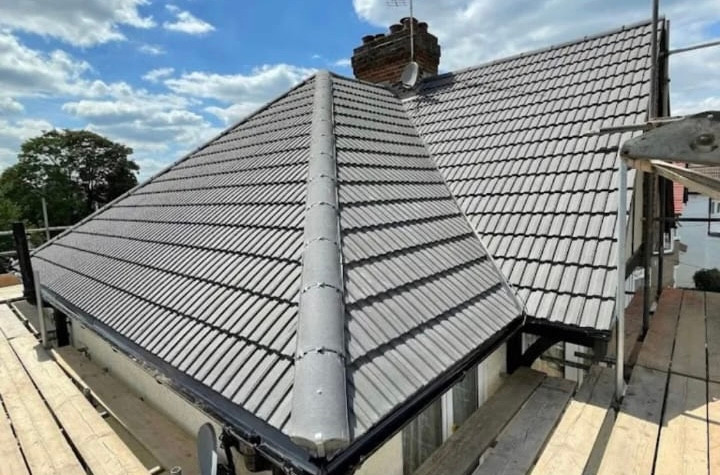
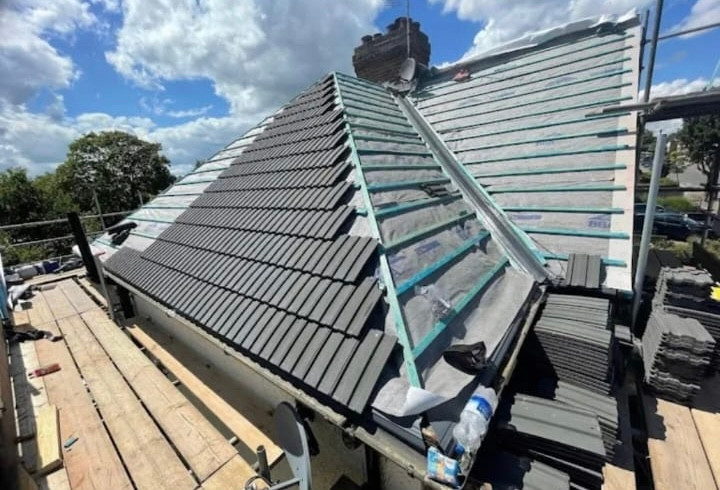
Bournemouth Roofing & Building do roof repairs and emergency roof repairs, roof replacements, new roof installations, flat roofing, leadwork and roof maintenance across Bournemouth, Poole and Christchurch, on houses and commercial buildings. Pitched roofs are stripped to the rafters and relaid on breathable membrane and treated battens. Flat roofs go down in torch-on felt, GRP fibreglass or EPDM rubber. An emergency roof repair starts with a temporary cover to stop the water, then the proper repair once it is dry. The site visit is free, and you get an itemised written price before anything starts.
Repair it if it can be repaired. Replace it when it cannot.
Most roofs do not need replacing. They need the right tiles putting back, the flashing redoing, or the ridge bedding sorting out.
We climb up, look at it properly, and tell you what is actually wrong. If a repair will hold for years, that is what we will quote for. If the battens have gone, the felt has perished and half the nails have rusted through, we will say that too, and show you the photographs instead of asking you to take our word for it.
Residential and commercial, pitched and flat, single repairs through to full re-roofs. All work is priced in writing before it starts, and the site is left clean when we finish.
We cover the whole conurbation from our base in Boscombe, so if you are the other side of the harbour there is a page for our roofers in Poole, and another covering roof repairs in Christchurch.
What we cover
New Roofs, Roof Repairs, Low Pitches & Leadwork
New roofs, repairs, low pitches and leadwork are all sides of the same job. Whether it is one slipped tile or the whole covering, it starts with a free site visit and one written itemised quote.
New Roofs
We fit new roofs across Bournemouth, Poole and Christchurch in concrete or clay tiles and natural or fibre cement slates, on houses, extensions and garages. You choose the covering, and we tell you what the pitch of your roof and its exposure to the weather will allow.
A full re-roof strips the old covering back to the rafters, replaces any battens or timbers that have gone, and goes back on with breathable membrane, treated battens and the tiles or slates you have chosen. Ridges, hips, verges and valleys are re-detailed so the whole roof is watertight, not just the middle of it. Durable materials, and a finish we are happy to put our name to.
Fixings are specified to BS 5534:2014+A2:2018, the British Standard code of practice for slating and tiling. It is the reason a modern re-roof carries far more nails and clips than the roof it replaces, and the reason we dry-fix ridges and verges and do not rely on mortar alone on an exposed elevation.
Roof Repairs
Roof repairs across Bournemouth, Poole and Christchurch, from a single slipped tile to storm damage and leaks. We get up on the roof and into the loft, find where the water is coming in, and photograph it so you can see what we saw.
Slipped, cracked and missing tiles, storm damage, loose ridge tiles, failed flashing and leaks that only show themselves when the wind is in a particular direction. We trace the water back to where it is actually getting in, not patching the spot where the stain appears on the ceiling. We tell you straight whether a repair will hold or the roof needs more.
Extension, Garage & Dormer Roofs
Flat roofing in felt, GRP fibreglass and EPDM rubber: new installations, repairs and full replacements. We check the deck underneath first, because a new covering laid over soft or rotten boards will not last.
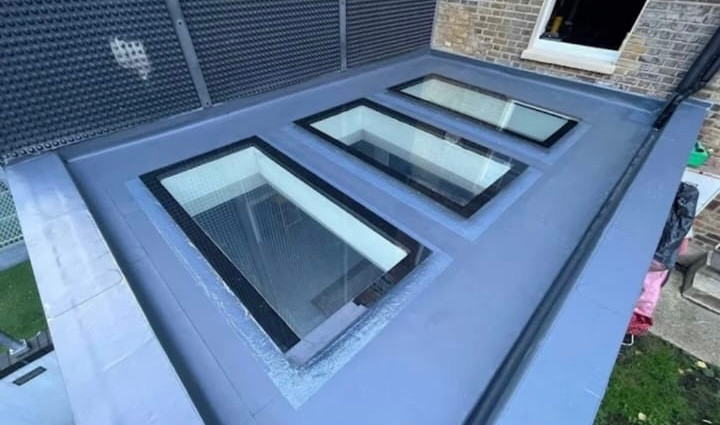
Torch-on felt, GRP fibreglass and EPDM rubber systems for garages, extensions, dormers, porches and outbuildings. New installations, replacements and repairs. The falls, upstands, trims and outlets are set out properly so water runs off instead of sitting in a puddle in the middle of the roof.
Leadwork
Leadwork on flashings, valleys, chimneys and roof junctions. We replace lead that has split or lifted, re-wedge flashings that have pulled out of the mortar joint, and repair lead that can still be saved instead of stripping it all.
Chimney flashings, soakers, valleys, box gutters, parapets and roof-to-wall junctions formed in code-rated lead. Lead is cut to sensible lengths, dressed to the profile and clipped so it can expand and contract without splitting. Most roof leaks start at a junction, which is why this detail matters more than it looks.
Flat roofing
Flat roofs: felt, GRP fibreglass and EPDM rubber
Felt, fibreglass or rubber, laid to fall
A flat roof is not actually flat. It needs a fall built into it so water runs to the outlet, and it needs the edges, upstands and any penetrations detailed correctly. Get those wrong and it will leak whatever material you spend your money on.
Torch-on felt is the economical option and works well on garages and smaller roofs. GRP fibreglass cures into one seamless sheet on site, takes foot traffic, and handles awkward shapes, rooflights and upstands neatly. EPDM rubber goes down as a single membrane with almost no joints and copes well with movement, which suits larger, simpler roofs.
We will look at the deck, the falls and how you use the roof, then tell you which system makes sense. If the existing deck is soft or the insulation is saturated, an overlay is a waste of money and we will say so. For the long version, our flat roofing page takes the deck, the fall, the upstands and each membrane one at a time.
We replace garage and extension roofs out towards Wimborne and Ferndown as well as in town.
| Flat roof system | Torch-on felt | GRP fibreglass | EPDM rubber |
|---|---|---|---|
| How it goes down | Bonded sheets, torched at the laps | Resin and matting laid wet on site, cures into one sheet | A single rubber membrane bonded to the deck |
| Joints | Lapped joints throughout | Seamless once it has cured | Almost none on a simple roof |
| Suits | Garages, sheds and smaller roofs | Dormers, balconies, rooflights, awkward shapes | Larger, simpler roofs with few penetrations |
| Foot traffic | Occasional access only | Takes regular foot traffic | Occasional access, protected if it is walked on |
| Movement | Moderate tolerance | Rigid, so the upstands and trims do the work | Very tolerant, the membrane stretches |
| Repairing it later | Patch and re-torch | Grind back and re-laminate, and the patch can show | Cut in a new piece and bond it |
| What moves the price | Deck condition and the number of upstands | Trims, upstands and rooflight detailing | Roof area, and how few penetrations there are |
Worth a look
How do you know your roof needs attention?
Slipped tiles, damp patches upstairs, a sagging roof line, heavy moss, failed flashings and overflowing gutters are the signs to watch for. None of them means you need a new roof, only that it is worth someone getting up there before the next spell of bad weather.
- Slipped, cracked or missing tiles, particularly after a gale
- Damp patches or brown staining on upstairs ceilings and chimney breasts
- A dip or sag in the roof line, easiest to spot from across the road
- Heavy moss build-up sitting in the tile laps and holding water
- Cracked, lifted or failed flashing where the roof meets a chimney or wall
- Gutters overflowing, dropping away from the fascia or leaking at the joints
How a roof job runs
How does a roof repair or re-roof run, from visit to finish?
A roof job runs from an inspection to a written quote, then a booked start with the scaffold up, then the work and a walk round at the end. You will know what is happening, who is coming, and what it costs before the first tile moves. If we find more once the roof is open, you get a photo and a price before we touch it.
Roof inspection
We come out and look properly, outside and in the loft where we can, and take photographs of anything we find.
Written quote
An itemised price covering materials, scaffolding, labour and taking the rubbish away, with the scope set out in writing.
Booked in
We agree a start date, order the materials, and get the scaffold up before the first working day on the roof.
Work and walk round
The job is done, the site is cleared, and we walk you round the finished roof before the scaffold comes down.
What it costs
What decides the cost of a roof repair or a new roof?
Roof prices are driven by access, area and what has to come off before anything goes back on, far more than by which tile you choose. On most re-roofs the scaffold and the strip-out are a bigger share of the quote than the covering, which is why a number given over the phone is a guess and a number given from the roof is a price.
We do not publish a rate per square metre. On a pitched roof the square metres are the easiest thing to work out and the least useful thing to know. These are the variables that actually move the figure, and any roofer quoting your job should be able to talk you through every one of them.
What moves the number
- Access and the scaffold. A terraced house with a shared alley, a bungalow you can reach off a tower, and a three-storey corner plot are three different jobs before a single tile moves. Roof work is work at height, and the HSE guidance on roof work is why a proper working platform is a priced line on the quote, not an optional extra. How long the scaffold has to stand matters as much as how big it is.
- Area, pitch and shape. Two roofs with the same footprint are not the same roof. A steep pitch, a hip on every corner, two valleys, a dormer and a chimney all add cutting, detailing and days that a plain gable roof does not have.
- What can be salvaged. Sound clay or natural slate that can be lifted, sorted and relaid changes the material cost completely. Concrete interlocking tiles that have lost their surface almost never come back, so a Ferndown or Verwood estate roof is usually a full re-cover, not a relay.
- What is under the tiles. Battens, membrane and fixings are the part nobody sees and the part that decides what a re-roof costs. A rotten batten run, a perished felt or a split rafter found on the strip is the most common reason a job moves.
- The junctions. Chimneys, valleys, box gutters, parapets and roof-to-wall abutments get priced individually, because that is where the leadwork time goes and where the leaks start.
- Disposal. A stripped roof produces a surprising volume of tile, batten and old felt. Skips or muck-away, and how far the lorry has to park from the house, is a real line on the quote, not a rounding error.
- Whether the appearance changes. Repairing or replacing like for like is normally treated as maintenance. Changing the covering, the material or the roof line is where permission can come into it, and the Planning Portal guidance on roofs sets out where that line sits.
What we will ask you
Roughly how old the house is, and whether the roof has been done before. What you can see from the garden, and what you can see in the loft on a wet day. Whether there is a chimney, a valley or a flat section. Where a scaffold could reasonably stand, and whether a lorry can get near the house. Photographs from the ground and from inside the loft answer most of that before we arrive, which is why we ask for them.
Why two quotes for the same roof come out different
Almost always because they are not quoting the same job. One includes the scaffold and the other leaves it with you. One strips back to the rafters and renews battens and membrane, the other overlays what is already there. One re-forms the chimney flashing in code-rated lead, the other seals it. One takes the waste away, the other leaves a skip on your drive at your cost.
So compare the scope before the total. Ask each quote what happens if a rotten batten turns up, whether the ridge is bedded in mortar or dry-fixed, what code of lead is going on the chimney, how long the scaffold is priced to stand, and who pays for the skip. If the answers are vague, what you are holding is not a price yet.
Reviews
What customers said
Two of the roofing customers who left a review after the job, in their own words. One talks about a team that turned up when they said and explained each stage, the other about being kept informed and a site left clean.
…The team were friendly, professional, and always turned up when they said they would. They took the time to explain everything, so I knew exactly what was happening throughout…
…The team were professional, friendly and kept me informed throughout the whole job. The workmanship was excellent, everything was completed to a high standard, and they left the site clean and tidy afterwards…
Straight answers
Straight answers before you book a roofer
Is it a repair or a new roof?
Most roofs need a repair rather than a replacement, and the way to tell is what is under the tiles rather than what is on top. A slipped tile, a lifted flashing or a ridge that has lost its bedding is a repair measured in hours.
A new roof is the right answer when the battens, the felt and the fixings have all reached the end together. The signs are tiles slipping all over the roof rather than in one place, felt in the loft that crumbles when you touch it, nails rusted through, and a dip in the roof line you can see from across the road. Concrete interlocking tiles that have lost their surface and hold moss are another. A roofer should look in the loft as well as on the roof, and show you photographs of what they found. If they say it needs replacing, ask them to point to the reason. You can start with our roof checks you can do from the ground.
Concrete or clay roof tiles: which is better?
Neither is better on every roof. The pitch, the rest of the street and the budget decide it. Clay tiles are fired, keep their colour, and can often be lifted, sorted and relaid when the battens underneath are renewed. Concrete tiles are usually cheaper to buy, and as large interlocking tiles they cover a roof quickly and work on shallower pitches than small plain tiles. Their weak point is the surface. Once it wears away the tile goes porous, holds moss on the shaded slope, and rarely comes back for reuse. Changing from one to the other is not always a straight swap. Plain clay tiles need a steeper pitch and more battens, and a heavier covering can mean the roof timbers need checking first. In a conservation area the street may decide it for you. Our guide to concrete vs clay roof tiles goes further, and we tell you at the visit what your roof will take.
Do I need building regulations approval for a new roof?
Often yes, even when you do not need planning permission. Replacing a roof covering is building work, and renewing a substantial part of a roof, such as a whole slope, counts as renovating a thermal element under regulation 23 of the Building Regulations. That means the insulation has to be brought up to the standard in Approved Document L where it is practical to do so. Over a cold loft that usually means topping up the insulation at ceiling level. Over a room in the roof it can mean insulation between or over the rafters. Building control has to be told, either by the contractor through a registered scheme or by a building notice before work starts. Replacing a few slipped tiles is not caught. Ask anyone quoting a full re-roof who is notifying it and how. Where the loft needs work, our loft insulation can go in while the roof is open, on the same written quote.
What happens if rotten timber turns up once the roof is stripped?
You are told and shown before anyone charges you for it. Rotten battens, perished felt, a split rafter or a soft wall plate are the most common reasons a re-roof changes once it is under way, and nobody can see them from the ground, however careful the survey. When the covering comes off and something is worse than expected, we stop on that part, photograph it, show you, and put a written price for the extra in front of you. Nothing extra goes ahead until you have agreed it. The rest of the roof is sheeted over and made secure while you decide. A good quote deals with this in advance by saying what happens if bad timber is found, so ask every roofer you are comparing the same question. A price with no answer to it is not the whole price. Our guide to what a roofing quote should include lists the other questions worth asking.
Questions
Roofing Questions and Answers
How long does a new roof take?
A straightforward pitched re-roof on a terraced or semi-detached house usually takes three to five working days once the scaffold is up. Bigger roofs, steeper pitches, and roofs with valleys, dormers or two chimneys take longer. What we find when the old tiles come off also matters, because rotten battens or a broken rafter add a day. You get a realistic timescale in writing with the quote, and we tell you straight away if the weather pushes it back.
Do you work through the winter?
Yes. Repairs, leaks and leadwork carry on all year round. Full re-roofs are planned around the weather, not the calendar: a cold dry day is perfectly good roofing weather, heavy rain and high wind are not. Anything stripped is sheeted and made secure at the end of each working day. Winter jobs simply take a few more days because of the days we lose.
How quickly can you deal with storm damage or an emergency leak?
Ring us and tell us what has happened, including whether water is getting in, and we will tell you what can be done first. The first visit is about making the roof safe and watertight, usually with a temporary repair or a sheet, so nothing gets worse while you decide what to do. We then quote for the permanent repair once we can see the full extent of it. Scheduled work Mon to Fri, 8am to 6pm. Something urgent? Ring, and if we miss you we call back.
Felt, GRP or EPDM: which is best for a flat roof?
All three last well when they are installed properly, so it comes down to the roof. Torch-on felt is the most economical and suits garages, sheds and smaller roofs. GRP fibreglass is laid wet on site and cures into one seamless sheet, which takes foot traffic and awkward shapes well, so it suits dormers, balconies and roofs with rooflights. EPDM rubber goes down as a single membrane with very few joints and copes well with movement, which makes it a good choice on larger simple roofs. We will tell you which one fits your roof and budget instead of pushing one system at everybody.
Is scaffolding included in the quote?
Yes. Where a job needs a scaffold or a tower it is priced in and shown as its own line on the quote, so you can see exactly what it costs. We arrange it, and we tell you roughly how long it will be standing and where it has to go. If access is tight, or the scaffold needs to stand on a public path or a neighbour's garden, we flag that before you commit to anything.
Do you handle insurance work and the paperwork that goes with it?
Yes. We will inspect storm or impact damage, take photographs, and write up an itemised quote and a plain description of the damage in the format insurers normally ask for. The claim itself stays between you and your insurer, and we do not act as loss assessors. Our part is the evidence, the pricing and the repair.
Areas covered
Roof Repairs & New Roofs Across Bournemouth, Poole & Dorset
We repair and replace roofs across Bournemouth, Poole and Christchurch, and inland to Wimborne, Ferndown, Ringwood and Verwood. We serve these areas, and the towns in between them:
Roofing by location
Roofing in every town and village we cover
Each page is written from the ground, the housing stock and the planning position of that settlement, using Environment Agency, British Geological Survey, Valuation Office Agency and Census records. A page for every place we cover, grouped by area.
Within 8 miles
8 to 14 miles
- Stone (also Sturminster Marshall)
- Furzehill
- Ashley Heath
- Beacon Hill
- Swanage
- Holt (also Chalbury Common, Gaunt's Common and more)
- Holton Heath
- Thorney Hill
- Three Legged Cross
- Lytchett Matravers
- Langton Matravers (also Worth Matravers, Harman's Cross)
- Barton on Sea
- Corfe Castle (also Studland)
- Sandford
- Ridge (also Stoborough)
- Ringwood
- New Milton
- Wareham
- Bashley
- Burley (also Burley Street)
- Verwood
- Hangersley (also Hightown)
- Ashley
- Milford on Sea
- Everton (also Hordle)
- Spetisbury (also Charlton Marshall)
- Alderholt
- Cranborne (also Whitmore)
14 to 20 miles
- Tarrant Monkton (also Pimperne)
- Hyde (also Frogham, North Gorley and more)
- Winterborne Kingston
- Lymington
- Brockenhurst
- Boldre (also Sandy Down, Tiptoe and more)
- Sandleheath
- Bere Regis
- Fordingbridge
- Blandford Forum
- Walhampton and Portmore (also Pilley)
- Wool
- Bryanston
- Rockbourne (also Martin)
- Lyndhurst
- Sixpenny Handley
- West Lulworth (also Burngate)
- Breamore (also Woodgreen)
- Minstead
- Winterborne Stickland
- Winfrith Newburgh (also Briantspuddle)
- Milborne St Andrew (also Winterborne Whitechurch)
- Stourpaine (also Durweston, Ash)
- Tolpuddle
- East Boldre
- Cadnam and Bartley
- Lover
- Redlynch
- Downton
- Ashmore
- Woodlands
- Crossways
- Iwerne Minster (also Shroton)
- Owermoigne
Not just houses
Commercial roofs, units and blocks of flats
Most of what is on this page is domestic work. We also cover warehouse and industrial unit roofs, shop and office roofs, and the communal roofs on blocks of flats, which come with their own problems: single ply and felt rather than tile, ponding where the falls have gone, outlets that block and back up, and a leak that shows up on a shop floor a long way from where the water actually got in.
That work also has to fit around a business that is still trading, so it is planned around your trading and sequenced so nothing is left open when you open the doors.
Free quote
Free Roofing Quotes in Bournemouth, Poole & Christchurch
Get a price for your roof, with no obligation. Send us a couple of photos or book a visit. We will look at it properly and put a clear written quote in front of you.