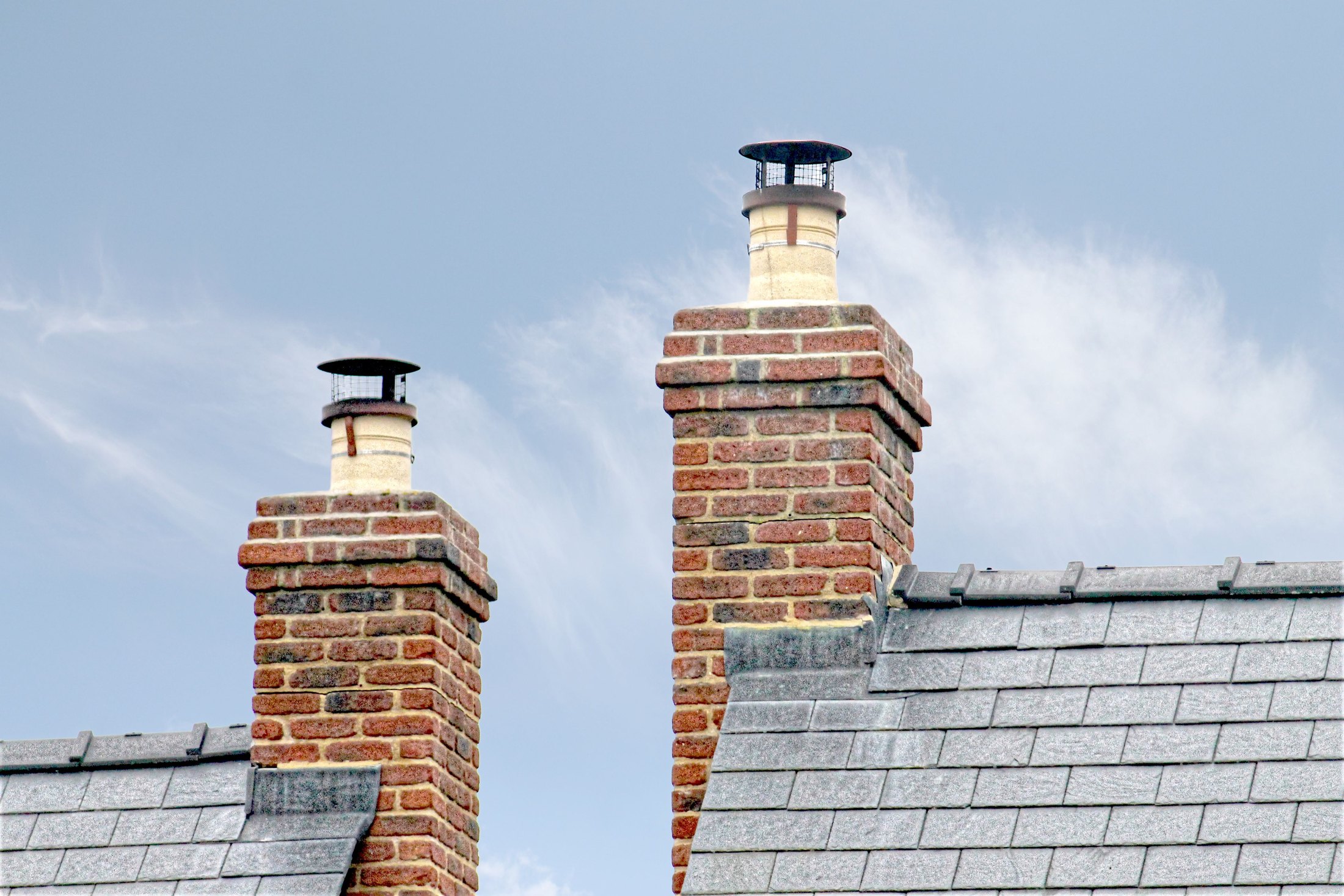
Roofing in Owermoigne
Roof repairs, dry ridge and verge, re-covering, flat roofs, leadwork and gutter work around Owermoigne and the DT2 lanes between Dorchester and Wool.
The site visit is free and so is the written itemised quote. Thomas Hannen prices every job himself.
Last updated
The roof is rarely the hard part in Owermoigne. Where the water off it ends up is the thing worth thinking about. The village has its own conservation area over its historic core. Outside it, on an unlisted house, a like for like re-cover needs no application and the covering is your choice. Inside it, a like for like re-cover is still maintenance, but a change of covering is worth raising with Dorset Council first.
The village is a handful of lanes and scattered plots in open country, and the roofs are as mixed as the buildings. An old cottage with a big chimney and a lead valley sits next to a house with a concrete tile roof and an attached garage. What is the same on all of them is the exposure and the ground. If rain is getting past a lead valley or a chimney into an Owermoigne cottage today, ring 07435 839745.
Somebody comes out, gets on the roof, opens up the eaves and goes into the loft with a torch, and you get the photographs. Then you are told plainly whether this is a fixing job, a run of edge work, or a covering that has reached the end. Where a roof turns out to be thatched or stone slate, that is said at the first visit and not later. The visit and the written itemised quote are both free.
The work
The valley gets blamed on the tiles for years
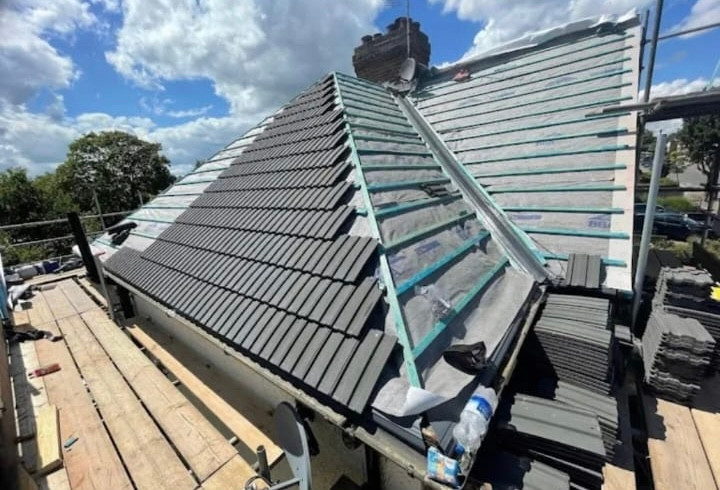
Leadwork on chimney flashings, soakers, valleys and abutments is done in code rated lead. The older roofs in Owermoigne carry lead lined valleys between ranges of different heights, and those are the leaks that get blamed on the tiles for years.
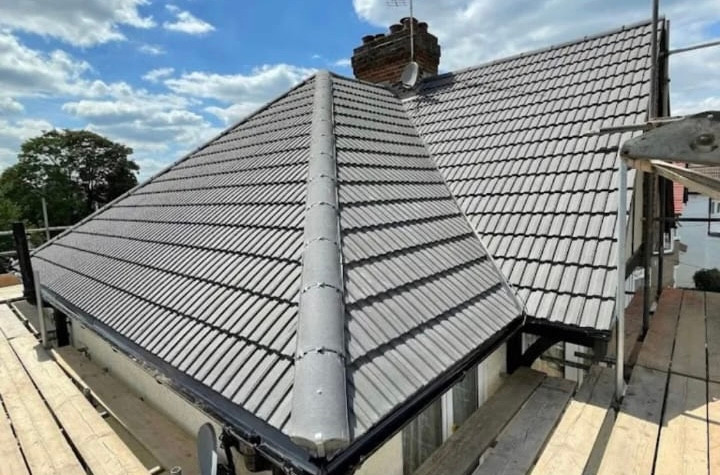
Ridge, hip and verge. Plots out in Owermoigne sit in the open, and wind works at the edges of a roof rather than the middle, so mortar bedding cracks and a verge loses its bedding while the field of the roof is still sound. We convert to dry ridge and dry verge screwed onto a ventilated roll, the mechanical fixing BS 5534 expects.
Newer houses in Owermoigne are concrete interlocking tile, and that tile outlasts the nails and clips beneath it, so what has failed is a fixing or a junction. The older cottages are plain clay tile or natural slate laid straight on battens. Purbeck stone slate appears on the oldest buildings in this part of Dorset, a specialist covering with its own sizing and fixing. Some roofs here are thatched, some half thatched with a tiled rear addition. We are not thatchers: we take on the tiled part and the junction between the two, which is a leadwork detail and is where those roofs usually let water in.
Nails rusted away, batten ends turned soft and underlay that tears in your fingers are what actually end a roof, and once all three have arrived the slope is relaid over breathable membrane on treated battens in a matched tile or slate, with wet timber cut out. A good number of apparent roof leaks are a gutter spilling over the back or a downpipe emptying into thin air, and on ground that shrinks and swells that matters beside a wall. With the roof open, insulation and eaves ventilation cost less to put right than they ever will afterwards, and Approved Document L is the standard a renovated roof is expected to meet. If all you have is one fault, a slipped slate or a leak to trace, see our page on roof repairs in Owermoigne.
How it runs
Re-roofing a house in Owermoigne, start to finish
Thomas makes the drive over from Boscombe and looks at the roof from the lane, from the garden and, where there is a hatch, from inside the roof space.
Then he writes the price line by line: scaffolding, the strip out of the old tiles or slates, fresh battens, a breathable membrane, the new covering, the leadwork and flashing at each chimney, valley and abutment junction, and disposal of the waste. The firm that quotes it is responsible for it from start to finish.
Being 22 miles out, the practical side is settled at that first visit. We agree where the lorry can unload without blocking the lane, where the skip sits and how the scaffold stands on soft ground, so none of it is worked out on the morning. At the end of each day the roof is felted or sheeted over and the site tidied, and the old tiles and timber go away with us. Should a rafter or the wall plate turn out rotten under the old covering, that part waits while you look at the photo and the price.
On an unlisted house, re-covering like for like is permitted development, and so is a rooflight that sits close to the slope; Planning Portal guidance gives the limits. Owermoigne has its own conservation area over the historic core of the village, and inside it a different covering or a new dormer should go past Dorset Council first. The parish has thirteen listed entries, and any roof work on one of those needs listed building consent.
Cost
Lanes, leadwork and what the tiles sit on
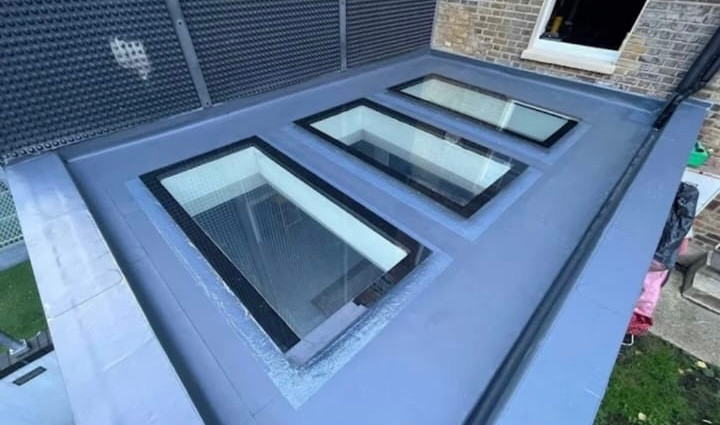
Pricing a roof here by the square metre would tell you nothing useful. These are the things that move the figure.
Getting everything here. Our base is 22 miles off, so scaffold, materials and skip are booked to turn up in order. A lane with soft verges may take a smaller lorry, and that can mean extra runs.
The new covering. Concrete tiles back on is one figure. Clay tiles or natural slate cost more, and a heavier tile means the rafters get checked before anything is ordered. Inside the conservation area, or on a listed house, you may need to match what is there now.
What lies under it. Plenty of older roofs have no membrane at all, only battens on the rafters, or a bitumen felt that has rotted through at the eaves. Soft battens and a dipped wall plate only show once the tiles are off.
Scaffold. Roofing is work at height, and the HSE rules on roof work are why the scaffold appears as a line of its own. On soft ground it also goes on sole boards so it cannot sink, and it gives a proper working platform along the eaves.
The fiddly parts. Each chimney, valley and abutment is priced on its own, since that is where the lead and the hours go.
Anyone else quoting in Owermoigne should be clear on new battens and membrane, the scaffold, and who is paying for the skip.
If it is leaking now
A leak, or tiles and mortar down on the path
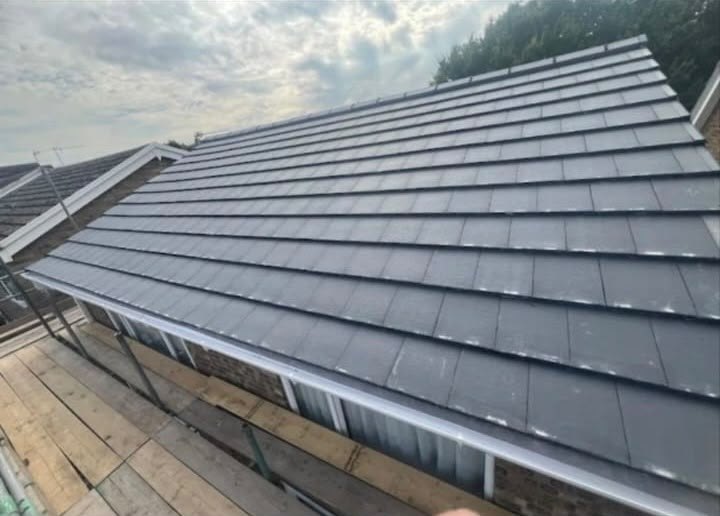
First, a bucket under the drip, anything electrical moved clear, and nobody up a ladder. Then look from the garden along the ridge and the gable verges, and check the path for fallen tiles, bedding mortar or a verge cap, because in open country that is often where a roof starts to fail.
Tell us what you see when you ring. The first visit is about making it watertight with a temporary repair or a sheet, and the permanent fix is priced after that. Scheduled roofing is Monday to Friday, 8am to 6pm. With a leak, a phone call beats the form, and if the phone goes unanswered, you will hear from us as soon as we can.
Worth knowing
Where the roof water goes matters as much as the roof
The ground around Owermoigne is cohesive and it shrinks and swells with how wet it is. That turns a rainwater problem into a structural one, and it is the reason a roof job here is not finished at the gutter.
A downpipe that empties at the base of a wall, a gully that has silted up, or a soakaway that never worked puts a lot of water into ground that changes volume with it, season after season. You see it as cracked render, a sticking door or a wet patch inside, and the roofer gets blamed for a leak that is nothing to do with the covering. Approved Document H is the standard for taking that water away properly, and what it wants is a positive outfall rather than a hole in the ground that happens to be out of sight.
So when we price a roof here we price the rainwater goods and where they discharge as part of it, and we will tell you if the real fault is at the bottom of the downpipe rather than the top.
Who you are dealing with
The roofer who drives out to you
Owermoigne sits 22 miles west of Boscombe, where we are based. We cover the village and the DT2 addresses between Dorchester and Wool, and every planning, listed building or building control question out here goes to Dorset Council.
The business is Thomas Hannen's, and it is Thomas who drives out, looks at your roof and prices it himself. The company is Bournemouth Roofing & Building Ltd, registered in England and Wales, company number 15471719. A verified customer on Checkatrade has marked us 10 out of 10. You are not charged for the visit, or for the written quote with each item listed. Before you book a visit in Owermoigne, you can read our customers' Google reviews, word for word, on our reviews page.
Planning at a glance
Do you need planning permission in Owermoigne?
Most repairs in Owermoigne need no application at all. What decides whether a change to the outside of your house does is who the council is, whether a conservation area or a listing applies, and whether the place sits in a protected landscape.
| Question | In Owermoigne |
|---|---|
| Who decides | Dorset Council is the planning authority for Owermoigne. Dorset Council's heritage pages set out what it controls. |
| Conservation area | Yes: Owermoigne Conservation Area. Check whether your street is inside the boundary before changing anything visible. |
| Listed buildings | Yes, there are listed buildings in and around Owermoigne. If yours is one, work can need listed building consent. |
| Protected landscape | No National Park or National Landscape covers Owermoigne. |
Questions
Questions about roofing in Owermoigne
The wall cracked after the dry summer. Is the roof to blame?
Partly, if the water has been going in the wrong place. Ground around Owermoigne is cohesive with a significant shrink and swell rating, so it moves through a dry summer and back again, and a gutter that has spilled against one corner for years makes that corner behave differently from the rest of the wall. We look at the joints, the gully and the fall of the ground at the survey and write down what we find.
Is there a conservation area over Owermoigne?
Yes, the Owermoigne Conservation Area covers the historic core, designated by Dorset Council in 1990. Thirteen entries are listed here, the Parish Church of St Michael and Moignes Court among them, and those individual buildings need listed building consent before anything comes off the roof. Elsewhere a re-cover in the same materials is maintenance, and inside the conservation area a change of covering is the thing to check with Dorset Council first.
Will a new covering be heavier than what is up there now?
That is exactly the right thing to ask, and it decides the specification. Concrete interlocking tiles weigh considerably more than natural slate, clay plain tile is heavy too, and an old roof structure was sized for what originally went on it rather than for whatever is easy to buy now. On the older buildings around Owermoigne we check rafter size, spacing and the state of the wall plate before suggesting a covering. If the timber will not carry it we say so.
There is no room at the side for scaffold. What then?
Access gets worked out at the survey, because it changes the method and sometimes the sequence. Where a gable sits tight against a boundary we can often use a narrower bay, a tower off a flat roof, or a lift cantilevered from the front elevation, and where we cannot, we ask the neighbour early, not the week before. If any leg lands on the highway, Dorset Council issue the licence and that takes time.
Will you be here every day until it is finished?
Once we start, yes, because Owermoigne is a twenty mile run and dipping in and out of a job at that distance suits nobody. We would rather begin the week we can see it through than open a roof and then disappear off it. The exception is a delay we cannot control, a special order tile or a spell of weather, and if that happens the roof is made watertight before anybody leaves.
Nearby, and next door
Roofing near Owermoigne
Nearby places we also cover for roofing, with straight-line distances from Owermoigne, and the other trades we offer in Owermoigne itself.
Roofing nearby
Our other trades in Owermoigne
Roofing guides
Concrete vs clay roof tiles: which is right? Planning, building regs or listed building consent Storm damage to a roof: the first 24 hoursEverything we do in Wareham Roofing, all areas Every area we cover
Free quote
Get a written price for your Owermoigne roof
Free site visit, free written itemised quote, and we will tell you honestly whether a repair will do.