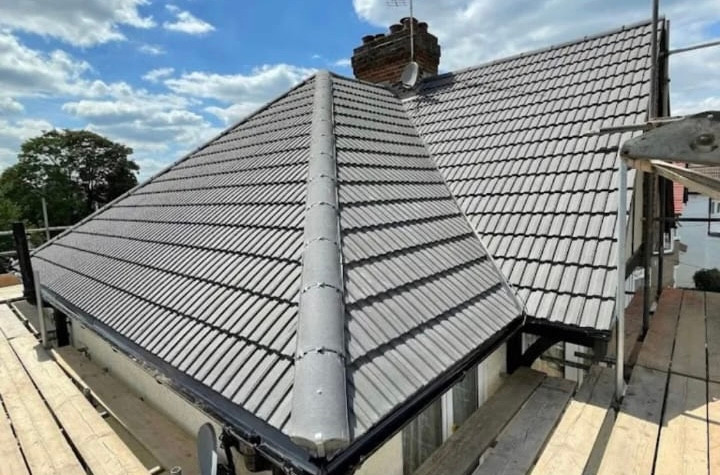
Emergency roof repairs and storm damage
Water coming through the ceiling, or tiles on the lawn after a blow. Keep off the roof, deal with the water from inside and ring. The first job is making it safe and dry. Working out the permanent repair comes after that.
The site visit is free and so is the written itemised quote. Thomas Hannen prices every job himself.
Last updated
Leaks and storm damage
What should you do if your roof is leaking right now?
Stay off the roof, contain the water from inside, switch off the lighting circuit under the leak and ring 07435 839745 rather than filling in the form. Once the wind has dropped we make the roof watertight with a temporary cover or a refix, find where the water is really getting in, and give you a written itemised quote for the permanent repair.
Bournemouth Roofing & Building repair leaking and storm damaged roofs across Bournemouth, Poole and Christchurch and the towns around them. Thomas Hannen prices every job himself, and the site visit and written quote cost you nothing.
A roof becomes an emergency when the weather is already inside or the covering is coming off. A drip or a brown ring spreading across a ceiling with the rain. Tiles, ridge or lead lying in the garden after a windy night. A split flat roof over an extension or garage. The order of work is the same for each of them: stop it getting worse, find the real cause, then decide the repair.
Scheduled work runs Monday to Friday, 8am to 6pm. For a leak, ring rather than use the form, because a form sits in an inbox and a phone call does not. If we miss your call, we ring back as soon as we can. We will not promise a time we cannot keep. On the phone we tell you honestly when we can be with you, and how to keep the water under control until then.
- Temporary cover or sheeting fixed properly, not weighted with bricks
- Slipped tiles and slates refixed, loose ridge and verge secured, lifted lead dressed back
- Flat roof splits sealed so the deck underneath stops taking on water
- The leak traced to where it starts, photographed, and priced in writing
Before anyone arrives
What can you safely do from inside the house?
Everything useful in the first hours happens at ground level or in the loft. Nothing on this list involves a ladder, and that is deliberate. The Health and Safety Executive tells people not to consider going on any roof in rain, ice, frost or strong winds, and puts the wind that affects your balance at 23mph. That is a fresh breeze, not a gale, and it is the weather people step out into thinking the worst has passed.
Take the power off where the water is
Water follows joists and cables. If it is anywhere near a ceiling light, a downlighter or a ceiling rose, switch that circuit off at the consumer unit, not the wall switch. Not sure which one? Switch off the lighting circuits and use a torch.
Move things, then catch it
Get furniture, rugs and electrics out from under it. A bucket or bin underneath, with an old towel in the bottom to stop the splash, emptied before it is full. A wet carpet left down for two days usually costs more than the tiles that let the water in.
Look in the loft, standing on the joists
With a torch, and only on the joists or on boards laid across them, never between them. Look for daylight, for water running down a rafter, and for the underlay sagging with water like a hammock. Pull soaked insulation back off the wet patch, because wet mineral wool holds water against the plaster and stops it drying. A container on a board under the drip keeps the water off the ceiling altogether.
A ceiling that is bulging
If a ceiling is sagging with trapped water, keep everyone out from under it, because it can come down in one piece. If you are not comfortable piercing it at the low point with the power off and a bin underneath, shut the door and leave it. Plaster is repairable, and once the roof is sound and the ceiling has dried, we can plaster it back.
When it is not a roofing problem first
A chimney leaning out of line, a gable or parapet that has moved, or masonry loose above a path is a dangerous structure before it is a roof repair. Keep people away and ring the council's building control. Section 78 of the Building Act 1984 gives a council the power to act straight away on a dangerous building. A cable down across the garden or pulled off the wall stops everything else: do not touch it, keep people back and ring 105, the free power cut number.
If the water is clean and it keeps coming on a dry day, it may not be the roof at all. A tank, a cylinder or a pipe in the loft leaks whatever the weather. A roof leak follows the rain, and often the wind direction too.
The first visit
What happens when we come out to a leak or storm damage?
The first visit is about stopping the water, not rebuilding the roof. It happens once the wind has dropped enough to work safely, and it covers the damage we can see and the likely route the water is taking. What each job looks like depends on what has failed.
A temporary cover or sheeting
Where tiles or slates have gone and cannot be refixed on the day, the hole gets covered. A sheet only works when it starts above the damage, is tucked under the courses higher up the slope and is held on battens, so water runs over it and back onto the tiles below. We do not nail through sound tiles to hold it, or weight it with bricks, which blow off and go through a conservatory. A properly fixed sheet buys time. It is not a repair.
Slipped tiles and slates
A slipped tile or slate is the typical storm damage. Concrete interlocking tiles and clay plain tiles are lifted, the batten checked, and the tile refixed with a nail or a clip. A natural slate is refixed with a copper or stainless tingle or a slate hook, because the nail holes are hidden under the slate above. BS 5534, the code of practice for slating and tiling sets out how tiles and slates should be fixed, and one slipped slate on a roof whose nails have all rusted is a warning, not a one off.
Ridge and verge
The ridge along the top and the verge down each gable end take the wind hardest. On older roofs both are bedded in mortar, and once the mortar cracks the tiles rock and then lift. Loose ridge tiles are taken off, the old bedding cleaned away and the tiles re-bedded and mechanically fixed. A verge losing its mortar can be re-pointed or, where the roof suits it, changed to a dry verge system that does not rely on mortar at all.
Flashing and lead
Lead is where the roof meets something else: a chimney, a wall, a dormer cheek or a valley. Wind gets under an apron or a step flashing and peels it back, and water runs down the brickwork into the house. Lifted lead is dressed back, re-wedged into its chase and pointed. Split or missing lead gets a temporary seal until new lead is cut and fitted. Soakers and the back gutter behind a chimney are checked at the same time.
Flat roof splits
A split in felt, a lifted lap in EPDM or a crack in GRP lets water straight into the deck. On the first visit the split is cleaned, dried as far as the weather allows and sealed with a compatible repair material, and the outlet is cleared so water is not sitting on it. What we will not do is paint coating over a wet deck and call it done. Whether the covering can be repaired or needs renewing is a separate question, covered on our flat roofing page.
At the end of the visit we tell you what we did, what we found and what we think caused it, with photographs. Anything beyond the make safe is priced in writing and waits for your agreement.
Finding the leak
Where is the water really getting in?
A leak rarely comes through the ceiling where it gets into the roof. Water that passes a tile or a flashing lands on the underlay, runs down to a batten or a rafter, and follows it until it drips off. From there it can cross the top of the ceiling before it shows. So we start where the water can get in and work towards the stain, not the other way round.
- Chimneys. Aprons, step flashings, soakers, the back gutter and the flaunching round the pots.
- Valleys and abutments. Where two slopes meet, or a roof meets a wall, a lot of water funnels through a narrow detail. A blocked or undersized valley overflows in heavy rain.
- The field of the roof. Slipped, cracked or porous tiles, and nail fatigue that lets whole runs of slates slide.
- Wind driven rain. Some leaks show only when the wind blows from one direction, pushing rain up under laps and verges. When you ring, tell us which way the wind was.
- Gutters and downpipes. A blocked gutter overflowing at the back edge puts water into the wall and the soffit, and looks like a roof leak from inside.
- Condensation. Damp on the underside of the roof with no single drip is often warm air from the house condensing in a cold loft. That is a ventilation question, not a leak.
That last one matters, because a condensation problem patched as a leak comes straight back. We look for a pattern: wet on the north slope, on the nails and round the loft hatch points to condensation, one wet track from one point to rain. Our piece on what a brown stain on the ceiling means goes through how to tell. If the cause turns out to be the rainwater run and not the roof, clearing it is on our gutter cleaning page, and renewing a rotten fascia, soffit or gutter is on our fascias, soffits and guttering page.
We photograph the route the water takes at each point, so you see what we saw. That is also the evidence an insurer or a landlord asks for.
Insurance
What should you photograph for a buildings insurance claim?
If the damage came with a storm, your own buildings insurance may cover the repair. That is between you and your insurer. We do not handle claims, speak to your insurer on your behalf or act as loss assessors. What we can do is put in writing what we found, what failed and what caused it, with photographs and an itemised quote. That is the document a claim needs from a roofer.
Roof claims are rarely lost on whether there was a storm. They are lost on whether the storm was the main cause, or whether the roof was already failing and the weather was simply the occasion. The Financial Ombudsman Service, which settles these disputes, asks three questions: were there storm conditions at the time, is the damage the kind a storm causes, and were the storm conditions the main cause. It also says the onus is on an insurer to show that an exclusion applies if it relies on one to decline a claim. Damage that builds up slowly over time is treated differently, which the ombudsman sets out in its guidance on gradual damage.
What to photograph, and when
- The debris before you clear it. Tiles, ridge pieces, lead or felt where they landed. It shows the material came off in the event, and it is the first thing people tidy away.
- The roof from the ground. Wide shots to show the whole slope, then zoomed in on the damage, from the garden and from upstairs windows. Never from a ladder.
- The inside. The stain, the wet insulation, the damaged ceiling and belongings, and the water in the bucket.
- Anything from before. A dated photograph of the roof in good order is worth more than anything else in a claim, and hardly anyone has one.
- Receipts. Buckets, a dehumidifier, emergency work. Keep every one.
Ring your insurer before any permanent work is done. Emergency work to stop further damage is what they expect of you. A roof rebuilt before anyone has assessed it has had the evidence removed. Ask what you are allowed to instruct, whether they want to inspect first, and write down who you spoke to and when.
Named storms and warnings
What do Met Office storm warnings mean for your roof?
Storms that hit the UK are named jointly by the Met Office and its Irish and Dutch counterparts. A storm gets a name when it has the potential to cause disruption or damage that could bring an amber or red warning, which the Met Office explains in how storms are named. The name follows the warning, not the other way round, and a new list starts each September.
The colour of the warning tells you more than the name. In the Met Office severe weather advice, the amber impacts include some structural damage, such as slates dislodged from roofs, and the red impacts include roofs blown off. So an amber wind warning is the point where a sound roof can start losing material, and it goes at the edges first: the verge, the eaves and the ridge. Colour also reflects how likely the impact is, not only how bad it would be, so a yellow warning can still describe serious damage at lower confidence. Open the warning and read the impact text.
Before it arrives, everything useful is done on the ground. Put the bins, garden furniture, trampolines and ladders away. Look along the ridge and the verges from the lawn for anything already loose, and take a few dated photographs of the roof while it is still whole. Our two pieces on what a named storm and the warning colours mean and roof checks to do before winter, from the ground go into more detail. When one has been through, what to do in the first day after storm damage takes you through it in order.
After a big storm every roofer in the area is ringing round the same morning. We work through calls by how bad the water is and tell each caller honestly where they sit. A proper repair to a ridge, a valley or a slope is a dry weather job, which is why the temporary cover has to be done well.
Rented and shared buildings
Who arranges the repair if you rent, let or lease?
If you rent, your landlord or letting agent arranges a roof repair; on a leasehold flat it is usually the freeholder or managing agent. When a roof is not yours alone, who arranges the repair matters as much as the repair.
Tenants
Tell your landlord or letting agent in writing straight away, with photographs, and keep a copy. On most tenancies section 11 of the Landlord and Tenant Act 1985 puts the structure and exterior, roof and gutters included, on the landlord. Protect your belongings and contain the water, but leave the roof to the landlord or whoever they send.
Landlords
If you let a house or flat, send us the tenant's contact details and we arrange access with them directly. You get the photographs, what we did on the make safe and the itemised quote for the permanent repair, so you can make a decision without travelling to look at it yourself.
Leaseholders and managing agents
In a block of flats or a converted house, the roof is usually the freeholder's or the management company's to repair under the lease, and the cost comes back through the service charge. A leaseholder with water coming in should report it to the managing agent first. Larger works that go through the service charge normally need consultation under section 20 of the Landlord and Tenant Act 1985, and where a repair is genuinely urgent the tribunal can dispense with some or all of that consultation. What an agent needs from us is a clear written record: what was made safe, what failed, what caused it and what the permanent repair involves, itemised so it can be put to the leaseholders. Bigger roofs over shops, offices and blocks are on our commercial roofing page.
Repair or replace
When is a patch enough, and when does the roof need more?
Once the roof is dry, the question is whether the damage was a one off or the first sign of a roof at the end of its life. We will tell you straight, and if a repair will see you through, that is what we recommend.
When a repair is enough
- One or two tiles or slates slipped, and the ones round them are firmly fixed.
- A single section of ridge or verge lifted, with the rest bedded and sound.
- A flashing peeled back by the wind, with the lead itself in good order.
- A clean split or lifted lap on a flat roof whose deck is still firm and dry.
When the roof needs more
- Slates sliding in runs across a slope, which usually means the nails have rusted through everywhere.
- Old bitumen felt underlay that crumbles when touched, or battens that are soft, so a refix has nothing sound to fix into.
- The same area leaking again after an earlier repair.
- A flat roof whose deck is soft underfoot, or that ponds for days after rain.
- Ridge and verge mortar failing along the whole length, not in one spot.
On a pitched roof that means stripping and re-covering the slope, or the whole roof, with new underlay and battens. That is planned work on our roofing services page, not an emergency, and it can wait for the right weather once the roof is watertight. On a flat roof the deck decides it, and our piece comparing GRP, EPDM and felt covers the choice of covering. Chimney brickwork that has lost its pointing is a repointing job, and a stack that needs rebuilding sits with our bricklaying and repointing work.
Whichever it is, the quote is written and itemised. The make safe, the permanent repair, any scaffold and anything we could not see until the roof was opened each get their own line. For the things a quote should show, see what a roofing quote should include.
Who turns up
Who should you let onto your roof after a storm?
Only a firm you contacted yourself. Storm damage brings people to the door, and some are not genuine, so be wary of anyone who knocks uninvited offering to go up now. You cannot check the photographs they bring down. Ask for a company name and look it up on Companies House. Our piece on somebody knocking to say your roof is dangerous covers what to do.
It is also worth knowing that if you ring a firm and ask for an urgent repair, the usual 14 day cancellation right does not cover that core work, as regulation 28 of the Consumer Contracts Regulations sets out. That is one more reason to have the price in writing before the work starts, which is how we do it anyway.
- One company from the make safe to the finished repair.
- Nothing is left open overnight. Anything stripped is sheeted and secured before we leave.
- Anything extra we find once the roof is opened is photographed and priced before it is done.
- Broken tiles, old lead and waste leave with us, and the garden is cleared of debris.
Bournemouth Roofing & Building Ltd is registered in England and Wales, company number 15471719, and the Checkatrade review on our profile is a verified 10 out of 10. Work on a roof is work at height, and HSE rules on roofwork are why access equipment is a priced line on a permanent repair rather than something skipped.
Reviews
What customers said
Two reviews written by customers after the job, word for word: a new roof, with good communication through the week, and a resin driveway, patio and decking in BH13.
I am really pleased with our new roof. The team were friendly and professional and kept up good communication with us through the week. We had no issues and I'd definitely recommend to anyone. Thank you!
Bournemouth Roofing and Building completed a beautiful resin driveway, patio, and decking area for us. The job was quite complex and far from straightforward, but they handled everything with professionalism and skill…
Questions
Emergency Roof Repair Questions and Answers
Should I go up on the roof to see what has happened?
No, the Health and Safety Executive says nobody should consider going on a roof in rain, ice, frost or strong winds, and that winds over 23mph affect a person's balance. Look from the garden and from upstairs windows, and deal with the water from inside. That applies to us too: nobody goes up while the wind is still up.
Can you come out in the evening or at the weekend?
Scheduled work runs Monday to Friday, 8am to 6pm, and we will not promise a visit outside that. For a leak, ring rather than use the form, and if we miss the call we ring back as soon as we can. When we speak we will tell you honestly when we can get to you.
What is the first thing you do when you arrive?
Make it safe and dry. That usually means a temporary cover or sheeting fixed above the damage, slipped tiles or slates refixed, loose ridge or verge secured and lifted lead dressed back. Then we find where the water is really getting in, photograph it, and put a written itemised quote in front of you for the permanent repair.
Is a tarpaulin enough to stop a roof leak?
For a few days, if it is fixed properly. A sheet only works when it runs from above the damage, is tucked under the courses higher up and is held on battens instead of nailed through sound tiles. Weighted with bricks on a pitched roof, it moves in the first gust. It buys time while the permanent repair is priced and booked.
Will my insurance pay for storm damage to my roof?
That depends on your own buildings policy, and only your insurer can answer it. Most claims turn on whether the storm was the main cause or whether the roof was already failing. Photograph the debris before you clear it, ring your insurer before anything permanent is done, and ask us to put in writing what we found and what caused it.
Why is the water coming through nowhere near the damage?
Because water runs. It gets in at a lap, a flashing or a valley, then tracks down the rafters, along the underlay or across the top of the ceiling until something stops it. A stain in the middle of a bedroom ceiling is very often fed from a chimney or an abutment several feet away, which is why we trace it from the loft side.
I rent my home. Who should arrange the roof repair?
Your landlord: tell them in writing straight away, with photographs, and keep a copy. On most tenancies the law puts the structure and exterior, roof included, on the landlord. Contain the water and protect your belongings, but leave the roof itself to the landlord or the firm they send.
Areas covered
Leak and Storm Repairs Across Bournemouth, Poole & Dorset
We trace leaks and repair storm damage across Bournemouth, Poole and Christchurch, and out to Wimborne, Ringwood, Swanage and Lymington. Leaks traced and storm damage made safe in these towns and the places between them:
- Bournemouth
- Boscombe and Southbourne
- Poole
- Christchurch
- Broadstone
- West Moors
- Ferndown
- Highcliffe
- Corfe Mullen
- Wimborne
- Swanage
- New Milton
- Ringwood
- Wareham
- Verwood
- Blandford Forum
- Lymington
The permanent side of the work sits on our trade pages: tiled and slated roofs, ridges, valleys and chimneys on our roofing page, garage and extension roofs on our flat roofing page, gutters, fascias and soffits on our fascias and guttering page, blocked runs on our gutter cleaning page, moss and lichen on our exterior cleaning page, and chimney pointing on our repointing page.
Water coming in?
Ring Rather Than Fill In a Form
Tell us what you can see, where the water is showing and which way the wind was blowing. Scheduled work runs Monday to Friday, 8am to 6pm, and if we miss your call we ring back as soon as we can. For anything that can wait, the site visit and written itemised quote are free.