GRP, EPDM or felt: which flat roof covering is right?
The certificates say something different from the sales pages, and the fall on your roof matters more than either.
Judged on two certificates and not the sales pages, the EPDM system beats the GRP one: BBA 89/2216 gives its EPDM system at least 30 years, while BBA 93/2932 puts its GRP system in excess of 15 years. But if your roof does not fall at 1:80 or better, all three coverings will fail the same way.
The short version
- These two certificates run the opposite way to most advice online, though each covers one system, not a whole material. BBA Agrément Certificate 93/2932 gives the GRP system a durability in excess of 15 years, with a laminate that can maintain its integrity for 30 years. BBA Agrément Certificate 89/2216 gives the EPDM system a service life of at least 30 years.
- The GRP certificate names the boards it will go on: 18 mm exterior plywood, oriented strand board with tongue and groove edges, or 18 mm and 22 mm P5 board. Chipboard is not on that list, and the certificate says other substrates fall outside its scope. Ask what your deck is before you accept a GRP overlay.
- Any quote that still says “designed at 1:40 to achieve 1:80” is quoting guidance that was taken out of the standard in December 2025.
- All three coverings need a minimum completed fall of 1:80, which is 12.5 mm of drop per metre of run. If water stands on your roof now and nothing in the quote corrects the fall, the covering is not what is wrong with it.
- Felt is not a bad material. It is a shorter-life material honestly priced, and on a shed, a lean-to or a roof you intend to overlay within ten years it is the sensible answer.
The certificated figures
What the certificates say, and why it is the reverse of the sales pages
Start with the document nobody quotes. Both GRP and EPDM systems are sold on the strength of a BBA Agrément Certificate, the installer will name it if you ask, and the certificate states the service life the assessor was prepared to put its name to. It is free to read. Almost nothing ranking for this question mentions it.
Instead you get numbers with nothing behind them. Across page one, GRP is variously given 20 to 30 years, 40 to 50 years, “well in excess of 50” and 100 years. EPDM gets 25 to 30, at least 35, and 50. None of those pages says where the figure came from, and several of them sell one of the two products.
Here is what two of those certificates actually say. BBA Agrément Certificate 93/2932 Product Sheet 1, covering one GRP roof waterproofing system, states on its front page that the system will have a durability in excess of 15 years, and that a GRP laminate formed under satisfactory conditions can maintain its integrity for 30 years. Read the two halves together, because they are not the same claim. Fifteen years is the life expectancy of the system as installed. Thirty years is what the laminate can do when it was laid in the right weather by somebody who followed the installation guide.
BBA Agrément Certificate 89/2216 Product Sheet 1, covering an EPDM rubber system, eighth issue December 2013 and originally issued in March 1989, states that under normal service conditions the systems will provide a durable waterproof covering with a service life of at least 30 years, and that all available evidence indicates a life in excess of 30 years.
So on these two certificates, the EPDM system’s figure is the higher. Each GRP system has its own certificate, so read the one you are quoted. That is the opposite of what you will have been told if anybody has been selling you a fibreglass roof.
Be fair to GRP about one thing, though. Fifteen years is not a prediction that the roof falls apart in year sixteen. It is the figure the assessor would commit to for the whole system on a real building, and a certificate is a cautious document by design. The honest reading is that a well laid GRP roof has thirty years in it and the certificate will only underwrite half of that.
EPDM figures vary by product, and you should hear that instead of a single number. Other EPDM certificates give a service life in excess of 25 years, and others again at least 35 years, depending on the product and which certificate covers it. So the honest summary is that certificated EPDM service life runs from in excess of 25 years to at least 35 years. Ask which certificate covers the exact system you are being quoted, and read the durability clause on its front page.
Two conditions sit on every one of those figures and both are on you rather than on the material. The certificates make the service life conditional on normal regular inspection and maintenance, and on there being no abnormal movement of the structure. A roof whose outlets have been blocked for four winters is not the roof the certificate describes.
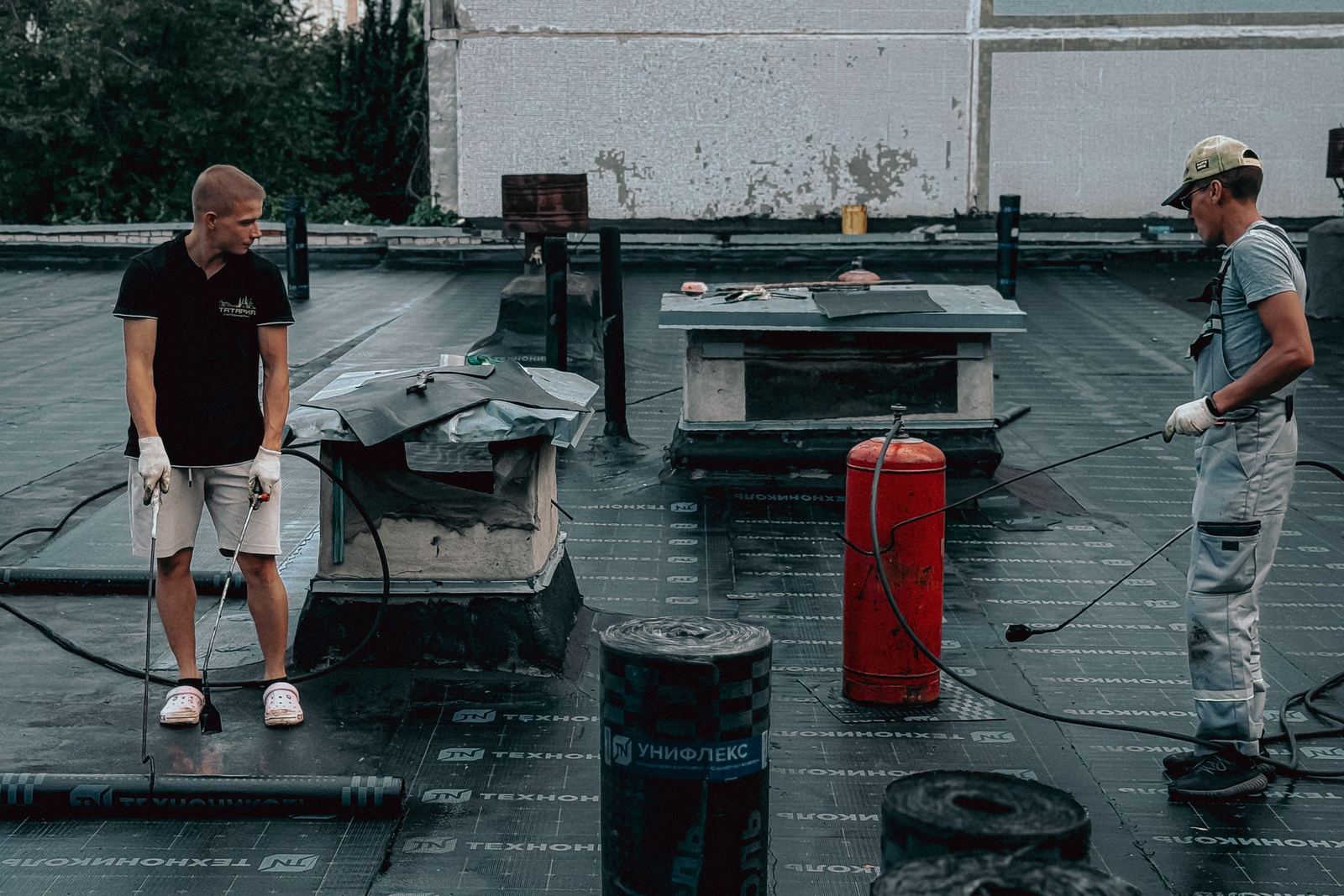
Felt has no equivalent single figure, and any page that gives you one is guessing. Reinforced bitumen membranes are specified as a build-up of layers rather than as a product, and the selection is governed by BS 8747, the guide to the selection and specification of reinforced bitumen membranes, with the membranes themselves made to BS EN 13707. A three-layer torch-on system on a well ventilated deck and a single-layer pour-and-roll job on a garage are both “felt” and they are not the same roof.
The deck
Ask what the deck is before anyone quotes you for GRP
What the deck is made of is the most useful question in the whole comparison. The GRP certificate does not just describe a resin. It names the boards the system is certificated to go on: 18 mm thick exterior plywood, oriented strand board with tongue and groove edges, or 18 mm and 22 mm P5 boards. It then says that other substrates are outside the scope of the certificate.
Chipboard is not on that list. Nor is thinner plywood, nor plywood that is not an exterior grade, nor a plank deck, nor the boarding on a lot of garages built before the 1990s. If somebody proposes to lay GRP straight over your existing deck and the deck is not one of the boards the certificate names, then the roof they are building is outside the scope of the document they are relying on when they tell you how long it will last. The fifteen years and the thirty years both belong to a system laid on a deck the certificate covers.
That is not a technicality. GRP is a rigid laminate bonded to the board underneath it, so it inherits whatever that board does. A chipboard deck that swells when it gets damp will take the laminate with it, and the crack will show along the board joint.
You can usually tell what you have. Plywood shows its layers on a cut edge like the pages of a book. Oriented strand board has large flat chips lying in visible directions. Chipboard is a mass of small particles with a smooth pressed face, and P5 board is the moisture resistant grade of it, often dyed green. If the ceiling below is open, look up. If it is not, ask the contractor to lift the covering at the edge and photograph what is underneath before pricing the job, and expect to see the photograph.
EPDM is easier here and this is its real practical advantage. Its certificate accepts a wider range of decks: steel profile decking, 12 mm and 18 mm plywood, 12 mm oriented strand board, and concrete with a separating fleece, with the decks themselves designed to the relevant standards. So when the deck is sound and is not coming off, EPDM will often be the one covering that can go over it and still be inside its own certificate.
Felt is the most tolerant of the three and will go on timber, concrete or insulation. Tolerance is not the same as suitability. A felt roof laid over a deck that is already damp will trap the moisture just as effectively as anything else.
Before anyone goes up there. A flat roof deck that has been leaking is a fragile surface, and HSE treats it as one. Its guidance on roof work is blunt about falls through fragile materials being a routine cause of serious injury. If the deck gives underfoot, or the ceiling below is stained across a wide area, nobody should be standing on it to take a measurement. That inspection is done from a ladder at the edge, or from underneath.
Falls
The falls guidance changed in December 2025 and most quotes have not caught up
If a quote in front of you says the roof will be “designed at 1:40 to achieve 1:80”, it is quoting wording that has been taken out of the standard. BS 6229, the code of practice for flat roofs with continuously supported flexible waterproof coverings, was republished on 16 December 2025 and that guidance was removed.
What replaced it is more demanding and more honest. The requirement is a minimum completed fall of 1:80, measured on the finished roof rather than on the drawing. The design fall is meant to come from analysis or from a survey of the actual structure, not from a rule of thumb. In practice 1:60 is a common starting point, and 1:40 is now reserved for the case where deflection in the deck exceeds 17 mm over a metre.
The reasoning behind the old rule was sound enough. Joists sag, decks deflect, and a roof drawn at 1:80 has a habit of finishing flatter than that, so the trade got into the habit of drawing everything at 1:40 and hoping. The 2025 revision asks a better question: how much does this deck actually deflect, and what design fall does that particular answer require. On a small garage with a short span the answer is often much less than 1:40, and pretending otherwise costs you height at the abutment and at the door threshold for no reason.
Both BBA certificates set the same minimum finished fall of 1:80, so this is not a point where the three coverings differ. It is the point at which all three are equally exposed.
You can check your own roof in ten minutes. A fall of 1:80 is 12.5 mm of drop for every metre of run, so a two metre garage roof needs 25 mm from the high side to the low side and a four metre one needs 50 mm. Put a long spirit level on the deck running downhill, pack the low end up with a tape measure until the bubble centres, and read the packing. Then look at where the water is meant to be going and whether the outlet is at the low point.
The other test is easier still. Look at the roof two days after heavy rain, from a window above it if you have one. If there is standing water, the roof does not have the fall, and standing water is what actually kills flat roof coverings. It holds grit against the surface, it freezes and expands in laps and joints, it grows a biological film that keeps the covering permanently wet, and on a roof that already has a leak it puts a head of water directly over it. That happens to GRP, to EPDM and to felt.
Ponding on the roof and water over the gutter are two different faults and are sometimes confused. Our guide to why a gutter overflows in heavy rain covers the second one, and the fix is usually nothing to do with the covering.
Side by side
GRP, EPDM and felt compared
Every row here carries the condition that changes it. A comparison that hands you one service life per material and stops is a comparison you cannot act on.
| Dimension | GRP fibreglass | EPDM rubber | Reinforced bitumen (felt) |
|---|---|---|---|
| Certificated service life | Durability in excess of 15 years; laminate can maintain its integrity for 30 years (BBA 93/2932) | At least 30 years (BBA 89/2216). Across the product range, in excess of 25 to at least 35 years | No single certificated figure. Selection and specification governed by BS 8747, membranes made to BS EN 13707 |
| Minimum completed fall | 1:80 | 1:80 | 1:80, as BS 6229:2025 requires for all continuously supported coverings |
| Decks accepted | Restricted. 18 mm exterior plywood, oriented strand board with tongue and groove edges, 18 mm or 22 mm P5 board. Other substrates outside the scope of the certificate | Wide. Steel profile deck, 12 mm and 18 mm plywood, 12 mm oriented strand board, concrete with a separating fleece | Very tolerant. Timber, concrete or insulation |
| Weather window to lay | Narrow. Work stops outside 5 to 35 degrees C, in frost, when rain threatens, or where conditions would cause surface condensation | Wider. Not in wet weather or below 0 degrees C; fully adhered work below 5 degrees C needs special precautions | Torch-on needs a dry deck and carries hot work restrictions |
| Seams | None in the field. One continuous laminate | Lapped and taped or welded. Large sheets, so few laps, but the laps are the weak point | Multiple lapped layers, the most joints of the three |
| Repairability | Poor and specialist. Cut out, grind the surrounding area to a roughened feathered surface 100 mm in each direction, re-laminate, colour match the topcoat. Repairs show | Good. Clean the area and apply a patch or a self-adhesive flashing | Good in principle, but patches on aged felt often fail at the patch edge |
| Movement | Rigid. Roofs over 50 square metres need provision for expansion and contraction | Highly elastic. Elongation of at least 300%, and it stays flexible in hard frost | Moderate. Ages, embrittles and blisters |
| Foot traffic | Good. Non-slip grades and heavier build-ups exist for regular access | Limited. Walkway pads where the roof is used, and it punctures on sharp objects | Poor to moderate |
| Maintenance the certificate assumes | Annual inspection, outlets kept clear | Annual inspection, particularly where there is no ballast | Annual inspection |
| Who may fit it | Restricted to contractors trained and registered by the certificate holder | Restricted to trained installers | No equivalent restriction |
| Relative cost | Highest | Middle | Lowest |
Two rows usually decide it, and neither is service life. They are the deck row and the weather window row.
The verdict
Which covering is right, and when the answer is none of them
GRP suits a small, walked-on roof where the deck is being replaced, EPDM a large simple roof, and felt a shed or a short-life roof. The two cases where none of them is right, a roof that ponds and a cold roof re-covered with nothing else done, cover more roofs than the first three do.
GRP is right when
The deck is coming off anyway, so the 18 mm plywood the certificate wants can go down underneath it. The roof is small, so the rigidity is not fighting much movement. It gets walked on, which is where a hard laminate genuinely beats a rubber sheet. And you can pick your week, because the resin will not cure properly in the cold or the damp. A balcony or a small terrace over a room is GRP at its best.
EPDM is right when
The roof is large, the shape is simple, nobody walks on it, and you want the fewest joints you can get and the easiest repair in ten years’ time. It is also the right answer whenever the deck is staying, because its certificate accepts a wider range of decks and it will not be fighting seasonal movement in the boards underneath.
Felt is right when
It is a shed, a lean-to, an outbuilding, or a roof you already know will be rebuilt inside ten years. Nobody should talk you out of felt on a coal shed by quoting certificated service lives at you. It is a shorter-life material at a lower price and that is a legitimate trade, as long as you are the one making it.
Neither, and this is the common one: the roof ponds
If the fall is under 1:80 and nobody in the quote proposes to correct it, none of the three will save you. They will fail in slightly different ways and on slightly different timescales, and they will all fail. Water that cannot get off a roof is the fault, and a new covering over the same fall is a way of paying to find that out again in five years.
The fix is one of two things. Either the falls are fired up, which means timber firrings tapered along the joists to build the slope into the deck, or you lay tapered insulation, which builds the slope in the insulation above the deck and improves the thermal performance while it is at it. Either way it is a line on the quote with a price against it. If there is no such line and your roof holds water, the quote is for the wrong work, and no amount of comparing coverings will fix that. Ask for it to be repriced with the fall corrected, and see what a roofing quote should include for the other lines that ought to be there. Where two quotes for the same roof are thousands apart, this is very often the reason, which is the subject of why two roofing quotes are so different.
Also neither: a cold roof being re-covered with nothing else done
The other way this goes wrong is a cold flat roof, insulated between the joists, that gets a new membrane and no attention to the construction underneath. If the reason it failed was condensation forming on the underside of a cold deck rather than a hole in the covering, then a new covering traps the moisture and the deck rots faster than before. BS 6229 does not recommend cold roof construction at all, and BS 5250 governs how the moisture is managed. In England it is Approved Document C, not Approved Document F, that deals with the roof void, and it accepts a roof built to BS 5250 as satisfying requirement C2.
If the underside of your deck has been wet, the construction is the question and the covering is a detail. We have set the two build-ups against each other in warm roof against cold roof, and if you are trying to work out whether what you have is a leak or condensation, how to tell condensation from a roof leak goes through the signs.
Next steps
What to do next
Before choosing a flat roof covering, check for standing water two days after heavy rain, find out what the deck is, and establish whether the roof is warm or cold. The first three cost nothing and they decide more than the choice of covering does.
- Look at the roof two days after heavy rain and check for standing water. If there is any, the fall is the job and the covering is a detail.
- Find out what the deck is. Plywood, oriented strand board, chipboard or concrete. If nobody can tell you, nobody should be pricing a GRP overlay.
- Check whether the roof is warm or cold construction, and whether the underside of the deck has ever been wet or stained.
- Ask every quote for the certificate number of the system being proposed, then read the durability clause on the front page of that certificate yourself. It takes two minutes and it settles the service life argument without anybody’s opinion in it.
- Ask what design fall has been used and where it came from. If the answer is 1:40 to achieve 1:80, ask whether the quote has been checked against the 2025 revision of BS 6229.
- Make sure the falls line, whether firrings or tapered insulation, is itemised separately so you can compare quotes that include it with quotes that quietly do not.
- Only then choose between GRP, EPDM and felt, and choose on the deck and the access first.
If you would rather have somebody look at it, that is what our roofing work covers, and where the answer is tapered insulation the insulation side handles it. Thomas Hannen comes out and prices the job himself, and a free written itemised quote comes out of the visit either way. If what he finds is that the covering is sound and the roof simply has no fall, that is what the quote will say.
Questions
Common questions
Which lasts longer, a GRP roof or an EPDM roof?
On the two certificates compared here, the EPDM system. BBA Agrément Certificate 89/2216 states a service life of at least 30 years for one EPDM system, while BBA Agrément Certificate 93/2932 puts one GRP system in excess of 15 years, with a laminate that can maintain its integrity for 30 years. Other systems have their own certificates. Both figures assume regular inspection and no abnormal structural movement.
Can GRP be laid over a chipboard deck?
Not inside the certificate: the GRP certificate names 18 mm exterior plywood, oriented strand board with tongue and groove edges, and 18 mm or 22 mm P5 board, then says other substrates are outside its scope. Chipboard is not on the list, so ask what your deck is before accepting an overlay.
What fall does a flat roof need?
A minimum completed fall of 1:80, which is 12.5 mm of drop per metre of run. BS 6229 was republished in December 2025 and removed the old advice to design at 1:40 to achieve 1:80. The design fall now comes from analysis or survey, with 1:60 a common starting point.
My flat roof holds water after rain. Does a new covering fix it?
No, standing water is a fall problem, and GRP, EPDM and felt all suffer from it. The work needed is firring the falls up in timber or laying tapered insulation, and that should appear as its own line on the quote.
Is felt ever the right choice?
Yes. On a shed, a lean-to, an outbuilding or a roof you expect to rebuild inside ten years, felt is a shorter-life material at a lower price and that is a reasonable trade. It is the wrong choice on a roof over a habitable room you intend to keep.
Read next
Related advice
The guides below pick up where this one leaves off, and the roofing page covers the work itself and the places we cover, if you would rather have the job looked at.
Who wrote this
Thomas Hannen
Thomas owns Bournemouth Roofing & Building and prices every job himself instead of sending somebody else. The company is Bournemouth Roofing & Building Ltd, number 15471719, registered in England and Wales. If you want to talk something through before you commit to anything, the site visit and the written itemised quote are both free.
Free quote
Not sure whether it is the covering or the fall?
Thomas comes out, checks where the water actually goes and puts what he found in writing. If the roof needs its falls corrected rather than a new covering, that is what he will price.