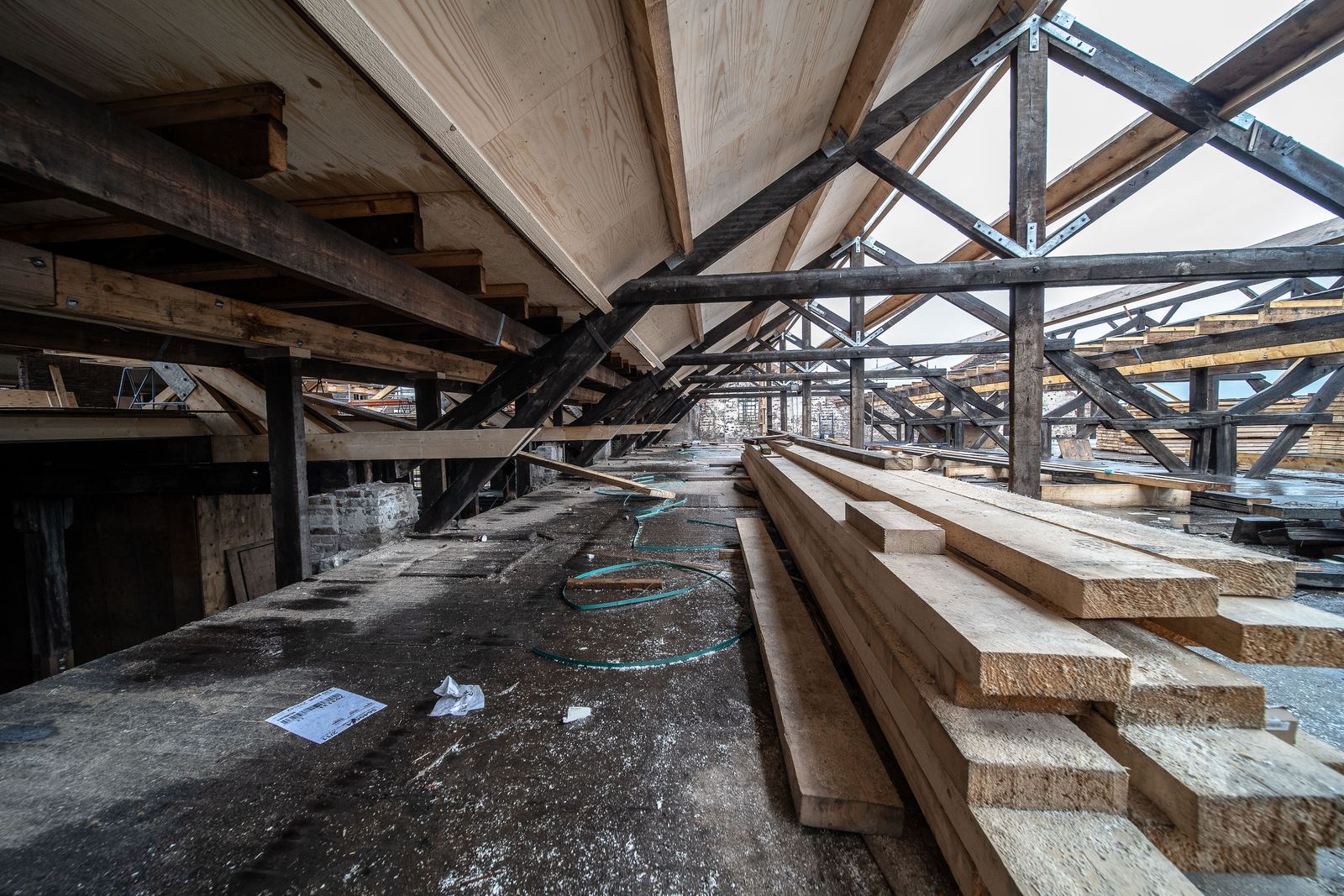
Condensation in the loft or a roof leak: how to tell them apart
One turns up on a dry morning after three dry days. The other tracks the rain. Telling them apart takes a torch and ten minutes, and it is the difference between a duct and a re-roof.
Condensation shows up when it is cold and dry. A leak shows up when it rains. If your loft is wet after three dry days, you have a ventilation problem, not a roof problem, and the fix is usually a rerouted extractor duct or a clear gap at the eaves instead of a new roof.
The short version
- Go up on a cold, still, dry morning after three rain-free days. Wet timber and beaded nail points with no rain behind them is condensation.
- Condensation is general and even, across both slopes. A leak is local and directional, running down one rafter from one failure.
- The commonest single cause is an extract fan discharging into the loft instead of outside. It is a builder’s error and it is everywhere.
- More insulation is the intuitive fix and it can make things worse, because insulation pushed into the eaves blocks the air path the roof needs.
- Black mould that returns after you wash it off means the moisture is still there: usually a ventilation and heating problem, not a roofing job.
The one test
Condensation happens when it is cold and dry, not when it is raining
Condensation in cold, dry weather diagnoses most lofts, and almost nothing else you will read puts that first. A leak tracks the rain. Condensation tracks the temperature outside and the moisture made inside, and the two rarely coincide.
Warm air holds more water than cold air, and your house makes plenty of it: showers, cooking, washing on a rack, kettles, breathing. It rises, finds any hole in the ceiling and enters a loft meant to be as cold as the outside. It meets the underside of the underlay, colder still on a clear night, and the water comes back out. That is your drip.
Rain does the opposite of helping. A wet week is usually a mild, cloudy one, and a loft only a few degrees colder than the room below does not condense much. The nights that soak a loft are the cold, clear, still ones. The BRE puts it in a line: “Dripping from roofs into the rooms below is often caused by a build-up of condensation in the cold roof voids, rather than by leaks which may initially be suspected.”
The dry-morning test
Pick a cold, still morning after at least three days with no rain. Go up early, before the sun has been on the roof, because the evidence burns off fast. Hold a torch low and close to the surface so wet timber glints instead of just looking dark. If the loft is wet and it has not rained for three days, the water came from your kitchen, not the sky.
Before you climb up. Loft joists are not a floor. Stand on the joists or a board laid across them, never between them. In a house built before 2000, do not disturb loose fibrous insulation you cannot identify. If there is water near a downlighter or a cable, switch that circuit off first.
Reading the loft
Where the water sits tells you the rest
Condensation is a whole-roof event and a leak is a point failure, and they look nothing alike once you know that. Condensation covers the underside of the underlay across both slopes fairly evenly, and it beads on the nail points, because a nail is a cold metal spike sticking into damp air.
Rows of droplets along the nails, or rust on them, all but settles it. On a properly cold morning you may find frost underneath the underlay instead, thawing around mid-morning and dripping all at once, which is why so many people describe a leak that happens on dry days.
A leak gets in at one point and runs downhill until something stops it. You get a stripe with dry timber either side, and the hole sits above the drip, often well sideways of it, uphill towards the ridge.
Then there is which face is wet. Condensation forms on the cold side, so it sits under the underlay and on top of the insulation, while a leak arrives from the outer face and works inwards. Insulation that is dark, damp on top and compressed flat over a wide area has been condensed on night after night, and black spotting on the rafters, worst low down at the eaves, is the same story over several winters.
| What you check | Condensation | A leak |
|---|---|---|
| Timing | Cold, still, dry nights | During or just after rain |
| Extent | General and even, both slopes | Local. One patch, one run, one rafter |
| Nail points | Beaded or rusting all over the roof | Dry except at the failure itself |
| Underlay on a cold morning | Frost underneath, thawing and dripping by mid-morning | A wet line, dry material either side |
| Insulation | Damp on top over a wide area, darkened and compressed | One wet patch, wet track above it |
| Which face is wet | The cold side: under the underlay, on top of the insulation | Arrives from the outer face, works inwards |
| Where in the loft | Over the bathroom, kitchen, hatch and downlighters | At a chimney, valley, vent pipe or rooflight |
If it is a leak, the tracing method is in what a brown stain on the ceiling means. If the patch grows during a dry spell, you may have a plumbing leak rather than a rain leak.
The causes
Warm wet air is getting into a cold loft that cannot breathe
Loft condensation is two failures at once. Air is getting up there that should not be, and it is not being changed often enough once it arrives. Fix either and you usually fix the problem.
The moisture itself is not a fault and nobody is doing anything wrong, and the government’s guidance says so plainly: “Moisture from normal occupant activities, such as showering, drying laundry and cooking, builds up in the air around a home if it cannot be removed.” The question is only how it reaches the roof.
An extract fan that terminates in the loft
Look for this first. A bathroom or kitchen extract fan is meant to discharge outside, through a tile vent, a roof terminal or a wall grille. A great many simply stop in the loft: the hose left lying on the insulation, or run towards a tile vent nobody cut in. So every shower is pumped, deliberately and at speed, into the coldest part of the building, and a fan running after a shower puts more water into a loft in a week than a slipped tile does in a winter.
Work out where the fan sits, find the duct and follow it with your hand to its end. If the end is inside the loft, that is your answer, and whoever fitted it did the job wrong. It is a genuine builder’s error, not bad luck. Putting it right means rigid or insulated duct on the shortest route to an outside terminal, sealed both ends.
The hatch, the downlighters and every other hole
A loft hatch with no draught seal and no insulation on its back is a chimney, sitting on the landing where the air is warmest. Foam strip and a board on top is an hour with a screwdriver. Downlighters are the same problem multiplied: an open fitting is a hole with a warm draught going up it, and a room with twelve of them has twelve. Sealed fire-rated fittings or hoods close that off, and anything touching the fittings is work for an electrician. Then the rest: boxing round a soil vent pipe, gaps at pipes and cables, an unsealed void above a wardrobe. Together they are why the loft is wet.
The trap
More insulation is the obvious fix, and it can make things worse
More insulation making condensation worse is the most useful thing on this page after the dry-morning test. The instinctive response to a cold, damp loft is more insulation, and that can make the condensation worse.
A cold roof works by being ventilated. Air comes in low at the eaves on both sides, crosses the void and leaves at high level, carrying the moisture with it. The insulation has to stop short of the eaves so the air can get past. When someone rolls out a second layer and pushes it hard into the corner where the rafters meet the wall plate, because that is where the draught is, the path closes. The BRE lists this among the causes of a dripping roof: “the ventilation of the space beneath the roof covering is restricted, for example where eaves vents are obscured by insulation”. The loft gets colder and stops being ventilated in the same stroke. The job was done with good intentions and it made things worse.
The fix is to hold the gap open. Rigid rafter trays clipped between the rafters keep a clear channel above the insulation, and going round the perimeter fitting them is an afternoon for most people. Gloves and a mask.
What the regulations actually say, because most pages get this wrong
You will be told that Building Regulations require 270mm of loft insulation. They do not. Approved Document L works in U-values rather than depths, and the figure for a thermal element being renovated is 0.16 W/(m²·K). The Approved Document’s own worked example reaches it at 250mm. The 270mm is the Energy Saving Trust’s recommendation: a sensible target, not a rule. What applies to your roof is in what Part L means for a re-roof or a loft conversion.
The second correction matters more. In England, Approved Document F deals with ventilating the rooms people live in: the bathroom extractor, the trickle vents. The roof void is dealt with under Approved Document C, which accepts a roof built in accordance with BS 5250, the code of practice for managing moisture in buildings. So a page telling you Part F requires loft ventilation has the wrong document. The opening sizes live in that standard, which is not free to read, so treat millimetre figures quoted online with caution.
An old bituminous felt underlay is effectively vapour-tight, so whatever gets into the void leaves through the vents or not at all. A breather membrane helps, but it will not rescue a roof fed by an extract fan. Which insulation belongs where is in PIR board against mineral wool, and if your wet loft arrives with a hard frost and a thaw at the gutter line, read what ice at the eaves is telling you.
The mould question
Black mould that comes back after you wash it off
If it comes back, the water is still there. Washing mould off removes the growth and leaves the conditions that grew it, so it returns on the next run of cold nights. Mould is the receipt for a moisture problem, not the problem.
Almost all household black mould is a sign of surface condensation, not a cause in itself. Something is colder than the air touching it, water forms on it, and mould grows in that film. Hence where it turns up: a top corner, a window reveal, a stripe above a lintel, the wall behind a wardrobe. Hence the seasonality too. Bad in January and gone by June is condensation.
On blame, the government is explicit: “We are absolutely clear that it is totally unreasonable to blame damp and mould in the home on ‘lifestyle choices’.” If you rent, that is the document to put in front of a landlord or agent who tells you to open a window.
This is where we tell you we are not the right trade
Most black mould is a ventilation and heating problem, and a builder is not the answer to it. What works is unglamorous and mostly free: move furniture a couple of inches off the wall, open the trickle vents and leave them open, run the extractor long enough after a shower, dry washing somewhere ventilated, and keep a low steady heat rather than short blasts.
There is real work in it sometimes. A cold bridge at a lintel can be improved, and a ceiling growing mould under a soaking loft is the problem described above, which is what our insulation work is for. But on a bedroom wall behind a wardrobe, in a house with closed trickle vents and a fan nobody runs, we would be taking money for a job you can do yourself.
Cleaning it off safely. Never mix bleach with another cleaning product, and do not dry-brush, sand or vacuum mould: all three throw spores into the air you are standing in. If the area is extensive, or anyone in the house has a respiratory condition, that is a conversation with a GP as well as a job for a cloth.
Next
The order to fix it in
Fix loft condensation from the house side first and add ventilation last. Work down this list and stop when the loft dries out.
- Do the dry-morning test. Three rain-free days, a cold still morning, a torch held at a low angle.
- Follow every extract duct to its end. If it stops in the loft, that is your cause.
- Clear the eaves. Pull the insulation off the wall plate and fit rafter trays so it cannot be pushed back.
- Seal and insulate the loft hatch. Foam strip and a board.
- Deal with the downlighters, through an electrician.
- Then, and only then, add ventilation. Over-fascia, soffit, tile or ridge vents. This is where somebody gets on the roof, and not before: vents fitted to a loft still being fed by a bathroom fan are money spent on the wrong end of the problem.
Not one of the first five is a roofing job, and that is the honest position.
If it is a leak, the work starts with finding the entry point, not the drip, and that sits with our roofing work. If it is the loft breathing badly, it sits with insulation and ventilation. Either way Thomas comes out and looks himself, on a dry morning if the question is condensation, and puts in writing what he found. You can ask for a written quote or describe what you are seeing first.
Questions
Common questions
How do I know if my loft is wet from condensation or a leak?
Go up on a cold, still, dry morning after at least three rain-free days. If the timber and the nail points are wet with no rain behind them, it is condensation. A leak tracks the rain and shows as one wet run down a rafter, not general dampness across both slopes.
Why are the nails in my loft wet and rusty?
A nail point is a cold metal spike sticking into damp air, so it is the first surface in the loft to reach dew point. Droplets beaded along the nails across the whole roof, or rust on them, is one of the clearest signs of condensation, as opposed to water coming in.
Can a bathroom fan cause damp in the loft?
Yes, and it is one of the commonest causes there is. A fan discharging into the loft instead of outside pumps the moisture from every shower straight into the coldest part of the house. Follow the duct with your hand: if it ends inside the loft, that is your cause.
Will more loft insulation stop condensation?
Often the opposite: extra insulation makes the loft colder and, if it is pushed into the eaves, blocks the air path the roof relies on. Pull it back off the wall plate and fit rafter trays to hold a clear gap before adding any more depth.
Why does black mould keep coming back after I clean it?
Because washing it off removes the growth and not the water. Mould grows in the film of condensation on a cold surface, so unless the surface warms up or the moist air is taken away, it returns on the next run of cold nights.
Read next
Related advice
The guides below pick up where this one leaves off, and the insulation page covers the work itself and the places we cover, if you would rather have the job looked at.
Who wrote this
Thomas Hannen
Thomas owns Bournemouth Roofing & Building and prices every job himself instead of sending somebody else. The company is Bournemouth Roofing & Building Ltd, number 15471719, registered in England and Wales. If you want to talk something through before you commit to anything, the site visit and the written itemised quote are both free.

Free quote
Not sure whether your loft is leaking or condensing?
Thomas comes out himself, looks at the loft and the roof together and puts in writing what he found, including when the answer is that you do not need a roofer.