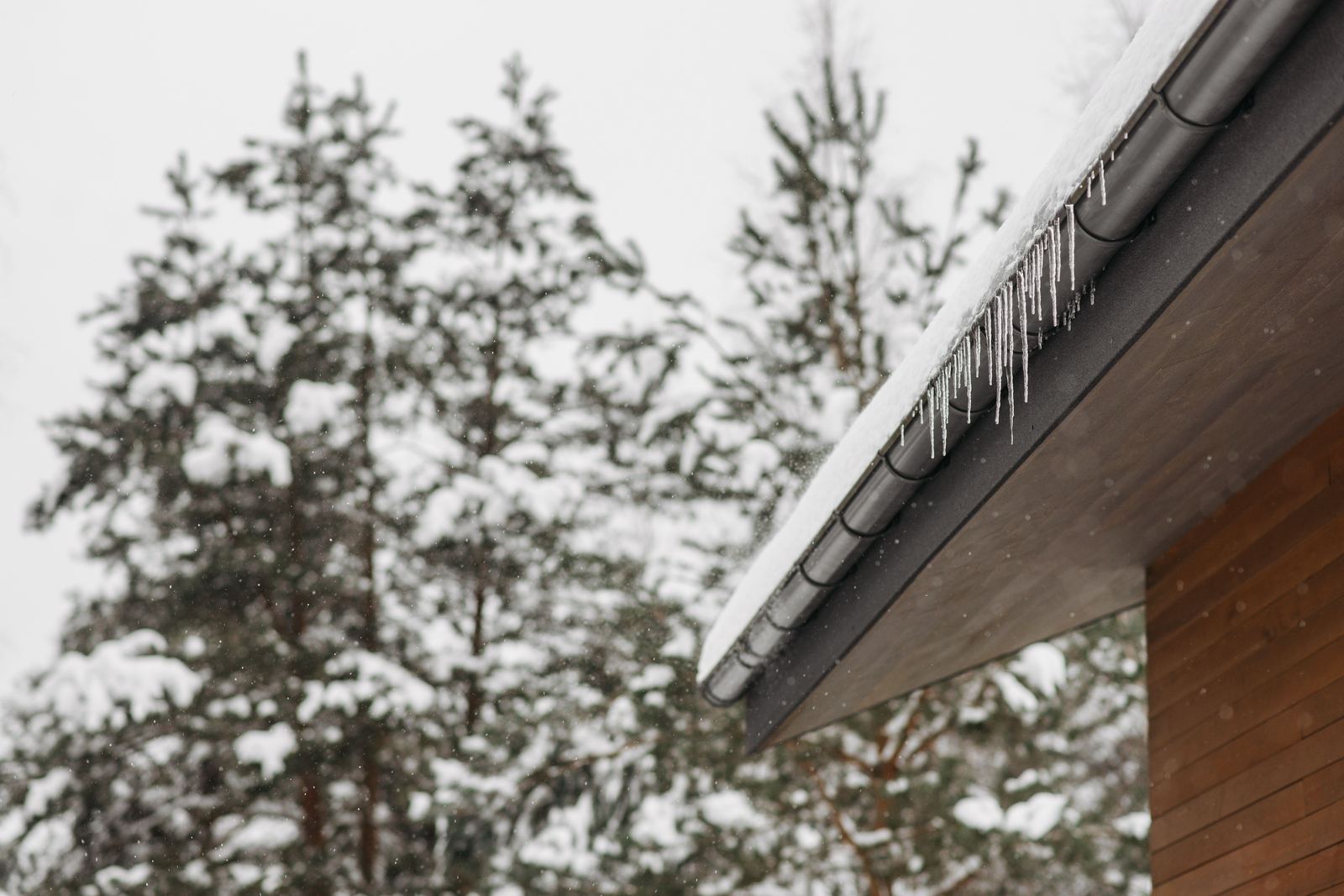
Ice dams, condensation and what your loft is actually telling you
Icicles on the gutter and a damp patch in the loft. Almost certainly the same cause, and almost certainly not the one you have been reading about.
You almost certainly do not have an ice dam. A true one needs snow lying on the roof for days while the air stays below freezing, which is rare in a British winter. What you have is condensation. Both come from the same fault, warm damp air getting into a cold loft that cannot ventilate, so the fix is the same.
The short version
- Icicles on the gutter are not proof of an ice dam. They tell you water ran and then froze, which happens on plenty of sound roofs.
- The real warning sign is bare patches in an otherwise snow-covered roof. That is heat coming up through your ceiling.
- Water dripping in the loft after three dry days is condensation, and the roof covering has nothing to do with it.
- Both problems share a cause, so the work starts inside the house with air sealing and ventilation.
- More insulation can make things worse, because insulation pushed into the eaves blocks the air path the roof runs on.
The mechanism
What an ice dam actually is, and what it needs
An ice dam is a bank of ice along the eaves that stops meltwater draining, so the water backs up the slope and gets in under the tiles.
The sequence goes like this. Snow lies on the roof. Heat escaping through the ceiling melts the bottom of that snow, even while the air outside stays below freezing, and the meltwater runs down the slope. The overhang at the eaves has cold air under it rather than a warm loft, so the water sets as it crosses that line. A few days of that and you have a bank of ice in the gutter with the next lot of meltwater standing behind it.
Standing water is what does the damage, and most explanations skip it. A tiled or slated roof is not waterproof. It sheds water, by pitch and by overlap, which works while the water keeps moving downhill. Sit a pool of it in the laps and it travels sideways and upwards instead, onto the underlay, and old bituminous felt with sagging laps will pass it through. That is a wet ceiling with no rain and every tile in place.
So it takes three things at once: days below freezing rather than one cold night, enough lying snow to keep supplying water, and a roof losing heat. Take one away and there is no dam. Lying snow is the condition that saves us, because snow sitting on a roof for most of a week is normal in Ontario and unusual here. Almost every page describing an ice dam is describing a North American house.
They are not impossible here, and some roofs are candidates: a poorly insulated roof with heat to spare, a shallow pitch that holds snow, a deep eaves overhang, a north slope, or a loft conversion insulated between the rafters with no air gap above it, which is a warm roof built like a cold one. In a hard winter, on that house, yes. Not in a mild wet January with no snow at all.
The thing you can see
Icicles on the gutter, and what they actually tell you
Icicles tell you that water ran and then froze. On their own, that is the whole message. Most are innocent. Sun at midday melts frost or a light covering of snow even when the air never gets above freezing, it runs to the gutter, and the afternoon sets it at the drip point. A gutter with a blocked outlet holds standing water, which freezes and grows icicles over the front edge: a gutter fault, not a roof fault.
Three things turn an icicle into information. It builds on a day the air never got above freezing, so nothing outside did the melting. There is snow above it and the snow is visibly going. And it forms at the same spot every winter rather than evenly along the run, which says the heat is local. When all three line up, go indoors and work out what sits under that part of the roof. A bathroom, the loft hatch or a run of downlighters are the usual answers.
Nobody goes on a snowy or icy roof, and nobody knocks icicles off one. The Health and Safety Executive is blunt about it: “Do not consider going on any roof in poor weather conditions such as rain, ice, frost or strong winds (particularly gusting) or if slippery conditions exist on the roof.” That is the regulator writing about trained people at work. A ladder on frozen ground is no better, and falling ice weighs more than it looks. Chipping at it breaks tiles and gutters, and rock salt corrodes the metalwork without touching the cause. Deal with any water from inside the loft and wait for the thaw.
| What you can see | What it means |
|---|---|
| Icicles along the whole gutter after a bright day | Sun melted the snow, the afternoon froze the run-off. Nothing about your loft |
| Icicles at the same spot every winter | The melting is local, so the heat is local. Look at what sits under it |
| Icicles growing on a day that never got above freezing | Nothing outside melted that snow. The hole is in the ceiling |
| Snow lying evenly and staying put for days | Your ceiling is holding the heat in. This is a roof that is working |
| Bare patches in an otherwise snow-covered roof | Heat is escaping there. Photograph it, because that is your work list |
| A melted band part way up the slope with ice below it | Warm roof above the wall plate, cold beyond it. The dam pattern |
Free survey
The morning after snow is the best look at your loft you will get
If it snows, go outside the next morning, look at your roof, then look down the street at everyone else’s.
Snow is a thermal test strip laid over your whole ceiling for free. It sits on a cold surface and goes off a warm one. A roof holding an even blanket while the neighbours keep theirs is a ceiling doing its job. A roof clear by lunchtime while the road is still white is heating the sky, and you pay for that every day of the year, not just the snowy ones.
Bare patches are the prize, because they are local and they point at something. Note where each sits, then stand underneath it indoors. What you find is usually dull and cheap: an uninsulated loft hatch, a run of downlighters, a bathroom, or a stretch where somebody laid boards onto the joists and squashed 200mm of mineral wool down to 100mm to do it. Boarded loft floors are one of the commonest causes of a warm stripe in the snow, and the two are easy to connect once you know to look.
Photograph it, because it is gone by lunchtime and may not come back for two winters. Same two-minute habit as the pre-winter checks you can do from the ground. Read it with care, mind: a slope in permanent shade holds snow whatever the insulation is doing, and snow lying deep on a flat roof is a different question.
The join
Both problems have the same cause, so the same work fixes both
An ice dam and a wet loft are the same fault wearing different weather. Warm damp air is getting into a cold roof that is not ventilating properly. In the rare case the heat in that air melts the snow; in the common case the water in it condenses under the underlay and drips onto your insulation. The covering is a bystander in both, which is why re-tiling fixes neither.
The order of work falls out of that: air sealing, then ventilation, then insulation depth, then the covering. Most people are sold the list backwards, starting with the tiles and ending with the hatch they could have sealed themselves in an hour.
Air sealing means every hole in the ceiling
Warm air is lighter than cold air, so every gap in the ceiling behaves like a small chimney. An unsealed loft hatch, open downlighters, the gaps where pipes and cables pass through. There is usually one bigger fault too, an extract fan that ends in the loft rather than outside, and that gets its full treatment in condensation in the loft or a roof leak, along with the point-by-point list for separating the two.
Ventilation means air crossing the void, under the right document
A cold roof is meant to be as cold as the outside, with air moving through it: in low at the eaves on both sides, out at high level, carrying the moisture with it. Get that right and the condensation stops, and the roof stops being warm enough to melt snow unevenly. The void is dealt with in England under Approved Document C, which accepts a roof built in accordance with BS 5250, the code of practice for managing moisture in buildings. Approved Document F covers ventilating the rooms people live in, the extractor and the trickle vents, which is a different job. Worth knowing, because anyone quoting you for roof vents should be able to say which standard they are working to without looking it up.
The trap
More insulation is the obvious answer, and it can make it worse
The instinctive fix for a cold damp loft is more insulation, and that can make the problem worse. A cold roof works by being ventilated, and the air comes in low, where the rafters meet the wall plate.
The insulation has to stop short of that corner so the air can get past. When somebody rolls out a second layer and presses it hard into the eaves, which is exactly where they can feel the draught, the path closes. Less air change, more moisture, and the condensation gets worse rather than better.
It also makes the rare problem more likely, which is the join again. Block the eaves and the main slope runs warmer, because cold air is no longer washing through, while the overhang beyond the wall plate stays as cold as ever. A warm slope above and a cold edge below is precisely the difference an ice dam is built out of.
The fix is to hold the gap open instead of hoping. Pull the insulation back off the wall plate, then clip rigid rafter trays between the rafters so the channel cannot be closed again by the next person with a roll. It is an afternoon, with gloves and a mask, and it belongs before any extra depth goes down.
What the rules actually say about depth
You will be told Building Regulations require 270mm. They do not. Approved Document L works in U-values, not depths, and the figure for a thermal element being renovated is 0.16 W/(m²·K). Its own worked example reaches that at 250mm. The 270mm is the Energy Saving Trust’s recommendation, a sensible target, not a regulation. What bites when you re-roof or convert is in what Part L means for a re-roof or a loft conversion.
One thing about the material. Mineral wool that has been damp and squashed has lost most of what you paid for and does not recover under a board. Drag it clear so both can dry, and replace whatever has matted flat. PIR board against mineral wool covers which one belongs where.
Next
What to do, in order
Ice dams and loft condensation are dealt with from the inside first: nothing happens on the roof while ice or snow is up there, water coming in is contained indoors, and vents come last. Work down this and stop when the loft stays dry.
- While there is ice or snow up there, nothing happens on the roof. Not by you, not off a ladder, not by anybody who turns up offering to sort it today.
- If water is coming in now, deal with it inside. A container under the drip on a board across the joists, wet insulation dragged clear of the ceiling, the circuit off at the consumer unit if the water is near a downlighter. Stand on the joists, never between them.
- Next time it snows, photograph the roof in the morning. Bare patches are your work list.
- After the thaw, check the loft on a cold, still, dry morning. That test separates condensation from a leak, and the method is in the condensation piece. If the ceiling has stained, tracing it back is in what a brown stain means.
- Seal the holes. Hatch, downlighters through an electrician, pipe runs, and follow every extract duct to its end.
- Clear the eaves and fit trays before you add any depth.
- Vents last. That is where somebody gets on the roof, and by then you will know whether you need them.
Only the last item is roofing work, and several of the others are a Saturday with a screwdriver. Worth saying plainly, because a loft with ice at the gutter and a damp patch in the corner gets quoted for a new roof more often than it deserves. If it does turn out to be the covering, that is our roofing work, and if it is the loft breathing badly, which it usually is, that is insulation and ventilation. Either way Thomas looks at the loft and the roof together and puts in writing what he found, including when the answer is that you do not need a roofer. Ask for a written itemised quote, or describe what you are looking at first.
Questions
Common questions
Do we actually get ice dams in the UK?
Rarely, an ice dam needs snow lying on the roof for several days while the air stays below freezing, plus enough heat escaping through the ceiling to melt it. That combination is uncommon in most British winters. A poorly insulated shallow-pitched roof with a deep cold overhang can produce one in a hard winter, but a wet loft in January is far more often condensation.
Are icicles hanging from my gutter a problem?
Not on their own: they mean water ran and then froze, which happens whenever sun melts snow or frost and the afternoon sets it again. They are worth investigating if they build while the air has stayed below freezing all day, or if they form at the same one or two spots every winter, because that points to heat escaping under that part of the roof.
Should I knock the icicles off the gutter?
No, the Health and Safety Executive says not to consider going on any roof in poor weather such as rain, ice or frost, and a ladder on frozen ground is no better. Falling ice is heavier than it looks, chipping at it breaks tiles and gutters, and salt corrodes the metalwork. Let it thaw and deal with any water from inside the loft.
Why is my loft dripping when it has not rained for days?
Because it is condensation, not a leak. Warm damp air from the house rises into the cold void, meets the underside of the underlay and gives the water back. It turns up on cold, still, dry nights, not wet ones, which is the opposite of how a leak behaves.
Will more loft insulation stop the problem?
Only if air can still get past it at the eaves. Insulation pushed hard into the corner where the rafters meet the wall plate blocks the ventilation path, which makes condensation worse and makes ice at the eaves more likely. Pull it back off the wall plate and fit rafter trays before you add any depth.
Read next
Related advice
The guides below pick up where this one leaves off, and the insulation page covers the work itself and the places we cover, if you would rather have the job looked at.
Who wrote this
Thomas Hannen
Thomas owns Bournemouth Roofing & Building and prices every job himself instead of sending somebody else. The company is Bournemouth Roofing & Building Ltd, number 15471719, registered in England and Wales. If you want to talk something through before you commit to anything, the site visit and the written itemised quote are both free.

Free quote
Damp loft, and not sure whether the roof is to blame?
Thomas comes out himself, looks at the loft and the roof together and puts in writing what he found, including when the answer is that the work is not a roofing job at all.