Commercial Roofing Bournemouth
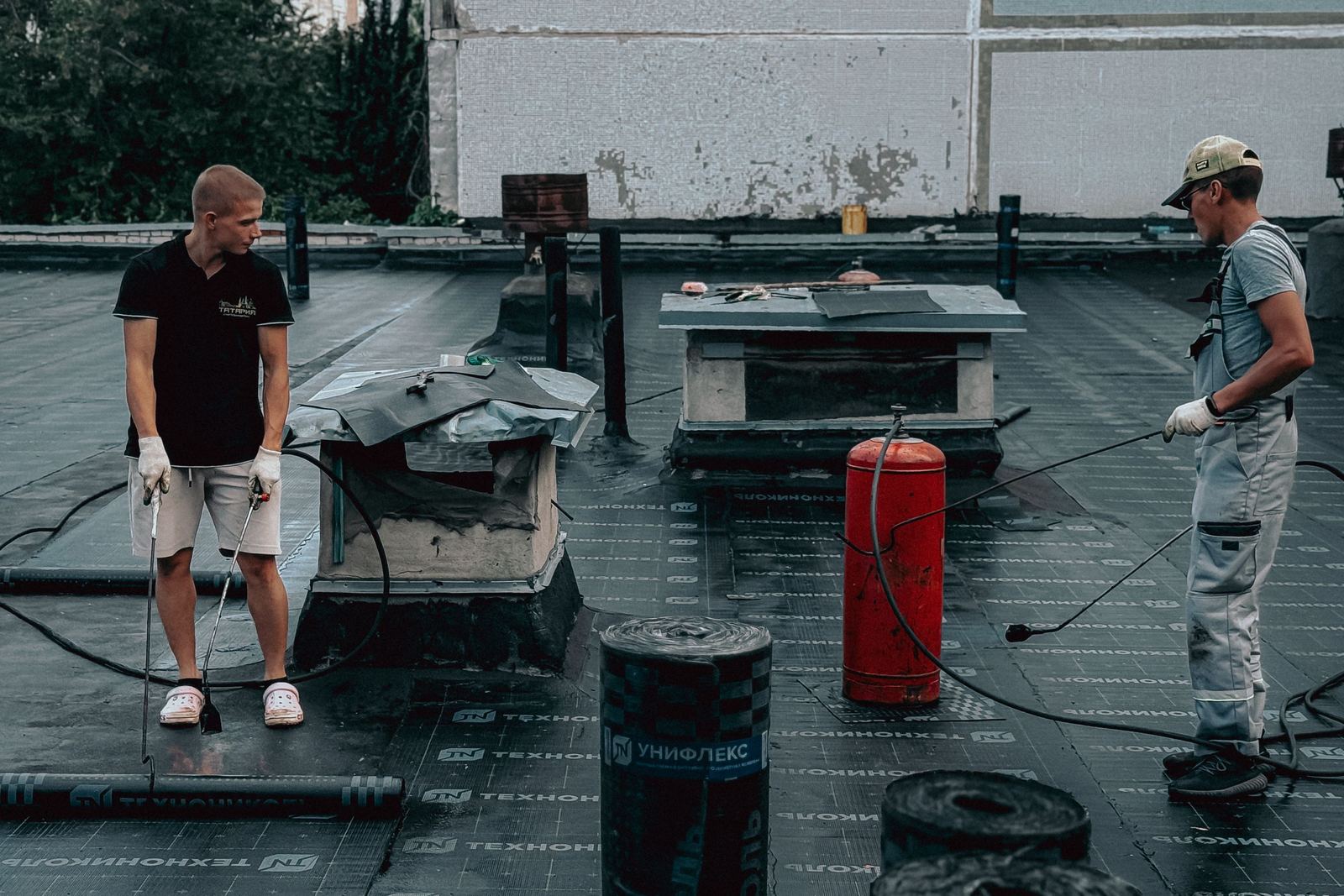
Roofs over working premises. Warehouses, industrial units, shops, offices and blocks of flats across Bournemouth, Poole and Christchurch, programmed around your opening hours.
The site visit is free and so is the written itemised quote. Thomas Hannen prices every job himself.
Commercial premises
Commercial roof repairs and flat roofing for business premises
On a big roof the drip inside is almost never underneath the defect. Water gets in at one lap, one split upstand or one blocked outlet, then runs along the deck profile or down a purlin until it finds a way through the ceiling. Chasing the stain across a warehouse floor wastes a day, so we work back from the outlets.
We take commercial and landlord work alongside the housing. The Nuffield and Mannings Heath estates in Poole, the Airfield estate in Christchurch and the older shop parades along Christchurch Road are all inside our normal working area. Free site visit, free itemised written quote, and Thomas Hannen prices every job himself.
The roof is part of the business, not just the building
A domestic leak is an inconvenience. A leak over a racked aisle, a server cupboard or a shop floor is stock and downtime, so the first visit is about stopping it rather than solving it beautifully. We sheet, seal or patch, then come back with a written scope once we have found the cause.
Pitched and domestic work sits on our roofing services page, and there is another for our roofers in Poole.
Premises we work on
Warehouses, units, shops, offices and blocks of flats
Four buildings, four problems, and not one of them looks like a house roof.
Warehouses and industrial units
Profiled sheeting, valley and box gutters between the bays, rows of rooflight panels, often a flat roofed office on the front. Warehouse roof repair is mostly gutter lining, lap sealing, fastener replacement and rooflight swaps, worked from a platform rather than by walking the sheets. On a unit built before 2000 we establish what the sheeting is first.
Shops and retail parades
Behind a smart shop front sits a small flat roof, a parapet, a box gutter shared with next door, and a rear extension in felt last touched decades ago. Half the leaks on a parade come from the party gutter, which two people own and neither clears. We work early, late or on a Sunday so the shutters go up on time.
Offices and mixed use buildings
Larger single ply or asphalt roofs, air handling plant on plinths, cable and pipe penetrations, access hatches. Every penetration is a joint, and a roof that has had two rounds of plant has had two rounds of holes cut in it. We form proper collars where somebody once ran sealant.
Blocks of flats and communal roofs
Shared coverings on flat roofed blocks and mansard conversions, with a service charge and a managing agent behind them. The structure belongs to the freeholder, so whoever sees the stain is rarely the one who can order the repair, and past the statutory threshold per leaseholder there must be a consultation under section 20 of the Landlord and Tenant Act 1985. More on that on our Bournemouth and Christchurch pages.
Flat roof coverings
Single ply, EPDM, felt, asphalt and GRP, and what actually fails
Commercial flat roofs are laid in five things, and each gives up in its own way. Which one you have decides whether the answer is a repair, an overlay or a strip and re-cover, and an overlay over wet insulation is wasted money.
| Covering | Where you find it | How it fails |
|---|---|---|
| Single ply membrane | Modern units and office blocks | Welded laps opening, fasteners pulling through, shrinkage at the upstands |
| EPDM rubber | Simple roofs, few penetrations | Bonded seams and corner details rather than the field of the membrane |
| Built up felt | Older shops, offices, blocks of flats | Blistering, splitting at the laps, the cap sheet losing its surface |
| Mastic asphalt | Period commercial buildings | Crazing, cracking over movement in the deck, failure at the skirtings |
| GRP fibreglass | Canopies and anything walked on | Hairline cracks where the deck below moves, thin laminate at the trims |
Ponding, falls and the things at the edges
A flat roof is not flat. It is built with a fall so water leaves it, and water still lying there two days after the rain says the fall has gone, the deck has deflected, or the outlet is not working. Ponding does not cause a leak. It finds one, sits on it and freezes in it until the covering gives up.
Outlets and gutters come first. They block with leaves, moss and sand, and the overflow then becomes the parapet, the door threshold or the ceiling below. Box and valley gutters are worse: long, taking the whole roof, and once the joints or the lining fail the water enters at the eaves. Lining one in place beats replacing it.
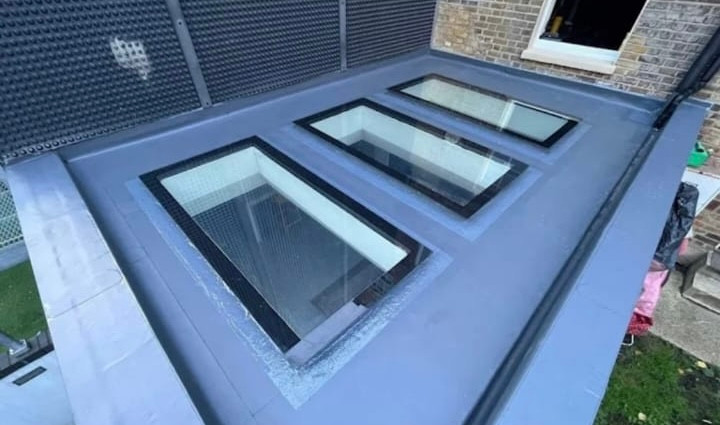
Then upstands, flashings, roof lights and edge trim. An upstand needs enough height that ponded water and driven rain cannot get over it, with a cover flashing chased into the wall rather than mastic across the top. Roof lights leak at the kerb far more often than through the panel, and the trim, drips and copings take the wind.
Leak tracing
Finding the leak on a roof the size of a warehouse
Water travels. It can enter twenty metres from where it comes out, so we work back from the outlets rather than out from the stain.
- Outlets, sumps and gutter joints cleared first, because most of it is there
- Every penetration walked: plinths, vents, cable entries, hatches, rooflight kerbs
- Sections hose tested in turn so the entry point has to show itself
- Boards lifted where the insulation feels heavy, because wet boards move water sideways
- The underside read from inside: purlin runs, deck laps, where the drip starts
- Dated photographs of the defect itself, to send the landlord or the agent
Working round you
Keeping the unit open while the roof is being done
Nobody closes a warehouse for a roof. The programme is written around deliveries, shifts and opening times before a date is booked.
Access worked out first
Scaffold, tower, cherry picker or mast lift, and where it stands clear of a loading bay or a fire exit. Priced as its own line.
Hours agreed
Early starts, evenings or weekends where noise or access would stop you trading. We work to your shift pattern.
Phased and made safe
The roof comes up in sections small enough to close down the same day. Nothing left open overnight, stock below sheeted.
Handed back with photographs
Outlets tested, roof swept, yard cleared, and a photographic record of the finished detailing for your file.
Quoting and instructing
What moves the price, and who signs it off
On commercial work the access and the sequence usually cost more than the covering does. A single ply roof you can drive a mast lift up to, and the same roof over a yard of pallets that has to be done on Sundays in four phases, are different jobs with identical square metres.
Roof work is work at height, and the HSE guidance on roof work is why a working platform, edge protection and a safe route onto the roof are priced lines rather than optional extras. Fragile rooflights and older cement sheeting change how a unit is approached, and both are settled at the survey rather than found on the first morning. The rest is predictable: how much of the build up is wet, how many penetrations and upstands there are, whether gutters are lined or replaced, disposal, and how much happens out of hours.
Who can actually instruct the work
Worth settling before anyone measures anything. A tenant on a full repairing and insuring lease may be liable for the roof; one on an internal repairing lease is not. An agent wants a scope that can go out to tender, and a residents' company needs one that survives a leaseholder consultation.
Questions
Commercial roofing questions we get asked
Do you take on warehouse and industrial unit roofs?
Yes. Warehouse roofs are mostly profiled sheet with valley or box gutters and rows of rooflights, often with a single ply or felt flat roof over the offices at the front. We line failed gutters, seal laps, replace fixings and brittle rooflights, and re-cover flat sections.
Can you work outside our opening hours?
Usually, and on a shop or an office it is often the only sensible way. Early starts, evenings and weekends all work for us. The sequence matters more than the hours: no area of roof is left open at the point you reopen, and anything stripped is made watertight before we leave.
Who instructs roof work on a block of flats?
The freeholder, normally through a managing agent or a residents' management company, because the structure is theirs and it comes out of the service charge. Past the statutory threshold per leaseholder they have to be consulted first, under section 20 of the Landlord and Tenant Act 1985.
The water comes in nowhere near where you say the fault is. How do you find it?
By working from the water backwards. It enters at one lap, outlet or upstand, then travels along the deck profile or down a purlin before it finds a route through the ceiling. We start at the outlets and every penetration, and hose test in sections until the entry point shows itself.
Where we work
Commercial roofing across Bournemouth, Poole and Christchurch
The commercial estates, parades and business parks inside our working area:
- Nuffield, Mannings Heath and Alder Hills in Poole
- Riverside Avenue, the Lansdowne offices and the Boscombe parades in Bournemouth
- The Airfield estate and Somerford Business Park in Christchurch
- Cobham Road and the Ferndown Industrial Estate, out towards Wimborne
Free quote
Get a price for your commercial roof
Send the address and a couple of photographs, or book a visit. We will get on the roof, find out what is actually wrong, and put an itemised written quote in front of you.