
Roofing and building in New Milton
Roofing and loft work, brickwork and repointing, plastering and rendering, insulation, driveways and exterior cleaning across New Milton, Old Milton, Barton on Sea, Ashley, Bashley, Becton, Walkford and Tiptoe. A BH postcode that answers to Hampshire, and a town that only exists because a station opened in 1888.
The site visit is free and so is the written itemised quote. Thomas Hannen prices every job himself.
New Milton, Hampshire
A Dorset postcode, a Hampshire planning file
BH25 is not a Dorset postcode. Every part of it sits in Hampshire, in New Forest District, and no part of it falls under BCP or Dorset Council. The BH prefix comes from Bournemouth and it misleads people constantly, including some tradesmen. If your address is in New Milton, the authority that decides your application, your conservation area consent and your building control is New Forest District Council.
That is the first thing that changes when you cross the boundary from Christchurch, and it changes the guidance your job is judged against.
BH25 covers two parishes, New Milton and Brockenhurst, which means the outcode also straddles the New Forest National Park boundary. For most jobs that second line matters more than the county one. We have checked it point by point. New Milton town centre, Barton on Sea, the Barton cliff top and Ashley are all outside the Park. Bashley, north of Sway Road, and Tiptoe are inside it. There is also Green Belt east of Barton. Inside the Park, a further layer of design policy applies to anything visible from outside your plot.
Two local documents then do most of the work. The New Milton Neighbourhood Plan was made in July 2021, backed by 87.9 per cent of those who voted on a 35.7 per cent turnout. The New Milton Local Distinctiveness supplementary planning document was adopted on 3 June 2010 and carries ordinary SPD weight, which makes it guidance rather than policy, but it is guidance the council quotes back at you. It splits the town into thirteen character areas, among them Great Woar, The Lanes, Becton Bunny Valley, Barton Sea-Front, Barton Gardens, Barton Court Avenue, West Garden and West Town. Which one you are in changes what is asked of the work.
The county boundary itself is Chewton Bunny, west of Walkford, crossed by what is recorded as England's first reinforced concrete bridge, built in 1900. Cross it going west and the rule book changes. We work both sides and keep the two apart on paper.
Where the town came from
No medieval core, an 1888 railway town
The council's own assessment calls New Milton "predominantly a modern settlement, having been created almost from scratch following the opening of the railway station in 1888". That one sentence explains most of what you find when you get a ladder up here.
The dates are tight. The station was built in 1886, the line opened in March 1888, and the stop was renamed New Milton in April 1897. The water tower of 1900 still stands and the council records it as a local landmark. Everything else in the centre grew outward from the platform in the decades that followed.
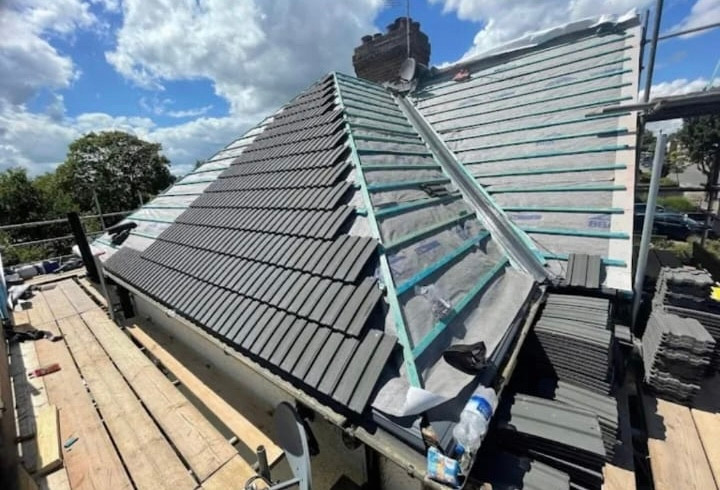
In a Saxon or Georgian town, matching a roof means reaching back two or three centuries and guessing at what an earlier repair covered up. Here it rarely means reaching back beyond your grandparents. The oldest part is Old Milton, around the green, and almost everything else is Victorian at the earliest. The coverings you meet are slate, clay tile, and on anything after about 1960, concrete interlocking tile. Very little is guesswork, which helps when you are pricing a matched repair.
The complication is the middle of town. The council records a significant amount of replacement during the 1960s and 1970s in the town centre, so the buildings on the main streets are often younger than the houses immediately behind them. A survey here can jump fifty years of construction in a hundred metres, and the right answer changes with it, as our recent project photographs show.
Heritage control
One conservation area, one listed building
New Milton has exactly one conservation area, Old Milton Green, and it contains exactly one listed building. That building is the Church of St Mary Magdalene: an ashlar tower of 1695, the remainder an 1830 rebuilding in red brick, extended in 1928.
Put that next to Lymington, in the same district under the same council, with three conservation areas and around two hundred and seventy listed buildings. Same authority, opposite regimes. It changes the honest answer to the question everyone asks first. Across most of New Milton, for most roof and wall work, you need no consent at all.
Old Milton Green also holds The George Inn of 1905, the Victorian rectory of 1876, and one surviving thatched cob cottage at the south end of Southern Lane. None carry a listing, but they set the character new work is assessed against inside the boundary. Barton Common Road is protected separately as an Area of Special Character.
One oddity is worth flagging before somebody quotes it at you. The council's character statement gives the designation date as June 1993. The government's national dataset gives 29 September 1999. We cannot reconcile the two and will not present either as settled. It makes no practical difference to what you can do today.
Materials
Slate on the roofs, smooth render on the walls
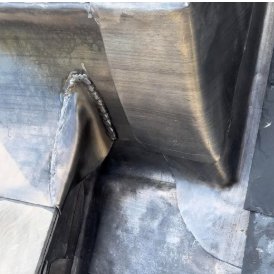
Inside Old Milton Green the council names what it wants protected: the original materials and techniques, meaning brick, smooth render and slate roofs. Slate, not clay tile, is the covering the guidance leads with here, the opposite emphasis to several of the older towns nearby.
The Town Design Statement puts the matching rule into one line: materials used in an extension should normally match the original, with bricks or rendering of the same colour or texture, and slated roofs of the same profile or pitch. Read that carefully. On the roof the test is profile or pitch, not only colour. A slate matching the shade but landing on a new slope at a different pitch is still a mismatch on the council's own wording, and that is decided long before anyone orders material.
Three material points that decide a New Milton job
- Pink and red brick in the centre. The supplementary planning document is specific that pink and red bricks are consistent with Station Road. If you are extending or rebuilding brickwork near the centre, that is the reference point, and it is worth taking a physical sample rather than matching from a photograph on a phone.
- Details that do not come back. The council singles out the mansard cottages on Cliffe Road, the old coastguard station, and the Post Office in Sea Road for their tile window heads, brickwork quoins and corbelled eaves. Those are the first things lost to a rushed repoint or a render slapped over the top of them.
- Thatch still exists here, just barely. There is thatch at Ashley crossroads and at Southern Lane in Old Milton. We do not thatch. If that is your roof we will say so straight away and point you at somebody who does, rather than take the survey.
Because smooth render is one of the named local materials, render is not a modern intrusion here the way it is in a brick-and-tile market town. It is part of what the guidance protects. A smooth render repair with the right texture and a clean line at the eaves reads as correct rather than as a patch, which is why we treat render and plastering work as part of the same conversation as the roof.
Roof form
Two storeys, plus the roof space
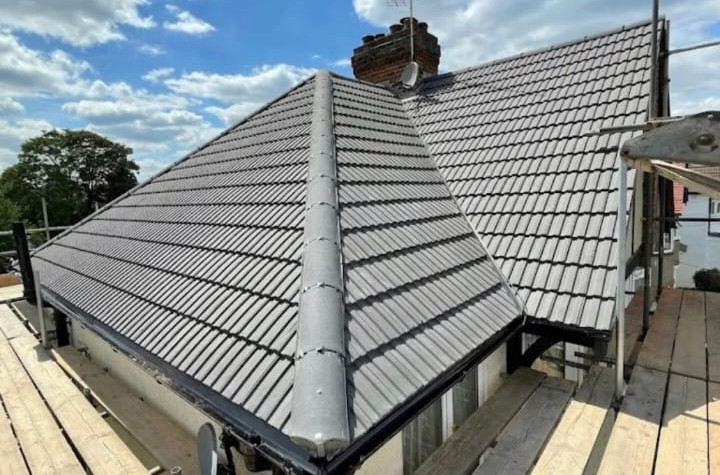
At Barton the council controls the shape of the roof more tightly than what is laid on it. The guidance describes the area as having predominantly uninterrupted hipped simple roofs, and says the bungalow areas have particularly distinctive hipped roofs, adding that there are examples where this has been ignored but it is important not to take those as precedent.
That last clause is the useful one, and it is unusual to see a council write it down in advance. A neighbour who got away with something is not an argument here. The guidance then names what it is against: overcomplicated roof forms with multiple hips, overbearing dormers, re-cladding, and unsympathetic extension and roof refurbishments.
The height rule points you somewhere specific. Two storeys is the maximum, excluding appropriately designed accommodation in the roof space. In plain terms, the council's own wording makes the loft the sanctioned place to find extra room here. Not a second storey, not a full width box on the front slope, but a conversion that leaves the hip line reading as it does now from the pavement.
That shapes the design before anything else. A dormer goes on the rear, set in from the hips and kept below the ridge, with rooflights taking the front elevation. The insulation has to be designed at the same moment, because the instant you convert, the insulation line moves from the ceiling up to the rafters and the ventilation path moves with it. Getting the insulation detail right in a converted roof is what stops condensation on the new plasterboard in the first winter.
Where the water goes
Flood Zone 1 everywhere, and a water rule anyway
Every location we have tested in New Milton comes back as Flood Zone 1, the lowest flood risk band, and yet the council still has a written rule about where your surface water ends up. That combination does not occur anywhere else we work.
The list is worth stating because it saves an argument with a surveyor. The town centre, Gore Road, Barton on Sea, the Barton cliff top, Naish, Ashley, Becton Bunny, Chewton Bunny and the Avon Water at Bashley all test as Flood Zone 1. Flooding is not the hazard that shapes building work here.
The rule that does shape it is in New Forest District Council's Town Design Statement, and we quote it in full because paraphrase weakens it: "Any development inland from the cliffs must take into account the internal water flows toward the cliffs. Experience has shown that major interference with the local aquifers can result in locally increased water flows that can seriously damage the cliffs. Developments that can be predicted to increase local flows must therefore be avoided."
What that means on the ground is simple. Groundwater moving through the sands and clays is the concern, so anything that concentrates water into the ground on the seaward side of town becomes a planning question rather than a construction detail. It argues for permeable surfacing and a soakaway designed to spread and slow water rather than post it into one hole. The council also records a danger area running from the cliff edge back to 60 feet inland, within which no development is permitted.
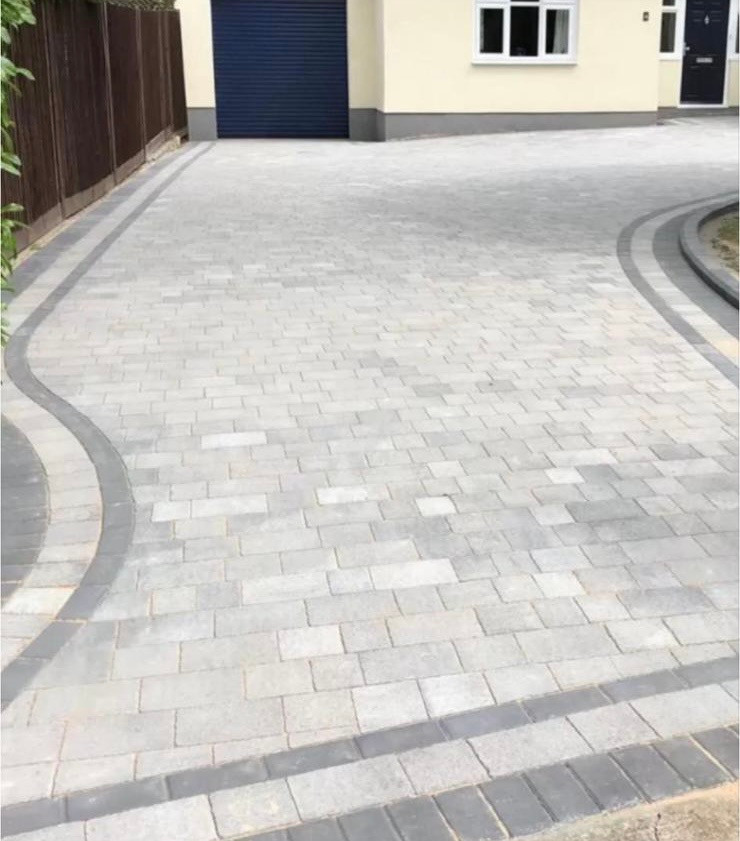
Then there is a second authority. Hampshire County Council is the Lead Local Flood Authority here, so drainage design sits with the county while the planning permission sits with the district. Two authorities, one driveway. We work out which question goes where before we price a permeable driveway build, not after the first load of sub-base is tipped.
The housing stock
Detached then, flats now
The 2021 census puts detached houses at 35.0 per cent of New Milton town and flats at 28.8 per cent, with terraced at 17.2 and semi-detached at 14.4. Barton and Becton read completely differently: detached 67.8 per cent, flats 12.6, and 3.2 per cent of households in a caravan or mobile home.
The Neighbourhood Plan is blunt about the direction of travel, complaining of the gradual loss of nineteenth century detached houses and their replacement with blocks of flats. On a roof here that shows up as a town centre where the building next to your job may be two generations apart in construction, and where flat roofs and shared communal roofs are a larger share of the work than they would be in a village.
West of the centre the pattern is streets of inter-war detached dwellings in narrow strip plots with generous back gardens, which is an access and scaffolding question as much as a roofing one. The 1940s bungalow estates around Oakwood Avenue and Brook Avenue North, the 1960s terraces whose open-plan front gardens have since been infilled, and Chatsworth Park and the North Milton Estate of the early 1980s each behave differently once the scaffold is up.
One more number is worth having. 76.2 per cent of the town heats on mains gas and 0.5 per cent on oil. In Barton it is 85.3 per cent gas and 0.9 per cent oil. This is, in practice, an all-gas town. There are almost no oil tanks to work around, and the sensible energy work is fabric rather than fuel.
| Part of town | Typical fabric | What usually needs doing | What governs it |
|---|---|---|---|
| Old Milton Green | Brick, smooth render and slate | Matched slate repair, leadwork, careful pointing | Conservation area control, one listed building |
| Town centre and Station Road | 1960s and 1970s replacement, pink and red brick | Flat roof work, edge details, render repair | Town centre design guidance |
| West Town, inter-war | Detached houses on narrow strip plots | Tile and chimney work, extension matching, access | Design guidance, otherwise permitted development |
| Barton and Becton | Pre-war and immediately post-war, hipped roofs | Hip and ridge detailing, loft conversion, drainage | Roof form guidance and the cliff danger area |
| Chatsworth Park and North Milton | Early 1980s, concrete interlocking tile, mortar-bedded ridge | Dry ridge and verge, felt at the eaves | Ordinary permitted development |
What we do in New Milton
Four trades, in the order this town needs them
Heritage control here is light and the stock is modern, so the pressure falls on the roof line and on the ground rather than on lime mortar. That sets the order below.
Roofing
First because the roof is the controlled feature here. At Barton the hip line and the absence of overbearing dormers are what the guidance protects, and a loft conversion is the route it points you down. In Old Milton Green it is matched slate, leadwork and profile. On the early 1980s estates it is dry ridge, dry verge and felt at the eaves, which is repair work rather than the re-roof people expect to be sold.
Roofing servicesDriveways and patios
Second because of the aquifer wording in the Town Design Statement. On the seaward side of town the drainage design comes before the surface choice, permeable build-ups are the sensible default, and the county rather than the district handles drainage. Elsewhere it is an ordinary job on ordinary ground, and we will say which of the two you have.
Driveways and patiosPlastering, rendering and insulation
Third because smooth render is a named local material, not an afterthought, and because an all-gas town with modern stock has its energy savings in the fabric. Loft insulation on the inter-war and post-war houses, rafter-level insulation and ventilation in a conversion, and render repair that keeps the original texture.
Plastering and renderingBricklaying and repointing
Fourth, and that is not a slight. There is less historic masonry here than in a Georgian town, so brickwork tends to mean extensions, boundary walls, chimney rebuilds and the pink and red brick of the Station Road area. Where the older details survive, the quoins, tile window heads and corbelled eaves, the pointing has to respect them rather than bury them.
Brickwork and repointingWe also clean roofs, render and paving, which comes up often where moss sits in the tile laps on a sheltered slope. Roof, render and patio cleaning sets out the soft-wash side of it.
Questions
Questions we get from New Milton and Barton
Is New Milton in Dorset?
No. BH25 is a Hampshire postcode in every part, covering the parishes of New Milton and Brockenhurst, and none of it falls under Dorset Council or BCP. The BH prefix comes from Bournemouth and it causes constant confusion. Your planning authority is New Forest District Council. The county boundary itself runs along Chewton Bunny, west of Walkford, crossed by what is recorded as England's first reinforced concrete bridge, built in 1900.
Is my house in the New Forest National Park?
Almost certainly not. We have checked the boundary point by point, and New Milton town centre, Barton on Sea, the Barton cliff top and Ashley all sit outside the National Park. Only Bashley, north of Sway Road, and Tiptoe fall inside it. There is also Green Belt east of Barton. It matters because being inside the Park brings a further layer of design policy over anything visible from beyond your plot.
Do I need consent to re-roof a house in New Milton?
Usually not. New Milton has exactly one conservation area, Old Milton Green, and it contains exactly one listed building, the Church of St Mary Magdalene. Outside that boundary most householder roof repair and re-covering is permitted development. What still applies is the council's design guidance, which asks that an extension match the original, including slated roofs of the same profile or pitch. We will tell you which side of the line your address falls on.
Why would the council ask about my driveway at Barton?
Because of groundwater. New Forest District Council's Town Design Statement says development inland from the cliffs must take account of the internal water flows toward the cliffs, that major interference with the local aquifers can produce locally increased flows that seriously damage the cliffs, and that developments predicted to increase local flows must be avoided. On the seaward side of town that makes permeable surfacing and a controlled soakaway a planning matter rather than a preference.
Can I put a dormer on a roof at Barton?
Possibly, but the shape is the issue rather than the principle. The council's guidance describes Barton as having predominantly uninterrupted hipped simple roofs, warns against overcomplicated roof forms with multiple hips and against overbearing dormers, and says examples where this has been ignored should not be treated as precedent. The height limit is two storeys, excluding appropriately designed accommodation in the roof space, so a well-judged loft conversion is the route the guidance points towards.
When was the Old Milton Green conservation area designated?
There are two published dates and we will not pretend otherwise. The council's own character statement gives June 1993. The government's national dataset gives 29 September 1999. We have not been able to reconcile them. It makes no difference to what you can do today, because the controls that apply are the same either way, but if somebody quotes you a designation date with confidence it is worth checking the source.
We cover New Milton and Old Milton, Barton on Sea, Becton, Ashley, Bashley, Tiptoe, Walkford, Beckley, Ossemsley, Fernhill and North Milton, across the BH25 postcodes. All of it comes under New Forest District Council, and the National Park boundary runs through the north of the area rather than around it, which is why we ask for the street name and not just the postcode.
Trade by trade
Each trade, written for New Milton
The same local evidence, read through each trade in turn. Ground conditions decide a driveway, exposure decides a roof, and the age of the housing decides insulation.
- Roofing in New Milton
- Flat roofing in New Milton
- Bricklaying and repointing in New Milton
- Repointing in New Milton
- Driveways and patios in New Milton
- Patios in New Milton
- Plastering and rendering in New Milton
- Rendering in New Milton
- Insulation in New Milton
- Loft insulation in New Milton
- Wall insulation in New Milton
- Exterior cleaning in New Milton
- Gutter cleaning in New Milton
- Fascias, soffits and guttering in New Milton
Who you are dealing with
A local firm you can check
New Milton and Old Milton are ours, along with Barton on Sea, Becton, Ashley, Bashley, Tiptoe, Walkford and Ossemsley, across the BH25 postcodes under New Forest District Council.
You are dealing with Bournemouth Roofing & Building, the trading name of Bournemouth Roofing & Building Ltd, registered in England and Wales, company number 15471719. That takes a minute to check. Thomas Hannen owns the firm and he prices every job himself, so the person who quotes it is the person answerable for it. One multi-trade team does the work, and none of it is sub-contracted out to somebody you have never met.
There is a verified customer's 10 out of 10 on our Checkatrade profile. The site visit is free and so is the written itemised quote. The phone is answered 24 hours for emergencies, and scheduled work runs Monday to Friday, 8am to 6pm.
Free quote
Get a price for your New Milton property
Tell us the street and what the roof is doing. If you are at Barton, or anywhere inside Old Milton Green, say so, and we will price the option that fits the guidance rather than the one that fits the van. The quote is free and it follows a site visit, in writing.