
Bricklaying in New Milton
Repointing, wall tie repairs, lintels, chimney stacks, boundary walls and new brickwork across New Milton and BH25.
The site visit is free and so is the written itemised quote. Thomas Hannen prices every job himself.
Last updated
Most failing New Milton brickwork needs the joints raking out and a handful of bricks cutting out on one elevation, usually the one facing the weather. The sheltered sides of the same house are often still sound and do not need touching yet.
New Milton brickwork typically fails at the seaward joints, along the wall ties or over an opening. The joints on the seaward side of the house have eroded back and the brick faces have started to flake with them. A crack has appeared that runs level along the wall, not up it, which is a different problem entirely and usually the wall ties. Or the brickwork over a window or a garage door has dropped and cracked, which is the lintel underneath it, not the bricks themselves.
Those three need telling apart before anyone quotes, because the cheapest of them and the dearest of them look similar from the pavement. We come out, get up to the wall, look at the sheltered elevations as well as the bad one, and give you a written itemised quote for what actually needs doing. The visit and the quote are both free.
The work
Brickwork jobs around New Milton
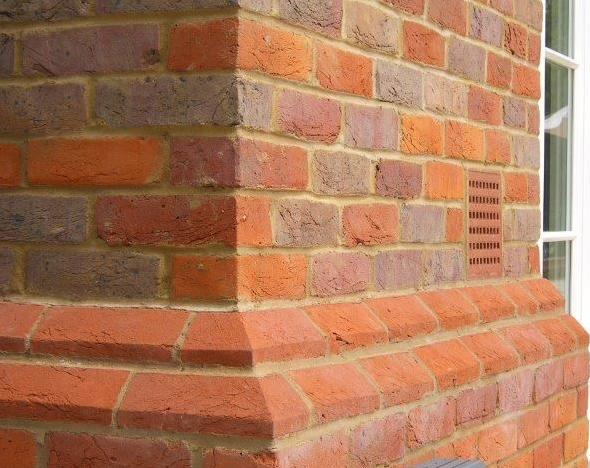
Postwar and eighties brickwork. A great deal of New Milton went up between the sixties and the late eighties, and that brickwork was pointed in a strong sand and cement, struck flush or bucket handle, in joints thinner than a Victorian wall would have.
It does not fail evenly. What goes first is the exposed edge: the top course under a coping, the corner returns, the reveals round the openings and the whole of the south west face. We rake out to sound mortar, twice the joint width where the brick will take it, and point back in a mix matched for strength and colour, not whatever is in the mixer that week.
A cavity wall of that age was built with galvanised ties, and under three kilometres from the water they corrode from the outer leaf inwards. As a tie rusts it swells, and it lifts the course it is bedded in. The sign is horizontal cracking at regular heights up the wall, roughly every fifth or sixth course, on the exposed elevation only. The repair is remedial ties fixed through into the inner leaf on a set pattern, then cutting out and replacing the courses that have been jacked apart. It is not a job to point over, because the crack simply comes back through the new mortar. Mild steel lintels over garage doors, patio doors and wide window openings rust the same way, with a cracked joint following the line of the lintel and sometimes a dropped soldier course above it.
Terraces and shared stacks. A quarter of the homes in New Milton are terraced, and on a terrace the chimney stack often straddles the line between two houses. That matters practically: scaffold usually has to go up over both properties, and the sensible thing is a single quote for the whole stack, the pointing, the flaunching and the copings together, not each owner pointing their half of it a year apart. We are happy to price it that way and to talk to the neighbour. The low dwarf wall under a fence, the garden wall along the boundary, the gate pier at each side of a drive and the single skin garage return weather from both faces at once and are the first brickwork on a property to go, most of them on a shallow foundation with no damp proof course in them at all. Where a face has blown we cut out the failed bricks and replace them with a match, reclaimed where the original run has gone, and where a whole panel has gone we will say so, not dot new bricks through it.
How it runs
Brick repairs, from the first survey to the clean down
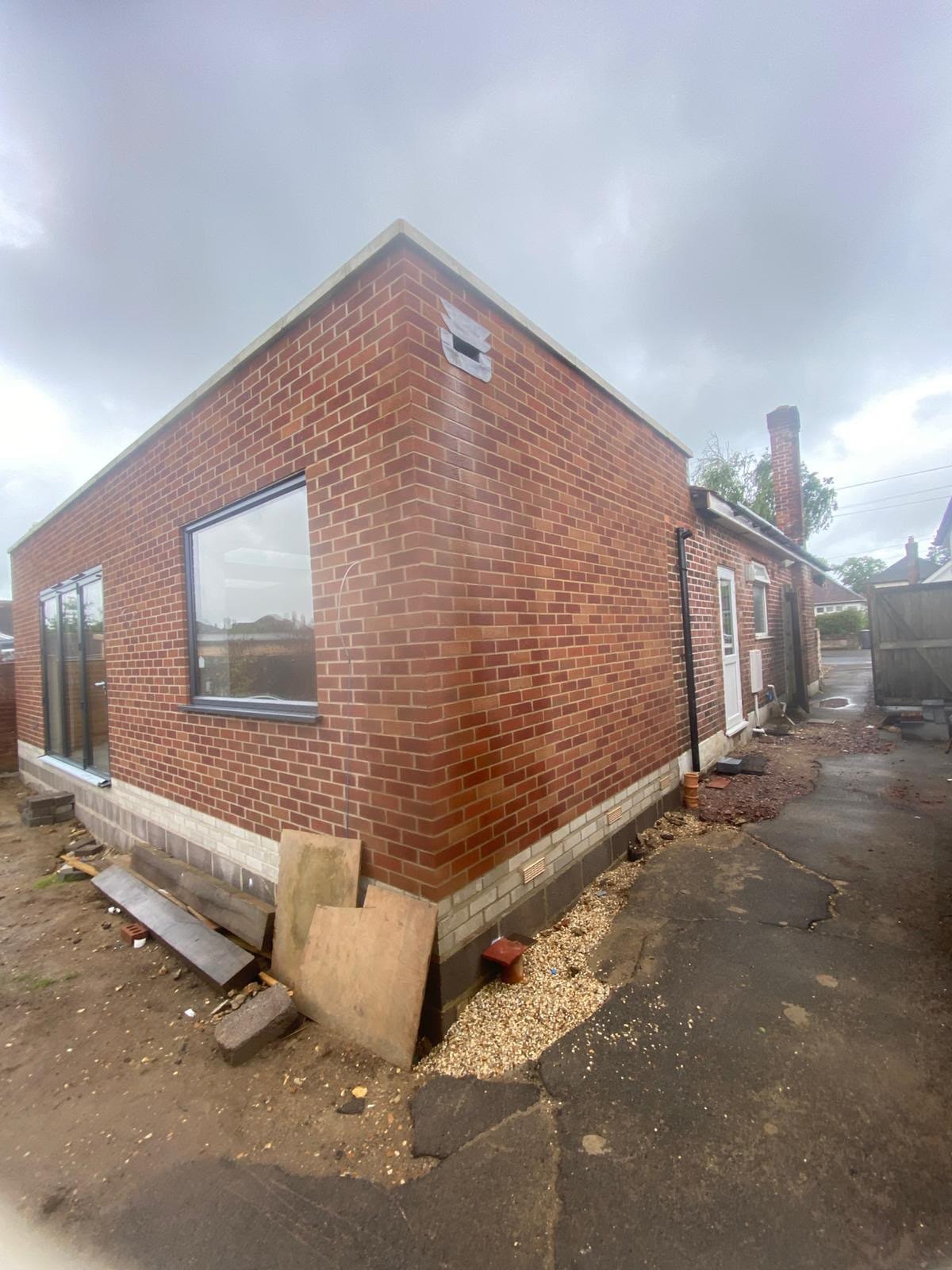
Thomas comes out, looks at each elevation and any garden wall, and prices the work himself. You get a written, itemised quote with a line for each elevation or wall: access, cutting out and replacing bricks, raking out and repointing, the mortar, any lintel or wall tie work, and disposal, with photographs of what he found.
Brickwork in town is mostly post-war and eighties facing brick in cement mortar, plus the low front walls in front of terraces and semis. A front wall onto a pavement needs barriers and a clear footway; a stack or gable on a terrace needs a scaffold, and on a shared stack the Party Wall etc. Act 1996 puts a notice period on the work before anyone cuts in. Brick dust is kept down and swept up, and the rubble leaves with us. A cracked lintel or a rusted tie found once the wall is open is photographed and priced for you, and we wait for your say before touching it.
Repointing and like for like brick repair are maintenance, so there is nothing to apply for and building control is not involved. Changing how a wall looks is where planning starts, and the Planning Portal sets out where that line falls. The Old Milton Green conservation area is small, but inside it appearance is controlled, so we check the address with New Forest District Council. Structural work such as a new lintel goes through their building control.
Cost
What sets the cost of brickwork in New Milton
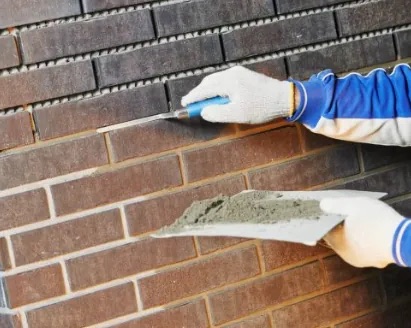
Matching the brick takes time. A lot of post-war and eighties facing bricks came in colours that are no longer made. Finding a match can mean reclaimed stock, or bricks taken from somewhere out of sight, and that takes time to source.
Matching the mortar. Colour and strength both matter. Too strong a mix on a softer brick pushes the damage into the brick face instead of the joint, so we mix trial panels before the main work.
Ground movement. Much of New Milton sits on clay that shrinks in a dry summer and swells in a wet winter. A crack wider at the top, near a tree or a leaking downpipe, may be the ground moving, not the wall failing, and that changes the repair. Where the rainwater goes is part of it, and Approved Document H covers that.
Access. A terraced front reached across a pavement, a stack shared between two houses, and a bungalow gable down a narrow side passage are different set-ups. A stack or gable needs a scaffold and a low boundary wall needs none, and the work at height rules are why the platform is priced by time as well as size.
Ask anyone else quoting how deep the joints are raked, by hand or disc, how many bricks are being replaced, and whether the scaffold is included.
If something has moved
A wall leaning over the pavement, or a loose stack
Ring us instead of using the form. Anything leaning, cracked right through or loose above head height comes first, so keep people and cars away from underneath it. In New Milton that is usually a front wall clipped by a car, or a chimney stack on a terrace that has started to lean.
The first visit makes it safe by taking down loose bricks, propping, or fencing it off, and the permanent repair is priced once we can see how far the movement goes. The diary for booked jobs is Monday to Friday, 8am to 6pm. A wall that could fall is worth a call, not an email, and a call we miss is returned as soon as we are able.
The local bit
Salt reaches the brickwork here
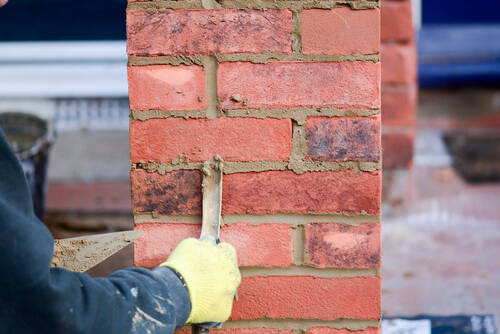
New Milton is a couple of miles back from the water, which is close enough that salt reaches the brickwork and far enough that people do not expect it to. Salt works on a wall from the surface to the steel. It holds moisture in the face between showers, so a brick that would have gone through ten freeze and thaw cycles in a winter goes through three times as many.
It crystallises inside the face and pushes the surface off from behind. And it eats galvanised metal, which is why ties, lintels and coping fixings on the seaward side of a house here fail a decade or two before the same components on the sheltered side. That is the practical point. Your house does not need one specification, it needs two.
So when you are comparing quotes, ask what is going on the exposed elevation as opposed to the rest. On the weather side we want a joint that sheds water rather than one that holds it, which usually means weather struck rather than deeply recessed, and a mortar mix strong enough to stand the exposure but still softer than the brick beside it.
Any replacement ties, straps or fixings within reach of the salt should be stainless rather than galvanised, and it is worth asking, because it is not a line most quotes make visible. One thing to say no to: a clear water repellent sealer over the face. On a wall that is carrying salt it traps what is already in there and pushes the spalling deeper in, and it makes the repointing underneath it harder to do later.
Who you are dealing with
Who looks at your brickwork
Our base is in Boscombe, eight miles west of New Milton. We cover BH25: the town centre, Old Milton Green, the estates either side of the railway, and out to Barton on Sea, Bashley, Ashley, Everton and Milford on Sea. New Forest District Council deals with planning and building control.
Bournemouth Roofing & Building Ltd, registered in England and Wales, company number 15471719. Owned by Thomas Hannen, who inspects the wall and prices the repair in person. Verified on Checkatrade: a customer's 10 out of 10. No charge for the site visit, and none for the itemised written quote. Before you book a visit in New Milton, you can read our customers' Google reviews, word for word, on our reviews page.
Planning at a glance
Do you need planning permission in New Milton?
Most repairs in New Milton need no application at all. What decides whether a change to the outside of your house does is who the council is, whether a conservation area or a listing applies, and whether the place sits in a protected landscape.
| Question | In New Milton |
|---|---|
| Who decides | New Forest District Council is the planning authority for New Milton. The National Park boundary runs close by, and the Park's property map shows which side an address falls. |
| Conservation area | Yes: Old Milton Green Conservation Area. Check whether your street is inside the boundary before changing anything visible. |
| Listed buildings | Yes, there are listed buildings in and around New Milton. If yours is one, work can need listed building consent. |
| Protected landscape | No National Park or National Landscape covers New Milton. |
Questions
Questions about bricklaying in New Milton
Why are the joints on an eighties house failing already?
Joints on an eighties house in New Milton fail because of how it was built rather than how old it is. The 1980s are the biggest single slice of New Milton's housing at 19.9%, and that stock has thin cement joints on a fast laid cavity wall. A thin joint has nothing in reserve, so once frost opens a perp it goes back quickly. It is nearly always the perps and the cills instead of the full face.
There is no side access. How do you get round?
Through the house or around the block, and we allow for it. A quarter of New Milton is terraced, 25.4% of it, so a rear elevation with no side gate is normal, not unusual. We board and sheet a route through, mix at the front and barrow round, or use a neighbour's access by agreement. It slows the work down and the quote says so instead of hiding it.
What should I look at before ringing you?
Run a screwdriver along a bed joint at eye level on the weather side of the house. If it comes back with dust and the point sinks in easily, that joint has gone soft and needs cutting out. Then look at the perps, which fail first on New Milton's newer estates. If the mortar is sound and the brick faces are blowing instead, you have a different repair on your hands.
Why is the brick above our window lifting?
A steel lintel is corroding behind it. New Milton is 2.8km from the coast, and salt laden air gets into the joint over an opening and rusts the exposed edge of the steel, which swells and lifts the course above. The sign is a horizontal crack in the bed joint straight over the window. That is not a pointing job. We take the brickwork over, treat or renew the steel and rebuild.
The path beside the house has sunk. Does it matter?
It matters if it now sheds water at the wall instead of away from it. The ground under New Milton shrinks and swells at a significant rating, so a slab that has tipped towards the brickwork sends every downpour into the same strip beside the footing. That shows up as damp inside at floor level and a soft joint in the bottom two courses. We re-lay the falls and point the base together, in that order.
Nearby, and next door
Bricklaying near New Milton
Nearby places we also cover for bricklaying, with straight-line distances from New Milton, and the other trades we offer in New Milton itself.
Bricklaying nearby
Our other trades in New Milton
Brickwork and repointing guides
Lime or cement mortar: which do you need? Single storey extension: planning and building regs Subsidence cracks: which ones matterBuilders in New Milton: all our building work Everything we do in New Milton Bricklaying, all areas Every area we cover
Free quote
Get a price for your New Milton brickwork
Tell us which elevation is giving trouble and we will come and look at all of them. The visit and the written itemised quote are both free.