Bricklaying and repointing in Poole
Lime repointing in the Old Town, wall ties on the interwar streets, parapets, stacks and front boundary walls.
The site visit is free and so is the written itemised quote. Thomas Hannen prices every job himself.
Bricklaying and repointing
Brickwork in Poole: three different towns, three different repairs
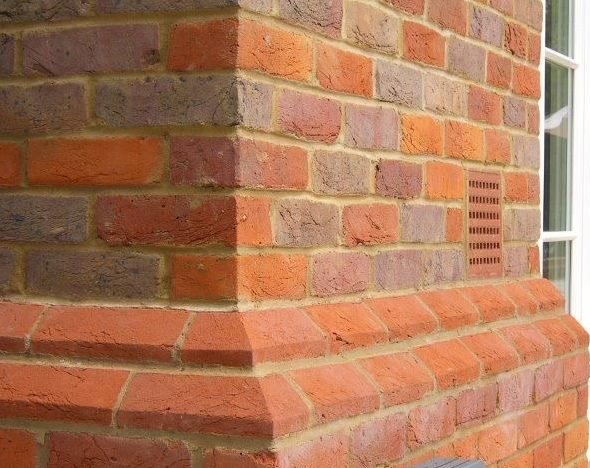
Poole is not one kind of brickwork. The Old Town is solid wall built in lime, the Victorian terraces behind it are solid wall pointed in cement by somebody in the 1970s, and the 1930s streets out from the centre are cavity walls with steel ties in them. Those three want three different repairs, and getting the wrong one is what turns a small job into a big one.
What brings people to the phone is fairly consistent. A front elevation on the street where the joints have gone back far enough to see. Brick faces flaking off below a window. A parapet or a chimney shedding mortar into the gutter. A front boundary wall leaning out over the pavement with a gate pier that has parted company from it.
We come out, look at the whole property rather than the wall you have spotted, and tell you which of those three buildings you actually own, because it changes the mortar, the method and the cost. If it can wait, we will say so. The site visit and the written itemised quote cost you nothing.
The work
The brickwork jobs we do around Poole
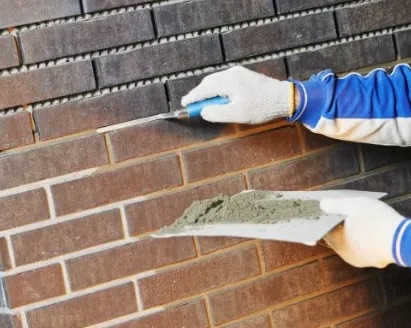
Old Town solid walls, in lime. The streets behind the Quay are handmade brick laid in Flemish bond, often with a gauged arch over the sash windows and a parapet at the top. There is no cavity in any of it. We rake the joints by hand, never with a disc, because a disc widens the joint and takes the edge off a soft brick, and point back in NHL lime matched for sand, colour and texture. On a frontage the joint profile is part of the look of the street, so we agree it with you before we start rather than default to whatever is quickest. The terraces around the town centre are the same solid wall construction and most have been repointed at least once in sand and cement. A hard joint on a soft wall stops the wall breathing and pushes the damp out through the brick face instead, which is why the faces are spalling while the joints look sound. Taking that out and putting lime back is slow work and it is the repair that actually fixes it. Terraces also bring shared parapets and shared stacks, so we sort the party wall position before anything is touched.
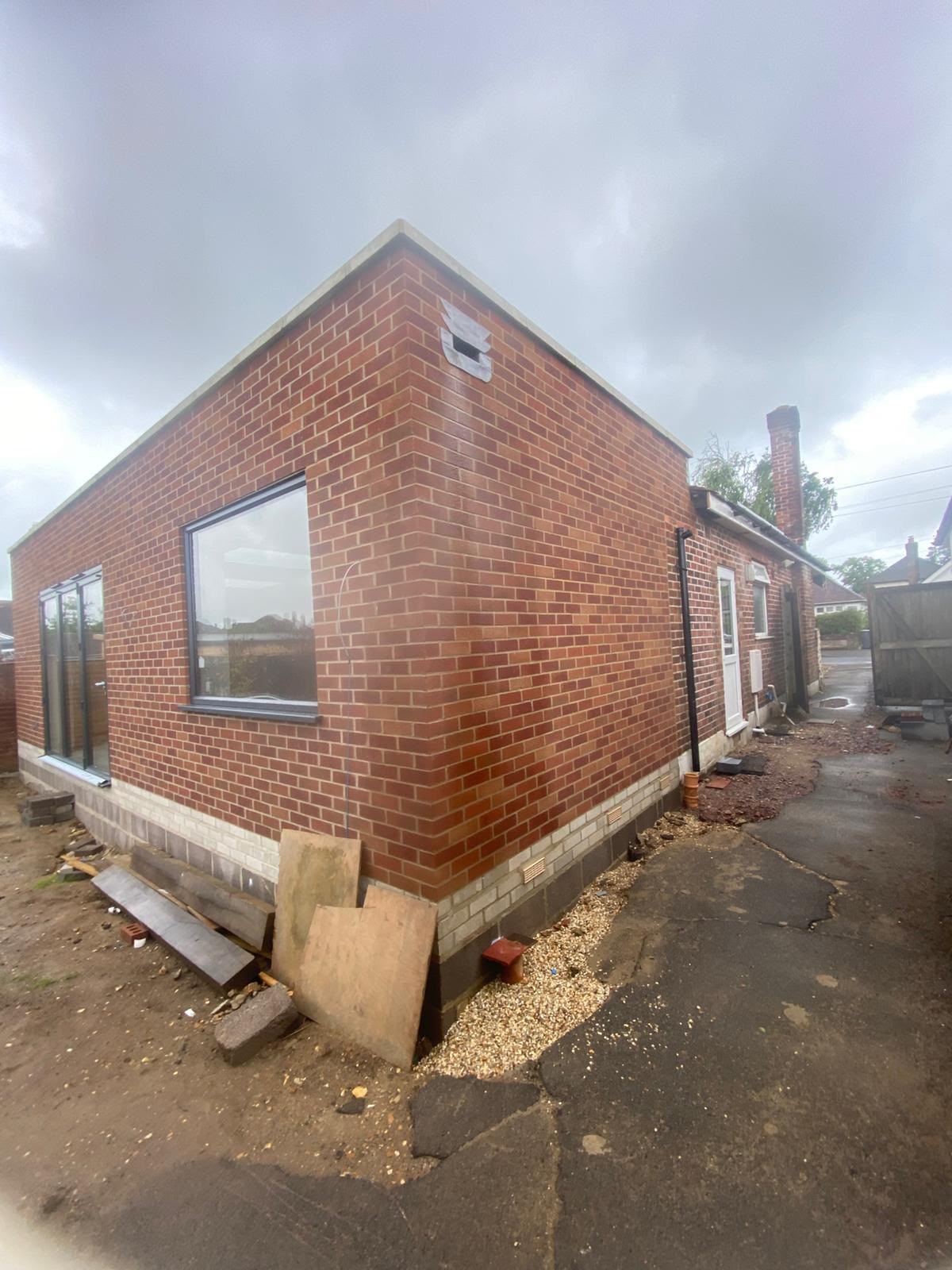
Roughly a fifth of Poole's homes date from between the wars, built as a brick outer skin in stretcher bond with a cavity behind. The galvanised ties in those walls corrode and swell, which lifts the outer skin a fraction at every tie and shows up as fine horizontal cracking at regular course intervals, usually worst on the gable. Remedial ties go in from outside without taking the wall down, and the holes are made good in matched mortar. The bay windows on those houses are carried on their own brickwork and are often the first thing to move, as is the steel over a garage opening or a wide patio door, which rusts, expands and cracks the courses sitting on it.
Flats and communal brickwork. A third of the homes in Poole are flats, and we price communal work for management companies and residents' associations as readily as for a single owner: parapets, balcony fronts, the brick panels between windows, and the corners that take the weather off the harbour. If you are a leaseholder, major works are usually subject to consultation under section 20 of the Landlord and Tenant Act 1985, so ask your freeholder where that has got to before anyone books a scaffold.
Almost every terrace and semi here has a low front boundary wall, most built with no damp proof course, so they wick water up and the bottom courses go soft. We rebuild bowed lengths on a proper footing, put a DPC in where the wall allows, reset or replace the coping, and rebuild gate piers so they are bonded in rather than freestanding. Be aware that taking one down inside the Town Centre Heritage conservation area is not automatically permitted. Where frost has taken the face off, we cut out and replace, matching with reclaimed or handmade stock, a sample off the wall and a trial panel you can look at before we commit. New brickwork means extension skins, porches, retaining walls between split level plots and new piers, built off a dug foundation with ties at proper centres.
How it runs
From your call to a written price
One team from first visit to last, and the price broken out by elevation so you can compare it line by line. The town centre and the Old Town sit inside the Town Centre Heritage conservation area, and the council keeps the list of conservation areas. Inside it, like for like repair is maintenance, but changing what a wall looks like is not, and that includes a different mortar colour or joint profile on a prominent elevation. There are listed entries in the centre too, including the parish church, and on a listed building repointing needs consent first: the council's listed building records. New or raised garden walls have height limits, set out in Planning Portal guidance on fences, gates and garden walls, and the Party Wall etc. Act 1996 covers anything on a shared wall.
Cost
What decides the price of a brickwork job
We do not price by the square metre. A Georgian frontage straight onto the pavement in the Old Town, a Victorian terrace with a shared parapet and a 1930s semi with a gable you can reach off a tower are three different set ups. Getting a platform to a stack or a gable is its own line on the quote, because work at height rules govern how long it stands. What sets the hours is how deep the joints have to come out and whether the faces have already spalled. Ask whether the mortar has been matched.
If something has moved
Loose brickwork, or a wall that has shifted
Ring rather than use the form. Anything overhead or leaning jumps the queue. The first visit is about making it safe and stable, and we price the permanent repair once we can see how far the movement goes. In Poole it is most often a front wall leaning over the pavement, or loose brickwork on a parapet above a shop front. The phone is answered 24 hours for emergencies; scheduled work runs Monday to Friday, 8am to 6pm.
The one local thing
In the conservation area, the mortar is a planning matter
The centre of Poole, the Old Town and the streets behind the Quay sit in the Town Centre Heritage conservation area, and that changes the brickwork job in a way most people only find out afterwards. A conservation area controls appearance. Repointing a wall exactly as it was is maintenance and needs nothing.
Repointing it in a mortar that is a different colour, or striking the joints to a different profile, changes how the building reads from the street, and on a prominent elevation that is the sort of change the council takes an interest in. The same goes for painting brickwork that has never been painted, and for cutting out sound brick to replace it with something that does not match.
The one that catches people out is walls. In a conservation area the demolition of a boundary wall or a gate pier over a certain height is not automatically permitted, even though the identical wall two streets outside the boundary could come down on a Saturday morning. If you are planning to take out a front wall to widen a drive, check the position before you book anyone.
The practical advice is simple: find out whether your address is inside the boundary before you agree a specification, and get whoever is quoting to write the mortar mix and the joint profile into the quote rather than leave it as their preference on the day. We do that as standard, and we will make the enquiry with the council for you if you would rather not.
Who you are dealing with
A local firm you can check
We are about six miles from Poole Quay and in the town most weeks, covering BH15 and the surrounding postcodes from Hamworthy and Upton through Longfleet, Parkstone and Broadstone. Bournemouth Roofing & Building Ltd, registered in England and Wales, company number 15471719, which you can look up in a minute. Thomas Hannen's business, and he is the one who comes out to price the job, not a salesman. A verified customer's 10 out of 10 on Checkatrade. The visit and the written quote are both free.
Questions
Poole questions we get asked
What does the Town Centre Heritage area stop us doing?
It controls how the work looks, not whether you can do it. The Town Centre Heritage conservation area in Poole means a repair in the same materials is upkeep, while a different brick, a changed joint profile or a coloured mortar on a street frontage is a change of appearance. We match the existing joint on anything visible from the road and can be more practical round the back.
What fails on a nineteen thirties Poole house?
The joints on the weather side and the bedding around the bay. The 1930s are the largest single slice of the town centre stock at 13.5%, with 19.1% of it inter-war overall, and those houses have soft sand and cement joints that erode rather than crack. Bay windows and the parapet over a bay are where water gets in first. We usually price the front bay and the exposed elevation together.
Our house fronts straight onto the pavement. Is that workable?
It is, with the footway organised first. A frontage on the back of the pavement means a licence from Bournemouth, Christchurch and Poole Council for scaffold or a skip, plus a walkway and lighting to keep people moving past. We work in shorter lifts, sheet the face and clear the footway every evening. The rear elevation is often the easier half and can be done separately.
Who instructs the work when the building is flats?
Whoever owns the building, not the individual owners. Flats are 33.3% of the housing in Poole town centre, and the external walls belong to the block rather than to any one flat. That also means we price a whole elevation, because there is no sensible way to point one flat's share of a wall. The freeholder is the one who can give the go ahead.
Why does the wall beside our parking space keep moving?
Vehicles and ground movement together. The cohesive ground under Poole shrinks and swells at a significant rating, so a shallow footing is already working with the seasons, and a car nudging or standing hard against the wall finishes the job. We look at what it is standing on, put a pier into a long run that has none and keep the vehicle load off the footing.
Nearby, and next door
Bricklaying and repointing near Poole
Bricklaying and repointing nearby
Our other trades in Poole
Everything we do in Poole Bricklaying and repointing, all areas Every area we cover
Free quote
Find out which repair your wall actually needs
A free site visit, a straight answer on lime or cement, and a written itemised quote you can hold against anyone else's.