
Bricklaying and repointing in Upton
Wall tie replacement, cracked lintels, brick repairs and rebuilt boundary walls across Upton, Lytchett Minster and BH16.
The site visit is free and so is the written itemised quote. Thomas Hannen prices every job himself.
Most Upton brickwork is cavity work from the fifties through to the early eighties, and on walls of that age the usual answer is a targeted repair rather than repointing the whole house. Cut out what has failed, sort the thing behind it that caused it, and leave the sound brickwork alone.
Three problems bring people to the phone in Upton. A crack that has appeared over a window or a garage opening and has got longer since you first noticed it. A horizontal line of cracking running along the wall at roughly the same height all the way round, which is a different fault altogether. Or a front garden wall, a pier or a low boundary wall that has started to lean and take the fence with it.
We come and look at the whole elevation, not just the crack you rang about. That means tapping for hollow render or loose brick, checking whether the crack is stepped through the joints or straight through the bricks, seeing where the rainwater from the roof actually ends up, and photographing all of it. Then you get a plain answer about what is moving, what has simply weathered, and what needs doing first.
The work
The brick jobs we do most in Upton
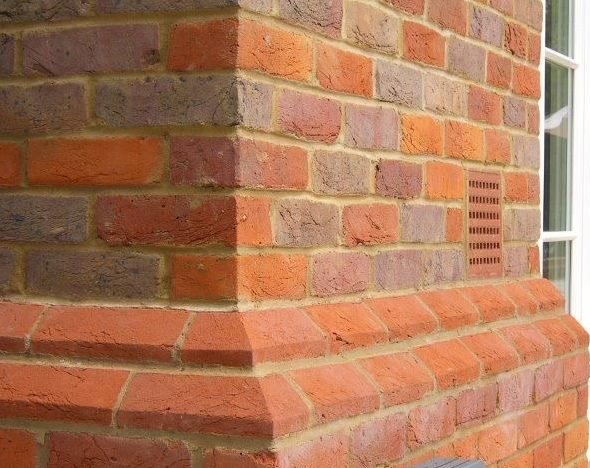
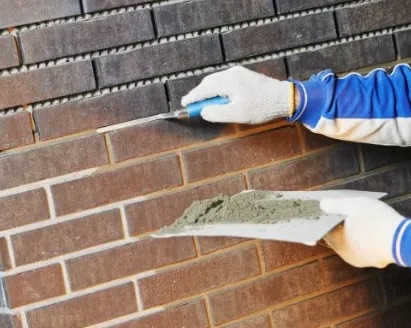
Wall ties. Just over half the housing in Upton, 52.1 per cent of it, went up between the war and the early eighties, peaking in the late 1960s and early 1970s. That is cavity walling tied with galvanised steel now at the end of its life. A rusting tie swells, and because it sits in a bed joint the swelling lifts the outer leaf, so you get fine horizontal cracking at regular intervals up the wall, worst on the elevation that takes the weather. The ties are isolated and replaced with stainless remedial ties from outside, and the cracked joints are cut out and repointed to match. Lintels go the same way. Rust behind a steel lintel lifts the course above it and cracks straight up the perpends, and the garage opening is the widest span on the house and the one most often left without a proper end bearing. We prop, cut out, put the right lintel in with a bearing at both ends and rebuild over it in the same bond.
Front walls and piers. The estates here are full of low boundary walls, dividing piers between two drives and planters built off the front wall, and most were built shallow. This ground shrinks and swells with the season, so a shallow footing moves and the wall follows it. We rebuild off a footing deep enough for it, tie the piers in, and re-bed or replace coping so the top of the wall stops drinking. Where rainwater ends up beside a wall is a structural question here rather than only a damp one, so we look at the gully and the border before we price the brickwork.
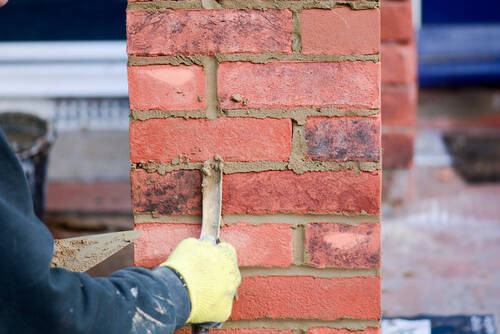
Frost takes the face off brick that has been kept wet, usually low down where a path or a border has been built up against it, or under a gutter that has overflowed for years. Those bricks are cut out whole and replaced, matched on colour and texture, with a sample panel first where the run will be seen from the road. Plenty of the older houses here still carry a stack that serves nothing: repointing above the roof line and renewing the flaunching keeps it sound, but taking a genuinely redundant one down below the roof is often cheaper and we will say so. New work is the rest of it, extensions, garages and garden rooms, with a blockwork inner leaf, stainless ties, a damp proof course at the right height and a facing brick chosen to sit with the house.
How it runs
From your call to a written price
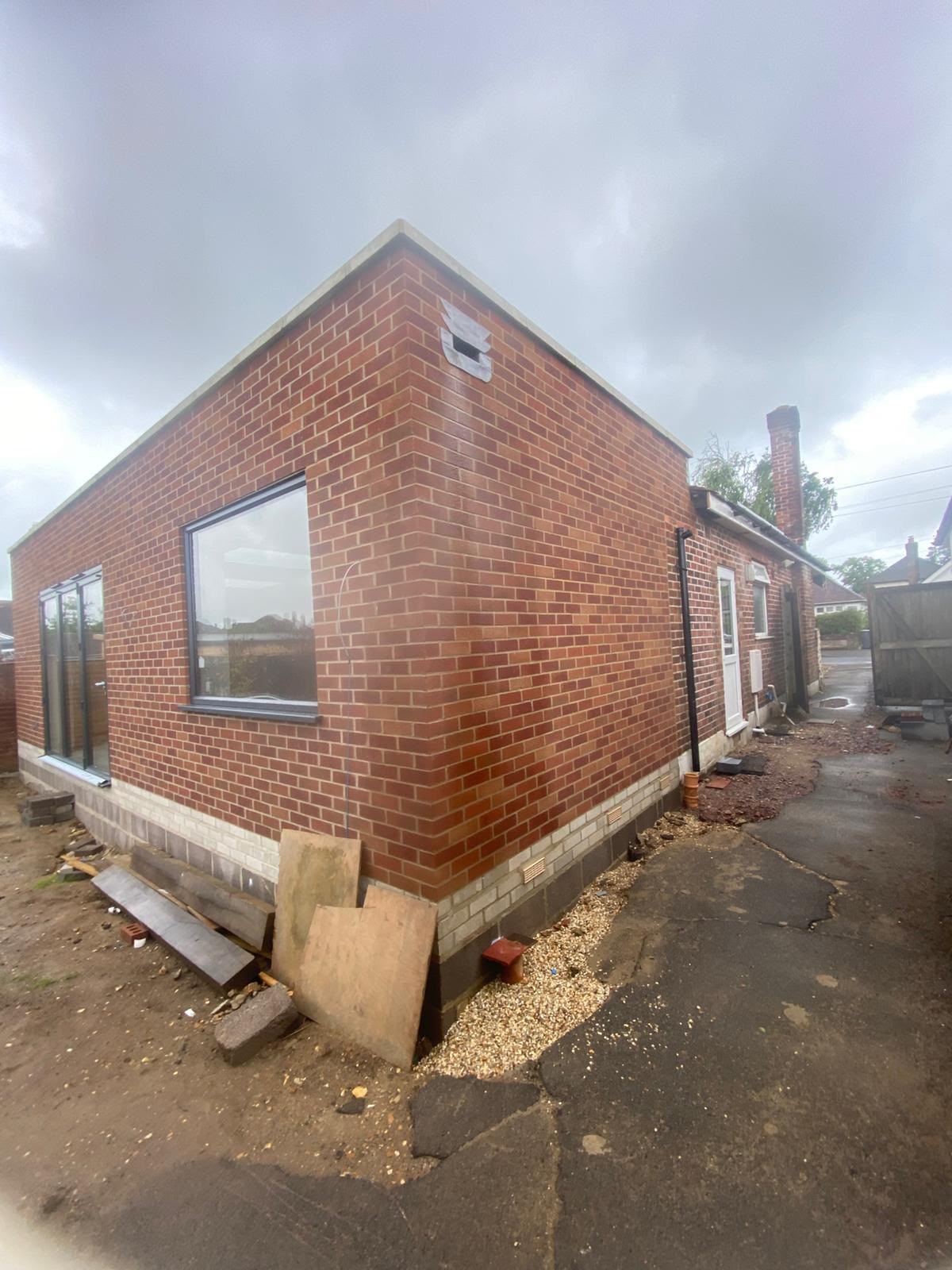
Repairing brickwork like for like is maintenance, so there is nothing to apply for. No conservation area covers the main part of Upton and the parish holds four listed entries, so at almost every address here the brick and the mortar are your choice. A new garden wall needs planning permission above a metre where it fronts a road and above two metres elsewhere, and the Planning Portal sets out where that line falls. An extension or a new opening brings Dorset building control in. On a semi or a terrace, where the work touches the wall you share, the Party Wall etc. Act 1996 gives your neighbour a formal notice period, worth starting early because it costs nothing but time.
Cost
What decides the price of a brickwork job
No rate per square metre. What decides it first is getting to the wall: a mid terrace where everything goes through the house, a semi with a side gate and a bungalow with a drive you can park a mixer on are three different jobs before a brick moves. How long a platform stands matters as much as its size, and work at height rules are why access is a priced line. Then the joints, how deep they come out and whether the faces have spalled. Ask anyone quoting how deep the raking is, by hand or by disc, and whether the scaffold is in.
If something has moved
Loose brickwork, or a wall that has shifted
Ring rather than use the form. Anything overhead or leaning goes to the front of the queue, and the first visit is about making it safe. A leaning front wall beside a pavement, or brickwork dropping over a garage opening, are the two we come out for first here. The phone is answered 24 hours for emergencies; scheduled work runs Monday to Friday, 8am to 6pm.
Worth knowing
The ground under Upton moves, and it takes walls with it
The ground here is cohesive and it carries a significant shrink and swell rating, which is the polite way of saying it gets smaller in a dry summer and swells back in a wet winter. Houses are usually deep enough not to care. Garden walls, piers, porches and old single skin extensions very often are not, because they were built off a shallow strip and the zone that moves is exactly the zone they sit in.
That is why so many boundary walls in Upton lean the same way and crack in the same place, and why rebuilding one on its old footing just buys you the same wall again a few years later. When we rebuild, the footing goes below the moving zone and long runs get movement joints so the wall has somewhere to go.
The other half of it is water, because clay moves most where it wets and dries the hardest. A downpipe emptying onto a border beside the wall, a soakaway put in too close to a foundation, or a gully that stopped taking water years ago will all move the ground next to that wall far more than the weather does, and Approved Document H is why surface water is supposed to be dealt with properly rather than tipped at the base of the building.
Trees matter for the same reason: a thirsty tree within its own height of a wall dries the ground under it every summer. If you have a crack, before anyone quotes you for underpinning anything, photograph it with a ruler beside it and look again at the other end of the year. A crack that opens in August and closes in February is seasonal movement. A crack that only ever gets wider is the one worth spending money on.
Who you are dealing with
A local firm you can check
We cover Upton, Lytchett Minster, Lytchett Matravers, Hamworthy and Creekmoor, across BH16 and into Poole. The free site visit is the survey: we look at the wall with you rather than pricing off a photograph. Bournemouth Roofing & Building Ltd, registered in England and Wales, company number 15471719, which you can look up in a minute. Thomas Hannen's business, and he is the one who comes out to price the job, not a salesman. A verified customer's 10 out of 10 on Checkatrade. The visit and the written quote are both free.
Questions
Upton questions we get asked
Why do you look at my gutters before quoting brickwork?
Because the ground under Upton shrinks and swells, and a downpipe emptying beside a footing keeps changing what that footing sits on. Movement shows in the mortar first, as stepped cracking through the perimeter joints near a corner. If I point over that without sorting where the water lands, the same joints open again by the following winter. So the drainage gets looked at before the trowel comes out.
Is stepped cracking near the corner a movement problem?
Usually, and on cohesive ground like Upton's it tends to be seasonal rather than sudden. The soil swells through a wet winter and shrinks back in a dry summer, so the crack widens and closes with the weather instead of growing steadily. I measure the width at the top and at the bottom, look at the faces of the broken joints, and check for a tree or a soakaway within reach of the foundation.
Are there heritage rules on brickwork in Upton?
Barely any. Upton has no conservation area of its own and only four listed entries, so on the great majority of houses here repointing counts as repair and needs nothing from Dorset Council. That does not mean anything goes. The mortar still has to suit the brick rather than the neighbour's new extension, because a hard cement mix on a softer brick does damage no permission would ever have prevented.
Our house is early seventies. What fails first?
The edges and the openings. With 52.1% of Upton's houses built between 1945 and 1982 and the peak in the late sixties and early seventies, most of what I see here is cavity work of a single age. Mortar under the sills and around the window reveals goes long before the middle of a wall does. That is usually where the job starts and where it finishes.
Where does the raked out mortar and rubble end up?
In a covered barrow, and off site inside the week. Raking out throws a fine grey dust that travels, so beds, paths and any garden furniture are sheeted before the first joint is cut, and the wall is brushed down at the end of each day rather than at the end of the job. On wet Upton ground I board the barrow run so the lawn does not get churned up.
Nearby, and next door
Bricklaying and repointing near Upton
Bricklaying and repointing nearby
Our other trades in Upton
Everything we do in Broadstone Bricklaying and repointing, all areas Every area we cover
Free quote
Get a written price for your Upton brickwork
Free site visit, free itemised quote, and a straight answer on whether that crack is moving or finished.