Rendering in Upton, and render over insulation
Once the scaffold is up and the old coat is off, insulation behind the new render costs a fraction of what it costs as a job on its own.
The site visit is free and so is the written itemised quote. Thomas Hannen prices every job himself.
If a wall is coming back to the brick anyway, that is the one moment in its life when insulation is cheap to add. The scaffold is already up, the old coat is already off, and the render that goes back on can sit over insulation board just as easily as over bare masonry.
It is worth raising here because so much of Upton is post-war terraced and semi-detached housing with narrow cavities and cold north facing gables. People ring about a failed render and end up asking a much better question, which is what the wall could be doing for them once it is opened up.
We price both ways so you can see the difference rather than take our word for it: the straight re-render, and the same elevation with external wall insulation behind it. Both go in a written itemised quote with the access, the preparation, the boards where they apply, each coat and the beads on separate lines. The visit and the quote are free.
The work
Re-render, or render over insulation
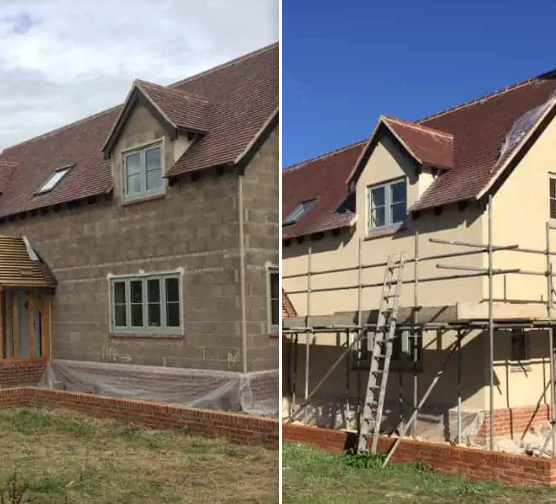
Tapping the elevation. A mallet over the whole wall with the hollow areas chalked, before any conversation about systems. How much of the existing coat is still bonded decides whether this is a repair, an overlay or a strip back, and everything else follows from that.
Hacking off and preparing the background. Blown render comes off to a firm edge, the brickwork behind is made good, old chases and patched openings are filled and a key is formed. Anything friable is brushed down and stabilised with a primer.
External wall insulation with a render finish. Insulation board is fixed and mechanically anchored to the prepared wall, a mesh reinforced basecoat goes over it, then a primer and a silicone topcoat. Where the wall or the detailing suits it better, a render carrier board takes the same build. It is building control work, and the thickness has consequences at every reveal, sill and eaves, so it is detailed before it is priced.
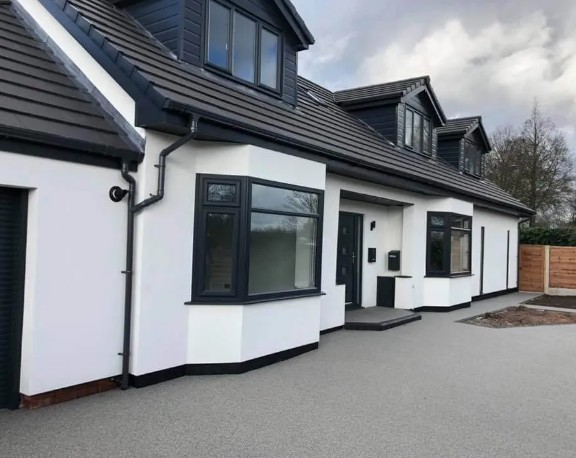
Straight re-render in silicone thin coat. Without insulation, the same basecoat and topcoat go directly onto the prepared wall. Through-coloured, breathable and flexible, and on the post-war housing here it is the usual choice.
Monocouche and traditional sand and cement. Monocouche in one build, scraped back the next day, for a heavier grain. Sand and cement where an elevation is being matched into an existing scratch and float build, or where a dashed finish is being repaired rather than replaced.
Pebbledash and Tyrolean repairs. Cut back to a firm edge, floated to thickness and re-dashed with matched aggregate. New dash reads lighter than weathered dash for a couple of seasons, so on a frontage it is often better to take the whole face.
Beads, bellcast and the detail around openings. Angle beads at the corners, stop beads at the reveals and a bellcast at the base. On an insulated wall this is where the work is won: the reveals get thinner board, the sills often need extending, and the eaves and verge details have to accommodate the extra thickness.
Cracking, delamination and staining. Cracks are cut out, meshed and made good before frost gets behind them. A coat that has parted from the wall comes off rather than being covered. Green algae on a shaded gable is surface growth and a wash with a treatment and a breathable coating clears it.
How it runs
From your call to a written price
Same team from first visit to last, one person to ring, and no sub-contracting your work out to somebody you have never met. The quote is itemised, not a figure on the back of a card: access and scaffold, protection, preparation of the existing wall, the system and number of coats, beads and stop ends, and making good on separate lines, so you can compare it properly against anyone else's.
Nothing is left open or unusable overnight. The site is swept at the end of each day rather than the end of the job, and what comes out leaves with us. If something turns up once we start that nobody could have seen, you get a photograph and a price before we carry on.
A straight re-render is maintenance and needs no application. Insulating the outside of a wall is different: it is a controlled service under the building regulations, so it goes through building control and Approved Document L sets the Part L standard the improved wall has to reach. There is no conservation area in Upton and the listed entries sit away from the housing, though listed building consent applies if a property is listed. Thickness changes what a house looks like at the reveals and the eaves, so that is drawn and agreed before anything is ordered.
Cost
What decides the price of a rendering job
No rate per square metre, because the square metres are the easy part; what is already on the wall decides the price.
Getting to it. A mid terrace where everything comes through the house, a semi with a side path, and an end of terrace gable facing a shared drive are three different platforms. A bungalow gable comes off a tower, a three storey elevation wants a scaffold, and the platform has to stand for the whole system rather than a day. The work at height rules are why it is a priced line rather than something folded into a rate.
What is already on the wall. Rendering over sound brick is one job. Hacking off blown sand and cement, or a pebbledash that has parted from the background, is another, and it is the part nobody can see from the road. We tap the whole elevation before quoting, because the hollow areas set the hours.
The system, and what the wall behind it needs. Silicone thin coat over insulation, monocouche through-coloured, or traditional sand and cement all price differently and behave differently. On a solid wall that has to breathe, a plastic-rich modern system traps moisture and moves the problem inside, so the right system is a wall decision rather than a colour decision.
Comparing quotes? Ask which system is being quoted and how many coats, whether the old render is being hacked off or overlaid, whether beads, bellcast and stop ends are included, whether the scaffold is in the price, and what happens to the existing sills and pipework. Two quotes for the same job are usually two different jobs.
If it has started to come away
Render that has blown or cracked open
Ring rather than use the form. A section that sounds hollow when you tap it, or a crack you can get a coin into, is letting water behind the render and the frost does the rest. We make the loose area safe, sheet it if the weather is against us, and price the elevation once we can see how far the blown area actually goes. We are under seven miles away, so an Upton address is normally looked at within a day or two. The phone is answered 24 hours for emergencies; scheduled work runs Monday to Friday, 8am to 6pm.
Worth knowing
The cheapest time to insulate a wall is while it is bare
Half the homes here went up between the war and the early eighties, which is the era of the narrow cavity and the uninsulated gable. Those walls lose a lot of heat, and the usual reason people never do anything about it is that external wall insulation carries a scaffold, a strip back and a new finish before a single board goes on. All three of those are already in a re-render.
So the comparison to make is not insulation against nothing. It is insulation against the re-render you were going to pay for anyway. Once the access, the hack off and the render are in both columns, the extra is the boards, the fixings and the extra care at the reveals, and that is a much smaller number than a standalone job.
Two honest cautions. The first is thickness. Insulation pushes the face of the wall out, so window reveals get deeper, sills usually need extending and the eaves, verge and rainwater goods have to be looked at. Done properly it looks right and done cheaply it looks like a wall with something stuck on it. The second is the fabric. On a solid wall the build has to stay breathable, or you have simply moved the moisture problem to the inside face.
Who you are dealing with
A local firm you can check
We cover Upton, Lytchett Minster, Hamworthy, Creekmoor and Corfe Mullen, broadly BH16, under Dorset Council. You are dealing with Bournemouth Roofing & Building, the trading name of Bournemouth Roofing & Building Ltd, registered in England and Wales, company number 15471719, which you can look up in a minute. Thomas Hannen's business, and he is the one who comes out to price the job, not a salesman. A verified customer's 10 out of 10 on Checkatrade. The visit and the written quote are both free.
Questions
Upton questions we get asked
Is it worth adding insulation while the render is off?
Usually, yes. The scaffold, the strip back and the new finish are in the price either way, so the extra is the boards, the fixings and the detailing. As a standalone job later it costs far more, because you pay for all of that again.
Does external wall insulation need building control approval?
Yes. Insulating an external wall is controlled work under the building regulations, and Approved Document L sets the standard the improved wall has to reach. A straight re-render does not, because it changes nothing thermally.
How much thicker does the wall get?
Enough to notice at the openings. Reveals become deeper, sills usually have to be extended and the eaves and verge details need adjusting. We draw those before ordering so the finished house looks designed rather than padded.
Can insulation go on a solid wall?
It can, but the whole build has to stay breathable, boards and render alike. Seal a solid wall in an impermeable system and the moisture that used to leave through the face ends up on the inside instead.
Will it look different from a normal rendered house?
Not from the road, if it is detailed properly. The finish is the same silicone or monocouche topcoat. What gives a bad one away is the openings, which is why the reveals and sills take the extra time.
Nearby, and next door
Rendering near Upton
Rendering nearby
Our other trades in Upton
Everything we do in Broadstone Rendering, all areas Every area we cover
Free quote
Get the elevation priced both ways before you decide
Thomas comes out, taps the wall and prices the straight re-render and the insulated build side by side in writing. The visit and the quote are free.