EPDM, GRP, Felt & Single Ply Flat Roofing Bournemouth
A flat roof rarely leaks where the stain is. It gets in at an upstand, a lap or an outlet, then runs along the deck until it finds a joint. What can go back on is decided by the boards underneath, and nobody can see those from the ground.
Flat roofs
Rubber, Fibreglass, Felt and Single Ply Flat Roofs Around Bournemouth and Poole
The covering you can see is the last decision on a flat roof, not the first. What matters is the deck under it and whether the water has anywhere to go. New membrane over soft boards fails at the same spot inside two winters, so the deck gets opened up and stood on first.
Bournemouth Roofing & Building strip, re-deck and re-cover flat roofs in EPDM rubber, GRP fibreglass, torch on felt and single ply, across Bournemouth, Poole and Christchurch and out through Wimborne, Ferndown, Wareham and Ringwood into the New Forest. Thomas Hannen prices every job himself, and the site visit and written quote cost you nothing.
Four calls come in more than any others. A garage roof split along one line. A brown patch in the corner of an extension ceiling. A dormer cheek staining a bedroom wall when the wind comes off the sea. And two quotes for one roof, one half the other. Tiled and slated slopes, ridges, valleys and chimney work are a different trade day and sit with the rest of our roofing services in Bournemouth.
- EPDM rubber, GRP fibreglass, torch on felt, built up three layer and single ply, chosen for the roof rather than the van
- Decks renewed in ply or OSB, rotten joist ends cut back, firrings reset so the fall runs to the outlet
- Upstands, kerbs, trims, outlets, rooflights and lead abutments detailed properly, because that is where flat roofs go
The site visit is free and so is the written itemised quote. Thomas Hannen prices every job himself.
The roofs we get called to
Garages, Extensions, Dormers, Bays and Balconies
Most flat roofs around here are small, awkward and joined onto something else, and the join is the problem.
Garages, Outbuildings and Porches
The commonest flat roof we take off. Usually the original felt on chipboard, with no upstand worth the name and a gutter screwed to a rotten edge. The deck is the real cost, and a covering laid over old boards is money you spend twice. Porches and canopies are the same job in miniature, with more detailing than area.
Single Storey Extensions and Rear Additions
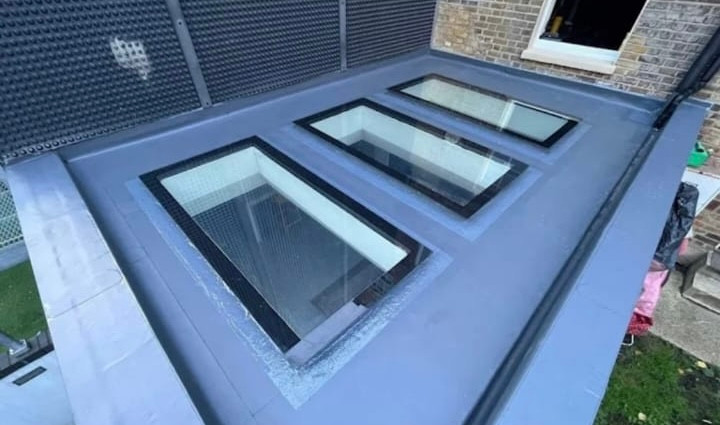
A kitchen or sitting room extension with a rooflight or two, an abutment along the house wall and often a parapet at one end. The build up matters here, because there is a heated room underneath. It is also where a thin quote shows itself, pricing the covering and skipping the layers below.
Dormer Cheeks, Dormer Tops and Bay Roofs
Small areas, heavy detailing, and almost always the reason for a stain on a bedroom wall. A dormer top wants a welt or trim at the front, a cheek needs the covering dressed in behind the tiles, and a bay roof sheds into a gutter too small for it. Fiddly rather than large, and worth doing once.
Balconies, Walkways and Flat Sections Between Slopes
Anything you walk on needs a covering that takes a boot, a threshold low enough to use and high enough to keep water out, and a fall that does not run back at the door. A flat section between two pitched roofs is the other awkward one: no access, no room for a fall, both slopes draining over it.
The systems
EPDM, GRP, Felt and Single Ply: What Each One Is Good At
There is no best flat roof covering, only the one that suits the shape, the access and the weather. BS 6229:2025 on flat roofs is the code of practice for how one is built, and it spends far more of its length on falls, decks and moisture than on the membrane.
EPDM rubber
A single sheet of rubber bonded over the whole deck. On most domestic roofs it goes down in one piece with no joints across the field, which removes the thing that fails on nearly every other system. It is cold laid, so no torch near your fascia, and it flexes as the timber moves. The trade off is a soft finish, fine for the odd bit of foot traffic but not for a balcony.
GRP fibreglass
Chopped strand mat and resin laid wet onto a fresh ply deck and cured in place, then topped with a coloured flowcoat. It comes out hard, seamless and walkable, and trims and upstands are formed in the same laminate rather than stuck on after. Two conditions. The deck has to be new, dry and firmly fixed, because GRP is rigid and takes on whatever moves under it. And resin will not cure cold and wet.
Torch on felt and built up three layer
Modern reinforced bitumen membrane, torched or hot bonded in two or three layers with the laps staggered so no joint sits above another. Nothing like the thin single layer felt people remember peeling off a garage. Three layers give redundancy, follow an awkward shape through changes of level, and forgive a deck that is not flat. The flame is the constraint: on a timber dormer we use a cold applied cap sheet.
Single ply
Thin sheet, usually PVC or TPO, laid loose or mechanically fixed and joined by hot air welding rather than adhesive. The welded seam is the point: done properly it fuses two sheets into one material and can be probed. It came from commercial work and belongs on bigger, plainer areas, the sort over shops and units on our commercial roofing page.
Underneath
The Deck, the Fall, and Why Nobody Can Price This From the Ground
Ply, OSB and chipboard
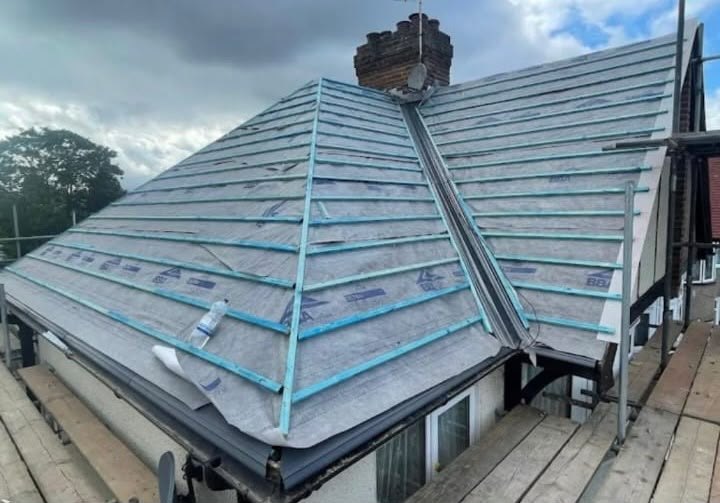
Three boards get used as a flat roof deck. Exterior grade ply is what we put back: it holds a fixing, takes a soaking, and GRP bonds to it. OSB is fine in a dry warm deck. Chipboard belongs on a floor, and a great many garage and extension roofs around Bournemouth have it. Damp chipboard swells, loses the screws and turns to porridge. That is the commonest reason a re-cover fails: the covering was sound, the boards were not.
Under the boards sit the joists, and the ends are what we look at hardest. A joist built into the wall at an abutment, or sitting on a plate under a leaking outlet, rots at the end while the middle stays sound. Cut the bad ends back, sister or replace, then re-deck. None of that shows in a photograph, so we open it up, price it, and you decide.
Firrings, falls and standing water
A flat roof is not flat. It is a very shallow slope, made by firrings, which are tapered timbers over the joists, or by tapered insulation cut to fall. That fall has to arrive at the outlet, not at the middle or the far parapet. Old roofs lose it as joists deflect, and a deck re-covered three times has thickness in the wrong places.
Ponding, water still standing days later, makes itself worse: it deflects the deck a little more each year, sits on a lap and freezes there. Coating over it does nothing. The answer is firrings, tapered insulation, or a new outlet at the low point.
Warm deck, cold deck and the vapour control layer
There are two ways to insulate a flat roof and they are opposites. A warm deck puts rigid PIR above the deck, with a vapour control layer under it and the waterproofing on top, so the timber stays on the warm dry side. That is what we build over a heated room, and tapered PIR gives insulation and fall in one layer. A cold deck puts the insulation between the joists with a ventilated void above, and it works only if that void is open at both ends.
Get that wrong and you have interstitial condensation: warm damp air from the room reaching the cold underside of the deck and condensing there. It rots boards and joist ends from the inside for years before a mark shows on the paint, and it looks exactly like a leak. The vapour control layer stops it, continuous, lapped and not punctured by every downlighter, and Approved Document F covers the ventilation half. Strip a roof over a heated room down to the deck and it counts as renovating a thermal element, so the insulation has to reach Approved Document L. That is the line a cheap quote leaves out.
Fault finding
What You See, What Is Behind It, and What Puts It Right
Flat roofs fail in a small number of ways, and the shape of the problem names the cause.
| What you see | What it usually is | What it damages | What puts it right |
|---|---|---|---|
| A puddle still there a week after rain | The fall has gone, or the outlet is above the low point | Every lap and trim it sits on, then the deck | Reset the firrings or lay tapered insulation to fall |
| Bubbles and blisters lifting off the surface | Moisture trapped under the covering, expanding in sun | The bond, which fails around each blister first | Cut back to sound material, dry it, re-lay |
| A straight split, often over a joint below | Movement a brittle covering could not follow | The boards under the split, within one wet winter | Re-deck the moving area, then a system that flexes |
| A lap or seam curling up at the edge | A cold bonded joint, or water standing on the lap | Everything downhill, once wind gets under | Welded or fully bonded seams, and fix the ponding |
| Stain in the middle of the ceiling, roof looks fine | Water in at an upstand, tracking along a joist | Plaster and insulation away from the entry point | Trace it from the details inwards, not from the stain |
| Damp underside with no leak anyone can find | Condensation in a cold deck with a blocked void | Deck boards and joist ends, for years | Open the void, or rebuild it as a warm deck |
That matters when you compare quotes. Two of those six are a morning's work, two are a section of deck out and re-laid, and two are the whole roof off. Price all six as a fresh covering and you sell the dearest answer to the cheapest problem. Price all six as a patch and the leak is back in twelve months.
Detailing
Upstands, Trims, Outlets and Everything Coming Through the Deck
The open middle of a flat roof almost never fails. Every leak starts at a change of direction, a joint or a hole.
Upstands and kerbs. Where the roof meets a wall the covering turns up and keeps going, high enough that driving rain and a build up of leaves cannot get behind it, held there mechanically rather than left to adhesive. A kerb around a rooflight is the same idea: built proud, membrane dressed over it, frame set on finished work.
Edge trim, drip and apron. At the open edges the covering finishes into a trim that throws water clear into the gutter instead of letting it run back under the deck and along the fascia. A drip at the gutter edge, an apron at the front of a dormer, both fixed into sound timber. A trim on a rotten fascia will move, and that is where wind gets in.
Laps and seams. Single ply is hot air welded, felt torched or hot bonded with staggered laps, EPDM joined with seam tape and primer, and GRP has no seam at all. We will not dress a joint in mastic and call it finished.
Rooflights, lanterns and pipes. A flat rooflight, a lantern or a Velux on a low pitch is a hole in your roof with a frame in it, and soil and vent pipes, ducts and a boiler flue are the same. Each gets a kerb or a purpose made collar, the membrane carried up it and a sealed clamp at the top. Each is a line on the quote.
Where it joins and where it drains
Abutments, Parapets and Getting the Water Away
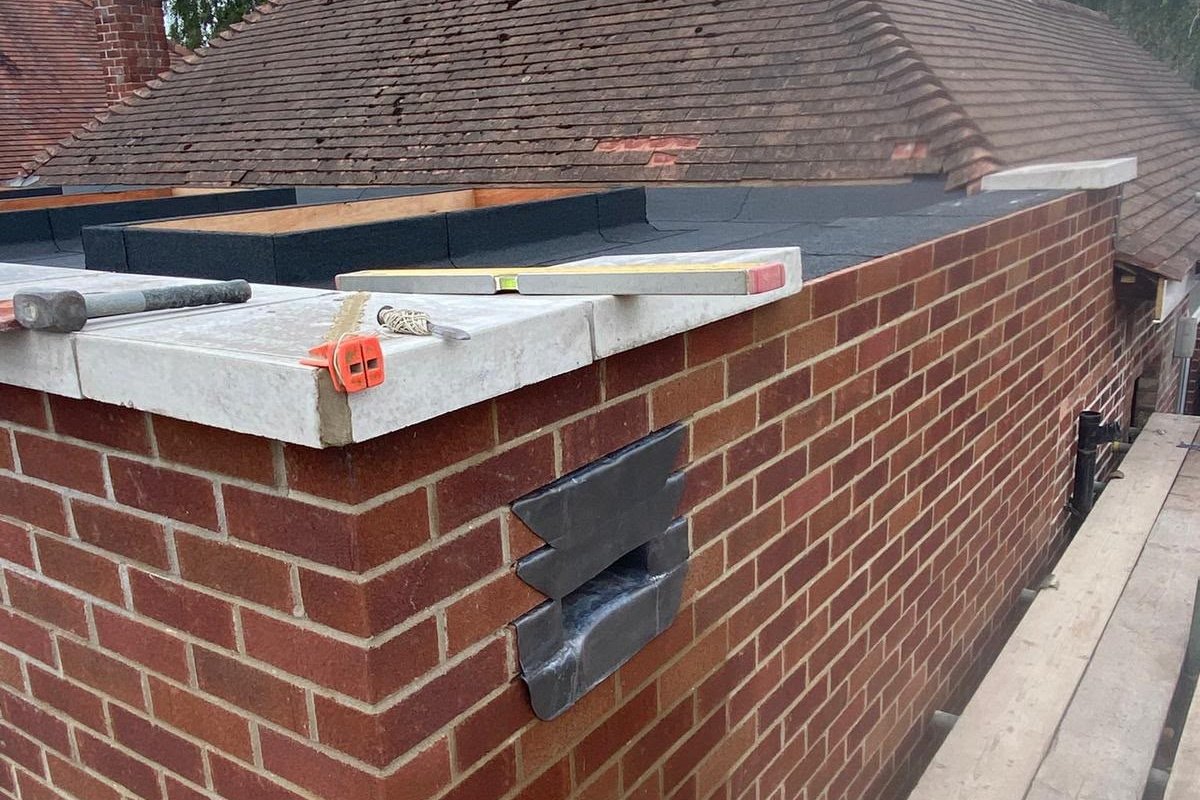
Most domestic flat roofs are joined to a taller wall, and that junction is the second place they leak. The covering turns up the wall as an upstand, then a flashing comes down over it so water off the brickwork is thrown onto the roof rather than behind it. The flashing sits in a chase raked into a mortar joint, wedged and pointed, or behind a cavity tray where one exists. Code rated lead, in lengths short enough to expand and contract without splitting, because over long lead is one of the few faults you can spot from the garden.
Parapets are their own problem. One takes weather on three faces, and the coping on top is often what lets water into the wall, from where it reaches the ceiling and gets blamed on the roof. Copings want sound bedding, a drip underneath and joints that have not opened. Where a cavity tray was left out or later bridged, water crosses the wall and comes out below.
Then the water has to leave. A flat roof drains through an outlet, a chute or an open edge into a gutter, and each has a capacity. Outlets sit at the low point, take a leaf guard and want the fall arriving from the whole area, not one side. A hopper head on the wall is common on older properties here, and a common blockage. If a downpipe discharges onto the ground rather than a gully, the roof is fine and the wall below it is soaking. Clearing and proving the whole rainwater run is on our gutter cleaning page, and replacing the boards, boxing and gutters at the edge is on our fascias, soffits and guttering page.
Permission and safety
What Needs Consent, What Needs Building Control, and How We Get Up There
Re-covering an existing flat roof is repair and maintenance, so it needs no planning application, which Planning Portal guidance on roofs confirms. Change the shape, raise the height or turn a flat roof into a terrace and you are somewhere else, because a usable balcony brings overlooking into it and is often an application.
Two things override that. A listed building needs listed building consent for work affecting its character, and a change of covering is exactly that. A conservation area controls what the outside looks like, and BCP publish the council's list of conservation areas. Those boundaries do not follow the roads you expect, so we check an address, not a town.
Building control is separate and applies whether planning does or not. Taking a flat roof down to the deck over a heated room brings the thermal element rules in, and notifiable work goes in as a building notice or an application with full plans. Replace joists or form an opening for a lantern and it is not a covering job.
Access is the last piece and it is not optional. Even a garage roof is work at height, and HSE rules on roofwork are why edge protection or a scaffold is a priced line rather than a saving somebody offers you. An old rooflight is what catches people out, and we treat every one as fragile until proven otherwise.
What it costs
How a Flat Roofing Quote Is Put Together
A flat roof is priced on what the deck turns out to be, how many details there are and how you get up to it, not on the area of the covering. There is no rate by the square metre here, because a plain garage roof and an extension with two rooflights, an abutment and a parapet are not the same metre.
What the survey is measuring
- The deck, the falls and the build up. Ply, OSB or chipboard, how it feels underfoot, and whether the joist ends at the abutment and over the outlet are sound. Then whether the fall still runs to the outlet or has to be reset in firrings or tapered insulation, and whether this is a warm deck with a vapour control layer or a cold deck with a void to reopen.
- How many details there are. Upstands, kerbs, trims, drips, aprons, outlets, rooflights, lanterns, vent pipes, lead flashings, parapets and copings, counted one by one. Detailing is most of the labour on a small roof.
- Access, and getting the old roof away. A garage on an open drive is a tower job where a rear extension behind a terrace means a scaffold and a long carry. Then the gutter work at the edge, making good inside, and the waste.
Reading two flat roofing quotes side by side
Ask whether anyone lifted the covering and stood on the deck, or priced it from the garden. Ask what happens if the boards are worse than they look, in writing, before the job starts. Ask which system is going on and why that one for this roof, and whether insulation and the vapour control layer are in it. Ask how many upstands, trims and outlets are in the price. Two prices for one garage roof are usually two different jobs, and the cheaper one looked at less.
Questions
Flat Roofing Questions We Get Asked Most
Can a flat roof be re-covered over the old felt?
Only where the deck under it is sound and dry, and that is decided by lifting a corner and standing on the boards, not by looking at the surface. A new membrane over soft chipboard or a wet joist end fails at the same spot within a winter or two. Where the deck is good, a re-cover is a real option and we will say so.
Water sits on my flat roof after rain. Is that a fault?
A shallow film that clears in a day or two is normal. A puddle still there a week later is not, and it means the fall has gone or the outlet is above the low point. Standing water finds every weak lap, then freezes and lifts it. The fix is firrings or tapered insulation, not more coating.
The stain is in the middle of the ceiling. Where is the leak?
Almost never above the stain. Water that gets through a flat roof runs along the top of the plasterboard or down a joist until something stops it, so it can appear two rooms from where it came in. We trace it from the upstands, the outlet and the abutment inwards.
How long does a flat roof take?
A small garage or porch is usually a day or two. An extension with a rooflight, an abutment and new insulation runs to three or four days, longer if the deck comes off and joist ends need cutting back. Nothing is left open overnight: the deck is made watertight before we leave.
Can you lay a flat roof in the winter?
Most of it, yes, but not every system in every week. GRP needs a dry deck and will not cure properly when it is cold, so a wet fortnight in January moves it. EPDM and felt are far less fussy. We will tell you which you are choosing before the date is set.
Areas covered
Flat Roofing Across Bournemouth, Poole & Dorset
Garage roofs, extensions, dormers and balconies re-covered in these towns and between them:
Bournemouth Roofing & Building Ltd is registered in England and Wales, company number 15471719, and the Checkatrade review on the profile is a verified 10 out of 10. Tiled and slated slopes, ridges, valleys and chimney work sit on our roofing page, moss and blocked runs on our gutter cleaning page, and the boards, boxing and gutters around the edge of a flat roof on our fascias, soffits and guttering page.
Flat roofing by location
Flat roofing in every town and village we cover
Each page is written around the flat roofs that are actually there: how much of the housing carries a garage or extension roof, how exposed the edges and trims are, and what the planning position does to a change of covering. 84 pages covering 115 settlements, grouped by area.
Bournemouth, Poole and Christchurch
Wimborne, Ferndown and the east Dorset heaths
- Wimborne Minster
- Corfe Mullen
- Ferndown
- West Moors
- Verwood
- Three Legged Cross
- Furzehill
- Holt (also Chalbury Common, Gaunt's Common and more)
- Woodlands
- Ashley Heath
- Stone (also Sturminster Marshall)
- Alderholt
- Cranborne (also Whitmore)
Purbeck, Wareham and the Frome valley
- Swanage
- Corfe Castle (also Studland)
- Langton Matravers (also Worth Matravers, Harman's Cross)
- Wareham
- Ridge (also Stoborough)
- Sandford
- Holton Heath
- Lytchett Matravers
- Wool
- West Lulworth (also Burngate)
- Winfrith Newburgh (also Briantspuddle)
- Owermoigne
- Crossways
- Bere Regis
Blandford, the Winterbornes and Cranborne Chase
- Blandford Forum
- Bryanston
- Stourpaine (also Durweston, Ash)
- Spetisbury (also Charlton Marshall)
- Tarrant Monkton (also Pimperne)
- Iwerne Minster (also Shroton)
- Winterborne Kingston
- Winterborne Stickland
- Milborne St Andrew (also Winterborne Whitechurch)
- Tolpuddle
- Sixpenny Handley
- Ashmore
Ringwood, Fordingbridge and the Avon valley
- Ringwood
- Hangersley (also Hightown)
- Burley (also Burley Street)
- Bransgore
- Sopley
- Thorney Hill
- Fordingbridge
- Sandleheath
- Rockbourne (also Martin)
- Breamore (also Woodgreen)
- Hyde (also Frogham, North Gorley and more)
- Downton
- Redlynch
- Lover
The New Forest and the Solent shore
- New Milton
- Barton on Sea
- Bashley
- Ashley
- Milford on Sea
- Everton (also Hordle)
- Lymington
- Walhampton and Portmore (also Pilley)
- Boldre (also Sandy Down, Tiptoe and more)
- East Boldre
- Brockenhurst
- Lyndhurst
- Minstead
- Cadnam and Bartley
West Wight, across the Solent
- Yarmouth (also Bouldnor)
- Freshwater and Totland
- Norton
Free quote
Find Out What Your Deck Is Before You Buy a Covering
Send one photograph of the flat roof from above if you can get to it, and one of the stain inside. Thomas comes out, lifts a corner, stands on the deck, looks at the upstands and the outlet, and puts a written itemised price in front of you.