Flat roofing in Winterborne Stickland
Garage roofs, back additions, porches and kitchen extension roofs across Winterborne Stickland and DT11. We check the deck and the fall, then price it in writing.
The site visit is free and so is the written itemised quote. Thomas Hannen prices every job himself.
Last updated
Before anything else on a flat roof here, look at what the deck is doing under the covering and remember that the village is in the Winterborne Stickland Conservation Area. The deck decides the price and the conservation area decides what you are allowed to put on.
The flat roofs in Winterborne Stickland are back additions, garages, porches and kitchen extensions. Some sit behind old cottages and some behind houses put up long after. What they have in common is that nobody looks at them until a ceiling starts telling a story.
We come out and look properly. That means getting up there, checking the outlet and every junction rather than just the surface, and opening a corner of the covering where there is a sensible place to do it. Then you get photographs of what is really up there, an honest view on whether a repair will hold, and a written price with each part of the work on its own line. Conservation area or not, water coming through a ceiling gets dealt with first, so ring 07435 839745.
The work
From a dripping porch to a new extension roof
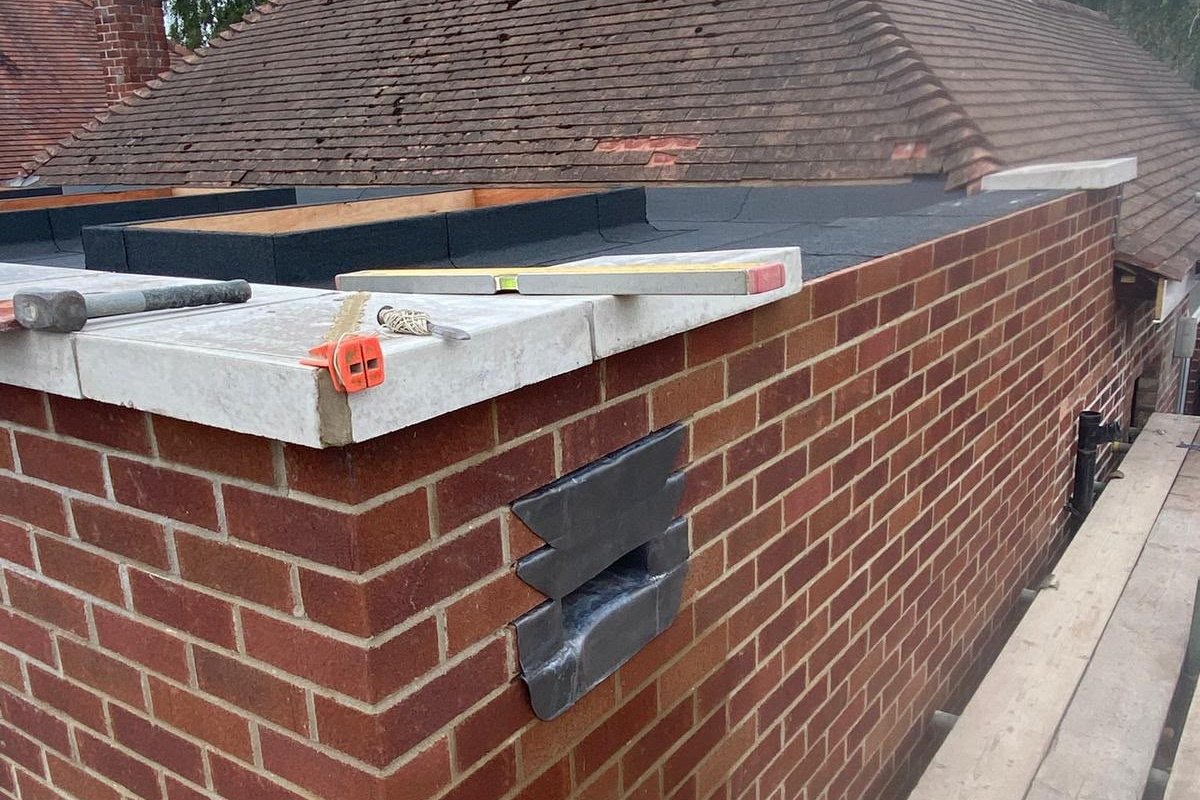
The deck comes first. Everything else follows from it. Lift a covering and you find plywood, OSB or chipboard decking laid over joists, with firrings on top forming the fall towards the outlet.
Chipboard that has been wet for a season swells, gives underfoot and has to come off, and that is the biggest single swing in the price of the job. On an older building in Winterborne Stickland the joists are rarely level, so the fall gets built rather than assumed. Where re-firring will not work we form the fall in tapered insulation instead, and BS 6229 is where those falls come from.
Why they leak. Ponding first. A roof holding standing water in the same corner all winter is a roof with no fall, and it will finish a new covering as surely as it finished the old one. Then the covering itself: felt splits along the creases once it goes brittle, blisters where damp was sealed in underneath, and lifts at a seam where it turns up an upstand. A failed seam is the one that fools people, because water travels under the whole roof and comes through somewhere else entirely.
What we lay. EPDM rubber on a plain rectangle, bonded down in a single sheet with no lap in the open field. GRP fibreglass where there are kerbs, corners and upstands to laminate round, or where the roof gets walked on. Single ply, hot air welded, on a long run. Torch on felt, in a three layer built up system with a mineral cap sheet, still suits some buildings better than any of them.
Insulation, if the room below is heated. Renewing the covering brings it into scope under Part L. The insulation belongs above the deck, over a vapour control layer, in PIR, with the membrane on top. That is a warm roof and the whole structure stays on the dry side of the dew point. A cold roof, with the insulation between the joists, leaves the boards below it, and interstitial condensation forms inside the construction and rots them from above long before anything shows outside. Building control get notified and see it before it is closed up.
The junctions and the openings. This is the slow part of the job and the part that decides whether it leaks. A chase raked into the wall at the abutment, lead dressed in as a cover flashing, and a cavity tray above it, or a stepped flashing worked into the joints where the wall is old and soft. A coping on the parapet and an apron below it. A kerb under every rooflight, lantern, Velux style flat roof window, hatch and soil or vent pipe. A drip trim along the free edges. And a rainwater outlet running to a hopper, a downpipe or the gutter. A garage is a day, an extension two or three working days.
How it runs
Renewing a flat roof in the Winterborne valley
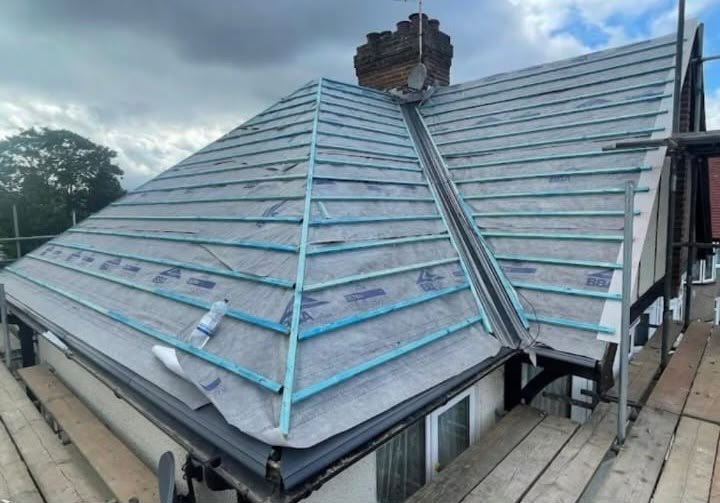
Thomas comes out to Winterborne Stickland, gets onto the flat roof and opens up a small section to see the deck. He checks the falls, each outlet, and how the roof meets the house wall, which on an older cottage is where the trouble usually starts.
His quote then prices, one by one, getting up there, taking off what is there now, deck boards and firrings if they are needed, the insulation, the new membrane, the upstands, the outlets, the edge trims, and clearing the waste. Stripping and re-covering are on the same sheet.
If the flat roof covers a back addition behind a Winterborne Stickland cottage with no side access, everything is carried through carefully, with floors sheeted. A garage or single storey extension is usually worked from a tower; anything over a two storey wall wants a scaffold. The roof is covered every night, the site is swept daily, and old felt and boards leave with us. If the deck is worse than the test section showed, you get a photograph and a price before any more is replaced.
Renewing a flat roof as it was is repair, so for most houses there is no planning permission to apply for. Winterborne Stickland is recorded as having its own conservation area, and Dorset Council can tell you whether your address is inside it, where a change of material or look is considered. On a listed building, listed building consent covers the whole property. Building control applies when the covering over a heated room is renewed, and the insulation then has to meet Approved Document L.
Cost
The deck and the drainage: a flat roof priced properly
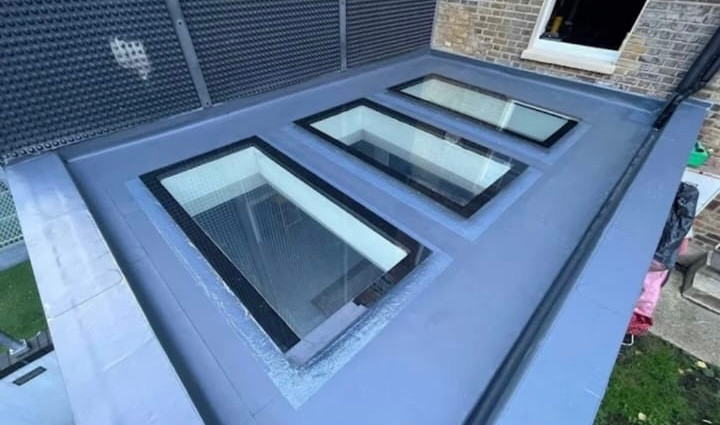
Square metres are the easy part of a flat roof, and they tell you little about the price. The deck. The boards under the membrane are the biggest variable. Sound ply can take a new covering. Chipboard that has been wet swells, sags and has to come off. You cannot tell from the ground, which is why we look under a corner before quoting.
Falls and outlets. Plenty of flat roofs in Winterborne Stickland fail because they were laid dead level, or because the water runs to an outlet that was later blocked. Firrings to set a proper fall are more work than a membrane alone, but they stop ponding for good.
Where it meets the house. On an older wall of brick or flint, the upstand and the lead flashing chased into the joint are where leaks begin. Each upstand, outlet and length of edge trim is priced separately.
Access. A tower in the garden is a small line. A scaffold beside a lane, or around a back addition with no side way, is a bigger one, and the work at height rules set how it is built.
Ask other quotes which membrane system and how many layers, whether the deck is replaced or overlaid, and whether the falls are being corrected with firrings.
If it is coming through
A flat roof that has split, lifted or started to pond
Ring us rather than using the form. A flat roof that has split or lifted at an upstand lets water straight through to the ceiling, and a wet deck keeps rotting after the rain stops. If water is near a light fitting, switch off that circuit.
On the first visit we get the roof covered and dry, with a patch or a weighted sheet, and then Thomas looks at how much deck has gone and prices the permanent job. Winterborne Stickland is a longer drive for us than most places, so we give you a clear arrival time rather than a vague one. Scheduled work runs Monday to Friday, 8am to 6pm. For urgent work, phone; a missed call is returned as soon as we can.
Worth knowing
Find out which side of the boundary your house sits on
Winterborne Stickland is recorded as having a conservation area of its own, and there are a couple of dozen listed entries in and around the village. It is worth checking with Dorset Council whether your house is inside the boundary. What people assume is that it covers everything. It usually does not. A village conservation area is normally drawn round the historic core, and plenty of houses on the edges sit outside it entirely.
That is worth ten minutes of your time before you order a roof, because the two situations are genuinely different. Outside the boundary, the covering on your garage or extension is your own decision and there is nothing to apply for. Inside it, appearance is controlled, so changing felt for a light coloured membrane, or putting in a rooflight or a lantern that can be seen, is something to agree first. Dorset Council hold the boundary maps and will tell you. Give us the address at the first visit and we will look at it with you, then put the position in writing next to the price so nothing depends on somebody's memory.
Who you are dealing with
Your flat roof, priced by the man who owns the firm
Thomas Hannen owns the business and is the one who gets up on your roof and writes the price. The company is Bournemouth Roofing & Building Ltd, registered in England and Wales, company number 15471719. Before you book a visit in Winterborne Stickland, you can read our customers' Google reviews, word for word, on our reviews page.
We are about 19.1 miles from Winterborne Stickland, based at 80a Wolverton Road, Boscombe, and we work across the village, Winterborne Whitechurch, Winterborne Houghton, Blandford Forum and the rest of DT11, all under Dorset Council. A verified customer rated us 10 out of 10 on Checkatrade. We do not charge for the visit or for the itemised written quote.
Planning at a glance
Do you need planning permission in Winterborne Stickland?
Most repairs in Winterborne Stickland need no application at all. What decides whether a change to the outside of your house does is who the council is, whether a conservation area or a listing applies, and whether the place sits in a protected landscape.
| Question | In Winterborne Stickland |
|---|---|
| Who decides | Dorset Council is the planning authority for Winterborne Stickland. Dorset Council's heritage pages set out what it controls. |
| Conservation area | Yes: Winterborne Stickland Conservation Area. Check whether your street is inside the boundary before changing anything visible. |
| Listed buildings | Yes, there are listed buildings in and around Winterborne Stickland. If yours is one, work can need listed building consent. |
| Protected landscape | Inside the Dorset National Landscape (formerly AONB), so anything visible from outside gets more attention. |
Questions
Questions about flat roofs in Winterborne Stickland
How do I know whether my house is in the conservation area?
The council hold the boundary map and it is public. Tell us the address at the first visit and we will check it with you, because it changes what can go on the roof and it is better known before the quote than after.
Can a flat roof be repaired rather than replaced?
Often, yes. A single split, a lifted lap or one failed upstand on an otherwise sound covering is a proper repair and it will hold. A covering that is brittle all over, or one sitting on a soft deck, is money spent twice.
What is the fall for, if it is called a flat roof?
To get the water off it. A flat roof is laid to a shallow slope so everything drains to an outlet. Without one the water sits, and standing water is what finds the first weak lap. Most flat roof failures start there.
Do you work out this far in winter?
Yes. EPDM is bonded cold so low temperatures do not stop it. We watch the forecast and we will not strip a deck we cannot close and make watertight again the same day.
Nearby, and next door
Flat roofing near Winterborne Stickland
Nearby places we also cover for flat roofing, with straight-line distances from Winterborne Stickland, and the other trades we offer in Winterborne Stickland itself.
Flat roofing nearby
Our other trades in Winterborne Stickland
Flat roofing guides
GRP, EPDM or felt: which flat roof covering? Snow on a flat roof or a conservatory Warm roof or cold roof: which do you need?Everything we do in Blandford Forum Flat roofing, all areas Every area we cover
Free quote
Get a price for your Winterborne Stickland flat roof
Tell us the address and what you have noticed. We will come out, open a corner where we can, and put an itemised price in writing. No charge, and no obligation.