Roofing in Winterborne Stickland
Chimney leadwork, valleys, repairs and re-covering on the clay tile, slate and concrete roofs of the village and the DT11 lanes around it.
The site visit is free and so is the written itemised quote. Thomas Hannen prices every job himself.
Repairing or re-covering in the same material is maintenance here and needs no application, even inside the conservation area. It is the things that stick up out of a roof, rooflights and vents in particular, that turn into a planning question in Winterborne Stickland.
The village runs along the bottom of a chalk valley with the downs on both sides, and the roofs follow suit: steep old pitches at the centre, plainer post-war slopes on the edges. Most people ring for one of two reasons. Something has let go at a chimney or a verge and a ceiling has stained, or a roof nobody has touched has started shedding mortar and you want to know how long it has left.
We come out, get on the roof, look in the loft and photograph what is there. You get told whether it is a repair, edge work or a covering that has finished, in writing and itemised. Site visit and quote both free.
The work
Flint stacks and the mortar fillet that always cracks
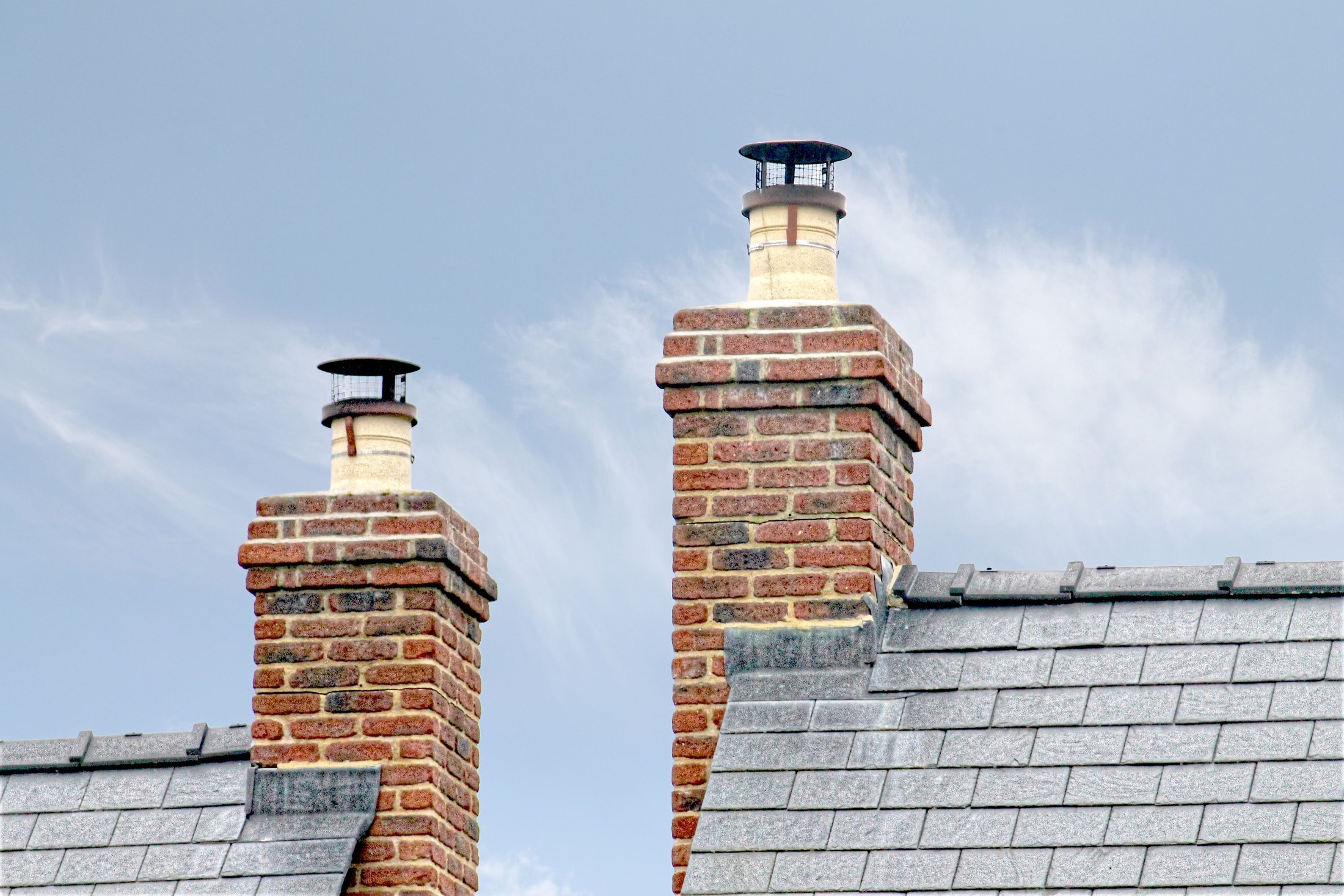
Chimney leadwork. The one that comes up most in the old part of the village. Flint and brick stacks here are tall, they stand well clear of a steep slope, and they take weather from every side. A mortar fillet where the stack meets the tiling will crack inside a few winters and it is the commonest leak we chase. It comes off and goes back as code rated lead: soakers up the sides, an apron at the front, a stepped flashing cut into the joint, sized so the lead can move instead of splitting.
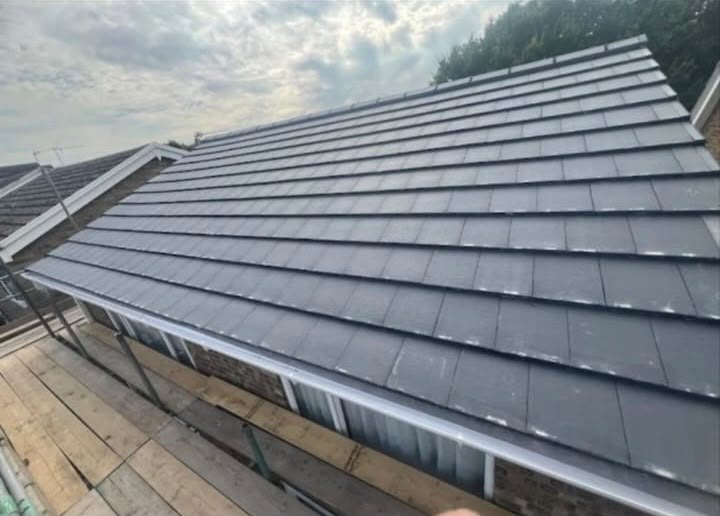
Valleys and abutments. Cottages added to over two hundred years end up with valleys between one roof and the next, and abutments where a later range meets an earlier wall. Those junctions carry two slopes of water at once, so they wear first, and we line them in lead rather than dropping a plastic trough in. Plain clay tile and natural slate on the older houses, laid over the underlay with no sarking board behind; concrete tile, mostly interlocking, on the later ones. There is no stone slate in this valley, so if a quote offers to match one, ask what that means.
Thatched roofs are part of the character of the street and we do not touch them. What we do is everything the thatcher does not: the tiled slope next door, the leadwork at the junction, the chimney the thatch runs up to and the rainwater goods below. On the exposed slopes above the valley floor wind works the edges rather than the middle. Where the house is post-war we convert to a dry fix system screwed to a ventilated roll, the mechanical fixing BS 5534 expects. On a cottage in the Winterborne Stickland Conservation Area we re-bed and point in mortar instead, because a dry verge trim on that sort of roof is the wrong answer whatever the fixing schedule says.
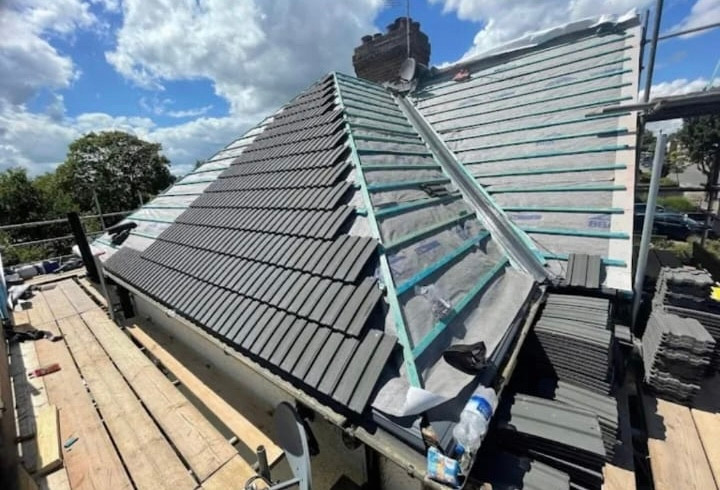
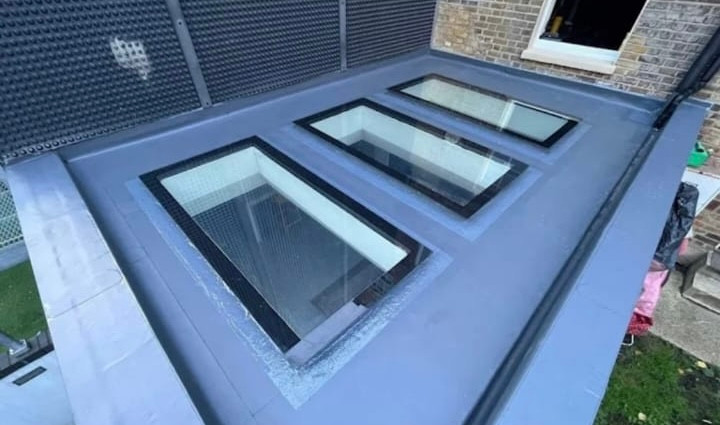
Once the nails have rusted through and the underlay tears at a touch, the covering comes off, soft rafter feet are cut out and replaced, and it goes back on breathable membrane and treated battens with a matched covering. On a steep old pitch that means roof ladders and a proper scaffold rather than working off the tiles. Rear extensions, garages and porches in felt, GRP fibreglass or EPDM rubber, deck first. A surprising share of the leaks we attend begin in the gutters. While a covering is off, insulation and eaves ventilation are far cheaper, and Approved Document L sets the standard a renovated roof is expected to reach.
How it runs
From your call to a written price
Same team throughout, one person to ring, and an itemised quote: scaffold, strip out, battens and membrane, the covering and each junction on separate lines. Winterborne Stickland Conservation Area covers the older part of the village and there are around twenty five listed entries in the parish. Repairing or re-covering like for like is maintenance either way, with no planning permission and no building control sign-off, within the limits Planning Portal guidance sets out. A change of covering inside the designated area is a different matter, and on a listed building you need listed building consent whether the work shows from the road or not. We check the address first and tell you before we price, not after. Dorset Council for both.
Cost
What decides the price of a roof
No rate per square metre: on a roof that is the least useful number there is. Stickland is narrow lanes with cottages built hard up to them, so on a good few houses the scaffold has to be planned before the roof is, and the material comes in on smaller loads than it would on an open site. It is work at height, and the work at height rules are why the platform is a priced line rather than an optional extra. Ask any other quote whether the scaffold is in and whether battens and membrane are renewed or covered over.
If it is leaking now
Water coming in today
Ring rather than use the form. Anything letting water in goes to the front of the queue, and the first visit makes it safe and watertight while you decide. Notice whether it only comes in when the rain drives from one direction: that points at a flashing, a verge or a chimney rather than the covering. The phone is answered 24 hours for emergencies; scheduled work runs Monday to Friday, 8am to 6pm.
Worth knowing
It is what sticks up that needs permission
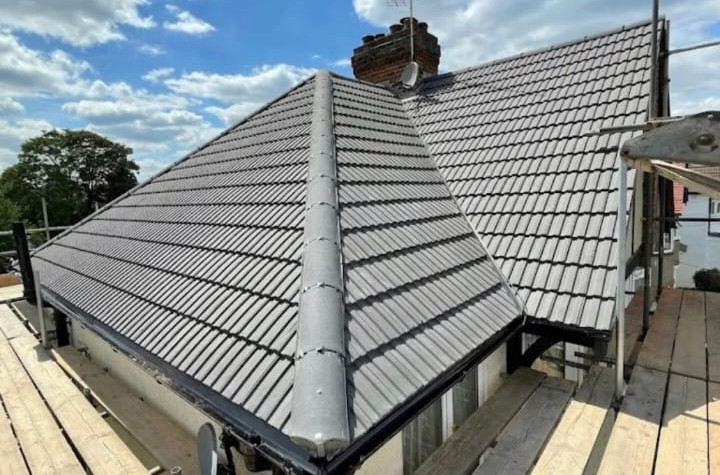
People here expect the conservation area to be a problem for repairs, and it is not. Putting back what is there, in the material that is there, is maintenance and nobody needs telling. The place it does bite is anything added to a roof slope.
Rooflights, sun tunnels, vents and solar panels are ordinarily permitted development on an unlisted house, but on designated land, which the conservation area is, that permission falls away on the slope facing the highway. On the front of your house it becomes a planning application. On the back, usually not.
The practical version: if you are re-covering and want more light in the loft, put the rooflights on the rear slope and the job stays simple. If it has to go on the front, allow for the application in your timetable rather than discovering it late. On a listed building none of that applies, because consent is needed regardless.
Who you are dealing with
A local firm you can check
About seventeen and a half miles from us, covering Winterborne Stickland, Winterborne Houghton and Turnworth and the DT11 addresses towards Blandford, with Dorset Council for planning and building control. Bournemouth Roofing & Building Ltd, registered in England and Wales, company number 15471719, which you can look up in a minute. Thomas Hannen's business, and he is the one who comes out to price the job, not a salesman. A verified customer's 10 out of 10 on Checkatrade. The visit and the written quote are both free.
Questions
Winterborne Stickland questions we get asked
Do the rules differ between the village and the outlying farms?
They can, because the Winterborne Stickland Conservation Area has a drawn boundary and a house outside it is not caught by the appearance controls at all. Inside it, a change of covering or of material needs an application while like for like repair does not. Some of the outlying buildings, Quarleston Farmhouse among them, are listed in their own right, which is a separate consent that travels with the building wherever it stands.
Can a scaffold lorry get down the lanes into Stickland?
We measure the access before anything else is decided. Winterborne Stickland is nearly eighteen miles out from us, and where a lane is too tight for a full sized wagon the scaffold comes in on a smaller vehicle across more deliveries, which changes the sequence of the work rather than the work itself. We also need somewhere to stand the tile pallets that does not block a passing place or a field gate, and that is agreed with you before a date is set.
Rain seems to get in above the bedroom window. Why?
Because water is being driven at the wall rather than falling onto it. On the exposed south west face the rain arrives more or less sideways, gets behind a short overhang at the eaves or a failed piece of lead over the window head, and tracks down inside the wall. The cure is normally a wider drip at the eaves and new lead at the head, not a new roof.
Where do matching slates come from on a repair?
From the roof itself where possible, and from reclaim where not. Winterborne Stickland has 25 listed entries, the Church of St Mary among them, and the village sits in a conservation area, so appearance is the thing being protected. Sound material comes off the least visible slope and goes back on the elevation facing the street, with reclaimed pieces put where nobody sees them. That is the argument we would put in writing if the work were queried.
Who turns up to price the job?
Thomas Hannen, who owns the firm and does the pricing himself. He goes up and looks rather than working off a photograph, and the written itemised quote follows with each element set out separately so you can see what is being replaced and what is being left alone. The visit and the quote are free. The company is Bournemouth Roofing and Building Ltd, registered in England and Wales, company number 15471719.
Nearby, and next door
Roofing near Winterborne Stickland
Roofing nearby
Our other trades in Winterborne Stickland
Roofing guides
Concrete vs clay roof tiles: which is right? Planning, building regs or listed building consent Storm damage to a roof: the first 24 hoursEverything we do in Blandford Forum Roofing, all areas Every area we cover
Free quote
Get your Winterborne Stickland roof looked at properly
A free site visit, a look in the loft and a written itemised quote you can compare line by line.