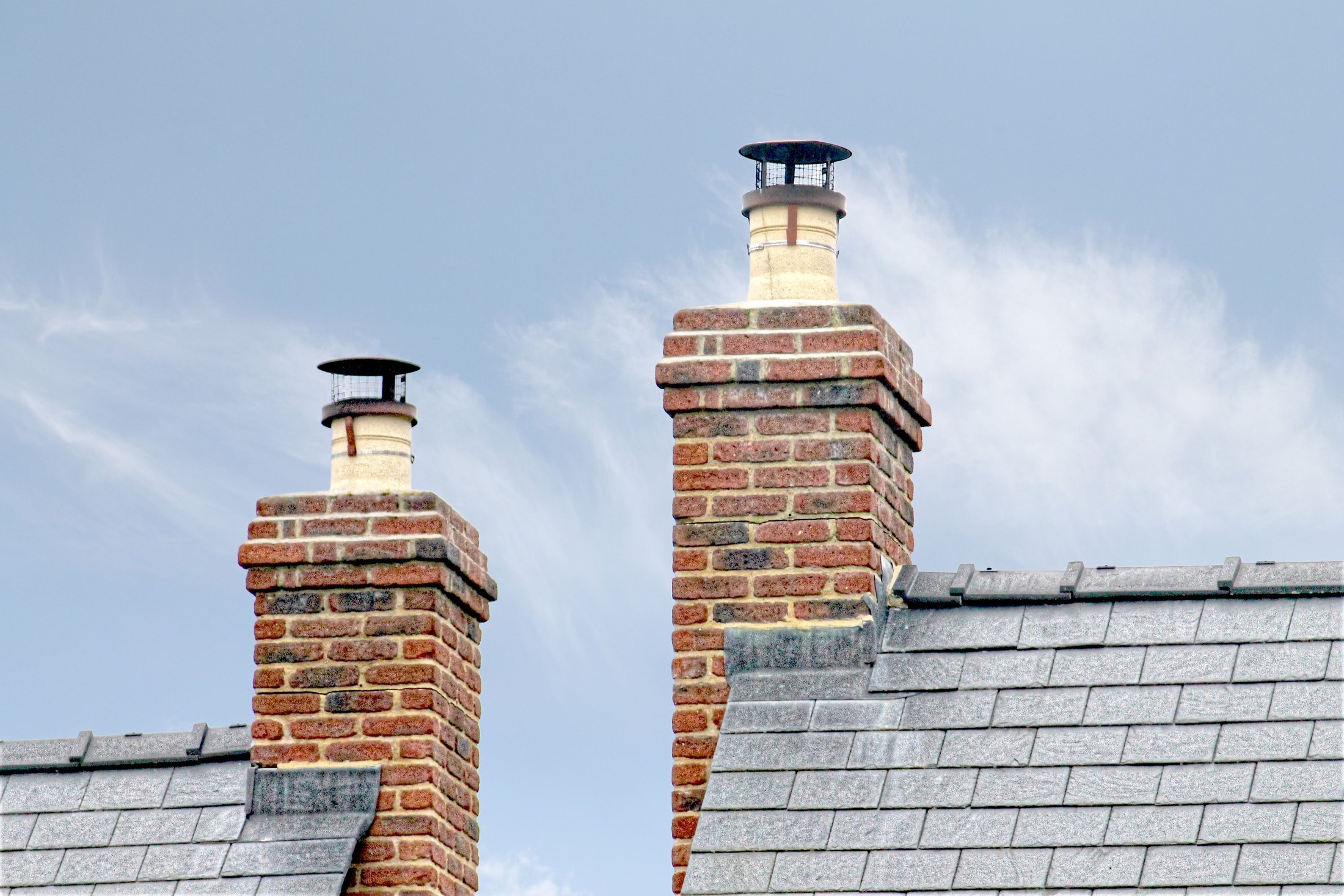
Roofing in Blandford Forum
Roof repairs, slate and tile re-covering, flat roofs, leadwork and gutter work across Blandford Forum, Blandford St Mary and Bryanston.
The site visit is free and so is the written itemised quote. Thomas Hannen prices every job himself.
On a listed building or inside the conservation area, putting a roof back exactly as it was is maintenance and needs no application, while changing the covering is a change of appearance and does. Everywhere else in Blandford Forum, a like for like re-cover runs under ordinary permitted development.
Three calls come out of Blandford more than any others. A stain has come through the top floor ceiling of a terrace, usually near the wall shared with next door. A roof on one of the 1970s estates has started dropping tiles and you want to know whether patching it again is throwing good money after bad. Or you own a flat, water is coming in, and nobody has told you whose roof it actually is.
We come out, get on the roof, put our head into the loft and photograph what is there. You get told which of three things you have: a repair that will hold, edge work that will buy you years, or a covering that has finished. If the address is listed or sits in the conservation area we say so before we price. Site visit and written quote both free.
The work
On a terrace the leak is usually the party wall
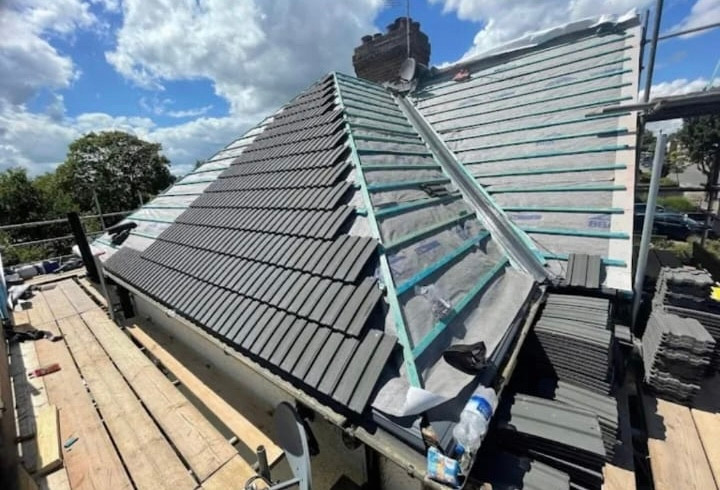
On a terrace the leak is usually the party wall. Terraces are 31.1% of the housing here, and on a terrace the leak is very often at the party wall: the abutment where your slope meets next door's, or the valley behind a back addition. That is leadwork, not tiling, which is worth knowing before you pay somebody to re-bed a ridge that was never the problem. Repairs are slipped, cracked and missing tiles, storm damage, and leaks traced back to where water genuinely enters rather than patched where the stain shows.
Slate and plain clay tile. Close to one house in five in the town predates 1919, and those roofs are natural slate or plain clay tile on battens, often with old lime torching crumbling out underneath. Slate itself rarely wears out; the nails rust through first, so you get a run of slipped slates across one course. One slate comes back on a tingle. Once a slope has gone the roof wants stripping and re-laying, sound slates sorted and matched second hand ones making up the shortfall. There is no stone slate on the ordinary housing here.
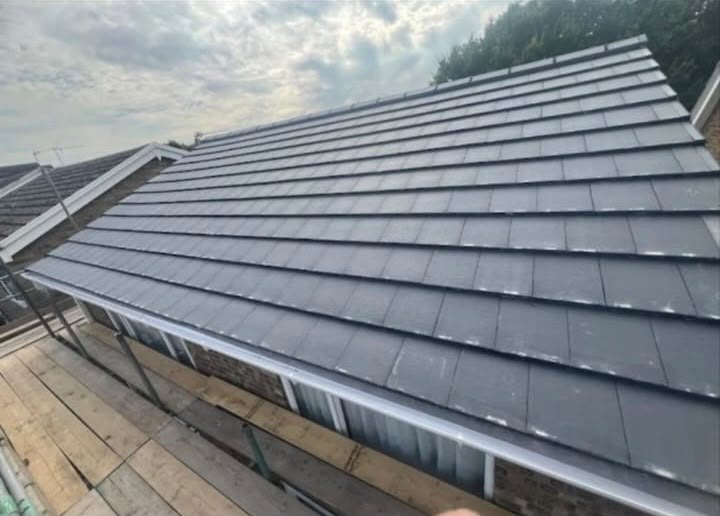
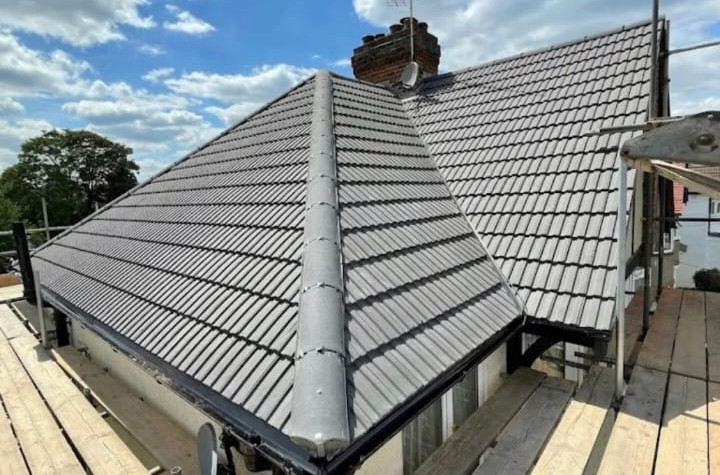
Well over a third of the town went up between 1945 and 1982, mostly concrete interlocking tile, and the tile outlives what holds it down. What finishes these roofs is nail fatigue, soft batten ends and underlay that tears as soon as you touch it. The covering comes off, soft rafter feet are replaced, and it goes back on breathable membrane and treated battens with a matched tile. Where the mortar bedding has cracked and the tiles are starting to rock, we convert to dry ridge and dry verge screwed onto a ventilated roll, the mechanical fixing BS 5534 expects, which ventilates the roof space along the ridge at the same time.
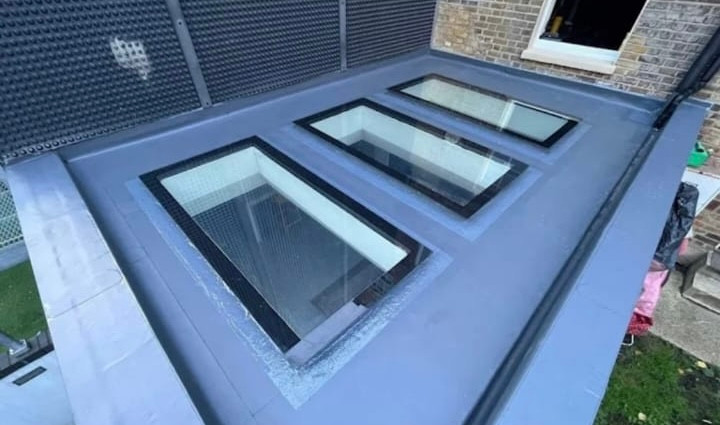
Back additions, dormers, garages and porches in felt, GRP fibreglass or EPDM rubber, all of which last when the deck is sound and the falls, upstands and outlet are right, so we look at the deck first. Chimney flashings, soakers, valleys and abutments go back in code rated lead, cut short enough to move without splitting. Older properties also carry lead lined parapet gutters, hidden from the ground and the most expensive thing here to ignore.
A fair share of the leaks we attend turn out to be a gutter running over or a downpipe discharging into nothing. On a terrace the gutter runs continuously across several houses, so a blockage two doors along is your wet wall. North facing slopes hold the moss and algae that wash down and pack it, and clearing that debris heads off the rotted fascia below.
With the covering off, insulation, eaves ventilation and any condensation problem are far cheaper to sort while the access is already paid for, and Approved Document L sets the standard a renovated roof is expected to reach.
How it runs
From your call to a written price
One team from first visit to last, one person to ring, and an itemised written price: scaffold, strip out, battens and membrane, the covering, each junction and disposal on separate lines, so you can compare it against anyone else's.
Dorset Council handles planning and building control here. On an unlisted house outside the Blandford St Mary and Bryanston Conservation Area, a like for like re-cover, a repair, new rainwater goods and rooflights all sit inside ordinary householder permitted development, within the limits Planning Portal guidance sets out. Inside it, appearance is what is controlled, and with over two hundred listed entries in the town, consent is needed on plenty of addresses whatever the work.
Cost
What decides the price of a roof
Getting to it. In Blandford this decides more of the price than the roof does. A town terrace has no side access, so the scaffold either goes up at the front over a public footway, which the council licences, or the platform is fed through the house. How long it stands matters as much as its size, and the work at height rules are why it is a priced line rather than an extra.
Chimneys, valleys and abutments are priced one at a time. Ask whether the scaffold is in the price, whether battens and membrane are renewed or covered over, and who pays for the skip.
If it is leaking now
Water coming in today
Ring rather than use the form; water coming in goes to the front of the queue. In a terrace they start at the junction with next door, not the middle of the slope. If you are in a flat, ring anyway: major works recharged to leaseholders need consultation under section 20 of the Landlord and Tenant Act 1985 first. The phone is answered 24 hours for emergencies; scheduled work runs Monday to Friday, 8am to 6pm.
Worth knowing
What the conservation area actually stops
Two hundred and nine entries in the parish are listed, and a good part of the town sits inside the Blandford St Mary and Bryanston Conservation Area. Both are misunderstood in the same direction: people assume they cannot touch the roof, then find out afterwards that they could have.
What a conservation area controls is appearance. Repairing a slate roof with slate, or a plain tile roof with plain tile, is maintenance, needs no application, and is what we would be recommending anyway. What cannot happen quietly is a change of material, so it is the slate roof coming back in concrete tile because that quote was cheaper that gets stopped.
A listed building is stricter again, and consent there covers the work itself, repairs included. Send us the address first. We check it against listed building consent before pricing, and where the covering is controlled we price the matched material rather than a cheaper roof you cannot have.
Who you are dealing with
A local firm you can check
Just over fifteen miles up the Stour from us, covering Blandford Forum, Blandford St Mary, Bryanston and the DT11 addresses around them. Bournemouth Roofing & Building Ltd, registered in England and Wales, company number 15471719, which you can look up in a minute. Thomas Hannen's business, and he is the one who comes out to price the job, not a salesman. A verified customer's 10 out of 10 on Checkatrade. The visit and the written quote are both free.
Questions
Blandford Forum questions we get asked
Two hundred listed buildings in town. Is mine likely one?
There are 209 listed entries in Blandford Forum, so it is a fair question. The older centre carries most of them, Ryves Almshouses and the Market Place among them, and if your address is on the list then even reslating in the same material can need consent where it changes the detail. Check the entry before you plan anything. A house on a post war estate will not be on it.
Does the Blandford St Mary and Bryanston area cover my street?
Only part of the town. The Blandford St Mary and Bryanston Conservation Area controls appearance where it applies, which means a like for like re-covering is maintenance but a change of material or profile is not. Dorset Council can tell you in a minute whether your address falls inside the boundary, and it is worth doing before you decide between clay and concrete rather than after.
I rent a flat above a shop. Who sorts the roof?
The freeholder, through whoever manages the building. Flats make up 23.7% of the homes in Blandford Forum, and on every one of them the roof is shared structure, so no single occupier can order work on it. Where a landlord has to consult leaseholders formally about major works, that process runs before anything starts on site. What you can do is report the fault in writing and pass our itemised quote to the agent.
My house fronts straight onto the pavement. Where does scaffold go?
On the pavement, with the council's permission first. Terraced housing is 31.1% of Blandford Forum, so a good share of jobs here have no front garden to stand in and need a licence from Dorset Council for a footway scaffold, usually with a lit walkway underneath. That takes a fortnight or so to come through, which is why we apply as soon as the job is agreed rather than the week before.
What goes wrong on the older slate roofs here?
Nail sickness, mostly. Getting on for a fifth of Blandford Forum was built before 1919, and on a roof of that age the slates themselves can be perfectly sound while the iron nails holding them have rusted through. You get slates slipping in ones and twos across the whole slope with no pattern to it. At that point patching stops working and the covering has to come off and go back on new fixings.
Nearby, and next door
Roofing near Blandford Forum
Roofing nearby
Our other trades in Blandford Forum
Roofing guides
Concrete vs clay roof tiles: which is right? Planning, building regs or listed building consent Storm damage to a roof: the first 24 hoursEverything we do in Blandford Forum Roofing, all areas Every area we cover
Free quote
Get a written price for your Blandford roof
Free site visit, free written itemised quote, and we will tell you honestly whether a repair will do.