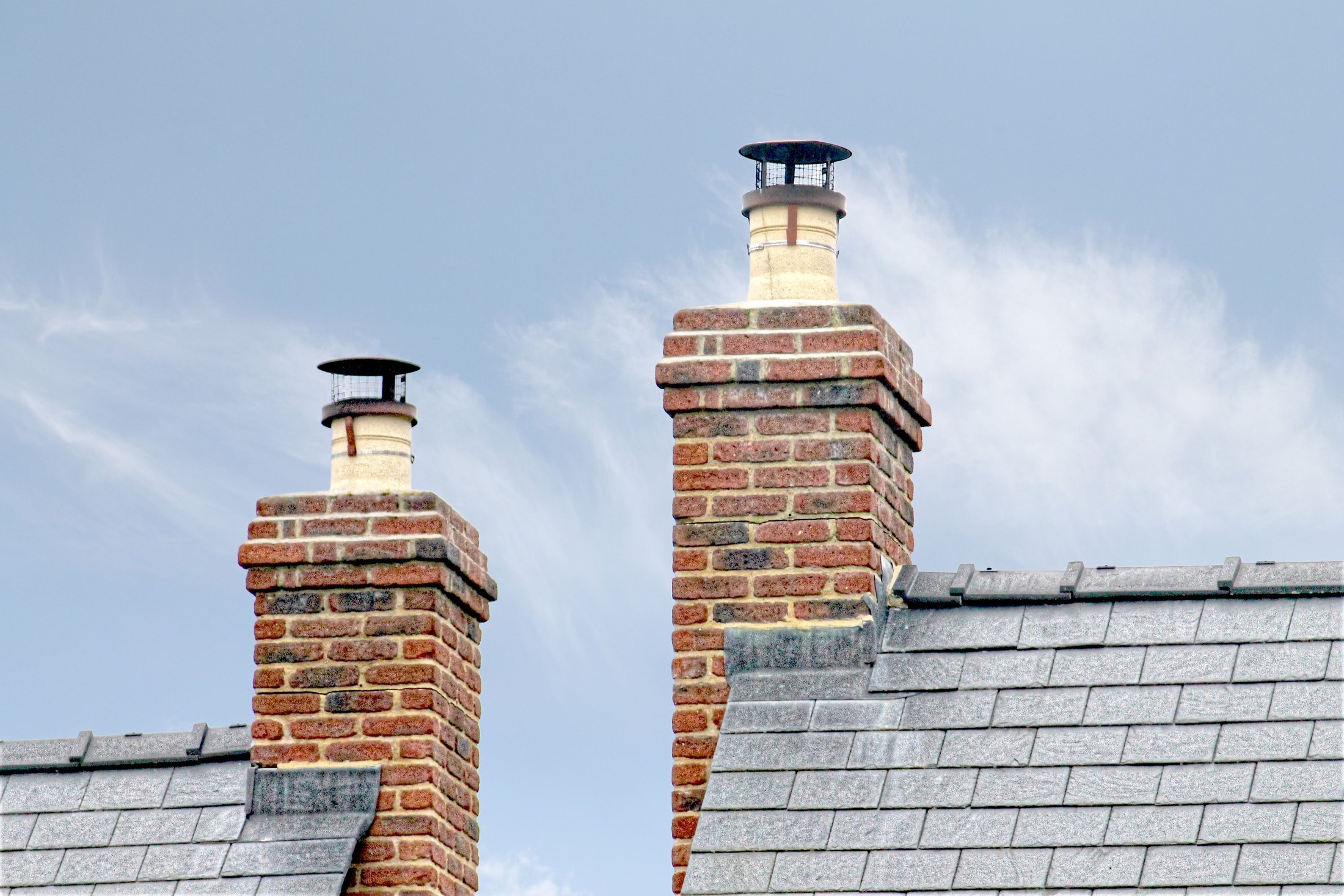
Roofing in Iwerne Minster
Repairs, strip and relay, leadwork and flat roofs on the village's older fabric and on the newer houses off the main road. Free site visit and an itemised written quote.
The site visit is free and so is the written itemised quote. Thomas Hannen prices every job himself.
Two in five houses in Iwerne Minster were built before 1919, so the usual modern answer of stripping a roof and dry fixing the ridge is often the wrong one here. On hand made clay plain tile inside the conservation area we sort and relay what is already up there, and bed the ridge in mortar.
People ring for the ordinary reasons: a tile down the bank after a blow, a damp patch on a bedroom wall beside the chimney, or a roof that has been patched by four different people and now needs somebody to look at the whole of it.
What is different here is the fabric: a village of brick, flint and greensand under steep pitched clay tile and slate, with tall chimneys, deep valleys, forty listed entries and its own conservation area. That changes the repair, not just the paperwork. We get on the roof, look from inside the roof space too, and photograph what we find. About twenty miles up the A350, and the site visit costs nothing.
The work
A plastic verge on a cottage looks like what it is
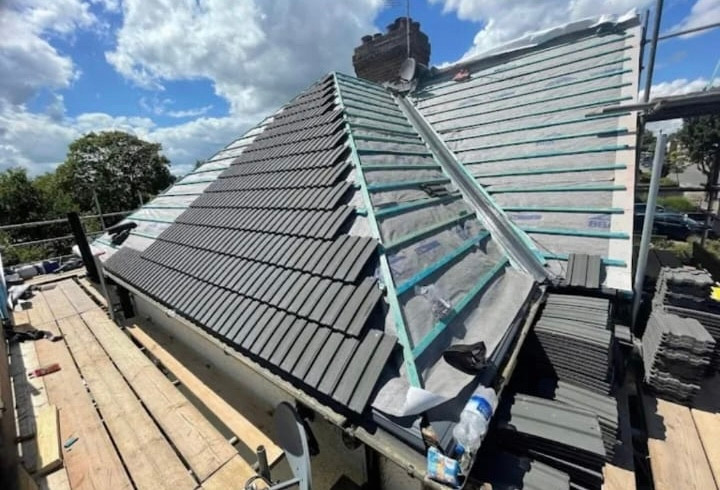
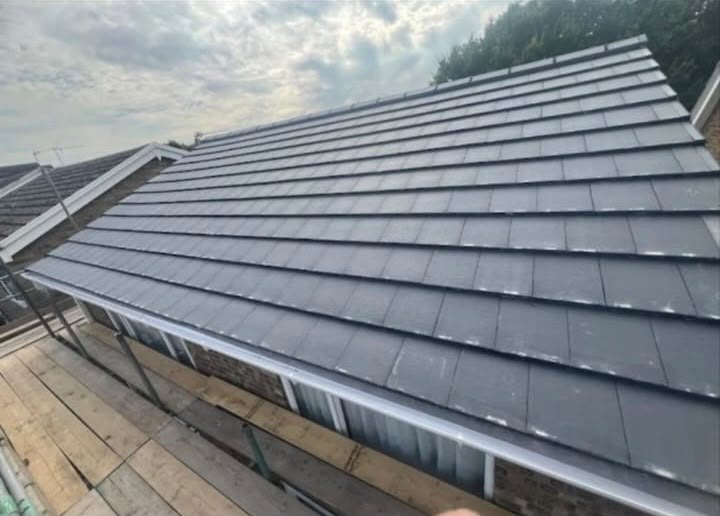
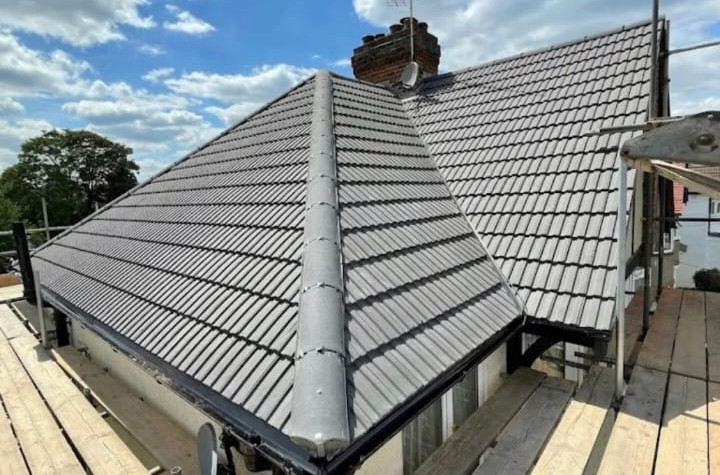
A plastic verge on a cottage looks like what it is. Two in five dwellings here predate 1919, so the ridge and verge question gets answered twice. On the post-war houses off the main street the concrete interlocking tile roofs get a dry ridge and dry verge screwed onto a ventilated roll, the mechanical fixing BS 5534 expects. On a plain tile roof in the conservation area we bed and point in mortar instead, because a plastic dry verge on a cottage of that age looks exactly like what it is. Two details, and we tell you which yours wants. On a nail sick hand made clay plain tile roof the tiles are often better than anything you can buy new: the pegs or nails have gone, not the clay. We lift, sort and put the sound ones back on the elevation that faces the road, and buy in reclaimed tile to make up the shortfall.
Under an old Dorset tile roof there is usually no sarking board and often no underlay at all, just riven battens over open rafters. A relay puts breathable membrane in for the first time, and that has a consequence worth knowing: a roof that used to breathe through every gap now needs eaves ventilation designing into it, or you swap a leak for condensation. Soft rafter feet and batten ends come out at the same time. Old roofs here carry swept and laced valleys in plain tile as well as open lead lined ones, and the two are repaired completely differently. Chimney flashings, soakers and the abutment where a rear addition meets the wall go back in code rated lead, stepped into a raked joint rather than smeared over the brickwork with mastic, and tall chimneys want the flaunching looking at while the access is there.
Thatch, which we do not do. There is thatch in this village and we are not thatchers, so we say so on the phone rather than after we have taken your deposit. Where a cottage is part tiled and part thatched we will look at the tiled half, but the junction is a job to plan with your thatcher, and nobody does hot work within reach of a thatched roof, including a neighbour's. A lot of cast iron rainwater goods survive here and a cracked gutter or downpipe section can be replaced, so it is usually worth repairing rather than ripping off, and the fascia and soffit behind a run that has been overflowing want checking while the access is up. Clearing the leaf debris out each autumn, and the algae off a shaded slope, saves the repair it would otherwise turn into. With the covering off, insulation and eaves ventilation cost far less to deal with, and Approved Document L sets the standard a renovated roof is expected to reach. On a solid walled cottage the ventilation matters more than the thickness of the insulation.
How it runs
From your call to a written price
One team, one person to ring, and an itemised quote you can hold against anyone else's. On permission, people get this backwards in both directions. For an unlisted house inside the conservation area, a like for like re-cover and a rooflight are still ordinary permitted development as long as nothing stands more than 150mm above the roof plane, and there is no application for a repair. What the conservation area controls is appearance, so swapping the covering for something different in colour or material is the part that needs asking about. On any of the forty listed entries in the parish, listed building consent applies to a repair as well as an alteration. Dorset Council for both.
Cost
What decides the price of a roof
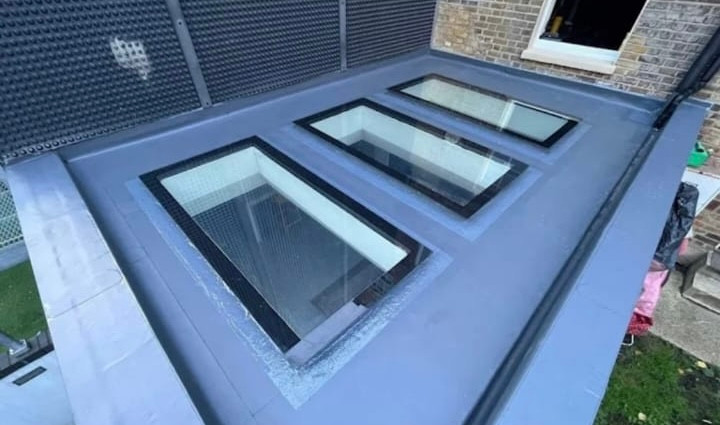
Village frontages here are tight, the lanes are narrow, and a scaffold that has to stand partly on a road or a verge needs arranging rather than assuming. How long it stands matters as much as its size, and the work at height rules are why the platform is a line of its own rather than an optional extra. Chimneys, valleys and abutments are counted one at a time, because that is where the leadwork hours go. Ask whether the scaffold is in the quote, whether battens and membrane are renewed or covered over, and who takes the old tiles away.
If it is leaking now
Water coming in today
Ring rather than use the form. Anything letting water in goes to the front of the queue, and the first visit makes it safe and watertight. On an old tile roof, do not let anybody seal or foam their way out of a leak, because undoing it is a bigger job than the repair. A slipped or missing tile can be re-hung meanwhile, and storm damage gets sheeted over before anybody talks about a re-roof. The phone is answered 24 hours for emergencies; scheduled work runs Monday to Friday, 8am to 6pm.
Worth knowing
Two in five houses here predate 1919
That single figure changes more about a roof than any planning line does. Pre-1919 walls are solid and they have to breathe, so the roof over them is not a sealed box: the eaves, the ridge and the wall head all have to let moisture out or it ends up in the plaster.
It is why we are careful about wrapping an old roof tightly in a modern membrane without designing ventilation to go with it, and why we point in lime rather than a hard cement mortar on old brickwork and flint, so the mortar stays softer than what it sits against.
It also changes what materials cost and how long a job takes. Matched hand made tile and natural slate come from a reclaim yard rather than a builders merchant, and that is a lead time rather than a delay. Sorting salvaged tile by hand takes labour that a modern strip and re-cover does not. We would rather price that honestly at the start than find it halfway up a roof.
Who you are dealing with
A local firm you can check
About twenty miles up the A350, covering Iwerne Minster, Iwerne Courtney, Fontmell Magna and the DT11 villages either side of the main road. Dorset Council for planning and building control. Bournemouth Roofing & Building Ltd, registered in England and Wales, company number 15471719, which you can look up in a minute. Thomas Hannen's business, and he is the one who comes out to price the job, not a salesman. A verified customer's 10 out of 10 on Checkatrade. The visit and the written quote are both free.
Questions
Iwerne Minster questions we get asked
Will the conservation area force me to reuse the same tiles?
It pushes hard in that direction. The Iwerne Minster Conservation Area controls appearance, so taking a covering off and putting the same thing back is maintenance, while moving to a different material or profile alters the look of the village and is treated as a change. In practice that means salvaging whatever is worth salvaging and matching the rest as closely as supply allows. We set the sound tiles aside on the scaffold as they come off.
Most of the village is pre-1900. What does that change?
Mortar, mainly, and the pace of the strip. With 39.6 per cent of the housing here predating 1919 and the pre-1900 slice alone at 38.4 per cent, we are usually working on soft brick, stone and lime, none of which take kindly to a hard cement mix. Fixings go into old timber that has to be checked rather than assumed sound. Stripping is slower because the tiles are worth keeping, and that time goes on the quote rather than turning up later.
There are listed cottages either side of us. Does that matter?
Only for their roofs, not for yours. Iwerne Minster has 40 listed entries including the Church of St Mary and The Chantry, and listing attaches to the building itself, so a neighbour's status puts no control on your covering. What does apply to you is the conservation area over the village as a whole. Where the neighbours do come into it is access, because a scaffold or skip against a listed boundary wall needs agreeing first.
Does the Cranborne Chase designation affect a roof?
It affects what can be seen from the surrounding downland rather than the fabric itself. Iwerne Minster sits within the Cranborne Chase and West Wiltshire Downs landscape, so a solar array, a large dormer or a bright new covering on a prominent slope attracts design scrutiny that a like for like repair never sees. If panels are part of the plan, ask the council before the roof goes back on rather than after it is finished.
Is Iwerne Minster too far out for a small repair?
No. It is 19.9 miles from our base, which is a straight run rather than an awkward trip, and we will still come out for a slipped tile or a leaking valley. What we ask is that you tell us everything needing attention while we are there, because a second journey for something remembered afterwards helps nobody. The site visit and the written itemised quote cost you nothing either way, however small the job turns out to be.
Nearby, and next door
Roofing near Iwerne Minster
Roofing nearby
Our other trades in Iwerne Minster
Roofing guides
Concrete vs clay roof tiles: which is right? Planning, building regs or listed building consent Storm damage to a roof: the first 24 hoursEverything we do in Blandford Forum Roofing, all areas Every area we cover
Free quote
A written price for your Iwerne Minster roof
Tell us the address and what the roof is doing. We check what is listed, look at the whole roof, and put a price in writing.