Insulation in Iwerne Minster
Loft top-ups, rafter level board work and honest advice on what your roof space can take, surveyed before it is priced.
The site visit is free and so is the written itemised quote. Thomas Hannen prices every job himself.
Almost every loft in Iwerne Minster already has something in it, so the honest answer for most houses here is a top-up laid over the joists rather than a fresh start. The free site visit is where we put a rule in what is already up there, look at how the roof breathes, and tell you whether topping up is enough or whether the old material has to come out first.
People ring us here for three reasons. A bedroom that will not hold heat once the wind gets up, usually one under a sloping ceiling. A loft that has gone damp at the edges, with black spotting on the underside of the boards and wet felt where the roof meets the wall. Or a house that has just changed hands and the survey has said the insulation is thin, which it almost always is.
All three come back to one question: whether the roof space can still breathe once you make it colder. Insulation keeps heat below the ceiling, so the roof above stops being warmed, and anything that was drying out on borrowed heat stops drying. Get that wrong and you swap a cold room for a damp one.
So we survey before we price: what is in there, how deep it really is, whether the eaves are clear, where the pipework and the tank sit, and what the ceilings below are made of. Then you get a written itemised quote with the method on it as well as the number.
The work
Plenty of these roofs have nothing under the tiles
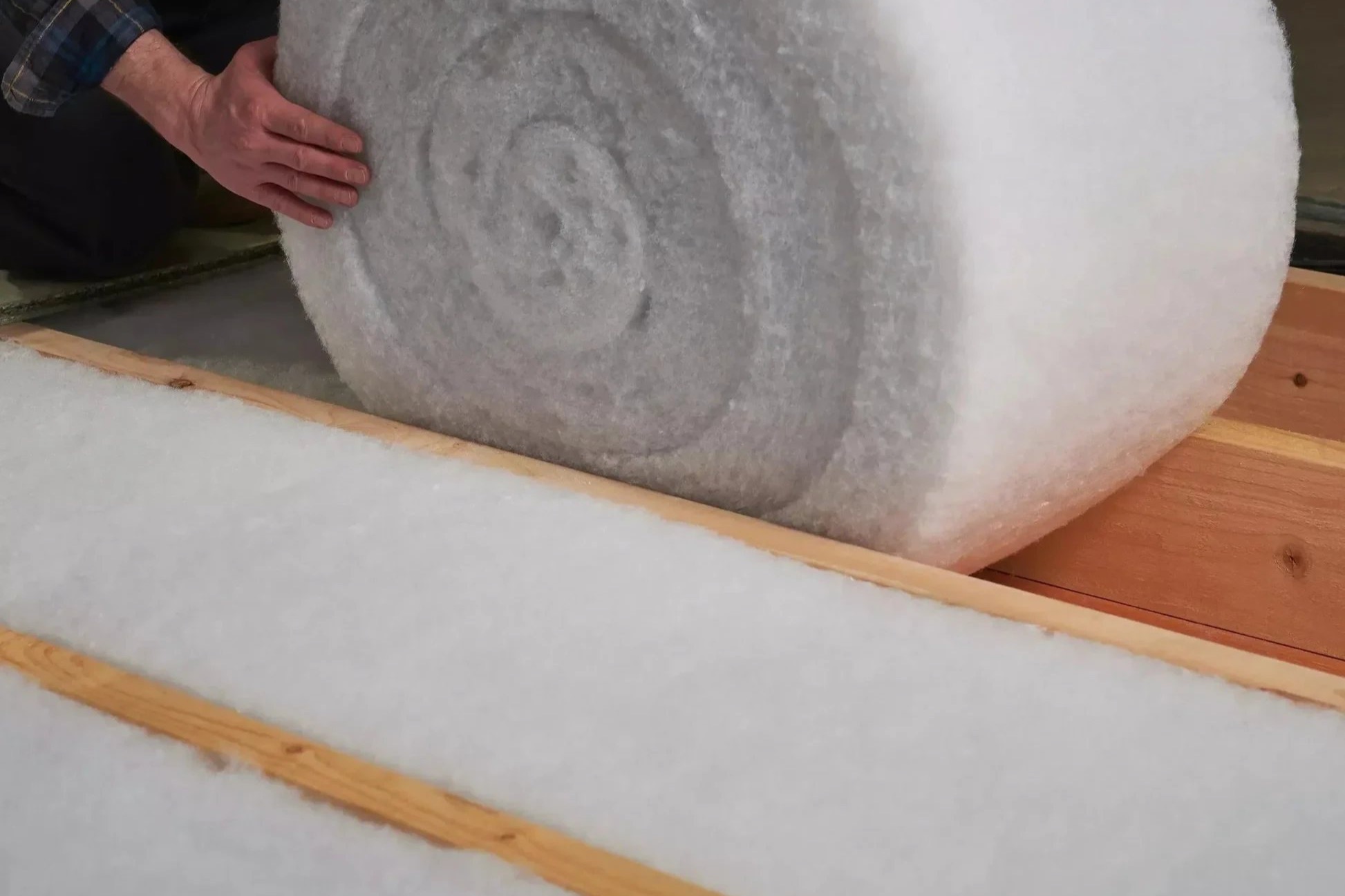
Topping up a loft over shallow joists. Nearly two in five dwellings in Iwerne Minster predate 1919, and on those cottages the ceiling joists are shallower than anything in a modern build, and often not evenly spaced. Filling between them and stopping there leaves you well short, and it leaves every joist working as a cold bridge straight through the layer. It goes in between and over: the first layer between the timbers, the second run across them at right angles so the joists disappear underneath it. Around 270mm of mineral wool eco roll is what it takes to bring a ceiling to the u-value of about 0.16 that Approved Document L expects when you renovate a roof.
Roofs with nothing under the tiles. A good many of the pre-war roofs in the village were never felted, so the underside of the tile or slate is what you are looking at from the loft. Those roof spaces have always been draughty, which is why they have got away with thin insulation for a century. Lay full depth in one and the air up there gets colder and wetter at the same time, so we keep the eaves clear with vent trays, check there is a way for air to cross the space, and never let the roll run out over the wall plate and choke the gap.
Under the oldest ceilings there is lime pushed through riven lath, which will carry insulation but not people and not a boarded floor. We work off crawl boards and keep the load light, and if you want storage it goes on a raised deck carried on legs off the joists rather than squashed down on the quilt. Compressed material stops working, and it is the single most common fault we find in a loft that has already been done once.
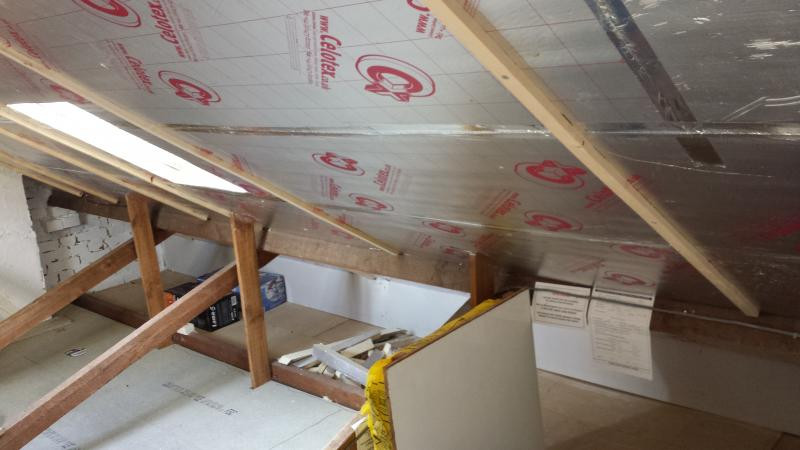
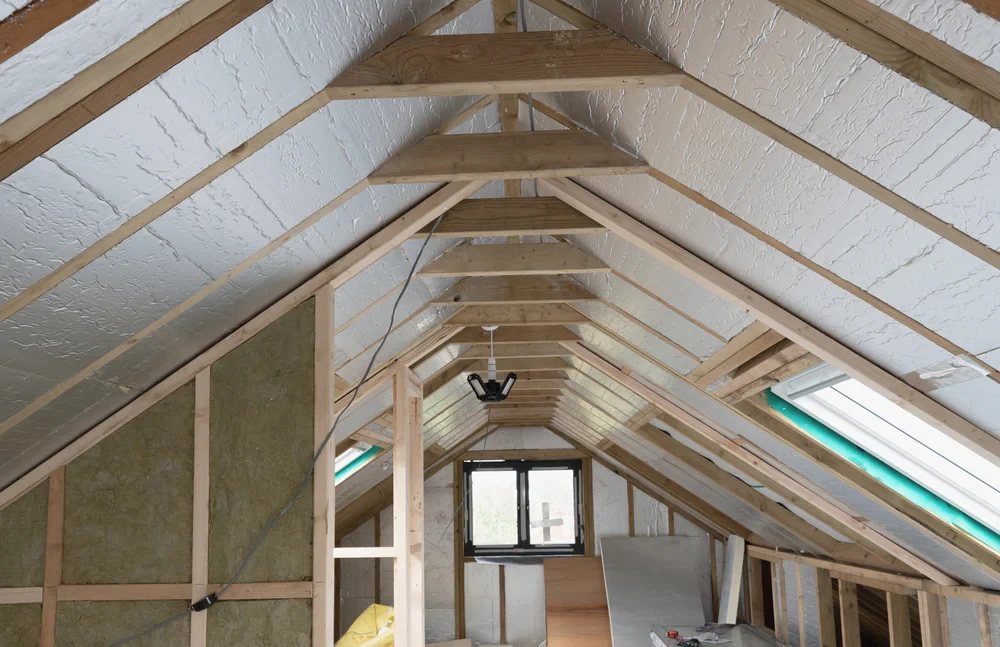
Several of the bigger detached houses here have a converted attic or a dormer, and there is no loft to lay a roll in, so it is rigid board work: PIR such as Celotex between the rafters with an air gap kept behind it, then a foil faced board under the rafters, or a multi-layer product like TLX where the depth simply is not there. Solid stone and brick walls have no cavity to fill, so the choice is internal wall insulation on the room face or external wall insulation, and in a conservation area with forty listed entries that decision is usually made for you. The post-war houses get a borescope before anyone quotes a fill.
How it runs
From your call to a written price
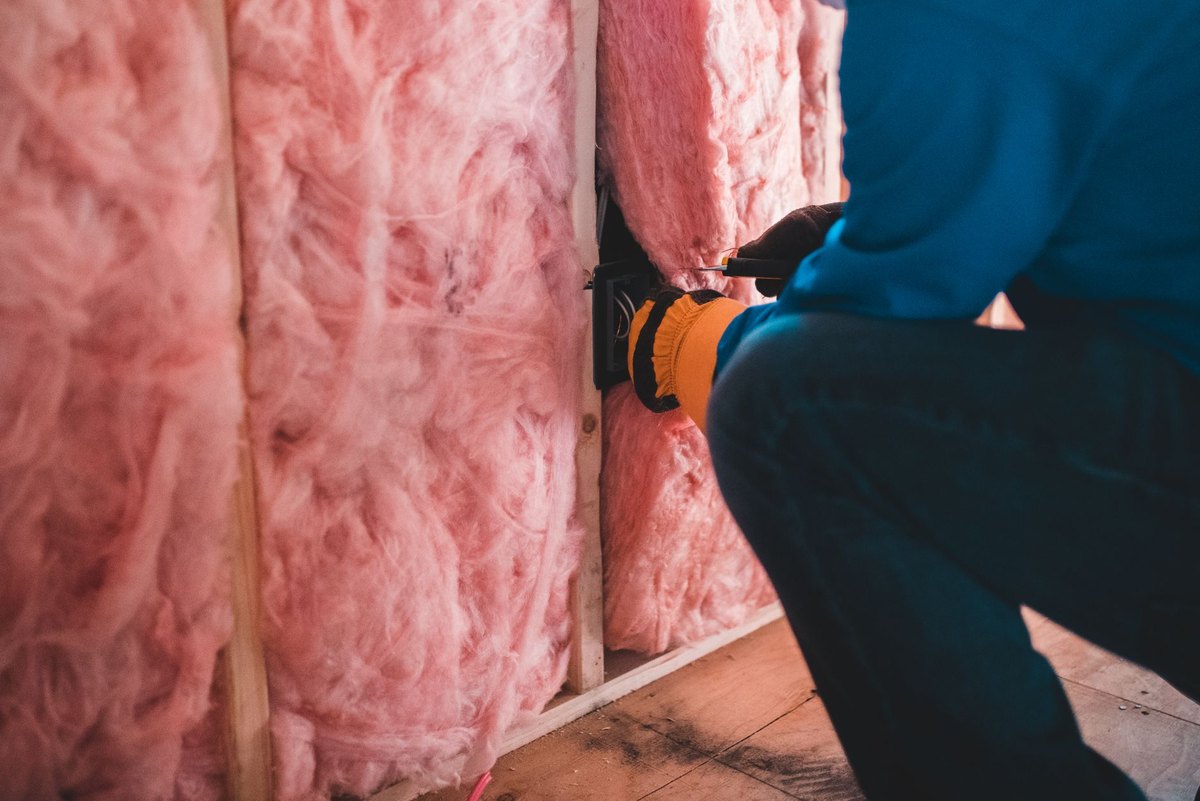
One team, one person to ring, nothing sub-contracted out. The quote is itemised line by line: survey, clearing, material and depth, ventilation and disposal. What comes out leaves with us. Insulating a loft or a wall is an improvement rather than development, so it sits inside permitted development, which is what the Planning Portal's insulation guidance says too. Building control comes in when a thermal element is renovated or a loft becomes a room. Iwerne Minster has its own conservation area and around forty listed entries, the Church of St Mary among them, so anything changing the outside face of a wall wants checking with Dorset Council first, and listed building consent can reach further into a building than people expect.
Cost
What decides the price of an insulation job
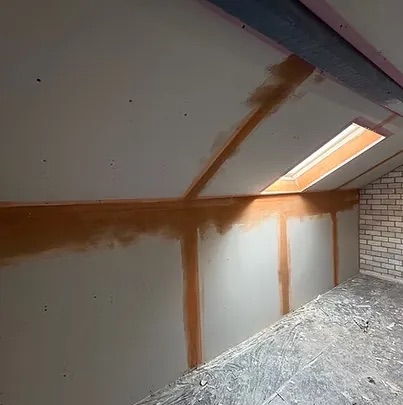
The area is the easy part, so there is no rate per square metre. What sets the price is everything around it. A stone cottage with the hatch over a narrow landing, a bungalow with a hip end and no room to work at the eaves, and a detached house with a boarded loft full of storage are three different days before any material is bought. Old material has to be bagged and taken away first. Approved Document L sets what the work is expected to reach. Ask what finished depth is being laid, and whether the eaves, the hatch and the tank are in it.
If it is urgent
Damp, condensation or a room you cannot heat
Ring rather than use the form. A loft dripping with condensation, or a room that will not hold heat before a cold snap, gets looked at quickly. Iwerne Minster is the far side of Blandford for us, so you get a straight answer on the phone about which day we can be there rather than a promised hour we would miss. The phone is answered 24 hours for emergencies; scheduled work runs Monday to Friday, 8am to 6pm.
Worth knowing
No gas main, so the fabric matters more here
A large share of the houses in and around the village are heated on oil or on electricity rather than mains gas. That does not change how we insulate anything. It changes the order you do things in. When you buy heat by the tankful, every draught and every thin ceiling is going out through the roof on a fuel you had to order in advance, and the loft is the part of the system you fix once and stop thinking about.
If a heat pump is anywhere on your list, do the fabric first: the size of the unit is set by how much heat the house loses, so insulating afterwards means paying for capacity you did not need. HMRC sets out how VAT on energy saving materials are treated.
Oil also puts things in the loft that a gas house does not have. Feed pipes cross cold roof spaces to reach a boiler in an outbuilding, and once a proper depth of quilt goes down the air above it is genuinely cold rather than merely chilly, so anything left unlagged up there is more likely to freeze than it was before the work.
A cold water tank should sit on an uninsulated patch so a little warmth still reaches it from below, be lagged on the sides and lid, and never be buried. Ask anyone quoting whether the pipework and the tank are in the price.
Who you are dealing with
A local firm you can check
We cover Iwerne Minster, Fontmell Magna and the Iwerne valley villages, down through Stourpaine to Blandford Forum on DT11, and Dorset Council is the planning and building control authority for this address. Bournemouth Roofing & Building Ltd, registered in England and Wales, company number 15471719, which you can look up in a minute. Thomas Hannen's business, and he is the one who comes out to price the job, not a salesman. A verified customer's 10 out of 10 on Checkatrade. The visit and the written quote are both free.
Questions
Iwerne Minster questions we get asked
Most of the village predates 1900. Can the walls be insulated?
Only with materials that let water out again. Nearly 40% of Iwerne Minster was built before 1919 and those walls are solid, often rubble filled, and they rely on evaporating moisture back through the surface. Anything with a plastic skin traps that water against the inside face. Wood fibre bedded in lime works where cement does not. Before any of it, get the roof space and the chimney draughts sorted.
Does the conservation area cover ordinary houses in the village?
It covers the whole designated area, not just the grand ones. Inside the Iwerne Minster Conservation Area what is controlled is appearance, so a swap of roof covering, new rooflights or a change of render finish all get looked at by Dorset Council. Work between joists or behind an internal wall lining changes nothing you can see from the lane and needs no application.
We are on oil and storage heaters. Which comes first?
The ceiling, every time. Oil runs 43.3% of homes in Iwerne Minster and electricity another 12.3%, which is a lot of houses buying heat they cannot easily turn down room by room. Improving the roof space narrows the gap between the rooms you heat and the ones you do not. Then draught proof the chimney and the sashes, which in a house of this age leak more than the walls.
Our house is listed. Does that rule insulation out?
It rules out some methods, not the job. Iwerne Minster has 40 listed entries, the Church of St Mary and The Chantry among them, and on a listed house the internal plaster, beams and floors usually count as part of the listing. Consent has to be granted before those are touched. Loose material over the joists rarely disturbs anything protected and is generally the first thing agreed.
Is there scrutiny over anything visible on the roof?
There is, because the village sits inside the Cranborne Chase and West Wiltshire Downs landscape designation and anything that reads from a distance gets looked at. Vent tiles, soil pipes and rooflights on a front slope are the usual sticking points. Ventilation for a newly improved roof can nearly always be brought in low at the eaves instead, which keeps the slope clean and avoids the argument.
Nearby, and next door
Insulation near Iwerne Minster
Insulation nearby
Our other trades in Iwerne Minster
Everything we do in Blandford Forum Insulation, all areas Every area we cover
Free quote
Find out what is actually up there
A free site visit in Iwerne Minster, a rule in the existing material, and a written itemised quote with the method on it as well as the number.