Roofers in Ferndown
Roofing, insulation, brickwork and repointing, plastering and rendering, driveways and patios, and exterior cleaning. Ferndown is a town of post-war estates, and a great many of their roofs are now at the age where the decision is replacement rather than repair.
The site visit is free and so is the written itemised quote. Thomas Hannen prices every job himself.
Ferndown, Dorset
A town of roofs that all went on at roughly the same time
Most of Ferndown was roofed in concrete interlocking tiles between the 1960s and the 1990s, and forty to sixty years is roughly the serviceable life of that tile. A large slice of the town's housing is sitting inside that window now, which is why the work here is weighted towards full re-roofs and loft upgrades rather than the delicate material matching the older towns nearby need.
Ferndown grew hard from the 1960s through to the 1990s, and it grew in detached houses and bungalows on generous plots. Almost all of them were roofed in concrete interlocking tiles.
That gives the town an unusual profile from a roofer's point of view. In an older place the roofs fail one at a time over a century. Here whole streets went up within a few years of each other, on the same covering, and they are now arriving at the same point together. Forty to sixty years is roughly the serviceable life of a concrete interlocking tile, and a large slice of Ferndown's housing is sitting inside that window right now.
So the work here skews differently from the period towns nearby. Less delicate matching of handmade materials, far more full re-roofs, and a lot of loft insulation upgrades on houses that were built long before anyone was serious about heat loss. Wide, shallow-pitched bungalow roofs make the re-roof bigger than people expect for a single-storey house.
Worth knowing before you compare quotes: a modern re-roof is fixed to a different standard from the roof it replaces. The British Standard code of practice for slating and tiling, BS 5534:2014+A2:2018, requires far more mechanical fixing than was normal when these estates went up, which is why a new covering carries more nails and clips and why ridges and verges are usually dry-fixed rather than bedded in mortar.
We cover Ferndown and the surrounding villages, across the BH22 postcodes: West Parley, Longham, Stapehill, Tricketts Cross, Dudsbury and out towards Hampreston. Ferndown sits under Dorset Council, so building control and any planning question goes there rather than to BCP.
The Ferndown roof, explained
Why a concrete tile roof runs out of road
Nothing dramatic happens. A concrete tile roof does not fail in a storm, it wears out quietly and then fails in a storm.
The tile surface goes
A concrete interlocking tile is a moulded sand-and-cement unit with a coloured surface layer that does the weathering. Decades of rain, frost and sun erode that layer away, the colour fades to a pale grey, and the body underneath is left exposed.
The tile starts drinking
Once the surface has eroded the tile becomes porous. It absorbs water instead of shedding it, gets noticeably heavier when saturated, and frost then works on the wet face until it flakes and delaminates. Grit in the gutters is the giveaway.
The felt tears
Under the battens sits bitumen sarking felt, and on a roof of this age it is usually the first thing to have failed. It goes brittle, sags in the rafter bays and tears along the batten lines, so the rain and snow that always gets past interlocking tiles no longer has anything catching it.
The fixings follow
Nails corrode and battens dry out, so tiles start slipping in ones and twos across the whole roof rather than in one place. That pattern is the clearest sign that the roof is finished as a system, not damaged in a spot.
What we do here
Every trade on a post-war estate
Everything on a house of this age tends to come due at once, which is worth knowing before you plan the work.
Roofing
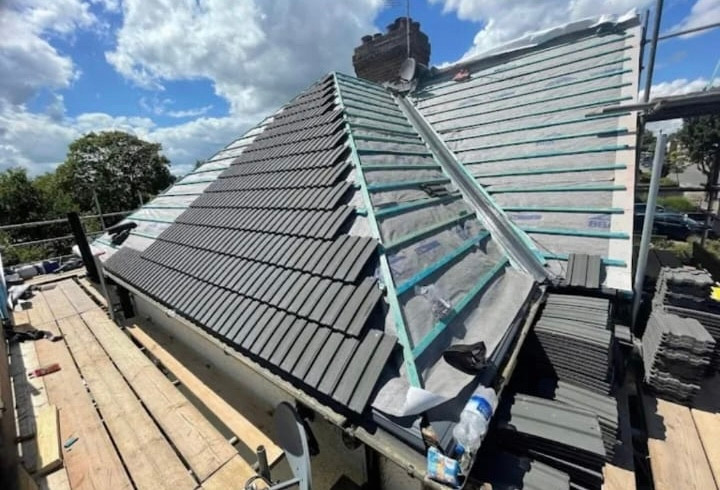
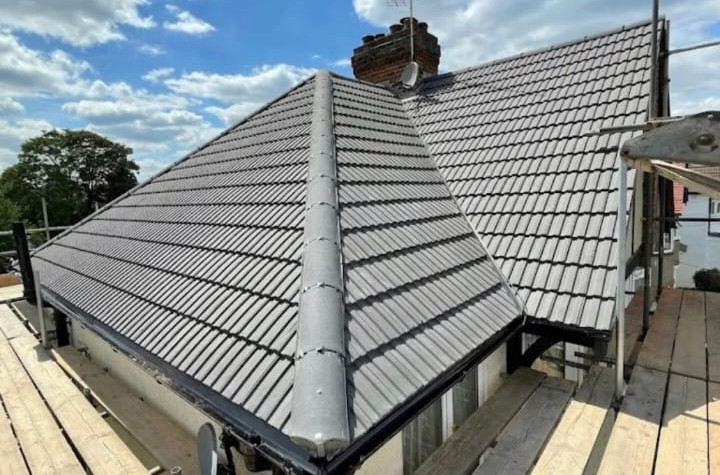
Most of what we do in Ferndown is full re-roofing: strip the tired concrete tiles, replace any battens and timbers that have gone, and re-cover with breathable membrane, treated battens and a new tile. Mortar-bedded ridges and hips from that era are usually cracked and lifting by now, so they get re-formed as a dry-fix system that does not rely on mortar staying intact.
Roofing servicesInsulation
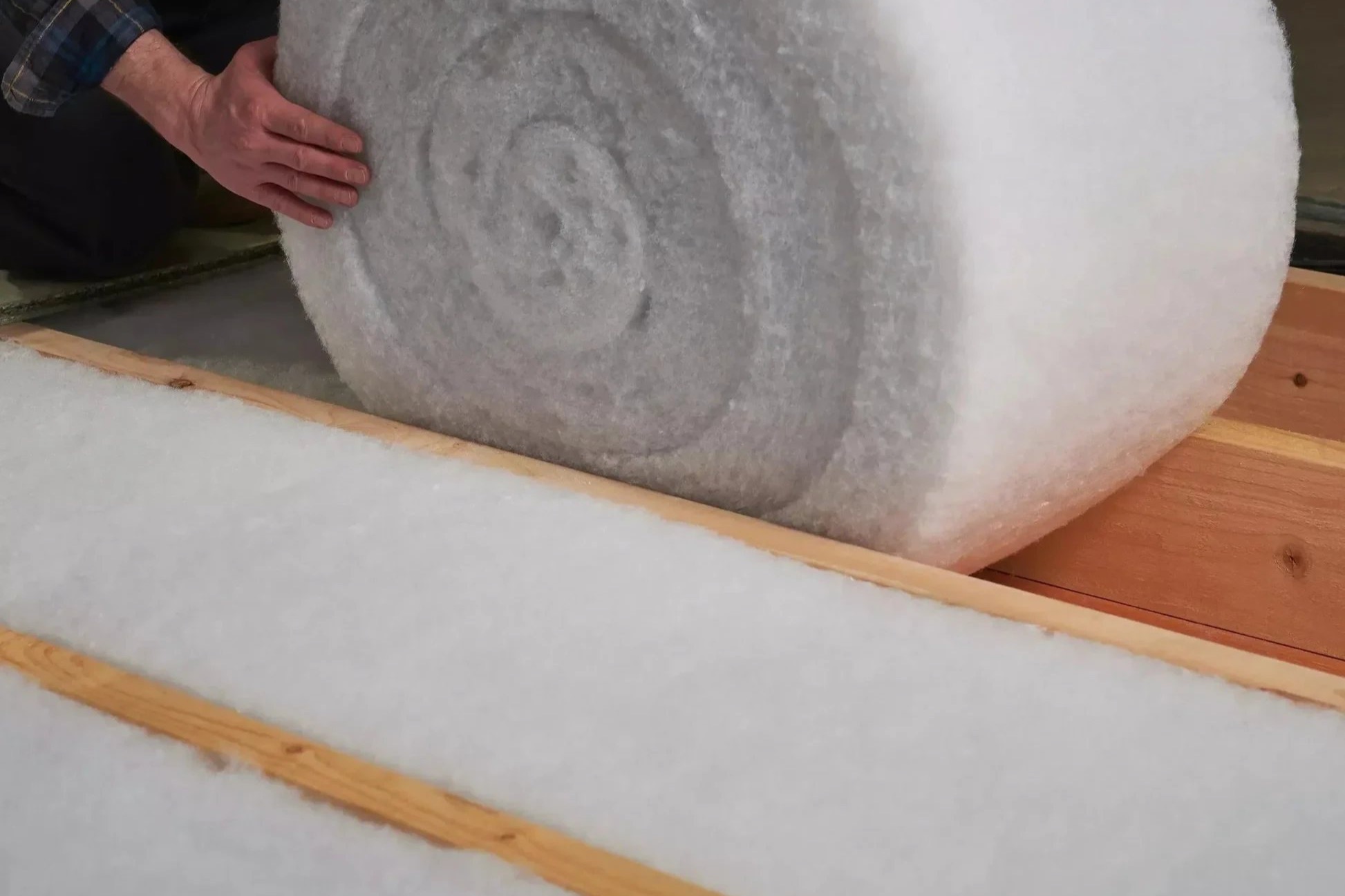
Houses from the sixties, seventies and eighties were built to far weaker thermal standards than anything going up now, and the insulation we find in those lofts is usually old, thin, patchy or squashed flat under boarding. Re-roofing is the obvious moment to fix it, because the access is already paid for and the roof is open.
Insulation servicesBricklaying & repointing
Cavity-wall brickwork of this period is a completely different animal from the soft historic brick you get in the older towns, and it takes a conventional mortar rather than lime. The jobs that come up are exposed gable ends, chimney stacks that never get looked at, and 1970s garden and boundary walls that have started to lean.
Bricklaying & repointingPlastering & rendering
Once a leak has been running through a bungalow ceiling for a winter the plaster rarely comes back, so re-skimming ceilings and patching walls often follows the roof job. Textured ceilings and dated finishes from the same era get overboarded and skimmed flat, and tired pebbledash gets re-rendered.
Plastering & renderingDriveways & patios
The plots here are generous and the original drives are the same age as the roofs, so cracked concrete, sunken slabs and tarmac that has gone to gravel are common. Block paving, resin and porcelain all suit these frontages, and a re-roof is a sensible time to do it because heavy traffic and skips have finished with the drive by then.
Driveways & patiosExterior cleaning
Worn concrete tiles hold moss beautifully, and a wide shallow-pitched bungalow roof gives it plenty of room to sit and hold water in the tile laps. Cleaning and a biocide treatment buys a sound roof time, but it will not rescue a porous one, and we will tell you which of those you have before you spend anything.
Exterior cleaningWhile the roof is off
The loft is the other half of the job
A re-roof stops water getting in. It does nothing on its own about heat getting out, and on a house of this vintage that is usually where the money is going. Lofts here were insulated to whatever was normal at the time and then largely forgotten about.
What we typically find: insulation laid between the joists only and never topped up across them, so every joist is a cold line straight through the layer. Boarding screwed straight down onto the insulation, crushing it flat where the previous owner wanted storage. Gaps around the hatch, the tank and the downlighters. And ventilation at the eaves that has been blocked by the insulation being pushed too far into the corner.
Doing it during a re-roof is simply cheaper and cleaner than doing it later, and it lets us deal with airflow and insulation together rather than solving one and creating a condensation problem with the other. We specify what suits your loft after looking at it, not from a page like this one.
There is a regulatory reason to do the two together as well. Where more than half of a roof is being renovated, the whole element has to be brought up to standard so far as that is feasible, and Approved Document L gives that standard for a roof as a U-value of 0.16 W/(m²·K), with 250 mm of mineral fibre as its own worked example for a cold loft. On a 1970s Ferndown bungalow with a thin single layer between the joists, that is a long way from where the loft currently is.
Worth checking
Signs a concrete tile roof has reached the end
One of these on its own means a repair. Several of them together usually means the covering is done as a system.
- Tiles that have lost their colour and gone pale grey with a rough, sandy face
- Flaking or delaminating tile faces, with grit collecting in the gutters
- Tiles slipping in ones and twos all over the roof rather than in one place
- Torn, sagging or daylight-showing felt visible from inside the loft
- Cracked mortar along the ridge and hips, or ridge tiles that rock when touched
- Damp or staining in the loft after driving rain, with no tile actually missing
Questions
Ferndown questions we get asked
My roof is about fifty years old but nothing has fallen off. Does it really need replacing?
Not automatically, but it does need looking at properly rather than from the pavement. On a concrete tile roof of that age the question is not whether tiles are missing, it is whether the tiles are still shedding water and whether the felt underneath is still in one piece. We go into the loft as well as onto the roof, and we photograph what we find. If the tiles are sound and the felt is intact, we will tell you it has years left. If the tiles are porous, the nails are going and the felt has torn, patching it is money spent on a countdown.
Can you replace the felt without stripping the whole roof?
No, not properly. The felt sits under the battens, and the battens sit under the tiles, so getting at it means taking the covering off in the order it went on. There are patch methods that involve dressing new material in from below or fitting a support tray at the eaves, and those have their place for a small localised tear. For a whole roof of perished felt, stripping and re-covering is the only honest answer, and it is also the point where you get a breathable membrane and new treated battens for very little extra.
Should we do the loft insulation at the same time as the re-roof?
If you are going to do it at all, yes. The scaffold is already up, the roof is open, the loft is accessible and there is a skip on the drive, so the disruption and the access costs are being paid for once instead of twice. Houses from the sixties, seventies and eighties were built to far weaker thermal standards than anything built today, and a lot of the insulation we find up there is old, thin, compressed under boarding or laid in one direction only. It is also the moment to sort out ventilation, because adding insulation without airflow moves the condensation problem rather than solving it.
We only need part of the roof done. Can you match the existing tiles?
Sometimes. Many of the concrete tile ranges used on Ferndown estates in the sixties and seventies are long discontinued, and current profiles are close rather than identical. Even where a range is still made, a new tile next to a fifty-year-old one will not match on colour because the old one has weathered. Where we can, we lift sound tiles from a less visible elevation and use them on the face that shows, then put the new stock round the back. If a match is genuinely not possible we will say so before you commit, rather than after.
Nearby
Working elsewhere in Dorset
Roofers in Wimborne
A short drive west and the opposite problem: conservation area, listed and period buildings, solid walls that have to breathe, and lime mortar instead of cement.
Wimborne pageAreas we cover
We are based in Bournemouth and travel out from there. Every town we work in is listed on one page, with what is particular about the housing in each.
See the full listTrade by trade
Each trade, written for Ferndown
The same local evidence, read through each trade in turn. Ground conditions decide a driveway, exposure decides a roof, and the age of the housing decides insulation.
- Roofing in Ferndown
- Flat roofing in Ferndown
- Bricklaying and repointing in Ferndown
- Repointing in Ferndown
- Driveways and patios in Ferndown
- Patios in Ferndown
- Plastering and rendering in Ferndown
- Rendering in Ferndown
- Insulation in Ferndown
- Loft insulation in Ferndown
- Wall insulation in Ferndown
- Exterior cleaning in Ferndown
- Gutter cleaning in Ferndown
- Fascias, soffits and guttering in Ferndown
Who you are dealing with
A local firm you can check
Ferndown and the villages around it are ours, across the BH22 postcodes and taking in West Parley, Longham, Stapehill, Tricketts Cross, Dudsbury and Hampreston, all under Dorset Council.
You are dealing with Bournemouth Roofing & Building, the trading name of Bournemouth Roofing & Building Ltd, registered in England and Wales, company number 15471719. That takes a minute to check. Thomas Hannen owns the firm and he prices every job himself, so the person who quotes it is the person answerable for it. One multi-trade team does the work, and none of it is sub-contracted out to somebody you have never met.
There is a verified customer's 10 out of 10 on our Checkatrade profile. The site visit is free and so is the written itemised quote. The phone is answered 24 hours for emergencies, and scheduled work runs Monday to Friday, 8am to 6pm.
Free quote
Find out what your Ferndown roof actually needs
We will get up on it, put our head in the loft, photograph what we find, and give you a clear written price for either the repair or the re-roof.