Roofing and building in Swanage
Roofing, stone and brickwork, repointing, plastering and rendering, insulation, driveways and exterior cleaning across Swanage, Herston, Durlston, New Swanage, Ulwell and Peveril Point. A stone slate town where the commonest repair is the one doing the damage.
The site visit is free and so is the written itemised quote. Thomas Hannen prices every job himself.
Swanage
Pointing a stone slate roof is not protection. It is damage.
If someone has offered to point up your Purbeck stone roof, that is not maintenance. The Swanage conservation area appraisal records that Purbeck stone and slate are the predominant roofing materials here, that most of the stone has been pointed, and that pointing is "a non-traditional treatment harmful to appearance which holds damp."
Historic England gives the reason in a sentence. If the roof is laid to the correct pitch and sufficient head and side laps are applied, pointing will not be necessary to keep the roof weather tight.
A stone slate roof is not sealed. It sheds by overlap and gravity, and dries between showers because air moves through it. Mortar in the joints does not stop water getting in, it stops it getting out. The first sign is a rafter end gone soft under a roof that looks sound from the pavement.
The traditional treatments here are torching and mossing. Never combine pointing with torching, because together they form a wick that draws water into the joint and holds it.
The rest is geometry. Never alter the pitch. Keep the head lap to no more than a third of the slate length and the side lap at 75 mm or more. Respect the diminishing courses, large slates at the eaves getting smaller towards the ridge. Historic England also warns about unbalancing the rafter loading if stone stays on one slope and something lighter goes on the other.
What we will not pretend to know
We will not quote a weight per square metre for Purbeck slate. The Stone Roofing Association's own table for Purbeck reads that it is still being checked, and comparable English limestones run roughly 80 to 140 kg per square metre, which is a range rather than an answer. There is no published Purbeck minimum pitch either, which is why the rule is to keep the pitch you have.
Materials
Purbeck stone, not Portland stone, and brick dug a mile from your door
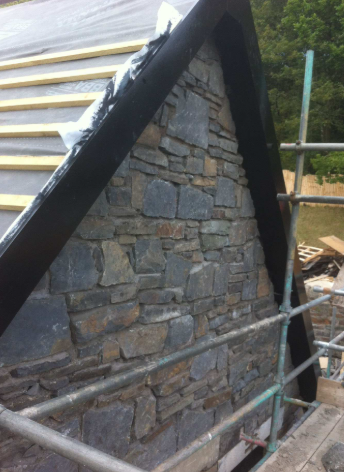
Almost everything a Swanage repair needs is still made within a few miles of the town. Purbeck stone is quarried two to four miles away. Haysom Purbeck Stone works at Langton Matravers, BH19 3JP, and Lovell Purbeck works the same beds. Nowhere else on our patch has that, and it changes what matching costs.
The brick is as local. Swanage Brickworks on Brickyard Lane, now an Ibstock works, has run since at least 1865 and still makes brick by hand from Wealden clay dug in the north of the town. Two hundred thousand went into Lambeth Palace Library, which took the Brick Development Association's top award in January 2022. A house here can be repaired in brick from clay dug a mile away.
Three details that get lost
- The ridge is often clay, not stone. The Herston appraisal records stone roofs here commonly ridged with clay tiles. A clay ridge on a stone roof is not a 1970s bodge.
- Easing courses mix the two on purpose. At 100 to 104 High Street a roof combines tile and stone in an easing course. Re-lay it in one material and that is gone.
- The substitutes are named, and they are not liked. The appraisal calls modern synthetic or reconstituted stone tiles a cheap alternative, and plain or interlocking concrete tiles a more modern and intrusive feature. That is the language a planning officer will use back at you.
Not everything on a Swanage frontage came from Purbeck
George Burt shipped stone to London and brought London back as ballast in the returning barges. The Town Hall frontage is the 1670 facade of the Mercers' Hall by Edward Jerman, re-erected here in 1882 and 1883, and Purbeck House of 1875 has London fragments in it. A repair here can involve stone that is neither local nor in any catalogue.
The appraisal is as direct about wall pointing, and it is the opposite of what most people are sold: "Raised strap pointing in hard cement mortar accelerates erosion of the stone surface. A flush pointing on stonework using non-hydraulic lime mortar coloured with stone dust is more traditional." There are finished examples in our recent projects
The ground
Two houses a few hundred metres apart, sitting on two different grounds
The British Geological Survey's own summary is that Swanage town itself sits on soft clays of the Wealden Group, while to the south are hard limestones of the Purbeck Group. The Purbeck Monocline is why. The strata are tipped steeply, in places to vertical, and the chalk at Ballard Down dips at 60 to 90 degrees. Cross 2.5 km of town and you cross limestone, clay, greensand and chalk. Two neighbours can sit on different foundation material and neither is wrong.
| Where | Bedrock | On site |
|---|---|---|
| The Square, town centre, station | Wealden Group mudstone | Shrink and swell clay |
| High Street, parish church, Herston, California | Stair Hole Member limestone, Durlston Formation, Purbeck Group | Hard ground, unlike the street below |
| Peveril Point | Peveril Point Member | Steeply dipping beds |
| Ulwell gap | Lower Greensand, with head over it | Superficial cover matters too |
| Ballard Down | Chalk, dipping 60 to 90 degrees | The only chalk, and not under the town |
| Durlston Head | Portland Stone Formation | The only Portland stone here |
Above the bedrock there is alluvium along the Swan Brook valley, beach sand on the seafront and head in the Ulwell gap, and no landslip is mapped under the built-up town. A belt of worked and infilled ground runs west and south through Herston, California and the old Swanage Hill quarries, which is the one to know about before anything needs a foundation or a sub-base. Two corrections: it is the Purbeck Group, not the "Purbeck Limestone Group", and Swanage is not built on chalk.
Radon comes out of the same ground
Swanage is a radon Affected Area, and the level varies sharply across the town. The indicative mapping puts the town and seafront at 3% to 5% of homes above the action level, the ground immediately west at 5% to 10%, the southern side towards Durlston and the quarry belt at 10% to 30%, New Swanage and Ulwell at 1% to 3% and Ballard Down under 1%.
The atlas colours each square kilometre by its highest value, so it overstates as often as it helps, and the definitive answer for one address is a report from ukradon.org. A ground-floor extension or garage conversion in the southern half of town may need a radon barrier under Part C, designed in at the start rather than found at inspection.
Exposure
The bay faces east, so the sheltered reading of the map is the wrong one
Swanage Bay runs from Peveril Point to Handfast Point and it faces east. The Swanage Local Plan says the bay is protected by Peveril Point from major south-westerly storms, and that the town's economic centre is most at risk from easterly storms. The shoreline management plan calls the frontage south-east facing, because south-westerly waves diffract round Durlston Head and Peveril Point and arrive from the south-east. Extreme wave heights run 3 to 4 metres.
A building here looks sheltered on any national exposure map and still takes severe salt and driven rain on its east, south-east and north-east elevations. The elevation needing attention faces the water, not the prevailing wind.
The rainfall confirms it. Swanage gets 852.7 mm a year against a UK average of 1162.7 mm, about 27% below, with 1805.5 hours of sunshine and 14.4 days of air frost against 56 at Hurn. The risk here is intensity, salt and wind, not volume.
Fixings therefore matter more than the covering. BS 5534 requires stainless steel to grade 304 or 316, or silicon bronze, and A4 or 316 is indicated for a C5 marine environment. A roof can be perfect while the nails holding it down have gone, a harder version of what our Poole harbourside page describes. We will not guess at the BS 8104 driving rain exposure zone or the basic wind speed for an address. Those are read off the mapping in Part C or calculated for the site.
Flooding here is overtopping, not a river
The watercourse is the Swan Brook, culverted under Station Road, and it is not what floods the town. The strategic flood risk assessment is explicit: during high tide, storm events and periods of strong easterly winds, the sea walls are overtopped and floodwater reaches the town centre. The Environment Agency's warning areas name the streets, among them Victoria Avenue, Church Hill, Station Road, The Square, Shore Road, High Street and The Parade. Shore Road overtopped on 5 February 2014, and Storm Ciaran on 1 and 2 November 2023 shifted 2.5 tonne temporary barrier blocks across the lower High Street.
Planning
You can re-roof here. You cannot dormer or render.
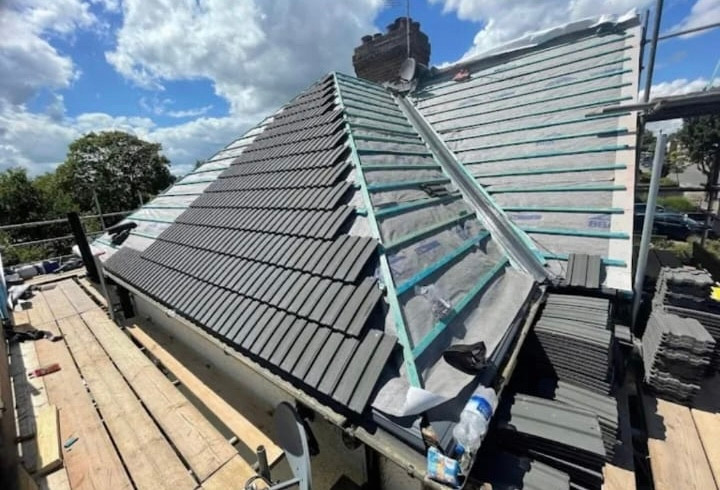
For an unlisted house inside the Swanage or Herston conservation area, re-roofing and rooflights are still permitted development. A dormer is not, and neither is cladding or rendering an elevation. Conservation areas are article 2(3) land, which removes Class B, covering roof extensions such as dormers, and Class A.2, covering cladding and rendering. Class C survives, so re-covering and rooflights are fine provided nothing projects more than 0.15 m beyond the roof plane.
People get this backwards both ways, assuming the conservation area stops a re-roof, and that a dormer is fine because a neighbour has one.
| What you want to do | Permitted | What governs it |
|---|---|---|
| Re-cover the roof, or fit rooflights | Yes | Class C, nothing beyond 0.15 m |
| Add a dormer or raise the roof | No | Class B withdrawn on article 2(3) land |
| Render or clad an elevation | No | Class A.2 withdrawn on article 2(3) land |
| Put up a satellite dish | No | The one area-wide Article 4 Direction |
| Anything to a listed building | No | Listed building consent regardless |
The Article 4 Direction covers satellite dishes and nothing else
That surprises people who expect a tightly controlled town. The area-wide direction was made on 1 September 1989 under Part 1 Class H, and three site-specific ones sit on top of it, at Sea Court on Taunton Road, 10 Cornwall Road and 6 Burlington Road. The appraisal is unhappy about it: "An absence of Article 4 designations has in the past allowed the disfigurement of many properties."
Which leads to the fact shaping everything else. The Swanage conservation area is on Historic England's Heritage at Risk Register, one of only two at risk in Purbeck, and one risk factor listed is unauthorised insensitive alterations of buildings. The controls are light and the area is deteriorating anyway.
Swanage conservation area was designated on 3 April 1970, extended in 1982, altered in 2008 and divided into six character zones. Herston followed on 7 April 1989, both appraisals date from July 2008, and Dorset Council administers them since Purbeck District Council was abolished in April 2019. There are over 150 listed entries in the parish, Historic England listing 156, of which 89 are inside the conservation area.
Two designations that reach past the conservation area
The Dorset National Landscape, designated 1 July 1959, covers the whole town rather than a fringe of it. Purbeck Local Plan Policy H14 only supports new housing there with a principal residence restriction in perpetuity, and that catches conversions and subdivisions too. On Ballard Down, Policy STCD says the area "should continue to support single storey development only", so a loft conversion or roof raise there meets adopted policy first.
Two plans are in play, the Swanage Local Plan adopted 13 June 2017 and the Purbeck Local Plan adopted 18 July 2024. One designation matters less than people expect: the Jurassic Coast World Heritage Site covers the seafront and Peveril only, with no buffer zone in the parish.
Getting there
The ferry stops at 20 tonnes, so the lorry goes round by Corfe
Swanage is 9.1 miles from us in a straight line and a good deal further by road, and we would rather say so at the quote stage than on the morning. The Sandbanks chain ferry toll schedule tops out at "Goods Vehicle 3,500kgs to 20,000kgs". There is no class above 20 tonnes, so a fully loaded tipper, a large grab lorry or an artic cannot cross, whatever the satnav suggests.
Those loads take the long way, roughly 21 miles by the A351 through Wareham and Corfe Castle. That is the only A road in and out of Purbeck, and when it floods at Corfe much of Purbeck is cut off. So we plan Swanage work in fewer, longer visits, with stone, scaffold and skips sequenced so the heavy movements happen once. The crossing itself goes cashless on 1 April 2026, with a car up to 3,500 kg at £6.26.
The road outside your house may not be the council's
The appraisal notes that Cowlease Road is roughly surfaced, and calls this "a characteristic common in the south of Swanage where many privately developed and owned roads remain unadopted by the Highways Authority." Surfacing and access responsibility in south Swanage therefore often sits with residents, not the council. That changes who you speak to before a scaffold, skip or delivery lorry arrives, and who pays to make the surface good afterwards.
The other point is the Purbeck stone pavements. The appraisal warns that patching them with asphalt threatens their long-term survival, so if a crossover disturbs one we price it to be relaid in stone.
The housing stock
Conversions and bungalows, not semis and terraces
Swanage housing does not look like England's, and that changes what a typical job here is. Flats are 38.7% of the stock and detached houses 33.7%, while semis are only 18.6% against 31.5% nationally and terraces 13.9% against 23.0%. Bungalows run 13.5% against 9.1%. And 11.6% of dwellings are conversions, against 5.2% for England, which here means Victorian guest houses cut into flats.
A conversion is a particular thing to work on. Roof, stair and party structures were built for one household and now serve several, so responsibility is shared and the person who calls us is often not the only one who has to agree.
The stock is old at one end and thin at the other: 28.2% predates 1919 against 20.6% for England and Wales, and only 12.6% dates from 2000 onwards. There were 4,512 households in 2021 against 6,020 council tax dwellings, a gap of roughly 1,500 in second homes, holiday lets and vacants. One correction: Swanage runs on mains gas at 77.4%, above the England figure of 74.0%, with 1.6% on oil. It is not off-grid, which matters if you are weighing loft and wall insulation against a heating change.
The appraisal picks out two problems that are ours not to make worse. On windows it records a high incidence of poor quality replacement in PVCu harming the street scene. On front gardens it notes that converted properties are the ones most likely to have lost their walls and gardens to off-road parking, and names loss of enclosure as a problem.
What we do in Swanage
The trades this town needs, in the order it needs them
The roof covering is the town's defining problem, the walls are second, and the ground comes last only because in south Swanage a lot of it is not the council's to dig.
Roofing
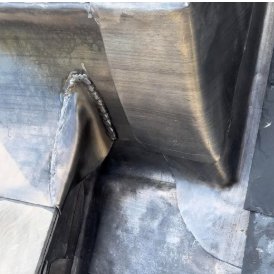
Purbeck stone slate in diminishing courses, clay ridging on stone, easing courses, leadwork and stainless fixings on the seaward elevations. The two jobs asked for most here are the two we most often talk people out of: pointing a stone roof, and replacing a covering that only needs its fixings and flashings sorting.
Roofing servicesStonework, brickwork and repointing
A stone town needs flush lime pointing coloured with stone dust, not raised strap pointing in cement. Where the fabric is brick, the local works still makes handmade brick from clay dug in the north of the town, so matching is a real option rather than a compromise.
Repointing and masonry repairPlastering, rendering and insulation
Rendering an elevation in the conservation area needs planning permission, so that conversation starts before the scaffold. Solid stone and lime walls need to breathe, and a gypsum skim over a wall still carrying damp will blow again.
Plastering and renderingDriveways and patios
The design starts with the ground, and here the ground changes street by street: Wealden clay in the centre, limestone up the hill, worked and infilled ground through Herston and California. Add the unadopted roads in the south and access is often the harder half.
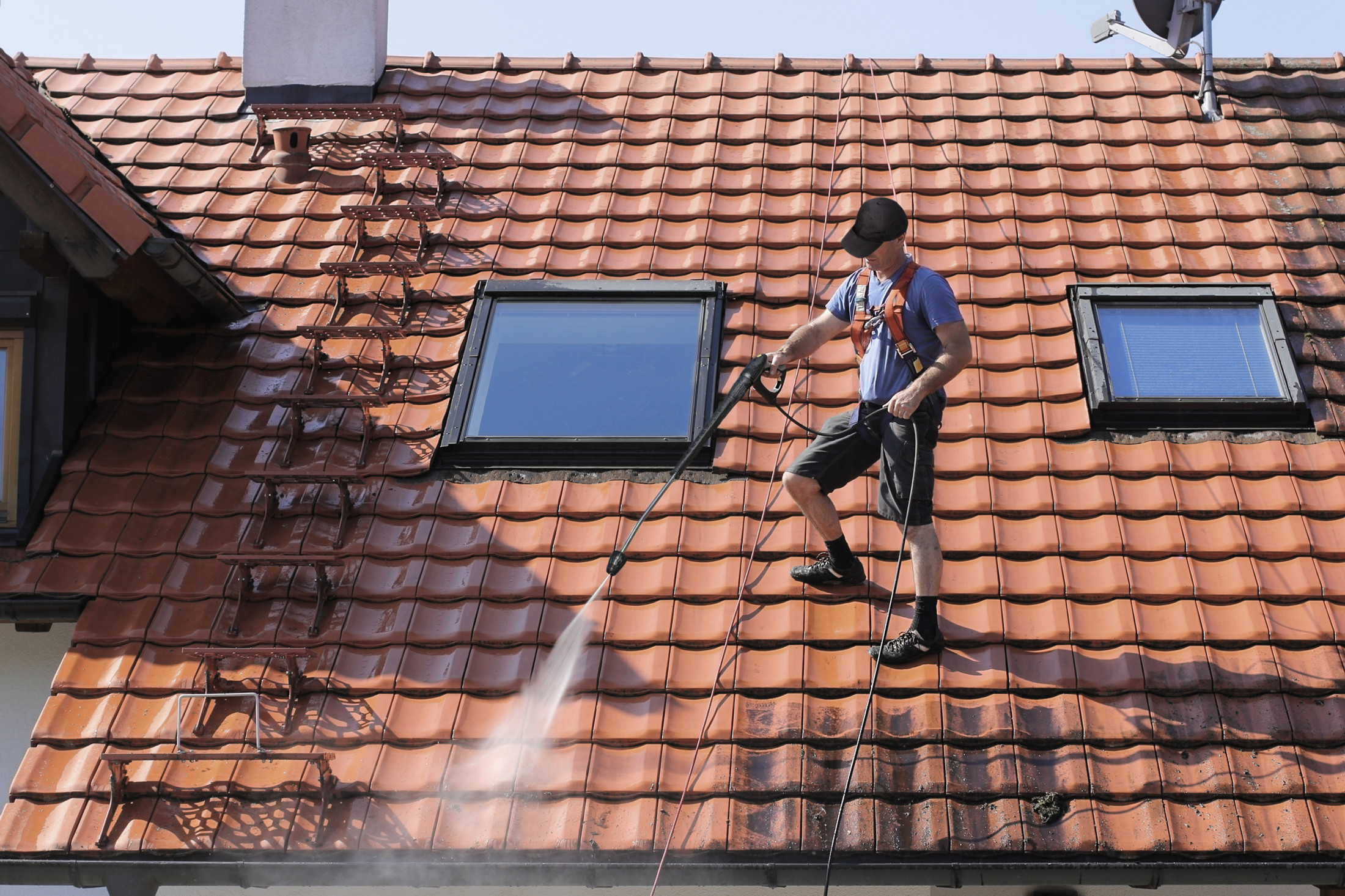
Driveways and patiosWe clean render, paving and roofs too, with one caveat. Mossing is a traditional bedding method on stone slate here, so moss on a Purbeck roof is not automatically a fault, and we do not pressure wash stone slate. Render, concrete tile and paving are a different matter, covered on our exterior cleaning page.
Questions
Questions we get in Swanage and nowhere else
Should I have my Purbeck stone roof pointed?
No. The Swanage conservation area appraisal calls pointing a stone roof a non-traditional treatment harmful to appearance which holds damp, and Historic England is clear that if the pitch is correct and the head and side laps are sufficient, pointing is not necessary to keep the roof weather tight. The traditional treatments here are torching and mossing. Never combine pointing with torching, because together they form a wick.
Can I put a dormer in if my house is in the conservation area but not listed?
Not under permitted development. A conservation area is article 2(3) land, which withdraws Class B, the roof extension right dormers rely on, so a dormer needs a planning application. Rendering or cladding an elevation is withdrawn too, under Class A.2. What survives is Class C, so you can re-cover the roof and fit rooflights without permission, provided nothing sits more than 0.15 m above the existing roof plane.
Is there an Article 4 Direction in Swanage?
Yes, but it only covers satellite dishes. The area-wide direction was made on 1 September 1989 under Part 1 Class H, and three site-specific ones sit on top of it, at Sea Court on Taunton Road, 10 Cornwall Road and 6 Burlington Road. The appraisal openly regrets this, saying an absence of Article 4 designations has in the past allowed the disfigurement of many properties.
Is Swanage built on chalk, like the cliffs?
No. The chalk is at Ballard Down, dipping 60 to 90 degrees because of the Purbeck Monocline. The British Geological Survey puts the town itself on soft clays of the Wealden Group, with hard limestones of the Purbeck Group to the south. The Square and the station sit on shrink and swell clay while the High Street and the parish church sit on limestone. Portland stone appears only at Durlston Head.
Does the Sandbanks ferry mean you can get to Swanage quickly?
For a van, yes. For heavy plant, no. The ferry toll schedule tops out at a goods vehicle class of 3,500 kg to 20,000 kg, with nothing above 20 tonnes, so a loaded tipper, a large grab lorry or an artic takes the A351 through Wareham and Corfe Castle instead, around 21 miles. That is the only A road in and out of Purbeck. We plan Swanage jobs in fewer, longer visits so the heavy movements happen once.
Do I need to think about radon before an extension in Swanage?
Probably, if you are in the southern half of town. Swanage is a radon Affected Area, and the indicative mapping runs from under 1% of homes above the action level at Ballard Down to between 10% and 30% on the southern side towards Durlston and the quarry belt. The atlas colours each square kilometre by its highest value, so get an address report from ukradon.org. A ground-floor extension may need a radon barrier under Part C.
We cover Swanage, Herston, Durlston, New Swanage, Ulwell, Peveril Point, Godlingston, Whitecliff, Belle Vue, California and Prospect, and out to Studland, Langton Matravers, Acton, Harman's Cross and Worth Matravers. All of it is Dorset Council, and BH19 is unusual in sitting wholly inside one authority. Corfe Castle and Kingston are BH20, which trips up a lot of address searches. One oddity: the Herston appraisal records a thatched building behind The Globe, and says no other building in Herston or Swanage is thatched. If that is yours, tell us at the enquiry and we will point you at a thatcher.
Trade by trade
Each trade, written for Swanage
The same local evidence, read through each trade in turn. Ground conditions decide a driveway, exposure decides a roof, and the age of the housing decides insulation.
- Roofing in Swanage
- Flat roofing in Swanage
- Bricklaying and repointing in Swanage
- Repointing in Swanage
- Driveways and patios in Swanage
- Patios in Swanage
- Plastering and rendering in Swanage
- Rendering in Swanage
- Insulation in Swanage
- Loft insulation in Swanage
- Wall insulation in Swanage
- Exterior cleaning in Swanage
- Gutter cleaning in Swanage
- Fascias, soffits and guttering in Swanage
Who you are dealing with
A local firm you can check
We come over the hill to Swanage, Herston, Durlston, New Swanage, Ulwell, Godlingston and Whitecliff, and out to Studland, Langton Matravers, Acton, Harman's Cross and Worth Matravers. BH19 sits wholly inside Dorset Council, which makes the paperwork simpler here than in most of our area.
You are dealing with Bournemouth Roofing & Building, the trading name of Bournemouth Roofing & Building Ltd, registered in England and Wales, company number 15471719. That takes a minute to check. Thomas Hannen owns the firm and he prices every job himself, so the person who quotes it is the person answerable for it. One multi-trade team does the work, and none of it is sub-contracted out to somebody you have never met.
There is a verified customer's 10 out of 10 on our Checkatrade profile. The site visit is free and so is the written itemised quote. The phone is answered 24 hours for emergencies, and scheduled work runs Monday to Friday, 8am to 6pm.
Free quote
Get a price for work in Swanage
Tell us the street and what the roof or the wall is doing. Say if it is stone, if it is listed, or if the road is unadopted, and we will price the right job rather than the quick one. The quote is free and a written price follows the site visit.