
Rendering in Swanage
Lime render and roughcast on the old stone walls, thin coat systems on the newer blockwork, and cement coats taken off the buildings that should never have had them.
The site visit is free and so is the written itemised quote. Thomas Hannen prices every job himself.
Getting on for three in ten homes in Swanage were built before 1919, which in practice means a solid Purbeck stone or brick wall with no cavity. Those walls dry through their own face, so they take a lime render. A silicone or cement rich system on one of them traps the water and moves the damp indoors.
The town has both kinds of building on one street. A rubble stone cottage below the church and a rendered blockwork house up the hill need opposite treatments, and the mistake that fills skips here is the modern system on the old wall.
We tap before we talk about finishes. What the hammer tells us is whether the coat is still stuck, whether the backing is lime or cement, and whether the wall behind is solid or cavity. The site visit and the written itemised quote are free, so finding out costs you nothing.
The work
Lime on the old stone, modern systems on the new blockwork
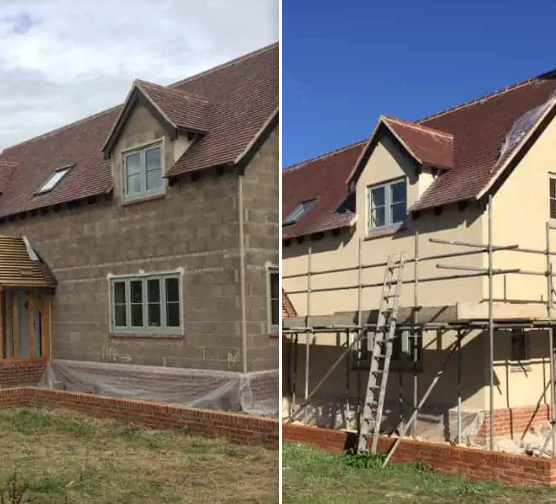
Lime render on solid walls. On a pre-1919 stone or brick wall the render is part of how the building manages water, not a raincoat over it. It goes on in three coats: a haired first coat pressed hard into the joints of the rubble so it keys, a straightening coat, and a fine finish coat, each given real time before the next. Grades of natural hydraulic lime are chosen to be weaker than the stone, because a render must always be the sacrificial layer. It is then finished with limewash or a mineral paint that lets vapour through.
Curing is half the job. Lime does not set the way cement does. It needs to be kept damp and protected from sun, drying wind and frost while it carbonates, which means hessian and sheeting on the scaffold and a programme that works round the weather. A lime job hurried in a hot week crazes and dusts, and there is no putting that right afterwards.
Roughcast and harling. Plenty of the older exposed walls in the town carry a thrown finish rather than a floated one, with the aggregate mixed into the coat and cast on. It is tougher against driven rain than a smooth face and it stays breathable, and where a wall already has it we would rather repair and re-throw it than smooth the building over.
Silicone thin coat and monocouche. On post-war and modern cavity blockwork the modern systems are the right answer. Mesh reinforced polymer basecoat, then a flexible through-coloured topcoat scraped to a fine texture, or a single thick monocouche coat ruled and scraped. Beads on those go on in stainless steel here, because galvanised ones close to the sea corrode and bleed a rust line through the finish.
Cement off an old wall. The commonest job in the old town is taking a cement render off stone that should never have carried it. We hack off by hand where the stone is soft, rake and make good the joints, and let the wall dry before any lime goes back on. That drying time cannot be skipped.
Cracking, spalling and staining. A cement coat on stone usually announces itself twice: a crack, then a hollow patch, then spalled stone behind it when it finally comes off. Fine crazing on a modern render is shrinkage. Green and black growth is algae and wants washing rather than rendering.
Flats and whole elevations. Close to four homes in ten here are flats, so much of what we survey is a full elevation instructed by a managing agent rather than one house.
How it runs
From your call to a written price
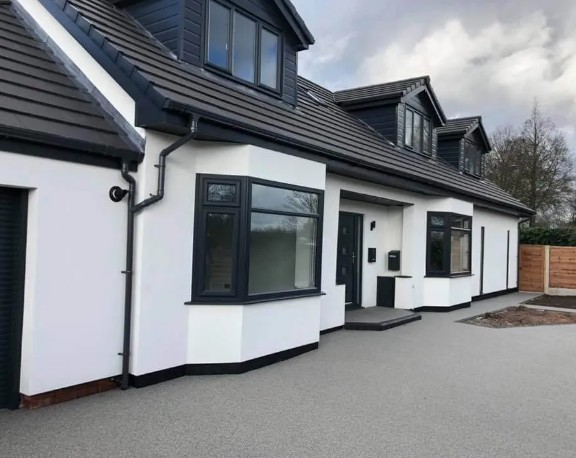
Same team from first visit to last, one person to ring, and no sub-contracting your work out to somebody you have never met. The quote is itemised, not a figure on the back of a card: access and scaffold, protection, preparation of the existing wall, the system and number of coats, beads and stop ends, and making good on separate lines, so you can compare it properly against anyone else's.
Nothing is left open or unusable overnight. The site is swept at the end of each day rather than the end of the job, and what comes out leaves with us. If something turns up once we start that nobody could have seen, you get a photograph and a price before we carry on.
Swanage carries a hundred and twenty-nine listed entries, and on a listed building consent covers the external render as well as the fabric inside. There is no conservation area of its own, though the town sits in a protected coastal landscape where appearance is looked at. On an ordinary house, renewing existing render is maintenance, while rendering a wall that never was is a planning question. A full elevation also brings Part L and building control in.
Cost
What decides the price of a rendering job
No rate per square metre, because the square metres are the easy part; what is already on the wall decides the price.
Getting to it. A stone cottage on a narrow lane, a seafront block and a post-war house up on the hill are three different platforms before anything is mixed. A bungalow gable comes off a tower, a three storey elevation wants a scaffold, and the platform has to stand for the whole system rather than a day. The work at height rules are why it is a priced line rather than something folded into a rate.
What is already on the wall. Rendering over sound brick is one job. Hacking off blown sand and cement, or a pebbledash that has parted from the background, is another, and it is the part nobody can see from the road. We tap the whole elevation before quoting, because the hollow areas set the hours.
The system, and what the wall behind it needs. Silicone thin coat over insulation, monocouche through-coloured, or traditional sand and cement all price differently and behave differently. On a solid wall that has to breathe, a plastic-rich modern system traps moisture and moves the problem inside, so the right system is a wall decision rather than a colour decision.
Comparing quotes? Ask which system is being quoted and how many coats, whether the old render is being hacked off or overlaid, whether beads, bellcast and stop ends are included, whether the scaffold is in the price, and what happens to the existing sills and pipework. Two quotes for the same job are usually two different jobs.
If it has started to come away
Render that has blown or cracked open
Ring rather than use the form. A section that sounds hollow when you tap it, or a crack you can get a coin into, is letting water behind the render and the frost does the rest. We make the loose area safe, sheet it if the weather is against us, and price the elevation once we can see how far the blown area actually goes. On a solid wall a loose area matters sooner than on blockwork, because water behind the coat is going straight into soft stone and lime. The phone is answered 24 hours for emergencies; scheduled work runs Monday to Friday, 8am to 6pm.
Worth knowing
Why Purbeck stone will not tolerate a modern render
A solid rubble stone wall has no cavity and no damp proof course. It was built to get wet in a storm and give the water back to the air afterwards, through its own face, over the following days. A lime render is porous and weak on purpose so it can take part in that. It is also softer than the stone, which means that when something has to fail, it is the render that goes and not the building.
A cement rich or plastic rich render breaks both of those rules. It is stronger than the stone, so movement cracks the stone rather than the coat. And it is close to impermeable, so the water that gets in behind it, through a hairline crack, round a sill, or up from the ground, cannot get back out through the face. It goes inwards instead, and that is the damp shadow along a skirting board that no amount of internal work will cure. In a hard winter the same trapped water freezes and takes the render off in sheets, bringing the surface of the stone with it.
Salt makes it worse rather than different. The weather walls are wetted repeatedly and carry salt in the surface, which holds them damp between showers and crystallises behind an impermeable coat. So if you are getting an old wall priced here, ask one question and listen to the answer: what happens to the water that gets behind this render. A quote with no answer to that is a quote for the wrong building.
Who you are dealing with
A local firm you can check
We cover Swanage, Herston, Durlston, Langton Matravers, Studland and the BH19 addresses around them, under Dorset Council. You are dealing with Bournemouth Roofing & Building, the trading name of Bournemouth Roofing & Building Ltd, registered in England and Wales, company number 15471719, which you can look up in a minute. Thomas Hannen's business, and he is the one who comes out to price the job, not a salesman. A verified customer's 10 out of 10 on Checkatrade. The visit and the written quote are both free.
Questions
Swanage questions we get asked
Why can our stone cottage not have a modern render?
Because it has no cavity and no damp proof course. A solid wall gets wet and dries through its own face, and a plastic-rich or cement-rich coat seals that route off. The water still gets in behind, then goes inwards instead, which is where the damp along a skirting comes from. Lime keeps the wall working the way it was built to.
How long does lime render take compared with a modern system?
Considerably longer, and most of the extra is waiting rather than working. Three coats with real time between each, then a curing period with the wall kept damp and protected from sun and frost. On an exposed elevation the job is planned around the season rather than squeezed into a week.
Ours was done in cement years ago. Can that come off?
It comes off, carefully, and the wall is allowed to dry before anything replaces it. Coming off is the easy part. What we look for underneath is spalled stone and washed out joints, because a coat that has been holding water usually leaves damage that needs making good first.
Are the beads different because we are near the sea?
On modern systems, yes, they should be stainless. A mile and a half from open water there is enough salt in the air to corrode a galvanised bead inside a render, and when it goes it cracks the corner and bleeds a rust stain down the finish. Lime work uses far fewer beads, which is one less thing to fail.
Our block of flats needs rendering. Who arranges it?
The freeholder or the managing agent. External walls are retained under a normal lease and maintained through the service charge, so a leaseholder cannot commission the work. Report it in writing and ask that we are invited to survey the elevation and quote it.
Nearby, and next door
Rendering near Swanage
Rendering nearby
Our other trades in Swanage
Everything we do in Swanage Rendering, all areas Every area we cover
Free quote
Get the wall identified before the render is chosen
Thomas taps the elevation, works out whether you have solid stone or cavity blockwork, and puts the right system, the beads and the access in a free written itemised quote.