Driveways and patios in Swanage
Sloping drives drained properly, front gardens opened up for a car, and patios that have gone green and slippery put right, across Swanage and BH19.
The site visit is free and so is the written itemised quote. Thomas Hannen prices every job himself.
Two things decide most driveway and patio jobs in Swanage: the slope and the sea. The town is built on a hill, so a drive is nearly always going somewhere rather than sitting flat, and everything that runs off it has to be caught at the bottom instead of allowed to arrive at a garage door or the road. The salt air then decides the detail, because it keeps a surface damp, greens the shaded parts and eats any steel that has been left where it can be reached.
Most people ring us here about one of three things. A patio that has gone green and slippery and is genuinely not safe in the wet. A drive on a slope where the water now runs the wrong way and ends up under a garage door or at the bottom of the steps. Or a small front garden behind a stone wall that has to become somewhere to put a car, in a town where on street space runs out early.
We will look at all three, tell you which are repairs and which are rebuilds, and put it in writing. We work across Purbeck rather than passing through it, and both the site visit and the written itemised quote cost nothing.
The work
What a Swanage frontage usually needs
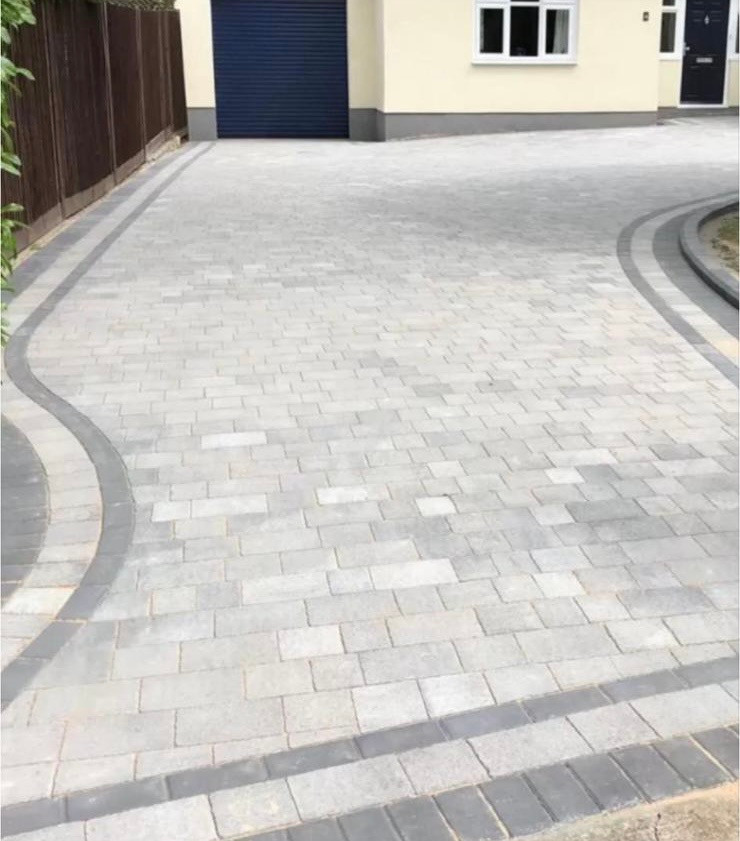
Front gardens in the old terraces. Getting on for three in ten homes in the town predate 1919, much of it late Victorian and Edwardian terrace and semi behind a low Purbeck stone wall with a short path to the door. Two jobs come out of that. The first is the path: old quarry tiles, worn flags and concrete cracked and lifted into a trip, which come up so the ground can be dug to a firm formation, a compacted sub-base laid and the path relaid in stone, porcelain or block to suit the house. The second is turning that garden into a parking space, which means an opening in the wall, a level standing behind it and a dropped kerb application to Dorset Council for the crossing. Take the wall down carefully, keep the stone, and rebuild the returns and piers with what came out, because it is the only way it looks like it belongs.
Drives on a slope. Half the streets here climb, and a sloping drive is a drainage design before it is a surface. A drive that falls towards the house needs a channel drain across the threshold with a real outfall, not a soakaway at the low point where it will simply fill, and on ground that drains as slowly as this that matters. Block paving grips better than a smooth finish. Resin and tarmac both work on a slope and both want a haunched edge restraint, because a bound surface with nothing holding its bottom edge will creep.
Patios facing the bay. Terraces cut into a slope, with steps and a retaining edge, and a good deal more wind than the brochure imagined, the most exposed elevation facing south west. We build on a proper base with the fall running away from the house, keep the paving clear of the damp proof course, and pick a surface with texture in it. A riven stone or a slip rated porcelain stays usable in the wet; a polished slab in a shaded corner a mile from the sea does not. Salt air keeps a surface damp between showers, so the joints go in as mortar or resin rather than loose sand.
Close to four in ten homes in the town are flats, so a lot of paving here belongs to everybody rather than to one household: courts rutting under turning wheels, a footpath that ponds after every shower, a bin store on cracked concrete, level access to a communal door. We phase that work so nobody loses their space or their route for more than a day, and the quote is itemised so a management committee can see what each part costs.
A great deal of what we are asked to look at does not need a new surface. Moss in open joints, staining under a parking bay, a sunken bay by a doorway, a bit of border edging nudged out by a car. Lifting a small area, correcting the base and relaying it, then a full re-sand and fresh pointing at the edges, buys years on a drive that is otherwise sound.
How it runs
From your call to a written price
One person to ring, and an itemised quote. Paving your own front garden stays permitted development while the water is dealt with on your own land: over five square metres the surface has to be permeable or drain to a border, lawn or soakaway inside the boundary, which is what the front garden paving rules require. That rule earns its keep here, because parts of the town carry a high surface water rating and some addresses sit in a flood zone, so the government flood check is worth running on your postcode first. With 129 listed entries, a frontage wall can be caught by the listing on the house it belongs to, and then listed building consent applies to the wall as well.
Cost
What decides the price of a driveway
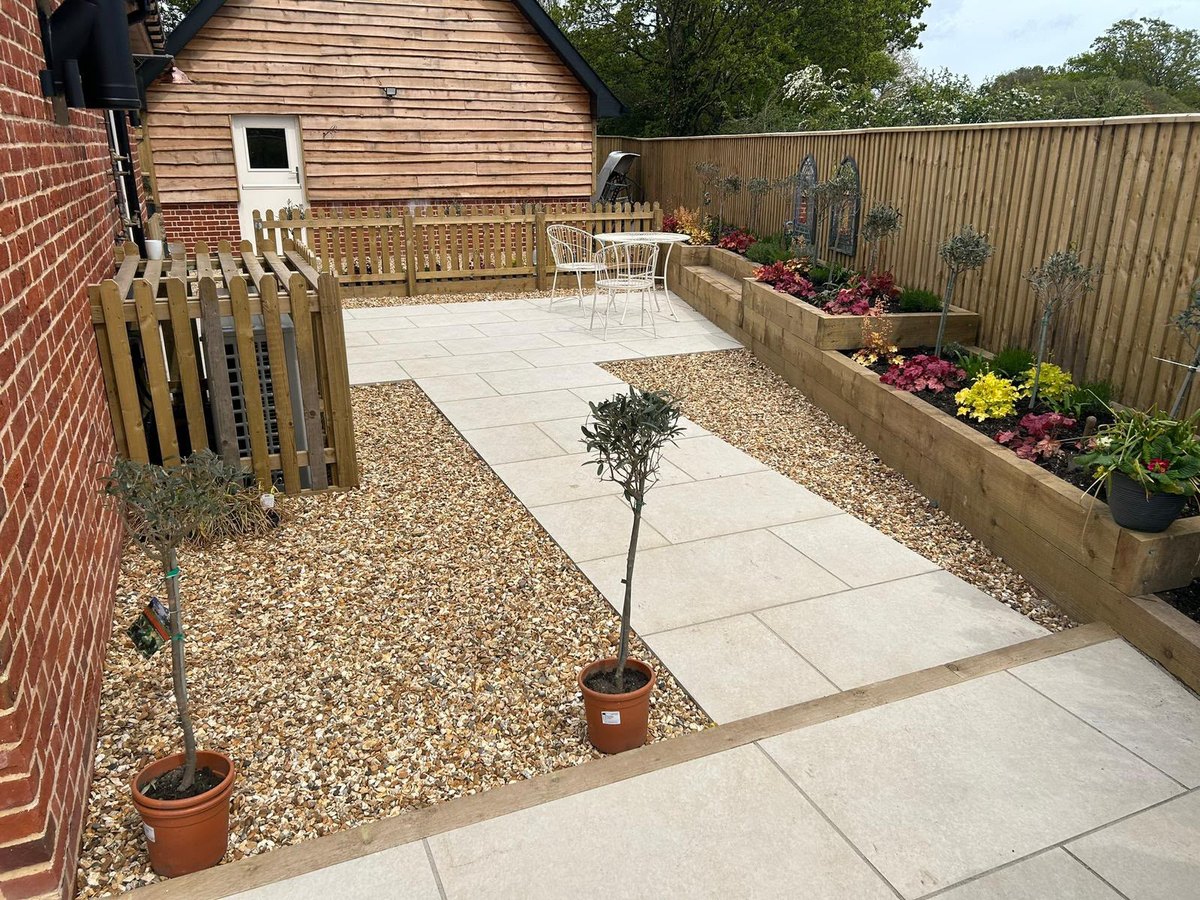
No rate per square metre, because what is under it decides more than what goes on top. A house with a drive a grab lorry can back onto is one job, a terrace on a hill where everything comes up by barrow is another, and a block of flats whose parking court has to stay half open all week is a third. Ground conditions, the depth of the dig and how much muck goes away are the real variables. Where the water is sent is the other, and here it is a design decision. Ask the depth of dig, the sub base and the drainage.
If it is urgent
A trip hazard, or a drive that floods
Ring rather than use the form. A lifted slab, a sunken bay by a doorway or a gully that has stopped taking water will not wait, because somebody falls or water ends up against the house. Tell us if it is a slab lifted at a communal door or water heading under a garage on a slope. The phone is answered 24 hours for emergencies; scheduled work runs Monday to Friday, 8am to 6pm.
Worth knowing
Salt air changes the detail, not the design
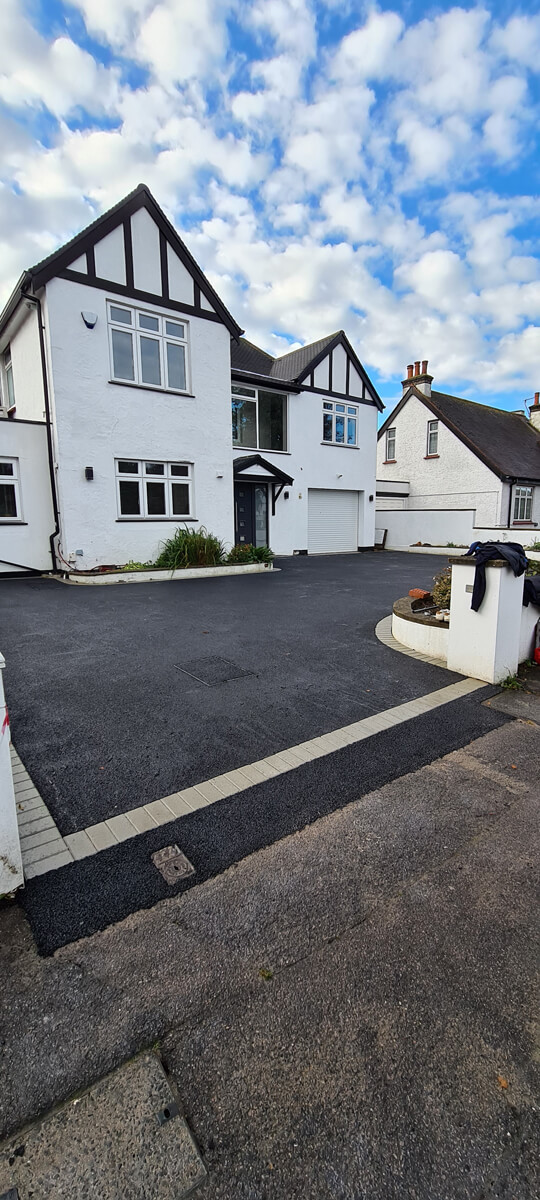
Swanage sits close enough to the water that salt is in the air on most days, and it does two things to paving. It holds damp, so a surface that would dry out in an hour inland stays wet for half a day, and anything shaded or north facing greens over far faster than the same slab would in Wareham. That is why so many patios here are slippery long before they are worn out.
It also goes after steel. Anything ferrous that can be reached by damp salty air will rust and stain around itself: pinned steel edgings, cheap fixings, the base of a gate post set straight into paving, and the reinforcement in a thin concrete slab that has cracked and let water in. The surface is not the problem in either case. The detail is.
So the specification shifts in small ways that cost very little at the time and a lot to put right afterwards. Edgings get haunched in concrete rather than pinned. Fixings, gate sockets and any ironwork sitting in the paving are stainless or non ferrous, and are bedded so water can get away from them rather than pool at the base. Anywhere shaded or seaward gets a textured finish with real slip resistance instead of a smooth one.
And the maintenance advice is the opposite of what people expect: do not blast it. High pressure strips the jointing sand straight out of block paving and opens up the surface of the stone, so it greens again faster the following year. A low pressure clean, a treatment for the growth and a proper re-sand is the routine that actually holds here, and it is why we would rather set a drive up to be cleaned gently than sell you a surface that has to be attacked once a year.
Who you are dealing with
A local firm you can check
We cover Swanage, Langton Matravers, Corfe Castle, Studland and the BH19 addresses across Purbeck, with Dorset Council for planning and building control. Send the postcode if you want to be certain. Bournemouth Roofing & Building Ltd, registered in England and Wales, company number 15471719, which you can look up in a minute. Thomas Hannen's business, and he is the one who comes out to price the job, not a salesman. A verified customer's 10 out of 10 on Checkatrade. The visit and the written quote are both free.
Questions
Swanage questions we get asked
The patio is green and lethal by December. Replace it?
Usually not. A mile from the sea, surfaces at Swanage stay damp between showers instead of drying out, and that film of damp is what the algae lives on. Replacing like for like gets the same problem back within two winters. What changes it is drainage and light: falls that shed water rather than hold it, a gap where the paving meets the wall, and cutting back whatever keeps the sun off. Then a textured finish, not a polished one.
Every heavy shower puts water under the garage door. Fixable?
Yes, though not by relaying at the same levels. Swanage carries a high surface water risk and the ground does not drain freely, so in a downpour the run off arrives faster than any soakaway will swallow it. The answer is a channel drain across the threshold connected to a proper outfall, with a reverse fall in the last stretch of the drive so water is caught short of the door instead of at it.
Can the paving be pointed in cement against the old walls?
Not against them. Getting on for three in ten homes in Swanage predate nineteen nineteen and those walls move moisture by breathing, so a hard cement joint traps it and pushes the damp back into the stone. Where paving meets a wall like that we leave a free draining margin instead of a sealed joint, and use lime for anything that genuinely has to bed against it. The rest of the field joints normally.
Do steel edgings and gates last on a seafront plot?
Not as long as they do inland. A mile from the water, salt sits on metal and works into the fixings from the edge inwards, so the galvanised pins holding an edging rail and the ironwork on a gate go long before the paving does. On Swanage jobs the edge restraint is concrete haunching rather than steel, and where metal has to sit in the ground it is stainless or non ferrous.
There is no room on the street for a skip. What then?
A grab lorry lifts the dig out straight off the ground, so nothing stands overnight. On the tighter terraces at Swanage we work to the lorry instead of the other way round: arisings get barrowed to one loading point, taken away that afternoon, and the road brushed before we leave. Where the only place to load is a marked bay, Dorset issue the suspension and it appears on the quote as its own item.
Nearby, and next door
Driveways and patios near Swanage
Driveways and patios nearby
Our other trades in Swanage
Everything we do in Swanage Driveways and patios, all areas Every area we cover
Free quote
Get a written price for your Swanage driveway or patio
Send the postcode and tell us what the ground is doing. We come out, look at the fall and the access, and put the price in writing with the days it will take.