Driveways and patios in Corfe Castle
Parking areas, stone patios, steps and retaining across Corfe Castle and the Purbeck villages. We sort the levels and the drainage first, then the surface.
The site visit is free and so is the written itemised quote. Thomas Hannen prices every job himself.
Around Corfe Castle the hard part of a drive or a patio is almost never the surface. It is the slope, the water and getting a machine anywhere near the job. Sort those three out and the paving is the straightforward bit.
Most people ring us about one of three things. A parking area worn down to mud, with rutting where the cars turn and weeds coming up through cracked concrete. A patio of old stone flags that rock, sit in ponding water for days and have gone slippery under the trees. Or a garden that steps down so steeply nobody uses the far half of it.
We come out, walk the levels with you, and work out where the water is going before we talk about materials at all. Then you get an itemised written quote with the excavation, the base, the drainage and the surface on separate lines, so you can see what you are paying for and compare it honestly with anyone else's price.
The work
Paving, parking and steps on a hillside village
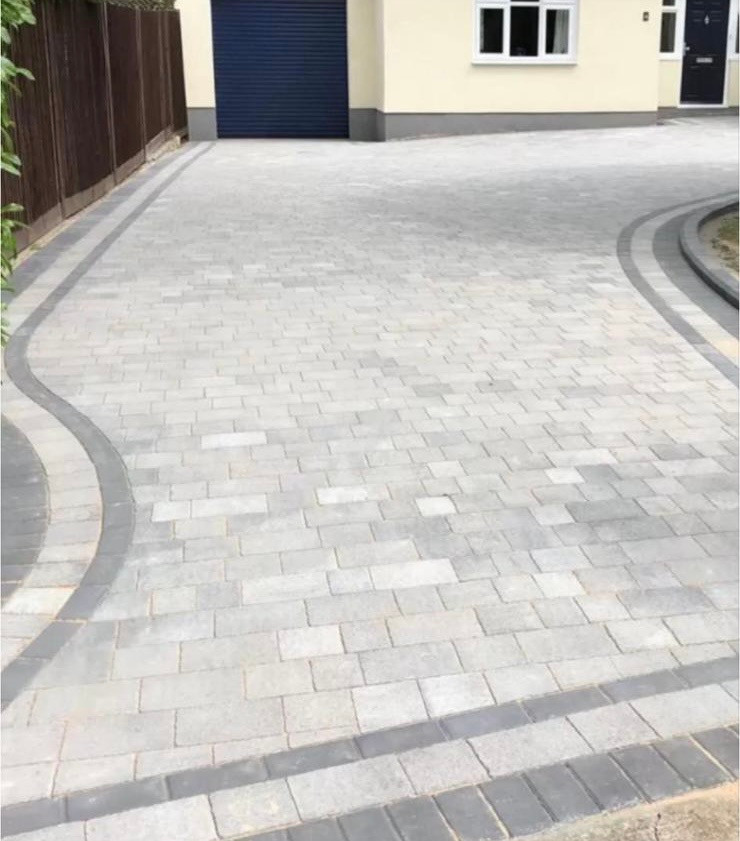
Parking where there is barely room for it. Off-street space is scarce here and most of what exists was never built, it just happened. A proper job means digging to formation at the depth the ground actually needs, a geotextile membrane, a compacted sub-base and edge restraint, then a surface chosen for the gradient. On anything sloping we would rather lay bound gravel, resin bound stone, a stabilising grid or block paving than loose shingle, because loose stone on a slope ends up in the road by February.
Steps, levels and retaining. Gardens that fall away want breaking into usable terraces rather than one long ramp. That is a retaining course, a set of steps with an even rise and a landing where the run is long, and a patio at each level that is genuinely flat. It is more groundwork than paving, and it is where an honest quote and a cheap one separate.
Plenty of the paths and terraces here are natural stone laid straight onto sand, and after enough winters they sit unevenly and hold water. The stone itself is usually still good. We lift it, keep it, put a proper base under it and re-bed it on a full mortar bed with the falls corrected, then point the joints. Broken pieces get cut and worked back in, and new stone is matched to what is already down rather than ordered by the pallet.
Many of the cottages here sit straight onto the ground with no modern damp proof course, so the finished level of a patio matters more than it would on a newer house. We keep the paving low, run the fall away from the wall, and where the ground insists on being high we put a drainage channel along the elevation rather than letting a threshold sit in a puddle. Drainage on this ground is impeded, so a soakaway is sized off a percolation test and sometimes has to become a positive outfall instead. Long shared accesses pothole and rut where the cross-fall has gone, and regrading, a fresh sub-base and a gully at the low point normally costs less than people expect. Where a lorry cannot reach, spoil and broken concrete come out by barrow and machine to one loading point, and the disposal is written into the quote rather than turning up later.
How it runs
From your call to a written price
The quote itemises excavation, muck away, sub base, edgings, surface and drainage separately. Paving a front garden is normally permitted development so long as the surface is permeable or the water goes to a border rather than the road, with five square metres as the point where planning permission comes in, and a new dropped kerb is a separate highway approval from Dorset Council. The village has its own conservation area and 134 listed entries in and around the parish. If your property is one of them, or the walls and gate piers at your boundary belong to a listed building, work that would be routine elsewhere can need listed building consent.
Cost
What decides the price of a driveway
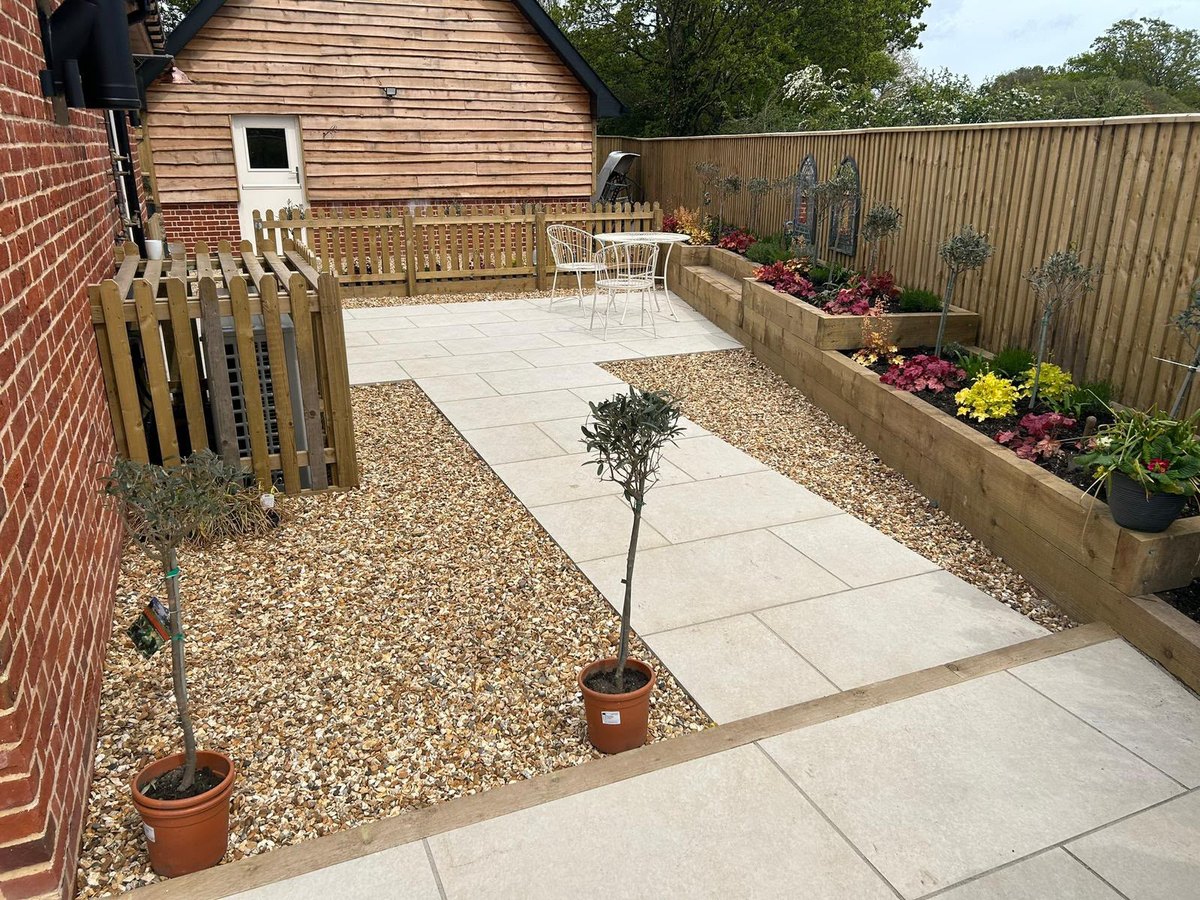
There is no rate per square metre worth quoting, because what is under the surface decides more of the price than the surface. A cottage on the street with no frontage, a house set above the lane with steps up to it, and a farm property at the end of a long track are three very different prices for the same area of paving. On a slope the retaining and the levels cost more than the paving does. Ask what depth is being dug, what sub base is specified, and who removes the spoil.
If it is urgent
A trip hazard, or a drive that floods
Ring rather than use the form. A slab that has lifted or a gully that has stopped taking water will not wait. On a slope a blocked gully stops being a small problem quickly, because everything that used to go into it now runs at the next thing downhill, which is often somebody's back door. The first visit makes it safe. Monday to Friday, 8am to 6pm; anything outside that by arrangement.
The one local thing
The ground here does not always take the water
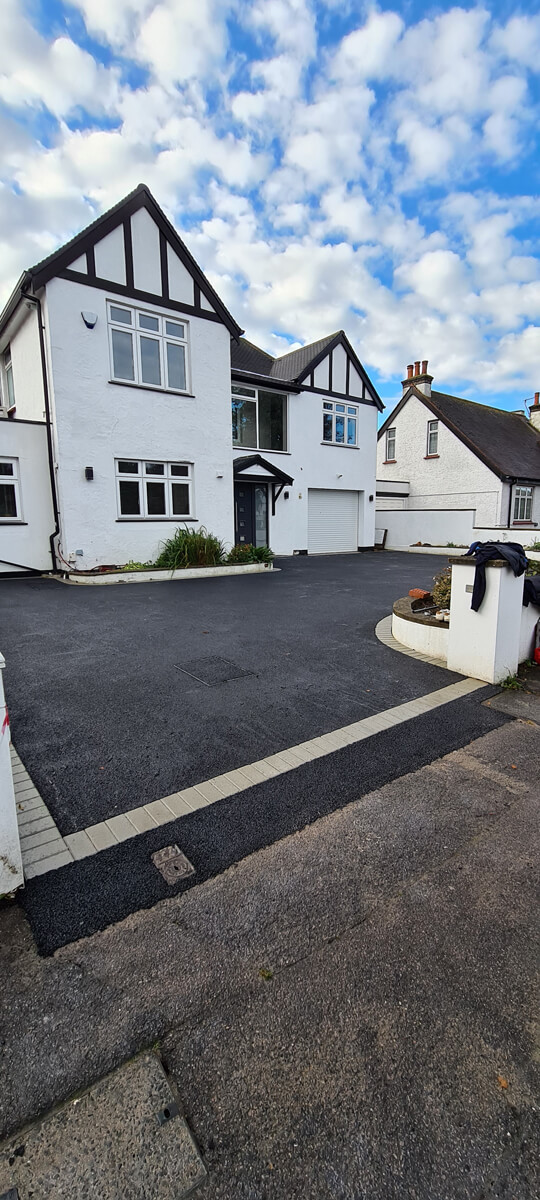
Ground around this part of Purbeck is often slow draining, and that changes the design of a drive rather than just the price of it. The default answer everyone reaches for is a soakaway, and on ground that will not accept water fast enough a soakaway simply fills up, stays full and starts pushing water sideways towards the nearest footing.
The only way to know which you have is a percolation test on your own plot, dug in the actual position the soakaway would go, and the pass or fail from that test decides the whole scheme. Approved Document H sets out the order the options are supposed to be considered in, and we work down it in front of you.
Add a slope and it gets more pointed. Water leaving a new drive has to be dealt with on your land, not sent down onto the lane or into the property below. In practice that means one of three things: a permeable surface over a deeper stone reservoir that holds the water while it releases slowly, a channel drain across the low end taking it to a positive outfall, or falls graded deliberately into a border with the capacity to take it.
All three are a line on the quote. If a price you have been given does not mention the water anywhere, that is the question to go back and ask, because the cost has not been removed, only postponed.
Who you are dealing with
A local firm you can check
We work across Corfe Castle, Kingston, Church Knowle and the villages of Purbeck through BH20, out from a Bournemouth base, and we come to you to price the job. Bournemouth Roofing & Building Ltd, registered in England and Wales, company number 15471719, which you can look up in a minute. Thomas Hannen's business, and he is the one who comes out to price the job, not a salesman. A verified customer's 10 out of 10 on Checkatrade. The visit and the written quote are both free.
Questions
Corfe Castle questions we get asked
With 134 listed entries here, does our paving need consent?
Only where the listing reaches your property. Corfe Castle has 134 listed entries, and listing follows a building and the ground within its curtilage rather than a whole street. If the house, a boundary wall or an outbuilding is on the list, hard surfacing beside it can need consent from Dorset Council. If none of it is, the conservation area still controls appearance, which is a lower bar but a real one.
Can new paving be matched to the stone in the village?
Within reason. The Corfe Castle Conservation Area controls appearance, so a frontage reading as modern next to local stone is the sort of thing that attracts comment. Reclaimed or quarried stone in a similar tone and coursing settles in, and gravel over a bound base is often the quietest answer of the lot. What rarely works is a bright block or sawn porcelain sitting hard against old rubble walling.
The yard holds water after every downpour. Can that be cured?
It can, once the water has somewhere to go. Ground under Corfe Castle has impeded drainage, so a soakaway can fill and stay full through the winter and leave the yard where it started. We dig a pit and time it. If it holds, the design becomes a fall across the yard into a channel and a piped outfall, with levels set so the run finishes clear of the house rather than at the back door.
What happens on the visit before a price is written?
Measuring, then digging. We break into the existing surface in a couple of places to see the make up and its depth, time how water leaves a hole, shoot levels between the threshold and the road, and establish whether the property or its walls fall within the listing. Thomas Hannen then writes the quote itemised, so excavation, base, edgings, surface and drainage stand separately. The visit and the quote are both free.
How does material get in without damaging the old walls?
Carefully, and in small loads. Working alongside old rubble walls in Corfe Castle means no plant leaning on them and no tipper reversing hard at a gateway, so material is dropped at the nearest sensible point and moved in by barrow or by a narrow tracked dumper running on boards. Corners get protected. It is slower than tipping straight onto the job, and that shows as labour on the quote rather than as a surprise.
Nearby, and next door
Driveways and patios near Corfe Castle
Driveways and patios nearby
Our other trades in Corfe Castle
Everything we do in Swanage Driveways and patios, all areas Every area we cover
Free quote
Get a written price for your paving
Free site visit, free itemised quote, and a proper look at where your water is going before anybody digs.