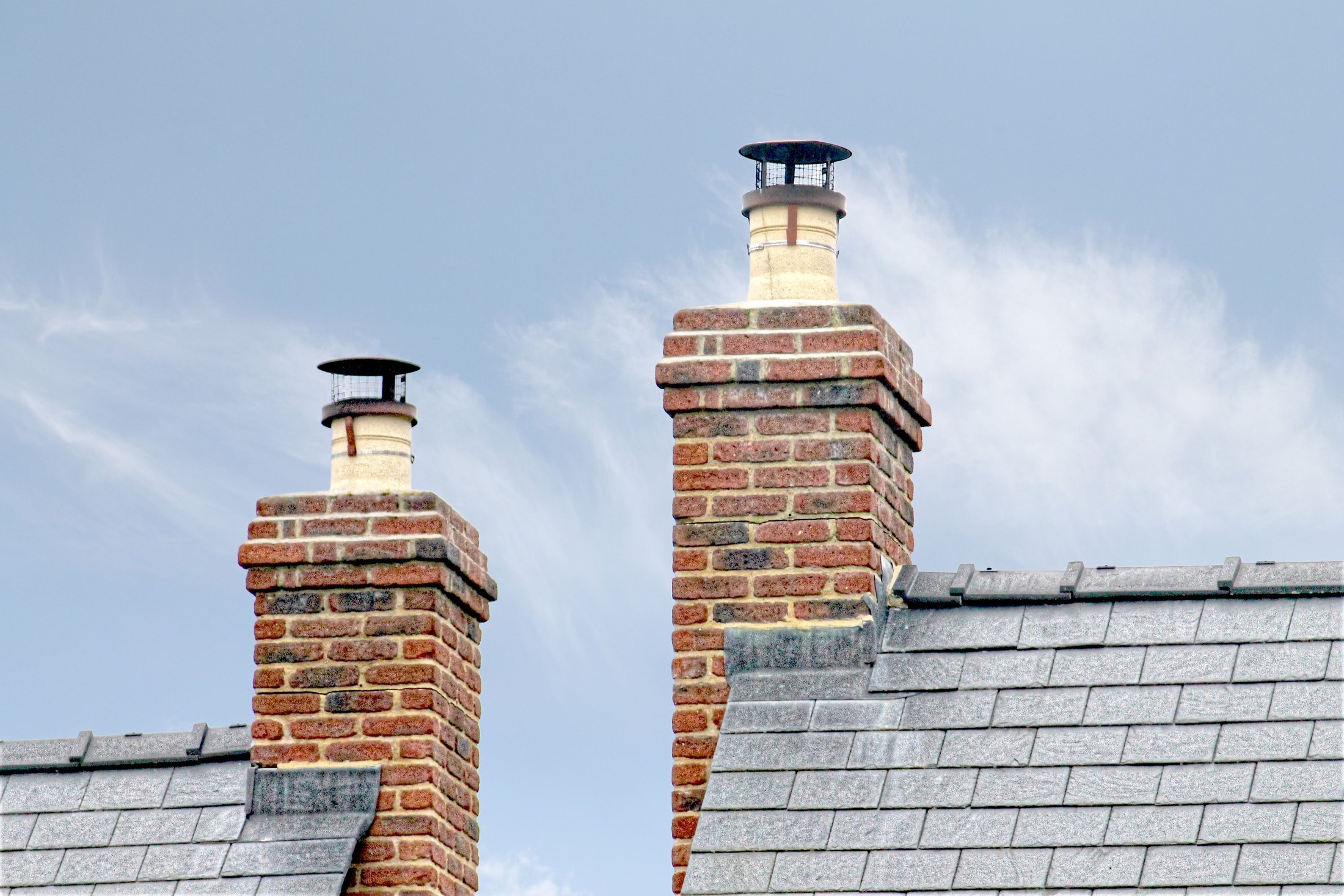
Roofing in Corfe Castle
Stone slate repair and relaying, tiled and slated roofs, chimney leadwork, flat roofs and rainwater goods across the village and the Purbeck lanes around it.
The site visit is free and so is the written itemised quote. Thomas Hannen prices every job himself.
Almost the whole of Corfe Castle sits inside a conservation area and the village holds more than a hundred listed entries, so the first question on any roof here is what your address is covered by. A like for like repair in the same material is maintenance. Changing the covering is a different conversation.
Most calls are ordinary: a stone slate has slid, a chimney has started letting water down the breast, a ceiling has marked, or the roof has reached the point where you want somebody to say plainly whether it needs patching or stripping. What is not ordinary is the fabric.
This is a Purbeck stone village, and stone, oak pegs and lime behave nothing like the concrete tile roofs a few miles up the A351. We get on the roof, look in the roof space where we can, and photograph what is actually there before anybody talks about money.
The work
We do not point a stone roof, and we do not seal one
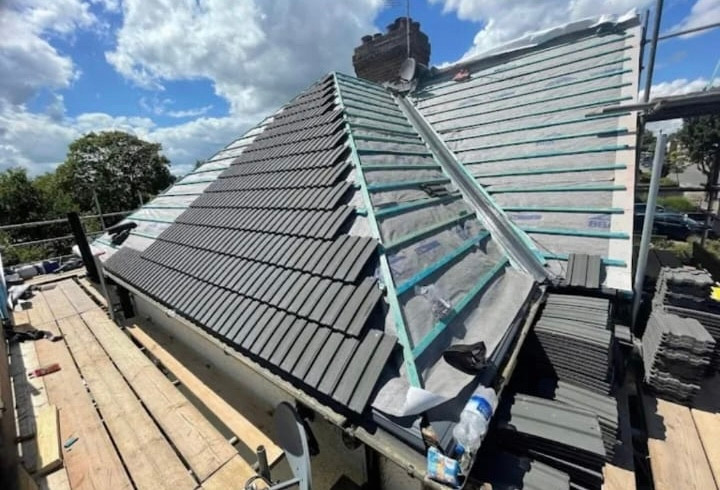
Stone slate slopes. Purbeck stone hung in diminishing courses, the biggest at the eaves and the smallest at the ridge. Individual slates are lifted and re-hung; whole slopes are stripped and relaid where the oak pegs or the nails have gone rather than the stone. Sound stone is sorted and put back, and only delaminated pieces are made up from salvage, which is why a stone roof takes longer to programme than a tiled one. We do not point a stone roof and we do not seal one. Stone is several times heavier than a concrete tile, so putting it back on a slope re-covered in something lighter years ago is a structural question about the rafters before it is a roofing one.
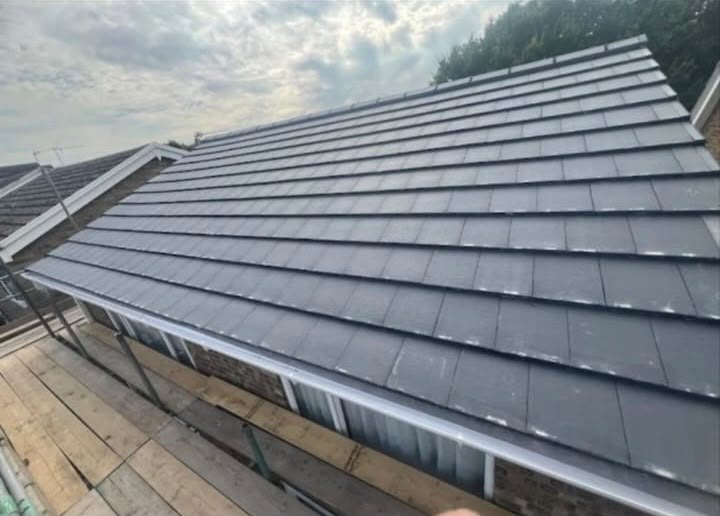
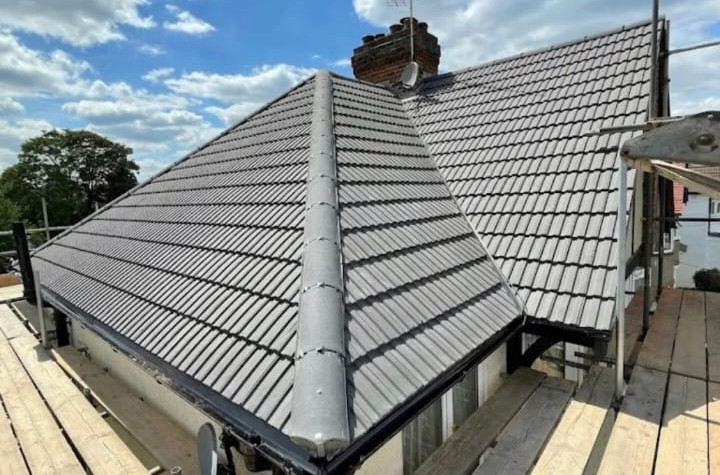
Not every roof here is stone. The later cottages and the twentieth century houses at the edges carry plain clay tile, natural slate and concrete interlocking tile, and those get the ordinary treatment: storm damage made good, ridge and verge screwed down under BS 5534 rather than re-bedded in mortar that will crack again.
Thatch, which we will not take on. There is thatch in the village. We do not touch it and we will tell you so. What we will do is the leadwork, the flashing and the rainwater goods where a stone or tiled slope abuts a thatched one, a junction that leaks far more often than the thatch itself.
Older slopes here often have no membrane at all and were torched with lime on the underside instead, and some slate sits on sarking boards. Perished felt, soft batten ends and a wet rafter foot are what we look for from inside first, because the strip is priced on what is under the covering. A village with a hundred and thirty four listed entries has a lot of stacks, and they are the commonest source of the leaks we chase: flaunching, flashings, soakers, valleys and abutments in code rated lead cut so it can move without splitting. Cement fillets in place of lead are a false economy and we replace them.
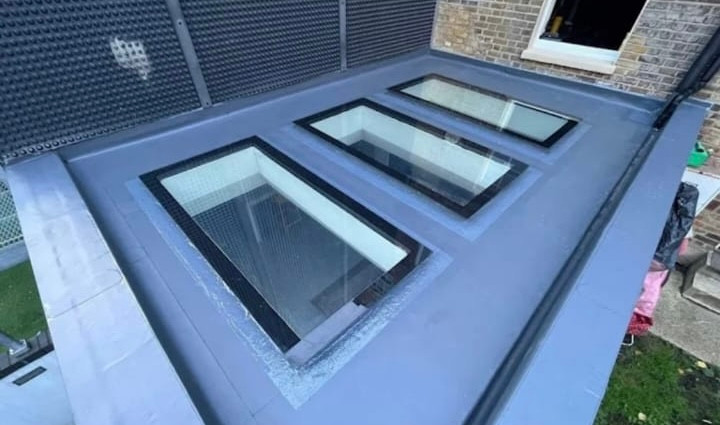
Rear additions and outbuildings come in felt, GRP fibreglass or EPDM rubber, with the deck checked before the falls, upstands and outlet. Cast iron gutters are usually worth repairing rather than ripping off, and moss on stone is not automatically a fault and never gets pressure washed. On a building whose appearance is controlled, the roof space is often the only place you can genuinely improve things, and Approved Document L sets the standard a renovated roof is expected to reach.
How it runs
From your call to a written price
Same team throughout, one person to ring, an itemised quote line by line, and a photograph and a price before anything extra. On permission, two separate things get muddled here. Planning permission governs what a building looks like from outside, and for an unlisted house a like for like re-cover, a repair and rooflights no more than 150mm above the roof plane stay permitted development even inside the Corfe Castle Conservation Area, within the limits the Planning Portal sets out. Listed building consent is a different process, and with a hundred and thirty four listed entries in the village it applies here more often than almost anywhere. Dorset Council for both.
Cost
What decides the price of a roof
No rate per square metre. Access is the awkward part of working in the village: lanes are narrow, the A351 runs straight through it and parking pressure is real, so where a scaffold and a skip can stand is settled before anything is priced, and a platform on the footway is a licence from the highway authority rather than a favour. Deliveries get sequenced so a stone lorry comes once. The work at height rules are why the platform is a priced line. Chimneys, valleys and abutments are priced one at a time. Ask whether the scaffold is in and who pays for the skip.
If it is leaking now
Water coming in today
Ring rather than use the form. Anything letting water in goes to the front of the queue, and the first visit makes it safe. If the roof is stone, do not let anybody seal, foam or mastic their way out of it: undoing that costs more than the leak, and a weighted sheet over battens holds it until we arrive. The phone is answered 24 hours for emergencies; scheduled work runs Monday to Friday, 8am to 6pm.
Worth knowing
A village where most of it is on the list
More than a hundred entries in this village are listed, and the conservation area covers nearly all of what is left. That is a much higher proportion than anywhere else we work, so the sensible assumption at a Corfe Castle address is that something applies until you have checked, rather than the other way round.
What it changes in practice is the specification, not just the paperwork. A listed roof has to go back in the same material, laid the same way, with the same laps and courses, and listed building consent covers the back of the building as much as the front.
That rules out the substitutions people are sometimes offered: a lighter tile in place of stone, a plastic dry verge on a stone gable, cement where lead should be. It also adds time at the front of a job, because matched stone gets sourced rather than ordered. Tell us the address when you ring and we will establish the status before we quote.
Who you are dealing with
A local firm you can check
About nine and a half miles from us, covering Corfe Castle village and out towards Church Knowle, Kingston and Harmans Cross, in the ward of South East Purbeck. Dorset Council for planning and building control. Bournemouth Roofing & Building Ltd, registered in England and Wales, company number 15471719, which you can look up in a minute. Thomas Hannen's business, and he is the one who comes out to price the job, not a salesman. A verified customer's 10 out of 10 on Checkatrade. The visit and the written quote are both free.
Questions
Corfe Castle questions we get asked
There are 134 listed entries here. How do I check mine?
You look it up before anything else happens. Corfe Castle carries 134 listed entries, an extraordinary number for a village this size, and a good share of the street frontage is affected. Listing covers the whole building, roof included, so consent comes before work rather than after it. Dorset Council holds the list and the conservation officer is who you deal with. We will not open a listed roof without it.
Where would you put a skip on a village street?
As close to the house as the road will take it, and sometimes not outside it at all. Inside the Corfe Castle conservation area the position gets agreed with Dorset Council rather than assumed, and we use a timed drop and collection instead of leaving a skip standing for a fortnight. Where there is no frontage to work off, spoil is bagged and carried out. Slower, but the street stays usable.
Rain seems to drive straight at one wall. Is that normal?
It is the pattern in this valley. The most exposed elevation at Corfe Castle faces south west, so driven rain hits abutments, verges and window heads on that side while the sheltered side stays dry for years. Water getting behind a flashing on the weather side then shows inside as a damp band across the top of a wall rather than a drip in the middle of a ceiling.
Does the Poole Harbour rule stop us converting the loft?
It does not stop it, it adds a step. Corfe Castle drains into the Poole Harbour catchment, where nutrient neutrality is engaged by any scheme adding overnight accommodation. Re-covering a roof adds none, so it never applies to roof work on its own. Turn the loft into a bedroom and it becomes part of the application, alongside listed building and conservation area consent where the house is affected by either.
Why does a heritage roof take longer to price?
Because the survey has to establish what is actually up there before anyone can cost putting it back. On a listed building in Corfe Castle that means recording the existing detail, the fixing method and the course spacing, then agreeing with the conservation officer what is allowed to change. The visit and the written itemised quote are free, but a roof like that takes a second look rather than one walk round.
Nearby, and next door
Roofing near Corfe Castle
Roofing nearby
Our other trades in Corfe Castle
Roofing guides
Concrete vs clay roof tiles: which is right? Planning, building regs or listed building consent Storm damage to a roof: the first 24 hoursEverything we do in Swanage Roofing, all areas Every area we cover
Free quote
Get a written price for your Corfe Castle roof
Tell us the address and what the roof is doing. We check what covers it, come out, and put an itemised price in writing at no cost.