Exterior cleaning in Swanage
Roofs, stone, render, gutters and paving cleaned at a pressure that a solid wall on this coast can actually take.
The site visit is free and so is the written itemised quote. Thomas Hannen prices every job himself.
On a Swanage house the question is not how dirty the wall is, it is what the wall is made of. A great deal of the older town is solid stone or solid brick with lime joints and no cavity behind it, and those walls keep the weather out by drying between wet spells. Wash one at high pressure and you fill it up, which is how a clean turns into damp inside by the winter.
Four things bring people to the phone here. Render or paintwork on the seaward side has gone green again within a year of the last clean. A block of flats needs the roof, the gutters and the communal walls doing and nobody is certain who arranges it. A stone path, a set of steps or a terrace has turned slippery and somebody has already had a near miss on it. Or a property is being let, sold or handed back and it has to look right by a fixed date.
We go through it surface by surface. What is growing, what it is growing on, how exposed that elevation is, and whether the stone, the render or the paint under it is sound enough to be cleaned at all. The site visit and the written itemised quote are both free, with the method against each line rather than one figure for the whole building.
The work
Stone, slate and salt on the Purbeck coast
Salt is on everything before the moss is. The town sits about a mile and a half from the sea and the most exposed elevations face south west, so the seaward side of a building carries the black speckle of lichen and a green film of algae while the sheltered side of the same building still looks clean. Salt keeps a surface damp between showers, which is why growth comes back faster here and why the treatment matters more than the wash. The rinse matters as much as the wash, because it takes the salt off rather than leaving it in the surface to hold damp again.
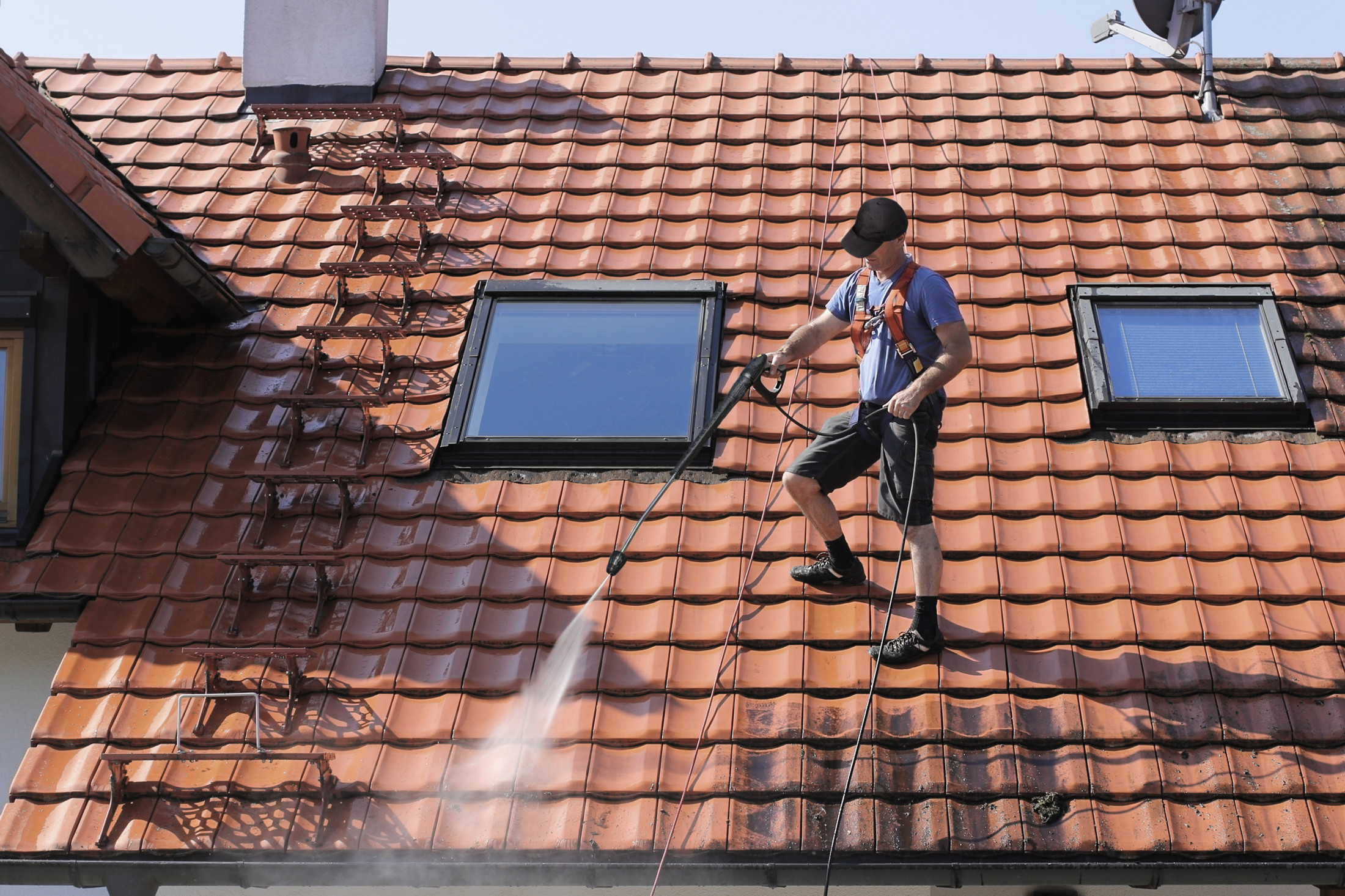
Roofs, and what is holding them on. Welsh slate on the Victorian terraces and the villas, clay plain tile on plenty of the rest, concrete interlocking tile on the post-war housing and the bungalows. Moss packs into the lap and into the channel of an interlocking tile, pushing water sideways under the covering instead of down it. It is a dry scrape and a brush, then a soft wash at low pressure with a biocide behind it, and slate sees no lance at all: the force gets under the lap, works at nail heads that are already corroding in this air, and washes the mortar bedding out from under the ridge. While the poles are up we look at the clips, the nails and the flashings, because salt eats those from the edge of the roof inwards and a cleaning visit is the cheapest time anybody will ever spot it.
Nearly three in ten homes here predate 1919, and their rubble stone walls, stone boundary walls with copings, steps and paving are bedded and pointed in lime, which is deliberately softer than the stone around it. Water under pressure goes for the joint, and on a rubble wall there is a great deal of joint, so that is low pressure work and a treatment where lichen has taken hold. Pull lichen off old stone hard and the face of the stone comes with it.
The Victorian terraces are the awkward ones for rainwater. Many have a valley or a parapet gutter tucked behind the front wall rather than a simple eaves run, and when one of those backs up the water goes inside rather than over the front. Every outlet is flushed to prove it takes it. The low ground in the town sits in flood zone 3 with the Swan running through it, so where the wash water goes gets planned rather than discovered. Planting is sheeted and watered down, gullies are covered, and what we spray goes on at the strength on the label, which is what the biocides regime the HSE administers asks of whoever is holding the lance.
Close to four in ten homes here are flats. On a block the roof, the gutters and the communal brickwork belong to the freeholder and come out of the service charge, so the person who rings is often not the person who can order the work. Give us the managing agent or the residents' company and we will quote them direct. Balcony glass, railings and communal stairs clean up off the same set up.
How it runs
From your call to a written price
One team from first visit to last, no sub-contracting, and an itemised written quote: method by surface, protection, access, and where the water and residue go. Cleaning is maintenance and there is nothing to apply for. There are well over a hundred listed entries in and around the town, so it is worth knowing whether yours is one before anybody changes how the building looks. Painting a wall that was never painted, rendering over stone, or coating masonry with anything that seals it are changes of a different order, and the Planning Portal sets out where consent is needed. Dorset Council is the authority here and it holds the records on listed building consent too.
Cost
What decides the price of a clean
The same square metre can be two minutes or twenty, so there is no rate for it. In this town access usually decides it: a terrace up one of the hill streets means parking somewhere else and carrying the kit to the door, a seafront flat needs the agent's say so and a route through a communal entrance, and a bungalow on the edge of town is straightforward work off the ground. work at height rules decide where the tower comes in. Salt and shade matter too, because a seaward elevation is more often a second visit than a harder first one.
If there is a date
A viewing, a visit or a deadline
Ring rather than use the form. A lot of the work here runs to the season, changeovers, lettings and sales, and the weeks either side of the summer are the busiest we have, so the earlier you ring the more likely we can hold the day you actually want. Tell us the date on the call, not after the quote. Outside Monday to Friday, 8am to 6pm, by arrangement.
Worth knowing
Solid walls have to dry out, and that changes the method
Getting on for a third of the homes in Swanage were built before the First World War, and almost all of those have solid walls: stone or brick right through, bedded in lime, with no cavity in the middle and nothing to stop water crossing from the outside face to the inside one. A wall like that does not keep the weather out by being waterproof. It keeps it out by being thick and by drying out again after rain.
Put a pressure washer on it and you do in ten minutes what a fortnight of driven rain would do, except that driven rain does not force water into the joints. On rubble stone there is a lot of joint and the water has a long way to travel back out. Add salt in the surface, which holds moisture against the wall between showers, and the drying takes longer here than it would on the same wall inland. That is why the damp patch appears in a bedroom in November and nobody connects it with the clean in June.
So on an older Swanage house the method is settled before the price is. Low pressure, a biocide doing the work on the lichen and the black spot rather than force, and a rinse in clean water that takes the salt off with the dead growth. Never let anybody seal or waterproof an old stone or brick wall after cleaning it. A masonry sealer stops the wall breathing, traps whatever moisture is already in there and makes the frost damage worse rather than better.
If your walls have already been painted with a modern masonry paint, expect a clean to show up where it is blistering, because that is the wall trying to dry through a coating that will not let it. If you are comparing quotes on a period property, ask three things: what pressure goes on the stonework, whether the rinse is in clean water, and whether they intend to apply any sort of sealer afterwards. The right answer to the last one is no.
Who you are dealing with
A local firm you can check
We cover Swanage, Herston and Durlston on BH19, out through Langton Matravers, Corfe Castle and the rest of Purbeck, and Dorset Council is the planning authority for this address. Bournemouth Roofing & Building Ltd, registered in England and Wales, company number 15471719, which you can look up in a minute. Thomas Hannen's business, and he is the one who comes out to price the job, not a salesman. A verified customer's 10 out of 10 on Checkatrade. The visit and the written quote are both free.
Questions
Swanage questions we get asked
Our render goes green again within a year. Is that the sea?
Largely, yes. Swanage sits about 1.6km from the coast and salt on a render face is hygroscopic, meaning it draws moisture out of the air and keeps that wall damp between showers. Growth needs water more than it needs dirt, so it returns faster here than it would inland. That is why the biocide matters more than the wash itself on a seaward elevation, and why we treat the surface rather than blast it.
We own a flat in a converted house. Who signs the work off?
The freeholder, or whoever manages the building for them. Flats and maisonettes are 38.7% of Swanage, more than any other type, and on all of them the roof, the gutters and the outside walls are common parts funded through the service charge. If several leaseholders want it done, the quickest route is for one of you to take our written quote to the agent. Above a certain spend the freeholder has a statutory consultation to run.
Our stone walls are covered in lichen. Can that come off?
Some of it, and slowly. Over a quarter of Swanage predates 1919, 28.2% of the stock, so most of these walls are solid stone with lime joints that have to breathe. Lichen grips into the surface, and taking it off mechanically takes the face of the stone with it. We use low pressure and a biocide, and the lichen greys off and weathers away across the months after. Anyone blasting it clean in a day will cost you stone.
The road floods by us. Does that affect where you wash?
It affects where the water is allowed to run. Parts of Swanage sit in flood zones 2 and 3 with a high surface water rating, so the gullies here go somewhere that matters and treated run off is not going into them. We bund the low side of a drive, work the fall towards a foul drain, and collect whatever we cannot direct. Nearest the Swan we do not treat at all with heavy rain forecast for that day.
Should we do the whole house or just the seaward side?
Just the side that needs it, as a rule. The most exposed elevation in Swanage faces south west, and that is the one taking driven rain off the bay and holding salt, so it will sit two or three shades darker than the sheltered faces. We price each face on its own for that reason. Doing the lot at once looks even for a month, then the exposed wall pulls ahead again and the difference is back.
Nearby, and next door
Exterior cleaning near Swanage
Exterior cleaning nearby
Our other trades in Swanage
Everything we do in Swanage Exterior cleaning, all areas Every area we cover
Free quote
Get a price for cleaning in Swanage
Tell us the address and which elevation has gone green, and whether it is a house or a block. We come out, look at it and put an itemised price in writing. Both are free.