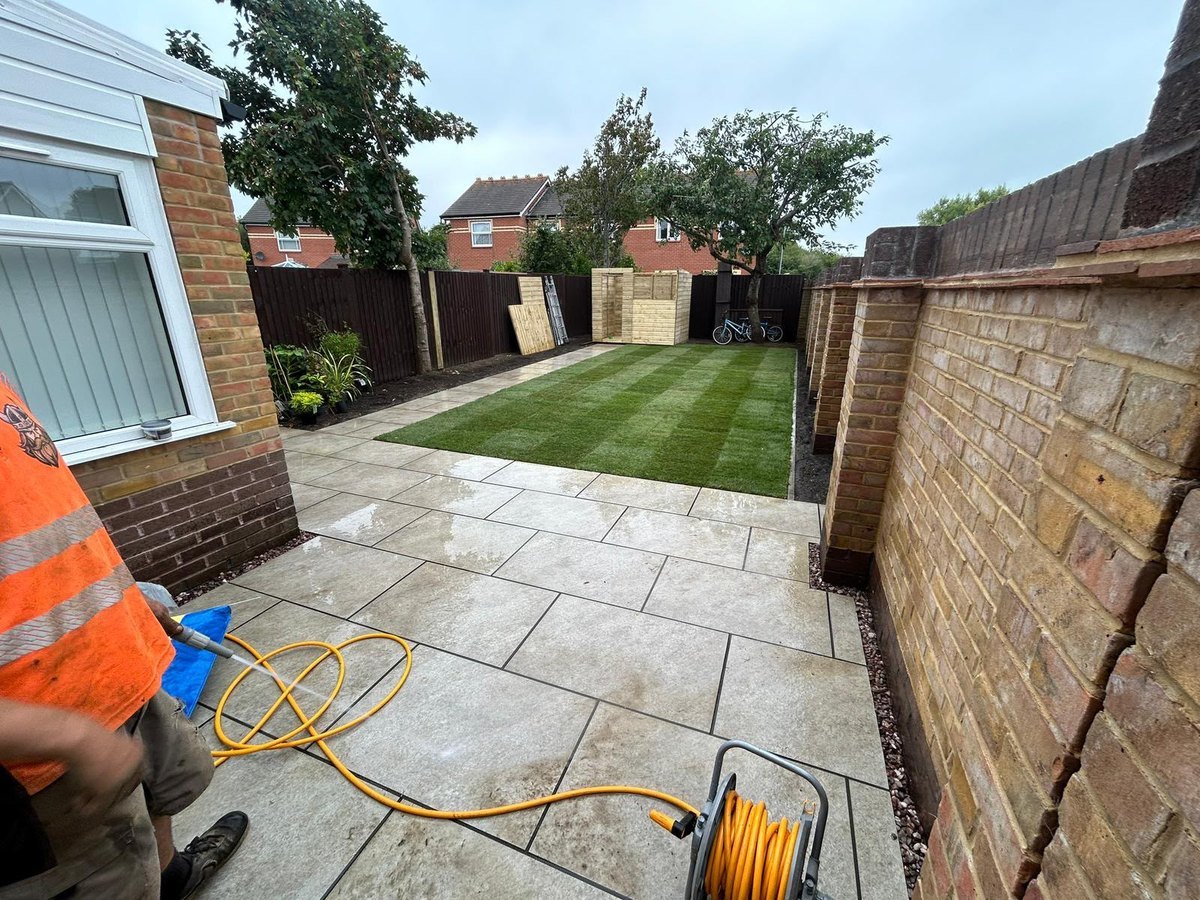
Patios in Winterborne Stickland, wet winter ground
The stream here runs only in winter, and so does the water under every garden in the village, which is the half of the year a patio has to survive.
The site visit is free and so is the written itemised quote. Thomas Hannen prices every job himself.
The village takes its name from a stream that only runs in winter, and that tells you most of what you need to know about building a patio here. Ground that is bone dry and firm in August can have water standing in a trial hole in February, and a terrace designed in summer is designed on half the evidence.
The three calls. A patio that ponds every winter and dries out perfectly by May. Slabs that rock after a wet spell and settle down again in a dry one. And a soakaway that percolated fine when it was tested and does nothing at all once the ground is full.
We come out, dig a trial hole and ask what the garden does in February, because that is the condition the patio has to survive. Then you get a written itemised quote with the dig, the muck away, the sub base, the drainage, the edgings, the slabs and the jointing on separate lines. The site visit and the quote are free.
The work
A terrace built for the wet half of the year
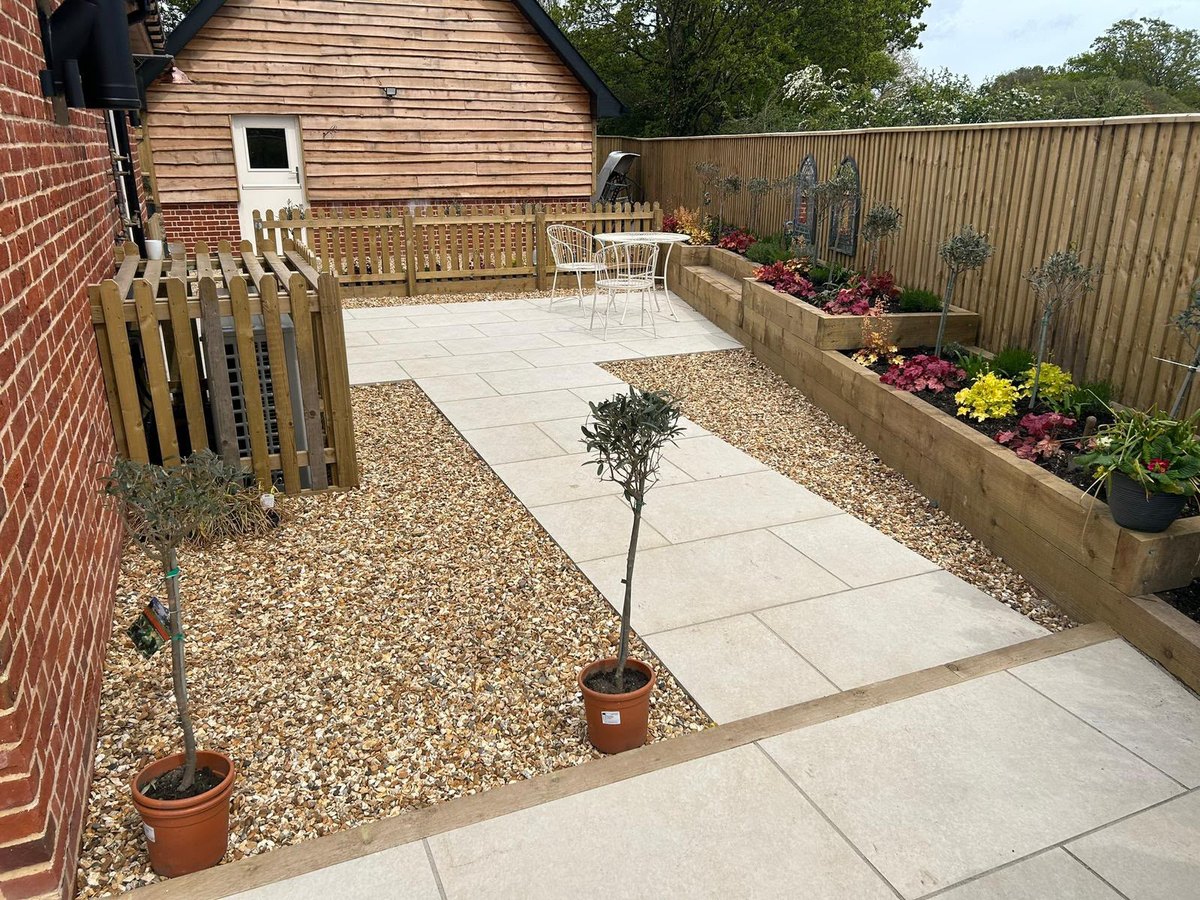
Finding out what the ground does. A trial hole is worth more here than anywhere. It tells us how deep the topsoil goes, whether there is chalk, clay or made ground below it, and whether water is already sitting at that depth. Old concrete, roots and rubble come out with the dig and the spoil goes by the load.
The sub base. MOT Type 1 laid and whacked in thin lifts to full compaction and carried past the edge of the paving, with a geotextile separator between the stone and the subsoil. Ground that saturates in winter and shrinks in summer moves, and the separator is what stops fines being pumped up into the base.
Full mortar bed, never dabs. Every slab on a full wet bed with a slurry primer painted on the back. A dabbed slab over ground that floods seasonally has a void underneath that fills every winter, and that is the mechanism behind almost every rocking patio we are called out to.
What goes down. Porcelain is calibrated, takes up no water and does not stain, so it comes through a wet winter unchanged. Riven sandstone is warmer, porous and darkens. Limestone marks and suits the chalk village stonework. Granite is the hardest wearing. Travertine is for a dry sheltered corner rather than a garden that sits wet for months.
Levels and the damp course. Paving falls away from the house and finishes at least two courses below the DPC, and in a garden that gets wet in winter that clearance is worth taking in full rather than at the minimum. Approved Document C explains what happens when the damp course is bridged.
Drainage that works in February. This is the part that catches people. A soakaway tested in a dry spell can pass and then do nothing when the water table has come up to meet it. So the design here is normally a channel with a gully and an outfall that keeps working when the ground is already full, with a permeable build up over open graded stone where a hard outfall is not available.
Edges, steps and retaining. A haunched edging or kerb where paving meets grass or a border, a retaining edge with coping where a level is held back, and steps set out with equal risers. On a village plot that falls towards the stream line, a continuous retaining edge across the flow is something we avoid rather than something we build.
Jointing and repairs. A brush in resin compound worked wet and tooled off, or hand pointing in a suitable mortar on older stonework. Open joints let winter water straight into the bedding. Then the usual repairs: lifted slabs, a sunk bay, rocking paving, cracked stone, algae on the shaded side, efflorescence on new sandstone and silt staining after standing water.
How it runs
From your call to a written price
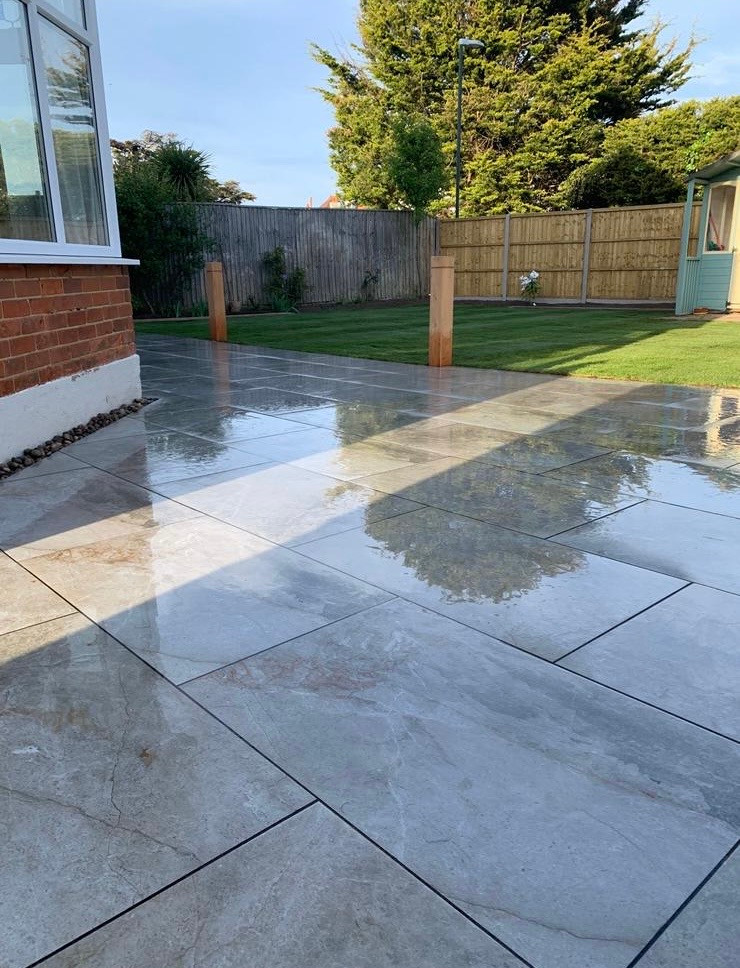
Same team from first visit to last, one person to ring, and no sub-contracting your work out to somebody you have never met. The quote is itemised, not a figure on the back of a card: excavation and muck away, the sub base, the falls and where water goes, edgings and steps, the slabs themselves, and jointing on separate lines, so you can compare it properly against anyone else's.
Nothing is left open or unusable overnight. The site is swept at the end of each day rather than the end of the job, and what comes out leaves with us. If something turns up once we start that nobody could have seen, you get a photograph and a price before we carry on.
The old part of the village is a conservation area with 25 listed entries in and around it, so appearance is controlled where the work can be seen. Ground level paving in a back garden is still normally permitted development and needs no planning permission, while building control applies where a retaining structure is being built. Dorset Council holds the conservation area and listed building records.
Cost
What decides the price of a patio
No rate per square metre, because the slabs are the part you choose and the smallest part of the price.
Getting to it. A thatched cottage on the village street, a farmhouse with a yard you can back a lorry into, and a modern house on the edge of the village are three different jobs. Everything comes in and goes out through the garden, often through a side gate or the house. A patio you can barrow to directly is a different job from one where every slab is carried. The work at height rules still apply to the dig and the machinery.
What is coming out before anything goes down. An old concrete slab, a raised bed, tree roots or made ground all have to be dug out and taken away, and that is priced by the load rather than by the metre. The dig is where a patio quote is won or lost.
Falls, levels and the damp course. A patio has to fall away from the house and finish at least two courses below the damp proof course, and getting that right often means steps, a retaining edge or a drainage channel. Laying a new patio up against a wall at the wrong level is the single most expensive mistake on this kind of job.
Comparing quotes? Ask how deep the dig goes and what sub base is specified, whether the slabs are laid on a full wet bed or on dabs, what the falls are and where the water goes, whether edgings and steps are included, and what the jointing compound is. Two quotes for the same job are usually two different jobs.
If it has become a hazard
A patio that has lifted, sunk or turned slippery
Ring rather than use the form. A slab that has lifted at one corner or a step that has dropped is a trip, and a north facing patio in winter can be genuinely dangerous. We can usually lift and re-lay the worst of it quickly, then look properly at whether the base under the rest has gone. If the patio is holding water now, ring while it is standing and take a photograph, because in July nobody will be able to see where it sat. The phone is answered 24 hours for emergencies; scheduled work runs Monday to Friday, 8am to 6pm.
Worth knowing
The ground here is not the same in February
A winterbourne is a stream that runs only in the wetter half of the year. It does that because the water table in the chalk rises through the autumn and winter until it reaches the surface, and falls again through the spring. The stream is simply the visible part of something that is happening under every garden in the village.
That is why a patio here can behave like two different patios. In summer the ground is firm, trial holes are dry, a soakaway percolates and everything looks straightforward. By February the same ground is saturated, the soakaway has nowhere to empty into, water that used to disappear now stands, and the bedding under any slab laid on dabs is sitting in it.
So we ask a slightly awkward question at the survey: what does this garden do in the winter? The answer changes the design. It usually means taking the level clearance below the damp course in full rather than at the minimum, putting in a channel and an outfall that still work when the ground is full instead of relying on a soakaway, compacting the base properly on a separator, and bedding every slab fully so there is no void for winter water to sit in.
Who you are dealing with
A local firm you can check
We cover Winterborne Stickland, Winterborne Whitechurch, Turnworth and the villages down the Winterborne valley, broadly DT11, under Dorset Council. You are dealing with Bournemouth Roofing & Building, the trading name of Bournemouth Roofing & Building Ltd, registered in England and Wales, company number 15471719, which you can look up in a minute. Thomas Hannen's business, and he is the one who comes out to price the job, not a salesman. A verified customer's 10 out of 10 on Checkatrade. The visit and the written quote are both free.
Questions
Winterborne Stickland questions we get asked
Why does my patio only pond in winter?
Because the water table under the village rises in the wetter months. Ground that takes water away in August is full by February, so anything relying on it soaking away stops working. The fall and the outfall have to work when the ground is already saturated.
My soakaway passed a test but still floods. How?
It was almost certainly tested in a dry spell. A soakaway can only empty into ground that is drier than it is, and once the water table has come up there is nowhere for it to go. Here we would rather build a channel to a real outfall.
Should the patio be surveyed in winter rather than summer?
Winter tells you more, so if you can ring while the garden is wet, do. If it is July we dig a trial hole and ask you what happens in February instead, because that is the condition the terrace has to survive.
Why do slabs rock in wet weather and settle again when it dries?
Because they were bedded on dabs. The voids under them fill and empty with the seasons, the bedding softens and the slab pumps every time you tread on it. A full mortar bed leaves nowhere for the water to collect.
Does a patio need to be higher in a village like this?
Not higher, but the clearance below the damp course is worth taking in full rather than at the minimum, and the paving still has to fall away from the house. Raising the level to beat the water is how people end up bridging the damp course.
Nearby, and next door
Patios near Winterborne Stickland
Patios nearby
Our other trades in Winterborne Stickland
Everything we do in Blandford Forum Patios, all areas Every area we cover
Free quote
Have the ground judged on its wet season
Thomas comes out, opens a trial hole, asks what the garden does in February and prices the work in writing. The visit and the quote are free.