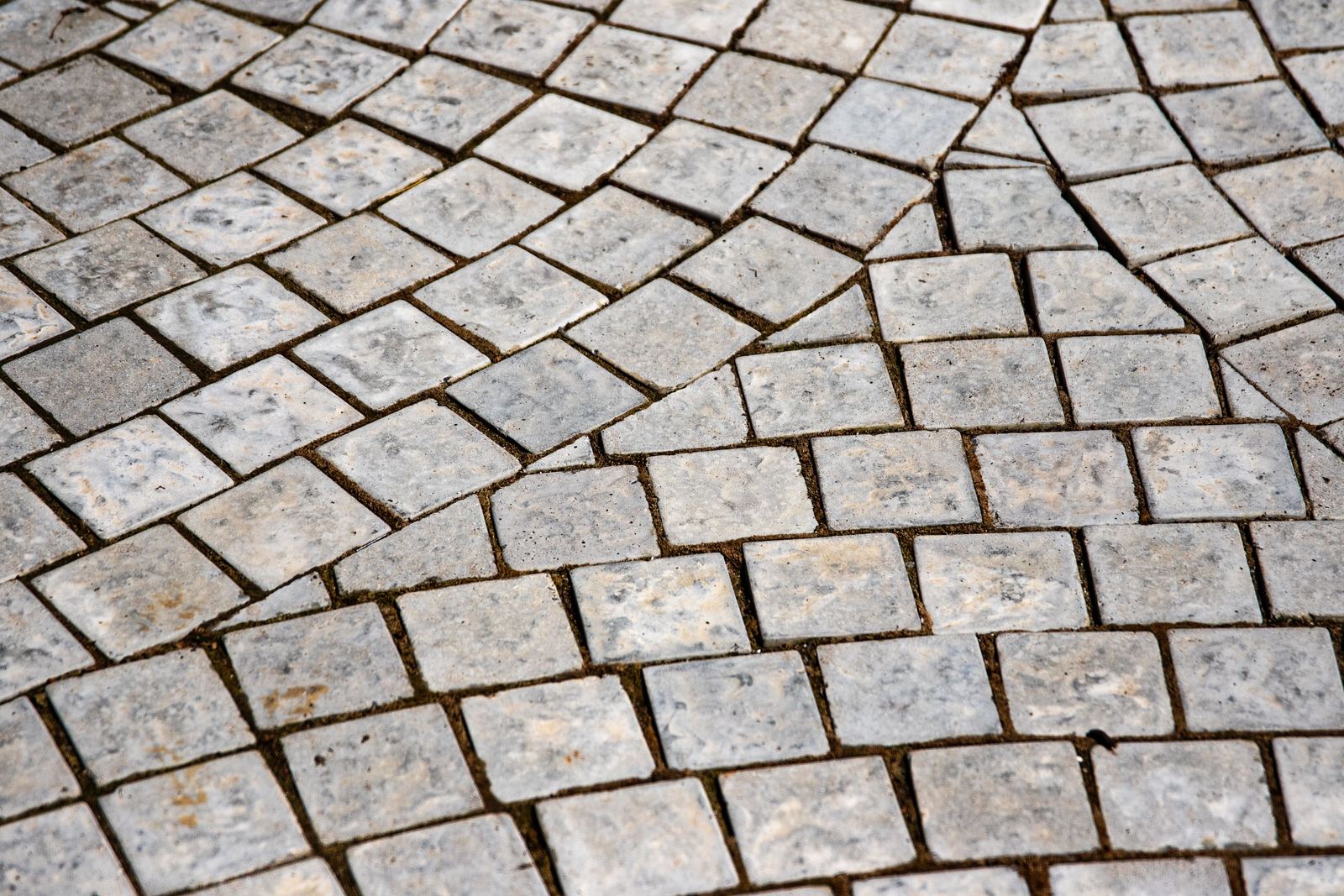
Resin bound, block paving or tarmac: which driveway surface?
The base under the surface decides all three, and the word bound or bonded decides which resin you are actually buying.
Choose on the base and the repair, not on the finish. Block paving is the only one of the three you can lift and put back. Tarmac is the cheapest honest way to cover a large plain area. Resin bound needs a bound, rigid base underneath it, and that base is why it costs what it does.
The short version
- Resin bound has the aggregate mixed through the resin, so water passes through. Resin bonded has stone scattered on top of resin, which seals the surface below. Get the word written on the quotation.
- Resin bound cannot be laid on compacted Type 1. It needs a bound, rigid base of open-textured asphalt or permeable concrete, and that base is why it costs more.
- Block paving is the only one you can take up and put back, which settles it if services will ever run under the drive.
- Modular paving has BS 7533-103:2026 and asphalt has BS 594987:2024. Resin surfacing has no dedicated British Standard, so its published life claims deserve more caution.
- If a quote does not say what depth of sub-base, what material and how it is compacted, it is a quote for a surface, not a driveway. Ask for the base build-up in writing.
The base
What is underneath decides all three, and only one of them says so
Everything that keeps a driveway flat is buried before you ever see the finish, which is why all three of these fail in much the same way.
Resin bound is the one where that is not a matter of opinion. It is a thin trowelled layer of stone held in resin, with no structural strength of its own, so it takes the shape of whatever is under it. It has to sit on a bound, rigid base: open-textured asphalt, or permeable concrete. It cannot go straight onto compacted Type 1 the way loose gravel can, because a granular layer moves under wheel loads and the resin above it cannot resist that.
That is a pricing point, and it is the part every competing page leaves out. A resin bound drive at an existing house is two jobs: somebody builds a pavement, then surfaces it. If the quotation does not describe that base as its own layer with its own material and depth, either it is not being built or the plan is to use whatever is there.
Block paving works the other way round. The blocks sit in a laying course and the sub-base below does the structural work, which is why BS 7533-101:2021, the code of practice for the structural design of pavements using modular paving units, is a document about layers rather than about blocks. The permeable version changes the material too: an open graded sub-base, fines taken out so water can move through it, not standard Type 1.
Tarmac is a sub-base, a binder course and a surface course, and what goes wrong is compaction rather than thickness. BS 594987:2024 specifies the transport, laying and compaction of asphalt. Material that has cooled too far before it is rolled never reaches density, and a drive laid cold looks fine in June and ruts in August.
So when a drive sinks, ponds or cracks, the surface is what you can see failing and almost never what failed. Why a driveway sinks or holds water covers what is going on underneath.
Two words
Resin bound and resin bonded are different products sharing a name
Get the word written on the quotation. Not “resin driveway”, not “resin system”. Bound or bonded. Resin bound is aggregate mixed all the way through the resin in a forced-action mixer and trowelled out as one layer. Every stone is coated on every side and the voids run right through the depth, so water passes through it.
Resin bonded is a different operation. The resin goes down on the base like an adhesive, dry aggregate is scattered over it, and the loose stone is swept off once it has cured. Each stone is stuck on one face and the layer beneath is sealed. It looks like gravel that does not move, and the texture is coarser.
That is a difference in wear, not only in drainage. Stone held on one face can come off, and it goes first at the edges, at the threshold and where wheels turn on the spot. Stone encased on every face stays put.
There is a legal consequence too, and it is not this page’s job. Over 5 square metres in a front garden, a permeable surface is permitted development and a sealed one that drains nowhere is not, so the two words do not sit in the same place. The rule, the percolation test and the dropped kerb are in permeable against impermeable driveways and when planning permission applies. That is the law and the water. This is the material decision.
Side by side
The three compared, and the one with no standard behind it
Two of the three have a British Standard behind them and one does not, which is worth knowing before you weigh a service life figure. BS 7533-103:2026 covers the design and installation of modular permeable pavements.
It was published on 12 March 2026 and replaced BS 7533-13:2009, now withdrawn, so a specification quoting the old part number is quoting a document that no longer exists. BS 594987:2024 does the same job for asphalt. Resin surfacing has no equivalent: its base can be designed as a modular or an asphalt pavement, but the wearing surface sits outside the British Standards. That is not proof it fails. It means the life claims come from the people selling it.
| Dimension | Resin bound | Block paving | Tarmac (asphalt) |
|---|---|---|---|
| Permeable as laid | Yes, if the base under it is permeable too | Only the permeable type. Standard blocks on sand and Type 1 are not | No, unless it is porous asphalt |
| Governing standard | None for the surfacing. Base designed under BS 7533 or as asphalt | BS 7533-101:2021 design, -102:2025 installation, -103:2026 permeable | BS 594987:2024, laying and compaction |
| Base requirement | Bound and rigid. Open-textured asphalt or permeable concrete. Not compacted Type 1 | Laying course over a compacted sub-base. Permeable versions need open-graded stone | Sub-base, binder course, surface course, compacted hot |
| Weeds and settlement | No joints for weeds. Settlement shows as cracking | The joints are the weak point: weeds, sand loss, rutting in the wheel tracks | No joints. Deforms under point loads and in heat |
| Repairability | Poor. Patches show, and colour matching a weathered surface is very hard | Excellent. Lift and relay individual blocks | Moderate. A patch is sound and obvious |
| Edge detail | Restrained edge, usually block or steel | Edge restraint is structural, not optional | Needs an edge or it ravels |
| Oil and fuel | Affected by fuel spills | Blocks stain, but a stained block can be swapped | Fuel softens bitumen, so a drip eats a hollow |
| Colour and finish | Widest choice of aggregate colours | Widest choice of formats and patterns | Black, or red where dyed |
| Relative cost | Highest, and the bound base is why | Middle, labour-heavy | Lowest per square metre for a plain rectangle |
| Before it looks tired | No British Standard covers it, so treat published figures with caution | Long if the base was right. Early failure is nearly always the base | Shortest. The edges go first |
Two rows decide most jobs and neither is colour: the base row and the repairability row.
Repair
Repairability is the row people read last and regret first
Ask one question before you choose: what happens the day somebody has to open this drive up. A soil pipe, a water main, a charger cable, a soakaway. Something usually does.
Block paving is the only one of the three with a real answer. The blocks come up, the work happens, the blocks go back, and if the base is reinstated properly the repair is invisible. Keep spares from the original delivery, because block colours run in batches.
Resin bound is the opposite. It is one continuous layer, so a repair means cutting in and trowelling fresh material into a surface that has weathered, and even a careful patch reads as a patch. Tarmac sits between the two: the repair is sound and obvious.
The maintenance nobody costs in
Jointing sand in block paving is a consumable, not a defect. Once a joint is empty a weed has somewhere to sit, and topping it up is a bag of kiln-dried sand and an afternoon with a brush. What empties them fastest is not weather but cleaning: a lance held close strips the sand out, and on resin it can pull stone out of the matrix. Soft washing against pressure washing covers the difference, and it applies to a drive as much as to a roof.
The verdict
Which surface is right, and the two cases where the answer is none of them
Resin bound suits a flat, permeable finish on a proper base, block paving suits repairs and services underneath, and tarmac suits a large plain area on a budget. The last two answers, a wrong sub-base and resin over an unsurveyed drive, cover more driveways than the first three do.
Resin bound is right when
You want a flat, jointless, permeable finish, you can afford a proper bound base under it, and nothing will be punched into the surface. A trailer jockey wheel or a caravan corner steady leaves its mark in a thin resin layer.
Block paving is right when
You want repairs that do not show, services might run under the drive, or you have any doubt about the ground. It is the only one you can take up and put back, which is worth real money on an older property.
Tarmac is right when
The area is large and plain, budget is the constraint, and the drive is a working surface rather than a feature. Tarmac has a shorter life than the other two and is priced accordingly, which makes it honest, not poor.
Neither, and this is the big one: the sub-base is wrong or absent
All three fail the same way and it is virtually never the surface. It is the ground and the layers built on it. A quote that names a product and a finish but says nothing about what happens below is a quote for a surface rather than for a driveway, and two of those cannot be compared on price at all.
Ask for the base build-up in writing on every quote. Three lines will do it: what depth of sub-base, what material, and how it is compacted. Somebody building it properly answers in one sentence without thinking. Somebody who will not put it in writing has told you something useful. That single instruction is worth more than the whole comparison above it, and it is the same principle as the itemised lines in what a roofing quote should include. Where two driveway quotes are thousands apart, the buried layers are usually the reason, which is the pattern behind why two quotes for the same job come back so different.
Also neither: resin bound over an existing drive nobody has surveyed
Resin bound over existing concrete or tarmac is a legitimate build-up and the commonest way the material goes wrong. The old drive becomes the bound base, so every fault in it becomes a fault in the new surface. A crack will come through the resin above it, usually in the first winter and along the same line. Ask what survey was done and how the cracks and movement joints are being dealt with. “We will prep it” is not an answer. And resin over sealed concrete does not make the drive permeable: the water still has nowhere to go, and where it goes follows the discharge hierarchy in Approved Document H, soaking away first, a watercourse next, a sewer last.
Next steps
What to do next
Before choosing a driveway surface, decide whether anything will run under it, find out what is there now and check where the water is meant to go. The first three cost nothing and decide more than the surface does.
- Decide whether anything will ever need to run under the drive. If the answer is yes or maybe, that points at block paving before you look at a sample board.
- Find out what is there now. If somebody proposes to build on the existing drive, ask what they found and what they will do about the cracks.
- Check where the water is meant to go. The government guidance on the permeable surfacing of front gardens carries a pit test you can run yourself with a spade and a hose, and the result changes the specification.
- Ask every quote for the base build-up in writing: excavation depth, sub-base material and depth, and how it is compacted. Compare quotes on those lines, not on the finish.
- If resin is on the table, get the word bound or bonded written down, and the base described as its own layer with its own depth.
- Ask which British Standard the work is built to: BS 7533 for block paving, BS 594987 for asphalt, and none for resin surfacing.
- Only then choose the colour.
If you would rather somebody looked at the ground, that is what our driveway and patio work covers, and where the water turns out to be coming off the roof the roofing side deals with it. Thomas Hannen comes out and prices the job himself, and a free written itemised quote comes out of the visit.
Questions
Common questions
What is the difference between resin bound and resin bonded?
Resin bound has the aggregate mixed all the way through the resin and trowelled out as one layer, so every stone is held on every side and water passes through. Resin bonded has the resin spread on the base with dry stone scattered on top, so the stone is held on one face and the layer below is sealed. Get the word written on the quotation.
Can resin bound be laid over my existing concrete or tarmac driveway?
Only after a survey: the old drive becomes the bound base, so any crack or movement in it will come through the new surface, usually in the first winter and along the same line. Ask what was found on inspection and how the cracks and movement joints are being dealt with before you accept that build-up.
Why does resin bound cost more than block paving or tarmac?
Because of what goes under it. Resin bound has no structural strength of its own and has to be laid on a bound, rigid base of open-textured asphalt or permeable concrete. It cannot be laid on compacted Type 1, so the job is effectively building a pavement and then surfacing it.
Which driveway surface is easiest to repair?
Block paving, by a long way. Individual blocks lift out and go back, so a repair after a service trench can be invisible if the base is reinstated properly. Keep spare blocks from the original delivery, because colours run in batches. Resin bound is the hardest of the three to patch without it showing.
Is there a British Standard for resin driveways?
Not for the surfacing itself: Modular paving is covered by BS 7533-101:2021 and, for permeable versions, BS 7533-103:2026, published on 12 March 2026. Asphalt is covered by BS 594987:2024. Resin surfacing has no dedicated British Standard, so treat published service life claims for it with more caution.
Read next
Related advice
The guides below pick up where this one leaves off, and the driveways and patios page covers the work itself and the places we cover, if you would rather have the job looked at.
- Driveways: when you need planning permission, and where the water has to go
- Why a driveway sinks or holds water
- Soft washing or pressure washing: which does your surface need?
- Why two quotes for the same job come back so different
Driveways and patios, and where we cover All advice articles
Who wrote this
Thomas Hannen
Thomas owns Bournemouth Roofing & Building and prices every job himself instead of sending somebody else. The company is Bournemouth Roofing & Building Ltd, number 15471719, registered in England and Wales. If you want to talk something through before you commit to anything, the site visit and the written itemised quote are both free.
Free quote
Not sure what is under your driveway?
Thomas comes out, looks at the ground and the existing base rather than the brochure, and puts what he found in writing. If the base has to come out first, that is what he will price.