Why two quotes for the same roof are so different
Nobody is necessarily trying it on. Three roofers priced three different jobs, and the totals are the one place that never shows it.
Nearly always because they are quotes for different jobs. One has priced stripping the roof back to the rafters and renewing the underlay, battens and fixings. Another has priced a new covering over what is already up there. Neither is dishonest. Until the scopes match, the totals are not comparable.
The short version
- The spread is usually scope, not price. Two quotes can both say "re-roof" and mean very different amounts of work.
- A low figure is not evidence of a worse contractor. It is far more often a smaller job, and the highest figure is not automatically the most thorough.
- Access moves a roofing figure more than the choice of tile does, and you cannot see it anywhere in the total.
- Scaffold is hired by the week, so "scaffold included" with no number of weeks in it has fixed nothing.
- A figure with no VAT against a figure with VAT added is not a like-for-like comparison, and neither trader is doing anything wrong.
Start here
Three quotes, three different jobs
The spread is almost always scope. The three roofers who came out did not price the same work, and the quotes do not say so, because each describes what that roofer intends to do and none describes what the other two left out.
One has priced stripping the roof back to the rafters with new underlay, battens, fixings, lead and a mechanically fixed ridge. One has priced a new covering over the battens already up there. One sits between the two and has allowed five weeks of scaffold because there is no rear access. Three real jobs, three honest figures, and nothing in the totals to tell you which is which.
So the useful question is not who is trying it on. It is what each one has actually priced. The line items a quote ought to carry are a separate list; this page is about why the totals land so far apart.
What comes off
Strip and re-cover, or cover over the top
The largest single difference between two roofing quotes is whether the old roof is coming off. A strip and re-cover takes the covering, battens and underlay off, back to the rafters, and rebuilds from there. Everything above the timber is new, anything rotten gets found, and it produces several tonnes of dense waste and keeps the scaffold up longer.
An overlay leaves the existing underlay and often the existing battens where they are and fixes a new covering over them. It is quicker, there is little to take away, and where the covering has worn out while the underlay and battens are still sound it is a sensible thing to do. What it cannot do is put right anything underneath. If the felt is torn at the eaves and sagging between the rafters, a new covering over it is a new-looking roof with the same fault in it.
Both get written down as a re-roof, which is why the first question to send back is not about money. Strip to the rafters, or cover over?
Underlay, battens and fixings
Ask for these three by name, because a quote can say re-roof and renew none of them. Underlay: which product, and felt or breathable membrane, because the two ventilate differently and swapping one for the other while changing nothing else is how a loft starts dripping in February. Battens: new or re-used, and if new, graded to BS 5534, the code of practice for slating and tiling. Fixings: worked out from the wind loading on that house, its exposure, height, pitch and tile.
Each is a real cost, so a quote renewing all three sits above one renewing none. Both can be honest. They are not the same roof when the scaffold comes down.
The ridge, and the lead
Every ridge and hip tile has to be mechanically fixed. Mortar bedding is still allowed alongside that fixing; mortar on its own is not, so a quote saying "bed ridge in mortar" and stopping there has priced an older standard. Fixing the ridge properly costs more than bedding it, and a dry ridge against a mortar-bedded ridge sets out what each involves.
Lead is the other line that hides money. It is sold by code, a thickness designation that belongs on the quote. Then whether the old lead is being renewed or re-dressed, and whether the new lead is let into a raked-out joint and wedged or sits on the face of the brickwork on a bead of sealant. Two quotes can both say "new lead flashings" and differ on all three, which is why what each line ought to specify is worth reading first.
The other half of the money
Scaffold, access, waste and tax
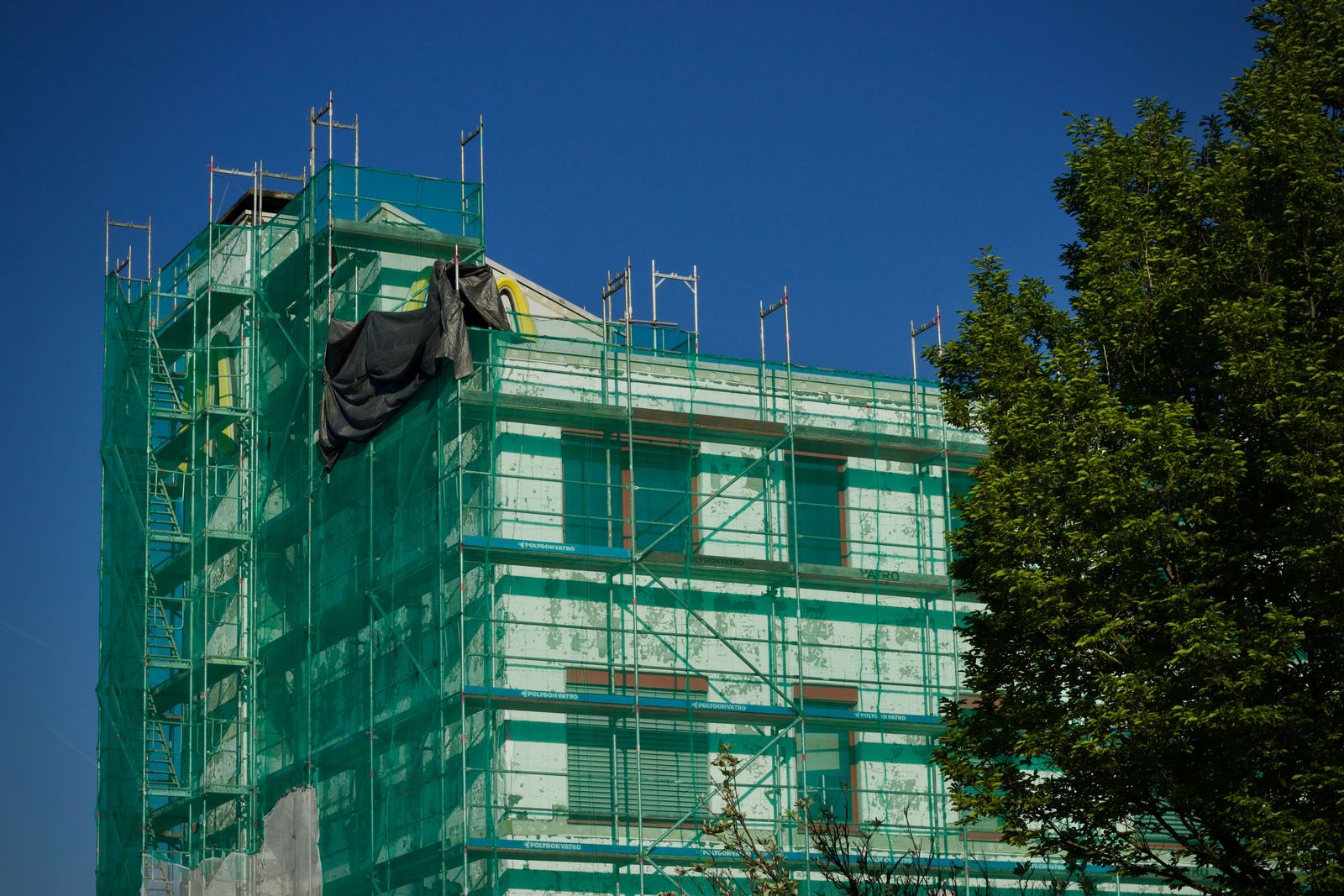
On a re-roof a large share of what you pay is not roofing at all, and those lines are the vaguest. Scaffolding is hired by the week on top of an erect-and-dismantle charge, so "scaffold included" with no number of weeks in it has fixed nothing.
Two weeks allowed and five weeks allowed price different amounts of weather and, if the job overruns, a different person paying for it. Who is liable when it is not included covers the duties that come with it.
Access moves a roofing figure more than the tile choice does and shows up nowhere in the total. A mid-terrace whose rear elevation can only be reached through a neighbour's garden is a negotiation before it is a job, and the Access to Neighbouring Land Act 1992 exists because that negotiation sometimes fails. Scaffold on or over a public footway needs a licence in writing from the highway authority, which costs money and takes time. A bridge over a conservatory, or a base on sloping ground, has to be designed rather than assembled. Any of those can be the whole difference.
Then waste. A stripped tile roof produces a great deal of heavy material, charged by weight as well as volume, and on an overlay that line disappears completely. Kerbside access lets a grab lorry load in bulk; a narrow lane forces a skip and more handling. Who takes it away, and their waste carrier registration number, belong on the quote.
And tax. A trader whose taxable turnover sits below the VAT registration threshold does not charge VAT and is doing nothing wrong. That is arithmetic, not a warning sign. But no VAT next to a figure with VAT to be added is not a like-for-like comparison, and which rate applies to your work is a subject of its own.
| What differs | Why it moves the figure | What to ask all three |
|---|---|---|
| Scope | A strip renews everything above the rafters. An overlay renews the covering only. | Strip to the rafters, or overlay? |
| Access | Sets the method before anyone prices a tile: rear access, a bridge over a conservatory, a footway licence. | What access is allowed for, and is a licence needed? |
| VAT status | A trader below the registration threshold charges none, so a fifth of the money is absent. | Inclusive, exclusive, or not chargeable? |
| Scaffold weeks | Hired by the week, so the allowance is a real cost and a real risk. | How many weeks, and who pays after that? |
| Substrate assumed | One assumed sound rafter ends. Another allowed to replace some. | What is assumed about battens and rafter ends? |
| Junctions | Valleys, hips, dormers, chimneys and abutments are where the labour goes. | How many are priced, and how is the lead fixed? |
| Waste route | Several tonnes on a strip, close to nothing on an overlay. | Who removes it, skip or grab? |
| Materials | Real, but usually smaller than the six above. | Which tile, which underlay, which lead code? |
Next door
Why the identical house next door costs more
Two houses built the same week on the same estate are not the same roofing job sixty years later, and most of the reasons cannot be seen from the pavement.
What has already been done to it. A house re-roofed in the 1990s may have battens with life left in them. A house that had a cheap re-cover has a substrate to undo first, and undoing somebody else's work costs more than starting from bare rafters.
What it is covered in, and what has been added. Slate and concrete tile of the same area are different weights and different numbers of units to handle, so a covering swapped by a previous owner changed the fixing calculation with it. A dormer, rooflight or rear extension added since brings abutments, valleys and often a flat roof that is a separate system, and that is usually the real answer when next door came in lower. A hipped roof carries more area and far more cutting than a gable over the same floor plan.
What is still standing on it. A chimney taken down forty years ago is one less thing to flash, one less to repoint and one less place to find spalled brickwork. A chimney that was kept is all three.
What is holding it up. A dropped purlin, a rotten rafter foot or a soft wall plate turns up once the covering is off, not before. A roofer who has allowed for finding one prices higher, and only one of the two will still be at that figure in week three. What counts as a fair extra then is its own question.
Where it stands. Exposure feeds into the fixing calculation, so the seaward end of a street is not priced like the sheltered end, and an end-of-terrace with side access is not a mid-terrace with none.
One difference is regulatory rather than commercial. Under regulation 23 of the Building Regulations 2010, renovating more than half the surface area of a thermal element brings it up to current standards. The trigger is more than 50%, not the 25% that circulates. Strip a whole roof and that can pull insulation work into a job the partial repair next door never triggered.
Reading the spread
The cheap quote is not automatically the bad one
A low figure is not evidence of a worse contractor. Far more often it is a smaller job: an overlay instead of a strip, battens re-used instead of renewed, three weeks of scaffold instead of five, no VAT because the trader is under the threshold. Every one of those is a legitimate way to work, and for some roofs it is the right answer.
The reverse is worth saying just as plainly. The dearest quote is not automatically the most thorough. It can be a bigger job, a busy firm pricing high because they do not need the work this month, or a generous allowance for something that turns out not to be needed. A figure on its own tells you very little about quality in either direction.
What does tell you something is how each of them answers a question. Whoever writes back with the tile, the underlay, the batten grade, the lead code and the weeks has thought about your roof. Whoever repeats the total has not.
Look at the allowances as well. A provisional sum is money set aside for work that cannot be measured until it is exposed, and it is neither a price nor a ceiling. Several large ones means the price has not really been fixed, and what a properly written one contains is four short things.
Next
What to do next
Go back to all three with the same short list and ask for the answers in writing. It costs nothing and turns three quotes you cannot compare into three you can.
- Strip to the rafters, or overlay? List what is being kept.
- Are the underlay and battens renewed, and if so, which underlay and what batten?
- How are the ridge, hips, verges and eaves being mechanically fixed?
- Is the lead renewed or re-dressed, what code, and is it chased into the joint?
- How many weeks of scaffold are allowed, and who pays after that?
- What is assumed about the rafter ends and wall plate, and what if that is wrong?
- Who removes the waste, and is a skip or a grab lorry in the figure?
- Is the figure inclusive of VAT, exclusive of it, or not subject to it?
Send it by email instead of asking on the drive, because what a trader writes to you about the service becomes a term of the contract where you took it into account.
When the replies come back, line the answers up before you line the totals up. Most of the time the spread explains itself in the first two questions. If two then match on scope and still differ, that is where the difference really is about the firm rather than the job.
If you want another pair of eyes before you decide, Thomas comes out and prices the job himself. What we cover is on the roofing page, and you can ask for a free written itemised quote or get in touch. If the roof has years left in it he will say so rather than sell you a new one.
Questions
Common questions
Why is one roofing quote double another?
Almost always because it is for a different job. A strip back to the rafters with new underlay, battens, fixings, lead and a mechanically fixed ridge is far more work than a new covering laid over the existing battens, and both get written down as a re-roof. Access, scaffold weeks and VAT status account for most of the rest.
Should I take the cheapest roofing quote?
Not on the figure alone, and not the dearest on the figure alone either. A low quote is more often a smaller scope than a worse contractor. Get all three to state what is being stripped, what is being renewed and how many weeks of scaffold are allowed, then compare them once they describe the same job.
How do I compare roofing quotes properly?
Send the same short list of questions to every contractor who quoted and ask for the answers by email. What is coming off, what is being renewed, how the ridge and lead are fixed, how many scaffold weeks are allowed, who removes the waste, and whether VAT is in the figure. The replies make the totals comparable.
Is a quote with no VAT on it a warning sign?
No, a trader whose taxable turnover is below the VAT registration threshold does not charge VAT and is doing nothing wrong. It does mean a quote showing VAT and a quote showing none are not a like-for-like comparison. The rarer thing to question is VAT charged on paperwork carrying no VAT number.
Why does my roof cost more than my neighbour's identical house?
Usually because the roofs stopped being identical years ago. A dormer or rooflight added since, a chimney kept instead of removed, a previous cheap re-cover that has to be undone, a heavier covering, a hipped rather than gabled shape, worse exposure or no side access for the scaffold will each move the figure.
Read next
Related advice
The guides below pick up where this one leaves off, and the roofing page covers the work itself and the places we cover, if you would rather have the job looked at.
Who wrote this
Thomas Hannen
Thomas owns Bournemouth Roofing & Building and prices every job himself instead of sending somebody else. The company is Bournemouth Roofing & Building Ltd, number 15471719, registered in England and Wales. If you want to talk something through before you commit to anything, the site visit and the written itemised quote are both free.
Free quote
Want a quote that says what it is actually for?
Thomas comes out, goes over the whole roof himself and puts what he found and what it would take to put right in writing, itemised, so you can hold it against anything else you have been sent.