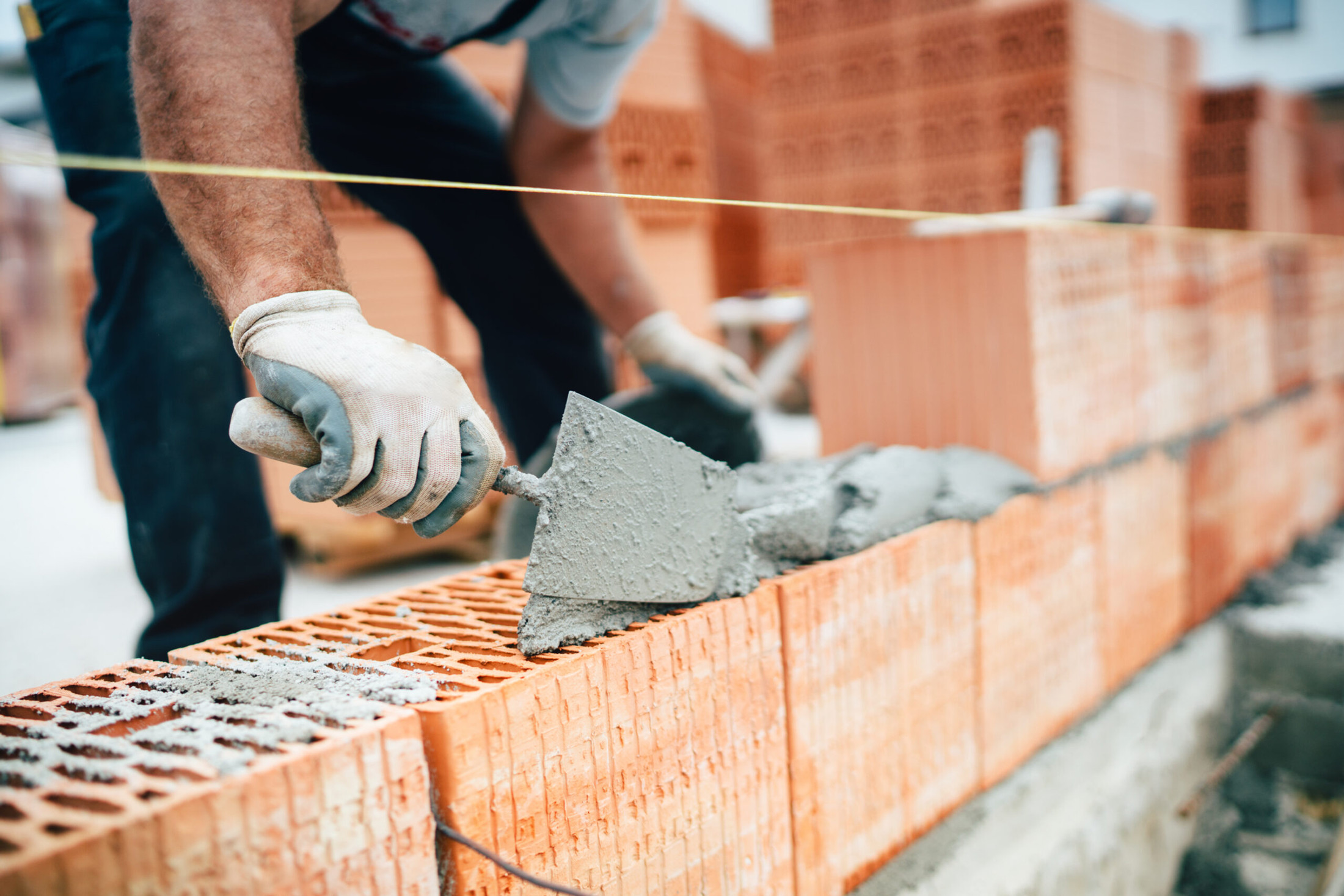
Flint and brick repointing in Winterborne Stickland
Beds raked back to sound lime by hand, filled in lifts, galleted with flint chips, and the brick banding pointed as its own job.
The site visit is free and so is the written itemised quote. Thomas Hannen prices every job himself.
On a flint wall the mortar is not the joint between the units, it is the wall. Flint has almost no bond of its own, so everything holding the thing up is the lime around it, and repointing one is slower and more careful work than pointing an ordinary brick elevation.
What brings people in the village to the phone is nearly always weather driven. A gable on the south west side where the joints have gone back and rain now stands in them. Flints that have started coming away by the handful out of a garden wall. Brick faces flaking under a cill. Or a chimney dropping sand into the gutter every time it blows hard.
Every one of those is mortar, and on the walling around here the mortar is doing more work than it does on an ordinary house. So we come and look at the wall itself before anything is priced, because no two out this way are built the same. We scrape joints in several places, find out what the original mix actually is, and photograph each face. What comes back is a written itemised quote, elevation by elevation, and we will say plainly which faces we would leave for now. Both the site visit and the quote are free.
The work
Pointing flint, banded work and the brick that ties it together
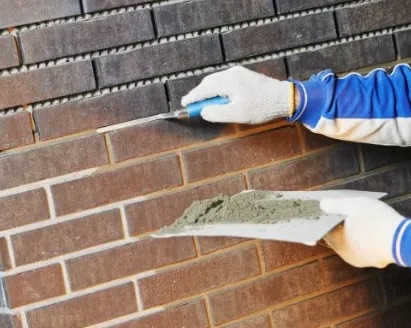
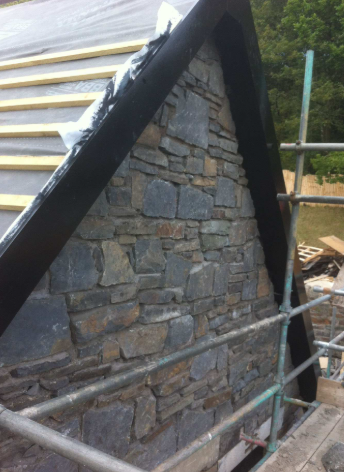
Flint rubble in lime. A lot of the older walling here is flint through the body of a solid wall with brick at the quoins and in bands running through to level it up. Because the flint contributes no bond, the joint is structure rather than decoration. We rake by hand with a chisel and a hacksaw blade until we reach sound material rather than to a set depth, damp the beds down, then fill in lifts and gallet the joints with small flint chips the way the wall was built. Neither a disc cutter nor an angle grinder goes anywhere near it: a cutter follows a straight line and flint work does not.
Start at the head of the wall. Flints loosen from the top down, because that is where water gets in once a coping has slipped or its bedding has washed out. Pointing the face of a wall while the head of it is still open is money spent in the wrong order. Coping rebedded, top courses pointed, then the face.
Brick bands, quoins and openings. The brick running through a flint wall was laid in a finer mortar with a narrower joint than the rubble around it, and it is what gives the wall its lines. We point it separately, usually an NHL lime or a lime putty gauged to suit, struck to the profile the brickwork already carries rather than smeared to match the flint. Losing that distinction is what makes a repaired wall look flat from the road.
Cement on soft walls, and what it does. Where flint or soft handmade brick has been pointed in sand and cement, the wall cannot dry through the joint, so it dries through the face instead. On brick that shows as spalling. On flint it is worse: the flint is impermeable, so everything is forced through the mortar and the brick, and once the cement lets go the flints come out with it. Taking it back off is slow hand work and it is priced on hours.
Brick plinths under render. Plenty of the cottages sit on a brick or flint plinth with something softer above, and the plinth is what keeps the wall above clear of the splash. Where one has been patched in cement the water gets trapped behind it and the brick goes to powder. Repointing a plinth wants an open, breathable mix and nothing sold as waterproof.
Stacks and flaunching. A stack out here is exposed on four sides with a cold flue up the middle, so the joints go friable and then wash out while the walls below are still sound. Repointing above the roof line, cutting out perished brick and renewing the cracked flaunching that beds the pots is a scaffold job and a priced line of its own.
How it runs
From your call to a written price
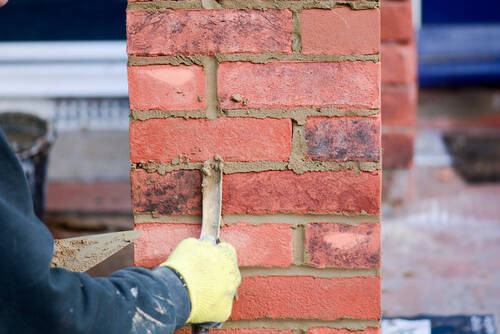
Same team from first visit to last, one person to ring, no sub-contracting. The quote is itemised: access, raking out, the mix, the area of each elevation, brick replacement and disposal on separate lines, so you can compare it against anyone else's.
Nothing is left open overnight and the site is swept at the end of each day. If something turns up that nobody could have seen, you get a photograph and a price first.
A like for like repoint is repair rather than development, so there is no planning application in it and nothing for building control to sign off. Two things here sit outside that. The village has a conservation area of its own, where appearance is controlled and a grey cement joint run across flint and brick is a visible change however it is described. And twenty five entries in the parish are listed, the church and Quarleston Farmhouse among them, where the mortar mix and the joint profile are part of the protected fabric and listed building consent is needed before a joint is opened. Dorset Council is the planning authority. We check the address before a mixer is filled and we write the mix, the sand and the profile into the quote.
Cost
What decides the price of a repointing job
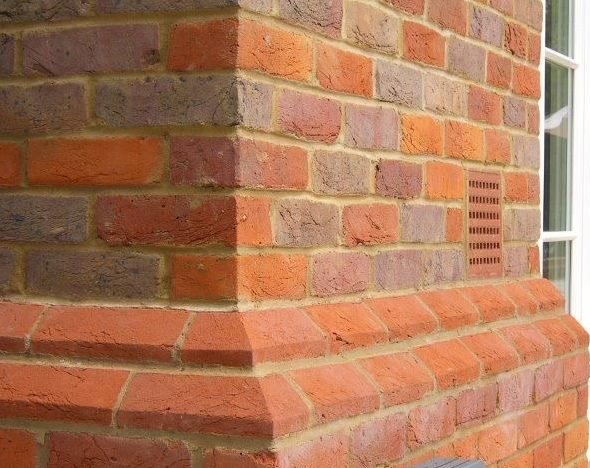
No rate per square metre. The area tells you almost nothing until somebody has looked at the joints.
Getting to it. A pair of cottages under one long roof, a rendered wall with a brick plinth at the bottom of a garden and a chimney on the ridge of a two storey house are three different set ups. A chimney or a gable wants a scaffold; a boundary wall wants nothing. The work at height rules are why access is a priced line rather than something absorbed into a rate.
The joints decide it, not the wall. How deep they come back, and whether the faces have spalled, sets the hours far more than the area does.
Matching is the part that shows. Lime is slower to work and slower to cure, and right on most pre-1919 walls here.
Comparing quotes? Ask how deep the joints are raked and by hand or by disc, what the mix is and whether it was matched, how many spalled bricks are being replaced, and whether the scaffold is in the price.
If water is getting in
Open joints, and water coming through the wall
Ring rather than use the form. Joints washed out let driven rain through to the inside face, and on a chimney it finds the flashings. We come and look, sheet or temporarily point the worst if the weather is against us, and price the elevation once it has dried enough to see what is sound. In the village that is usually the south west gable, because driven rain works at the openings and the corners of a wall long before it touches the middle of it. The phone is answered 24 hours for emergencies; scheduled work runs Monday to Friday, 8am to 6pm.
Worth knowing
A flint wall is priced by the bucket, not by the metre
On a brick elevation a rake out is fairly predictable. The joints are a consistent width, they run in straight lines, and they come back to roughly twice that width. A flint wall has none of that. The beds are deep, irregular and full of voids where the original mortar has washed back out of sight, and you do not rake them to a depth, you rake them until you reach material that is still doing something. On one face that is a finger's depth and on another it is most of the way into the wall. It is why we survey a flint elevation with a chisel rather than a tape.
It changes how the wall goes back together too. A deep void cannot be filled in one pass, because a thick lump of lime shrinks as it dries, cracks and falls out within the year. It has to go in lifts, each one pressed in and left to take up before the next, with flint chips galleted into the joint to take up the space and hold the mortar in place. That is slow, and it is why a run of flint takes longer than the same length of brick and why the two are not priced the same. If a quote gives you one figure for a property that is half flint, nobody has measured it. Ask which faces are flint and how the joints on those are being filled.
Who you are dealing with
A local firm you can check
We cover Winterborne Stickland, Winterborne Whitechurch, Turnworth, Durweston and across to Blandford Forum, broadly DT11, with Dorset Council as the planning authority. You are dealing with Bournemouth Roofing & Building, trading name of Bournemouth Roofing & Building Ltd, company number 15471719. Thomas Hannen's business, and he prices every job himself rather than sending a salesman. A verified customer's 10 out of 10 on Checkatrade. The visit and the written quote are free.
Questions
Winterborne Stickland questions we get asked
Why does flint cost more to point than brick?
Because the joint is bigger, deeper and less predictable, and because it has to go back in stages. On brick you rake to a known depth and fill in one pass. On flint you rake until the mortar is sound, which varies across a single elevation, then fill in lifts so it does not shrink and drop out. The material is cheap. The hours are the cost.
What is galleting, and does our wall need it?
Galleting is bedding small flint chips into the mortar joint while it is still soft. It fills the wide gaps between irregular flints so the mortar is not left as a thick unsupported mass, and it is how these walls were built in the first place. If the sound parts of your wall have chips in the joints, the repair should have them too, or the repaired stretch will look different from the rest.
On a downland house, which face is worth spending on first?
Whichever one the weather reaches, which here is normally the south west, and then the details on the other faces that are actually letting water in: the reveals, the heads over windows, the coping and the top courses of a stack. The middle of a sheltered panel is the last part of any wall to fail and it is rarely worth spending on early.
The brick plinth under our render is crumbling. Is that a pointing job?
Usually, yes, and it is worth doing before it turns into anything else. The plinth is there to keep the softer wall above clear of splash off the ground, and once its joints have gone the water gets in behind and works upwards. It wants an open, breathable mix. What it does not want is a cement skirt or a sealer, which traps the damp and moves the damage further up the wall.
How long does a flint elevation take?
Longer than most people expect, and the honest answer comes after the survey rather than before it. A garden wall is days. A house gable in flint with brick banding through it can be a couple of weeks, because the raking is slow and each lift of mortar has to take up before the next one goes in. The quote gives you working days and says what would move them.
Nearby, and next door
Repointing near Winterborne Stickland
Repointing nearby
Our other trades in Winterborne Stickland
Everything we do in Blandford Forum Repointing, all areas Every area we cover
Free quote
Have the flint work looked at before the coping goes
Thomas comes out, opens a joint on each face, photographs what he finds and puts the price in writing, itemised, at no cost to you.